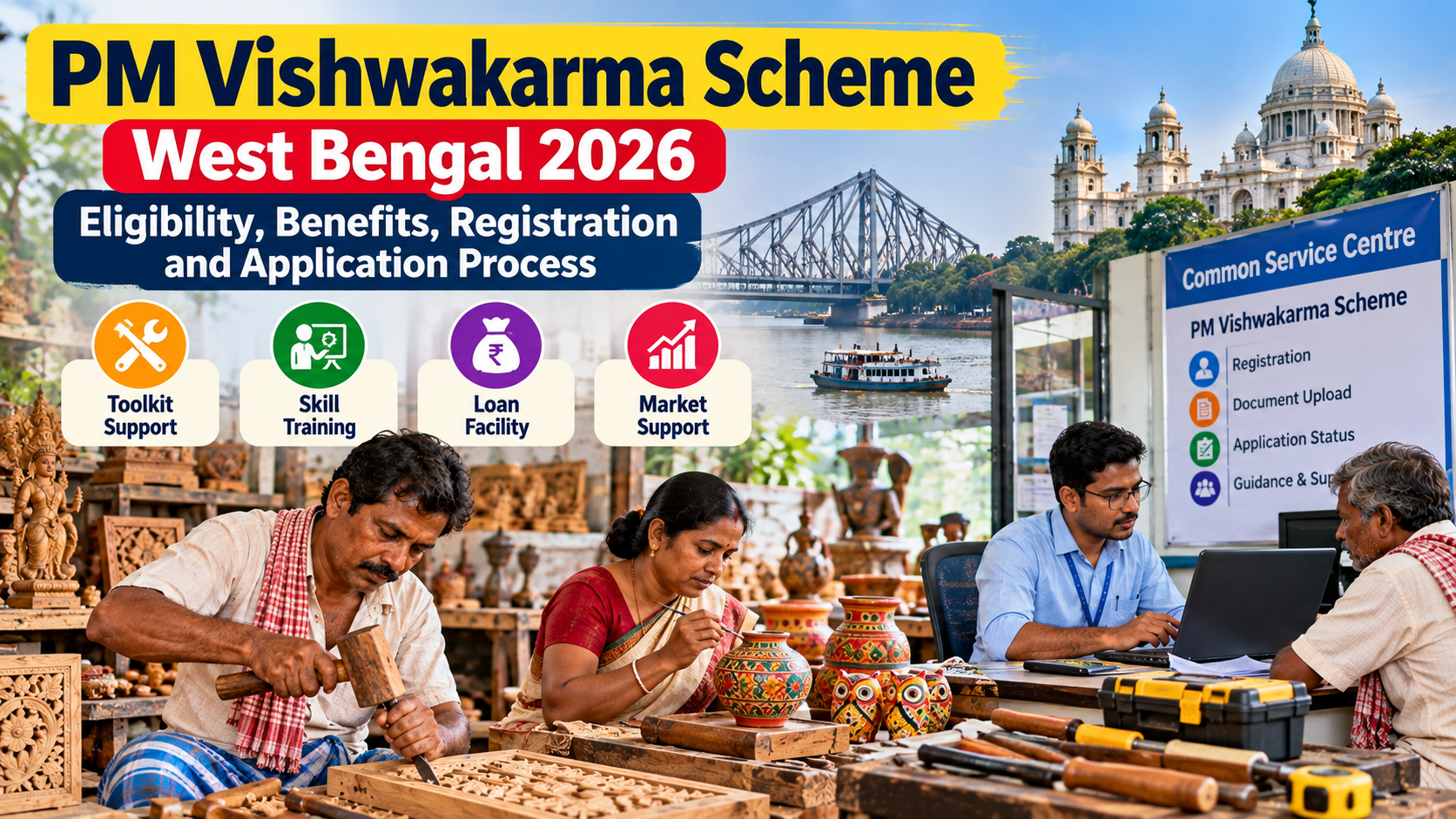
PM Vishwakarma Scheme West Bengal 2026: Traditional artisans often possess specialised skills but have limited access to modern tools, affordable business credit and larger markets. A carpenter may depend on basic equipment, a tailor may want to upgrade a small workshop, and a potter may struggle to improve production without additional investment. These challenges make government support for traditional occupations particularly important.
The PM Vishwakarma Scheme West Bengal 2026 provides a framework of recognition, skill development, toolkit assistance, concessional loans and market support for eligible artisans. The PM Vishwakarma Scheme is a Central Government initiative managed by the Ministry of Micro, Small and Medium Enterprises (MSME). State authorities and authorised institutions help implement the scheme and deliver its benefits to eligible artisans.
West Bengal decided to join the PM Vishwakarma Scheme in May 2026. According to a subsequent Ministry of MSME press release, 3,000 beneficiaries in the state had completed all three stages of the verification process. This indicates that implementation has begun, although individual registration and benefit availability depend on eligibility and approval.
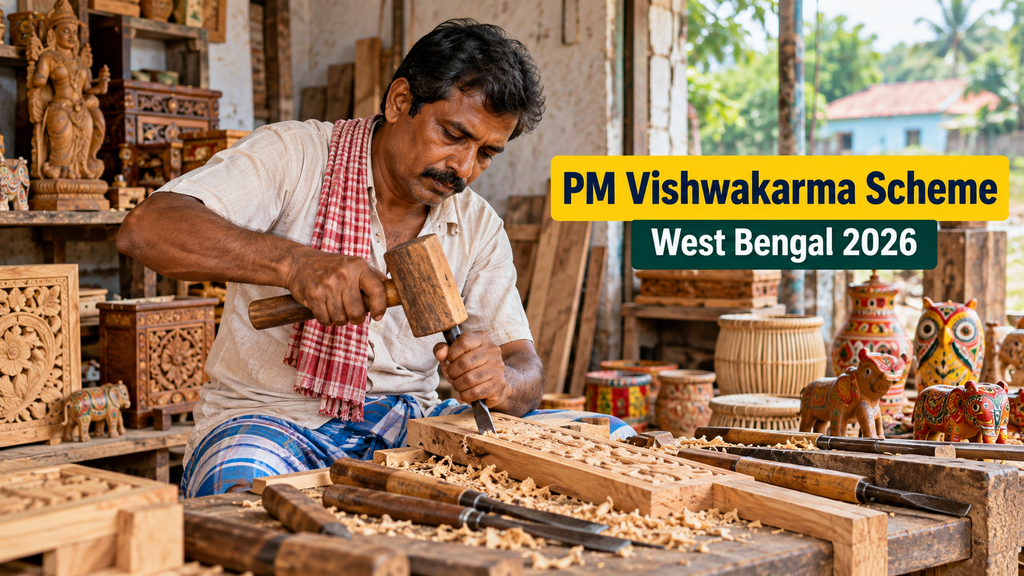
PM Vishwakarma Scheme West Bengal 2026: Overview
The following table summarises the main features of the scheme using the official scheme information available for 2026.
| Scheme detail | Information |
|---|---|
| Scheme name | PM Vishwakarma Scheme |
| Government | Government of India |
| Nodal ministry | Ministry of MSME |
| State | West Bengal |
| Eligible occupations | 18 notified traditional trades |
| Minimum age | 18 years |
| Toolkit incentive | Up to ₹15,000 |
| Training stipend | ₹500 per training day, subject to scheme rules |
| First loan tranche | Up to ₹1 lakh |
| Second loan tranche | Up to ₹2 lakh |
| Beneficiary loan interest rate | 5% |
| Registration assistance | Common Service Centre (CSC) |
| Official website | pmvishwakarma.gov.in |
The figures above describe the scheme’s prescribed benefits, not a promise that every applicant will receive every benefit. Eligibility checks, training requirements and lending decisions can affect individual outcomes.
What Is PM Vishwakarma Scheme?
PM Vishwakarma is a Central Sector Scheme launched on 17 September 2023 to support artisans and craftspeople who work with their hands and tools in specified traditional occupations. It combines formal recognition with training, improved equipment, credit and assistance in reaching markets.
The scheme’s implementation period is initially set through the 2027–28 financial year. Its broader purpose is to help traditional workers improve the quality and productivity of their work while strengthening their ability to earn from their skills.
For eligible workers in West Bengal, this can be relevant to occupations such as tailoring, pottery, carpentry, masonry and traditional toy-making. However, simply working in a craft-related business is not sufficient: the occupation must fall within the scheme’s notified trade list, and the applicant must satisfy the other conditions.
PM Vishwakarma Scheme Benefits in West Bengal
1. Toolkit incentive of up to ₹15,000
Eligible beneficiaries can receive a toolkit incentive of ₹15,000 to obtain improved tools for their occupation. The support is provided through an e-voucher mechanism rather than as an unrestricted cash grant.
For example, an eligible craftsperson may use the prescribed support to obtain tools that improve work quality or productivity. The tools and purchases must comply with the scheme’s applicable process.The ₹15,000 toolkit incentive is meant to help eligible artisans purchase approved tools for their work. It cannot be treated as unrestricted cash for personal or household expenses.
2. Free skill training with a stipend
The scheme provides skill verification followed by basic training, generally lasting five to seven days. Eligible participants may also be offered advanced training lasting 15 days or more.
The prescribed training stipend is ₹500 per day, subject to the programme’s attendance and payment rules. Training is intended to help artisans improve their technical skills and learn about modern tools, productivity, entrepreneurship and market requirements.
For an artisan in West Bengal, training may provide an opportunity to improve an established occupation without abandoning traditional methods. The actual training schedule and location depend on the arrangements made by the implementing authorities.
3. Collateral-free business loans up to ₹3 lakh
Credit support is one of the scheme’s major components. Eligible beneficiaries may access loans in two tranches:
| Loan stage | Maximum amount | Prescribed repayment period |
|---|---|---|
| First tranche | ₹1,00,000 | 18 months |
| Second tranche | ₹2,00,000 | 30 months |
The prescribed interest rate charged to beneficiaries is 5%. The second tranche is not automatic; eligibility depends on the scheme’s conditions, including repayment performance and requirements relating to digital transactions or advanced training. The participating lender must process the credit facility under the applicable rules.
Important: These are loans, not grants. Borrowers must repay the amount according to the loan agreement. Before accepting credit, applicants should consider whether their occupation can generate sufficient income to meet the repayment schedule.
4. Incentive for digital transactions
The scheme includes an incentive of ₹1 per eligible digital transaction, subject to a maximum of 100 transactions per month under the prescribed rules.
This component encourages artisans to accept and use digital payments. It may be useful for a tailor, barber or other eligible craftsperson who receives payments directly from customers. However, only qualifying transactions count; applicants should verify the current rules rather than assume every bank transfer is eligible.
5. Marketing and market-linkage support
Eligible artisans may receive assistance related to branding, quality certification, e-commerce connections, exhibitions and other marketing activities.
For traditional craftspeople in West Bengal, market access can be as important as equipment. Better tools may improve production, but access to customers determines whether that improvement translates into sustainable income. Marketing support is intended to help bridge this gap, although participation in specific events or programmes is subject to availability and applicable conditions.
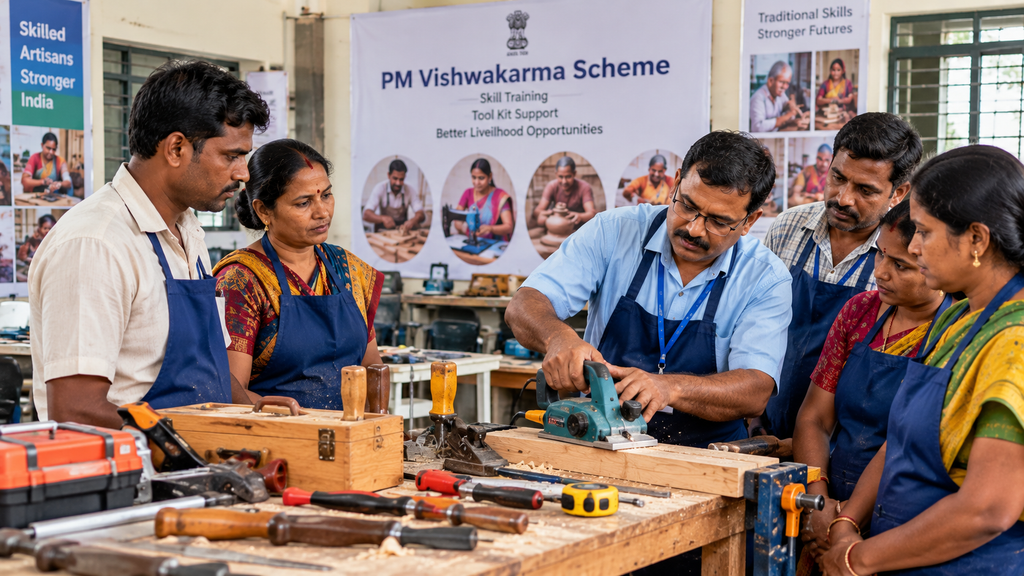
PM Vishwakarma Eligibility Criteria 2026
Applicants in West Bengal must satisfy the central scheme’s eligibility conditions. The principal requirements are as follows.
- The applicant must be at least 18 years old on the date of registration.
- The applicant must work with hands and tools in one of the 18 notified traditional trades.
- The work must be carried out on a self-employed basis in the unorganised sector.
- The applicant must be actively engaged in the relevant occupation when registering.
- Only one member of a family can register under the scheme.
- Applicants who have received loans under specified similar government self-employment or business-development schemes during the preceding five years may be ineligible, subject to the scheme’s detailed exceptions and rules.
- Government employees and their family members are excluded.
The five-year loan restriction is particularly important. The scheme’s eligibility rules refer to programmes such as PMEGP, PM SVANidhi and Mudra. Applicants should disclose their previous borrowing and ask the registration authority to assess their specific circumstances rather than assume that every previous loan has the same effect.
Which trades are covered?
The 18 notified trades include:
- Carpenter
- Boat maker
- Armourer
- Blacksmith
- Hammer and tool-kit maker
- Locksmith
- Goldsmith
- Potter
- Sculptor, stone carver and stone breaker
- Cobbler, shoesmith and footwear artisan
- Mason
- Basket, mat and broom maker, including specified coir-weaving work
- Traditional doll and toy maker
- Barber
- Garland maker
- Washerman
- Tailor
- Fishing-net maker
The trade categories are defined by the scheme, so applicants should check the official list if their work falls near the boundary between a notified occupation and a different business activity.
Documents Required for PM Vishwakarma Registration
Applicants should prepare the information and documents needed for registration and verification.
| Document or information | Why it is needed |
|---|---|
| Aadhaar card | Identity verification |
| Aadhaar-linked mobile number | OTP-based verification where required |
| Ration card | Family information and registration requirements |
| Bank account details | Relevant payments and credit processing |
| Occupation details | To establish the notified trade being practised |
The official scheme guidance identifies Aadhaar, a mobile number, bank details and a ration card among the registration requirements. If an applicant does not have a ration card, the published guidance specifies that Aadhaar cards of family members may be required. Applicants without a bank account should ask the CSC about the prescribed arrangements for opening one.
Requirements may differ according to the stage of the application. Keep original documents available for verification and do not share Aadhaar OTPs or banking passwords with unauthorised individuals
How to Apply for PM Vishwakarma Scheme West Bengal 2026
Registration is carried out through the scheme’s prescribed online system with assistance from Common Service Centres. Applicants should follow the official process rather than submit personal documents to unofficial websites or agents.
Step 1: Visit the official portal
Open pmvishwakarma.gov.in and review the current registration instructions. Check whether the relevant registration option is available and whether any state-specific guidance has been published.
Step 2: Visit a Common Service Centre
Eligible applicants can approach a nearby CSC for registration assistance. The centre can help with the online application and explain the required verification process.
Step 3: Complete Aadhaar verification
The registration procedure includes Aadhaar-based verification. Follow the authorised process for OTP verification and any biometric verification required at the CSC.
Step 4: Provide occupation and personal details
Enter the requested details accurately, including personal information, bank details and the traditional trade being practised. Make sure the occupation matches the scheme’s notified categories.
Step 5: Submit the application
Review the information before submission. Save the application or acknowledgement number provided by the system so that you can refer to it during follow-up.
Step 6: Complete the verification stages
The application undergoes a prescribed three-stage verification process:
- Verification at the Gram Panchayat or urban local body level.
- Examination and recommendation by the District Implementation Committee.
- Final screening and approval under the scheme’s prescribed procedure.
Completing the application form does not mean that registration has been approved. The authorities must complete the relevant checks before the applicant can formally register as a beneficiary.
Step 7: Follow the next instructions
Approved beneficiaries can receive scheme recognition through a certificate and ID card. Access to training, toolkit support and loans then follows the applicable requirements for each benefit.
Applicants should check their application status through the official system or the authorised registration centre.
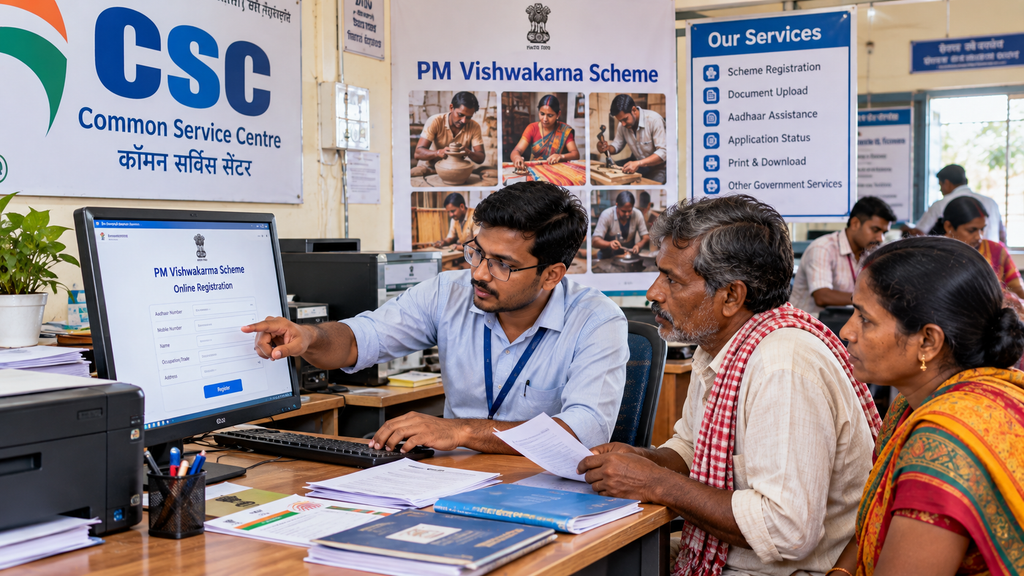
PM Vishwakarma Scheme West Bengal: How to Check Application Status
Applicants who have already registered should keep their acknowledgement number and contact details available when following up on an application.
To check the status:
- Visit the official PM Vishwakarma portal.
- Look for the applicable login or beneficiary-status facility.
- Enter the requested application or registration details, if prompted.
- Review any displayed status or instructions.
- If the information is unavailable online, contact the CSC where the application was submitted.
The exact status-check options may change as the portal is updated. Applicants should not interpret a submitted application as proof of final approval or assume that a pending application guarantees a toolkit incentive or loan.
Also Read:
- Vetri Payanam Scheme 2026: Free Bus Travel, Eligibility, Buses Covered and Launch Date
- Kanya Sumangala Yojana 2026: Eligibility, ₹25,000 Benefit, Online Apply and Status
PM Vishwakarma Scheme in West Bengal: What Applicants Should Know
West Bengal’s decision to onboard the scheme in May 2026 is significant because state-level implementation is necessary to connect eligible artisans with the verification and training system. A July 2026 Ministry of MSME release confirmed the scheme’s implementation in the state, while a subsequent official release reported that registered beneficiaries were receiving basic skill training.
However, three practical distinctions matter.
First, eligibility and registration are separate. An artisan may appear to meet the age and occupation requirements but still need to complete the prescribed checks.
Second, registration and credit approval are separate. A beneficiary’s registration does not guarantee a loan.
The bank or other authorised lending institution reviews the application and decides whether to approve the loan based on the scheme’s eligibility criteria and lending rules.
Third, the advertised benefit amounts serve different purposes. The toolkit incentive is intended for prescribed tools, the training stipend relates to training participation, and the loan facility must be repaid. They should not be added together and described as a guaranteed cash payment.These distinctions help applicants make informed decisions and reduce the risk of relying on misleading claims about government assistance.
What the Evidence Suggests
Official scheme information establishes a broad support structure combining skill development, equipment, affordable credit and marketing. West Bengal’s onboarding provides a route for eligible artisans in the state to participate. Nevertheless, the scheme’s value for an individual depends on successful verification, access to training, the suitability of the support for the occupation and the artisan’s ability to use credit responsibly.
For a small self-employed worker, improved tools may increase productivity, but they cannot guarantee higher sales. Similarly, a loan can help expand a business, but it also creates a repayment obligation. Applicants should therefore consider the entire support package rather than focus on a single headline benefit.
In Conclusion
The PM Vishwakarma Scheme offers eligible traditional artisans in West Bengal a combination of formal recognition, skill training, toolkit assistance, concessional credit and market-linkage support. Its importance lies in addressing several barriers to small-scale traditional work rather than providing only one form of financial assistance.
For applicants, the sensible next step is to verify their trade, check the eligibility conditions and complete registration through the authorised process. For the scheme to translate into lasting livelihood improvements, access to support must be matched by useful training, suitable tools, responsible borrowing and opportunities to reach customers.
Frequently Asked Questions
Is PM Vishwakarma Scheme available in West Bengal in 2026?
Yes. The Government of West Bengal decided to onboard the Central Government scheme in May 2026. Official Ministry of MSME information subsequently confirmed implementation in the state and reported beneficiary registrations and training activity. Individual applicants must still complete the prescribed eligibility checks and verification process
How much financial assistance is available under PM Vishwakarma?
Eligible beneficiaries may receive a toolkit incentive of ₹15,000 and access collateral-free loans of up to ₹3 lakh in two tranches: ₹1 lakh initially and ₹2 lakh subsequently. Training participants may receive a stipend of ₹500 per training day, subject to applicable rules. These benefits have different conditions and are not a guaranteed lump-sum cash payment.
Who can apply for PM Vishwakarma Scheme West Bengal 2026?
Applicants must generally be at least 18 years old, self-employed in the unorganised sector and actively engaged in one of the 18 notified traditional trades. Family restrictions, previous government business-loan conditions and government-service exclusions also apply. Meeting the basic requirements does not remove the need for official verification.
Can I apply for PM Vishwakarma online?
The scheme has an official online portal, and registration assistance is available through authorised Common Service Centres. Applicants should use the official registration process and complete any required Aadhaar and biometric verification. Check the current portal instructions or consult a CSC to confirm the process available to you.
Is the ₹3 lakh PM Vishwakarma benefit a grant?
No. The maximum ₹3 lakh credit support is a loan facility, not a grant. It is provided in two tranches, subject to the scheme’s requirements and lending procedures.
Which documents are required for registration?
The published scheme guidance lists Aadhaar, a mobile number, bank details and a ration card among the registration requirements. Alternative family documentation may be required if the applicant does not have a ration card. Additional verification requirements should be confirmed with the authorised CSC or through the official portal.