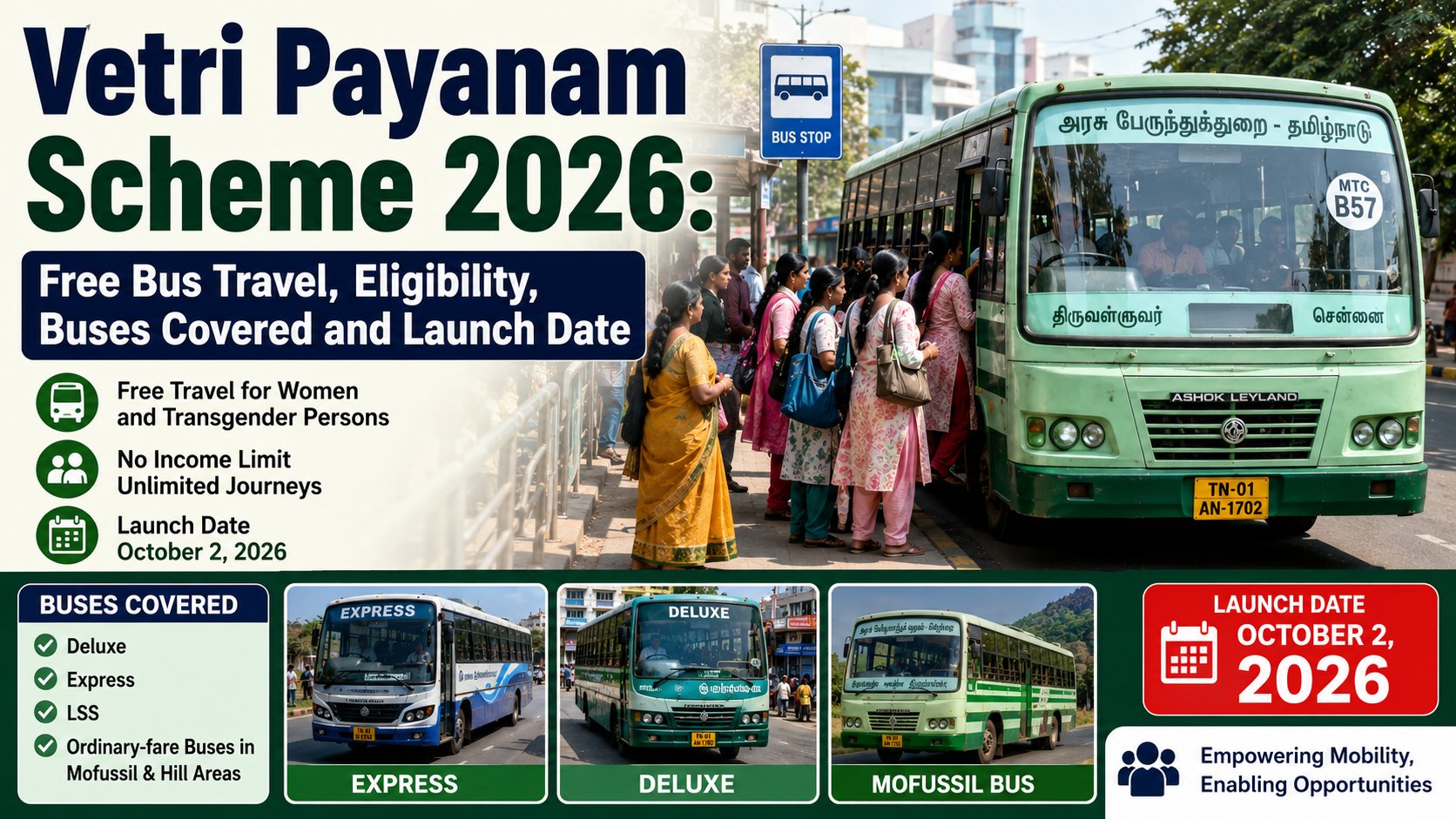
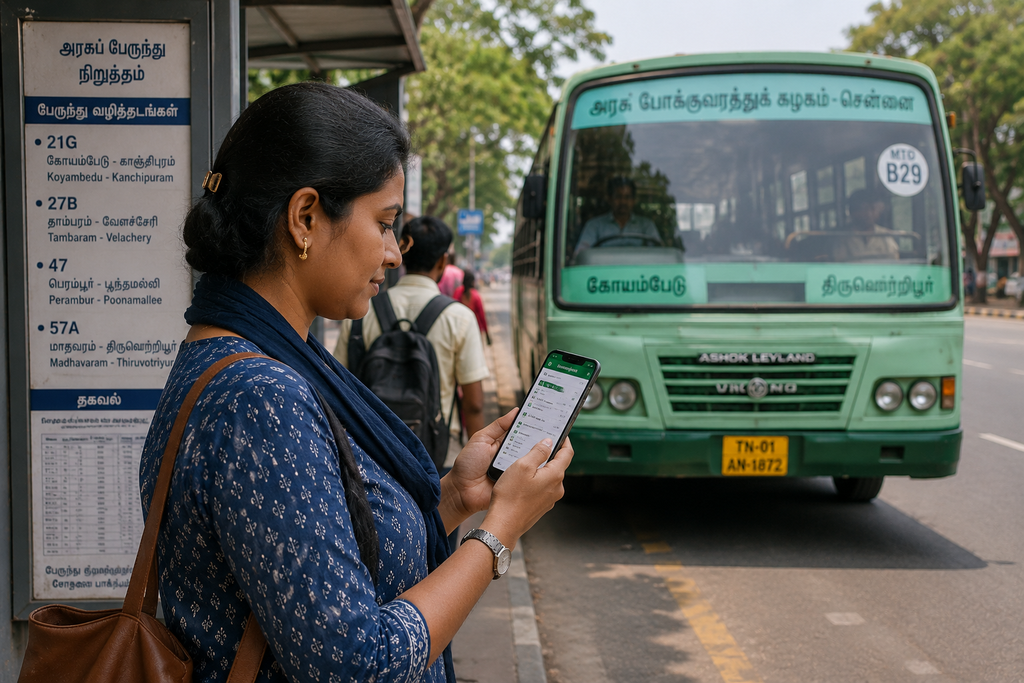
Vetri Payanam Scheme 2026: The Vetri Payanam Scheme 2026 is an announced expansion of free bus travel for women and transgender persons in Tamil Nadu. The proposal is significant because it moves the discussion beyond ordinary-fare travel and towards a wider set of government-operated bus services. The announcement was made in the Legislative Assembly on August 24, 2026, under Rule 110, with the expansion scheduled to begin on October 2, 2026.
The practical question is not simply whether travel will be free. It is whether a passenger’s usual route, bus category, and travel conditions fall within the announced coverage. That distinction matters for people who depend on buses for work, education, healthcare, and family responsibilities. It also matters for readers trying to distinguish this scheme from similarly named Tamil Nadu initiatives.
What is the Vetri Payanam Scheme 2026?
Vetri Payanam is an announced Tamil Nadu government scheme to expand free bus travel for women and transgender persons. The Assembly announcement states that the expanded facility is intended to cover additional government-operated services from October 2, 2026. The scheme is associated with the state’s broader “Vetri Thamizhagam” vision plan.
The transport announcement is therefore best understood as a mobility and access measure. Its immediate relevance is to passengers who already use public transport or who may be able to travel more frequently when fares are reduced or removed.
When will Vetri Payanam begin?
The announced start date is October 2, 2026. This is the date stated in the Assembly announcement for the expansion.
That date should be treated as the announced commencement date, not as proof that every operational detail has already been published. Passengers should rely on subsequent official transport instructions for the precise implementation arrangements.
Who is eligible for free travel?
The announced beneficiaries are women and transgender persons. The available announcement describes the expansion without an income limit or restriction on the number of journeys.
This is an important distinction from schemes that depend on income, age, education, or family status. However, eligibility alone does not answer every travel question. The passenger must also use a service included in the scheme’s coverage.
Does the scheme have an income limit?
The announcement states that the expanded benefit is intended to operate without an income limit.
For readers, this means the benefit is described as a public-transport entitlement rather than a targeted cash transfer. It is not presented as a reimbursement that passengers must claim after completing a journey.
Which buses are covered?
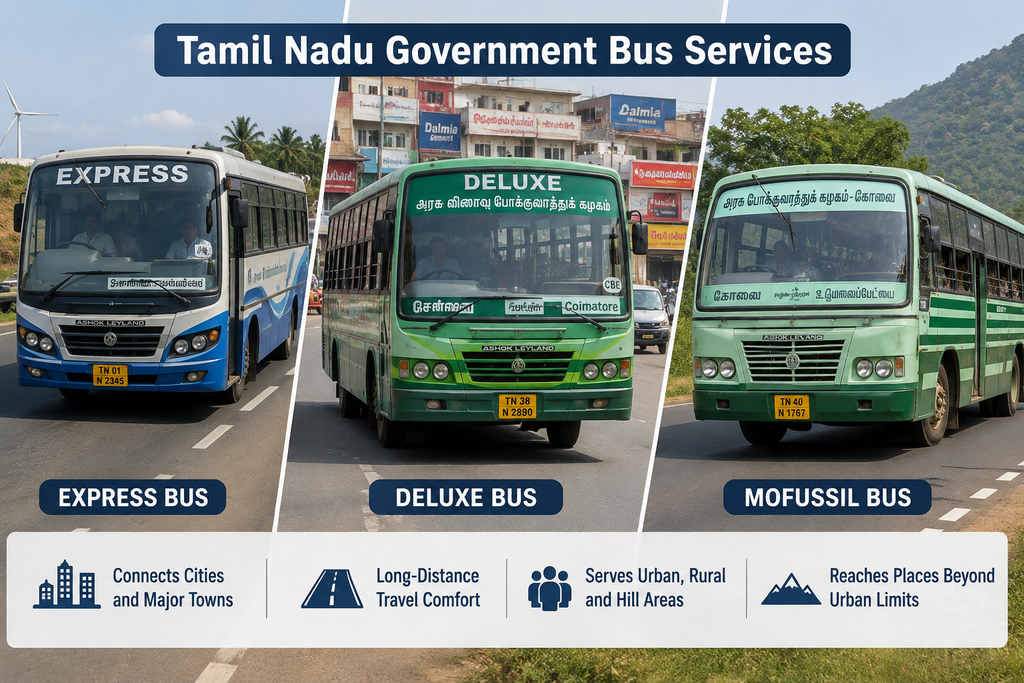
The announcement identifies additional categories of government-operated services, including Deluxe, Express, LSS, and ordinary-fare buses in mofussil and hill areas.
| Bus service | What readers should understand |
|---|---|
| Deluxe | Included in the announced expansion. |
| Express | Included in the announced expansion. |
| LSS | Included in the announced expansion. |
| Ordinary-fare mofussil buses | Included in the announced expansion. |
| Ordinary-fare hill-area buses | Included in the announced expansion. |
The significance is practical. A passenger who travels beyond a short urban route may depend on Express or mofussil services. Including these categories can make the benefit relevant to a wider range of journeys than a scheme restricted to one local bus type.
The exact implementation should still be checked against official instructions, especially where services operate across different transport divisions or route types.
How is Vetri Payanam different from existing free-travel arrangements?
Tamil Nadu already has free-travel arrangements for women in specified ordinary-fare services. The Vetri Payanam announcement is notable because it describes an expansion to additional categories, including Express, LSS, Deluxe, and selected ordinary-fare services in mofussil and hill areas.
The policy distinction is important:
- Existing arrangements: The scope depends on the applicable service category and rules.
- Announced expansion: The stated objective is to include additional government-operated services.
- Practical result: More routes may become accessible, but passengers should confirm the service-specific implementation.
- CG List Chhattisgarh Yojana List 2026: Complete guide for best Government Schemes in chhattishgarh
- PM Kisan Status Check 2026: Complete Beneficiary Status, Installment & eKYC Guide
Why does this matter for ordinary commuters?
The value of free travel is not limited to the fare saved on one journey. For people who make repeated trips, transport costs can influence whether they accept a job, attend college, visit a hospital, or maintain regular contact with family members.
For women, the wider policy question is whether affordable public transport can support greater mobility. A person who previously avoided a journey because of cost may find it easier to travel for work or education. For transgender persons, inclusion in the announced benefit also places recognition and access within the state’s public-transport policy.
The announcement, however, should not be treated as proof of a specific increase in employment, income, or educational outcomes. Those effects would require evidence from implementation and later evaluation.
Competitive Advantage: What passengers should check before travelling
The most useful way to interpret the scheme is through three separate questions.
First, am I an eligible passenger? The announcement identifies women and transgender persons as beneficiaries.
Second, is my bus service covered? The announced categories include additional services such as Express, LSS, Deluxe, and ordinary-fare buses in mofussil and hill areas.
Third, has the implementation instruction for my route been issued? The announcement provides the policy direction and start date, but passengers should check the official transport department or State Transport Undertaking information for operational details.
This framework is more reliable than relying on social-media messages that may use the scheme’s name without distinguishing the announcement from the final operating rules.
What should passengers do before October 2, 2026?
Passengers should keep their usual route information available and check the relevant official transport updates as the launch date approaches. The useful details to confirm are the service category, the applicable travel conditions, and any instructions issued by the transport authorities.
The announcement does not establish a separate application process for the benefit. It is therefore important not to assume that a new registration, fee, or private payment is required merely because the scheme has a new name.
For a reader, the sensible approach is to distinguish between scheme information and route-level operational instructions. The first explains the policy; the second determines how it works in practice.
What the evidence suggests
The available evidence supports a cautious conclusion: Vetri Payanam is an announced expansion of free bus travel, with a stated start date of October 2, 2026 and a broader set of eligible bus categories.
The evidence does not yet justify claiming that every possible bus service is covered, that all implementation details are final, or that the scheme will automatically produce a particular economic outcome. Those are questions for official instructions and later evaluation.
That distinction is especially important in government-scheme reporting. A credible article should explain what has been announced while avoiding claims that the evidence does not support.
Broader significance for Tamil Nadu
Tamil Nadu’s public-transport policy has implications beyond fare collection. The state’s government bus network connects urban centres with mofussil and hill-area communities, and transport access affects the practical reach of employment, education, and public services.
The Vetri Payanam announcement places free travel within that wider context. Its significance will depend on whether the expansion is implemented clearly, whether passengers can understand the rules, and whether the covered services are available where people actually need them.
The unresolved question is therefore not only the size of the benefit. It is whether the benefit becomes a dependable part of everyday mobility.
FAQ Section
1. What is the Vetri Payanam Scheme 2026?
Vetri Payanam is an announced Tamil Nadu government scheme to expand free bus travel for women and transgender persons. The Assembly announcement states that the expansion is scheduled to begin on October 2, 2026, and includes additional government-operated bus categories
2. When will Vetri Payanam start?
The announced start date is October 2, 2026. Passengers should check subsequent official transport instructions for the precise implementation arrangements applicable to their routes.
3. Who can use the Vetri Payanam benefit?
The announced beneficiaries are women and transgender persons. The announcement also describes the expanded facility as operating without an income limit or restriction on the number of journeys.
4. Which buses are included?
The announcement identifies Deluxe, Express, LSS, and ordinary-fare buses in mofussil and hill areas as part of the expanded coverage. The exact operational application should be confirmed through official transport instructions.
5. Is Vetri Payanam the same as Vetri Nichayam?
No. Vetri Payanam is a public-transport announcement, while Vetri Nichayam is a separate Tamil Nadu Skill Development Corporation initiative focused on skills and employment opportunities.
6. Is there an income limit?
The Assembly announcement states that the expanded benefit is intended to operate without an income limit. Passengers should still follow the official implementation conditions for the service they use.
7. Do passengers need to apply online?
The available announcement does not establish a separate online application process for the benefit. Readers should avoid assuming that registration or payment is required and should follow official transport instructions as they are issued.
Conclusion
Vetri Payanam is best understood as a transport-access announcement whose importance lies in the services it brings within reach of eligible passengers. Its success will not be measured only by the fare removed from a journey, but by whether people can use the benefit confidently, consistently, and on the routes that matter to their lives. The next stage is therefore implementation: clear rules, reliable information, and a transport system that makes the announced entitlement meaningful.



One Comment