
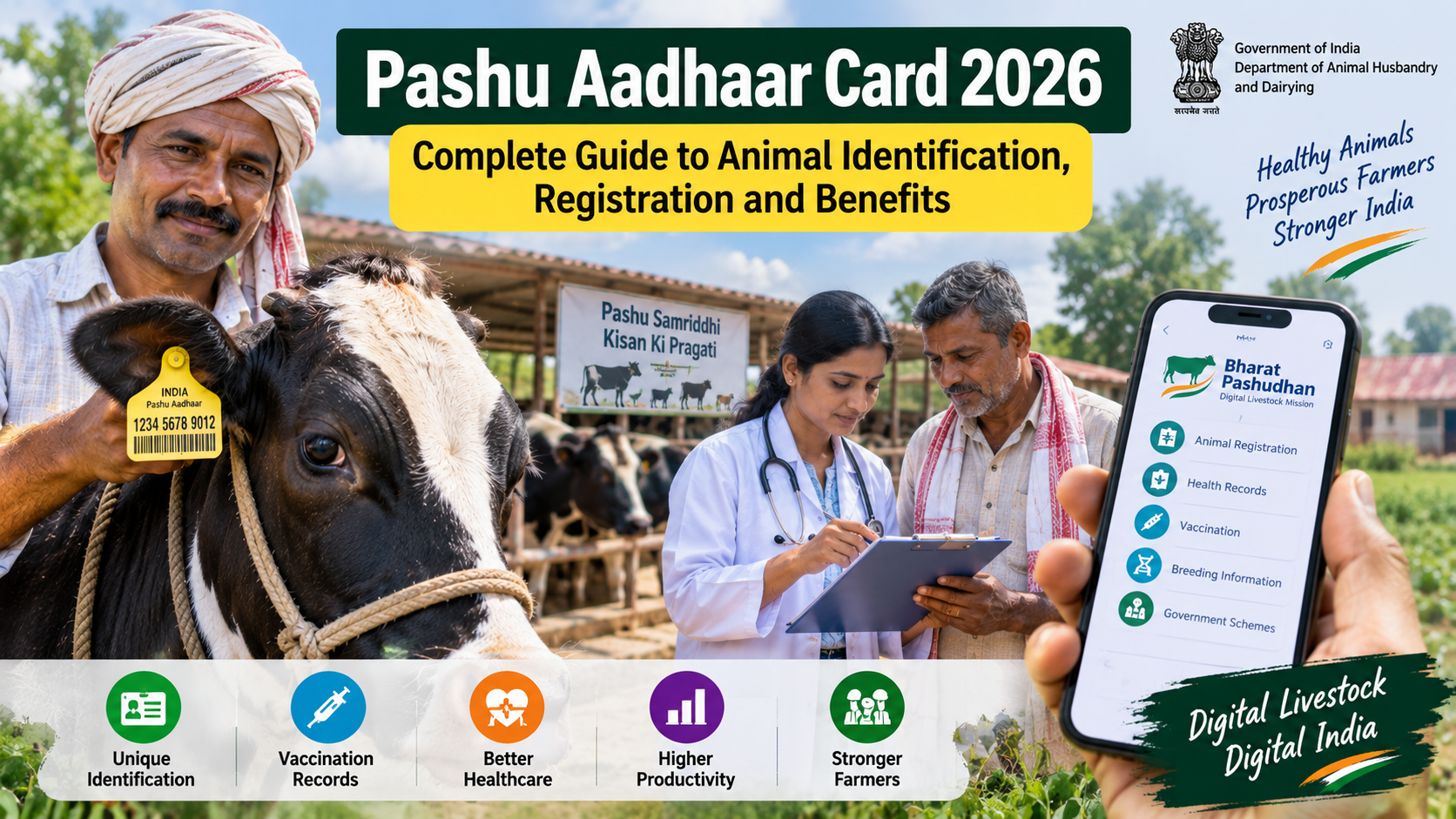
The phrase Pashu Aadhaar Card 2026 is increasingly used to describe India’s digital livestock-identification system. But the name can create confusion: it is not the same as the Aadhaar card issued to an individual. In official livestock-management material, “Pashu Aadhaar” refers to a unique identification number associated with an animal’s ear tag, which is then used to connect breeding, vaccination, treatment and other records.
That distinction matters because the real purpose of the system is not simply to issue a card. It is to create a more reliable record of an animal throughout its productive life. For farmers, the value lies in being able to identify an animal and connect its records to veterinary and livestock services. For government agencies, the system can support disease-control programmes, breeding management and better planning.
What is Pashu Aadhaar Card 2026?
Pashu Aadhaar is the unique identification system for livestock under the National Digital Livestock Mission. Official material describes a 12-digit, bar-coded tag ID issued in the form of an ear tag. The number acts as the primary identifier for recording activities such as vaccination, breeding and treatment.
The system is associated with Bharat Pashudhan, a unified digital livestock ecosystem implemented by the Department of Animal Husbandry and Dairying in collaboration with the National Dairy Development Board. Its objective is to make animal-related information more traceable and useful for farmers and field-level workers.
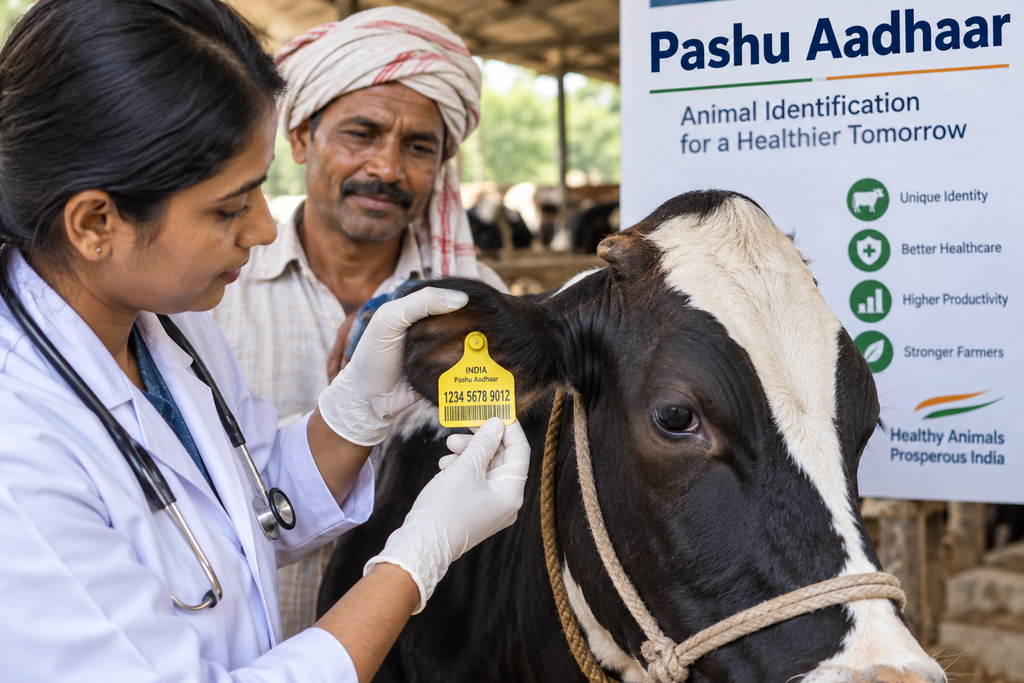
Is Pashu Aadhaar a physical card?
Not necessarily. The official description centres on the ear tag and its unique number, rather than a conventional identity card for the animal. Farmers may encounter certificates, printed records or other documents connected with livestock services, but these should not automatically be treated as a separate national “Pashu Aadhaar card” unless the relevant authority specifies that format.
The important question is therefore not only, “Where is my card?” but also, “What is my animal’s identification number, and which records are linked to it?”
How does the animal identification system work?
The basic process is straightforward:
1. Animal identificationA unique ear tag is associated with the animal.
2. Record creationThe identification number is used to connect animal and owner details with service records.
3. Service updatesVaccination, breeding, treatment and related interventions can be recorded against the animal.
4. Access by authorised usersFarmers and field workers can use the information for relevant animal-health and productivity services.
This is why the system is better understood as a digital identity linked to records, not merely as a tag. The National Dairy Development Board’s INAPH platform, for example, captures breeding, nutrition and health information at the farmer’s doorstep.
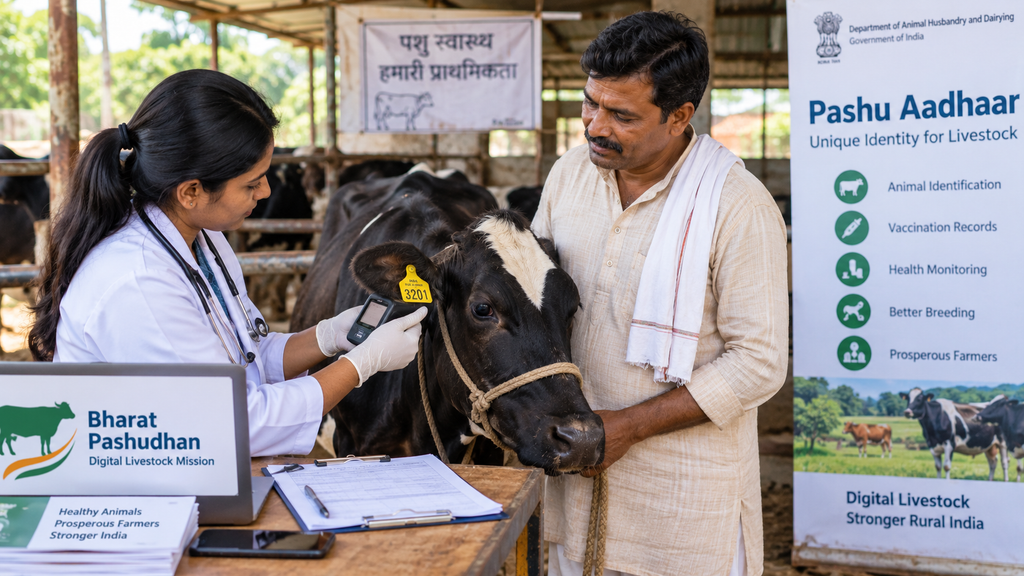
Which animals can receive Pashu Aadhaar?
The official national livestock-identification description covers a broad range of livestock, including cattle, buffaloes, sheep, goats and pigs. The exact animals covered in a local registration drive may depend on the programme being implemented and the instructions of the relevant animal husbandry department.
This distinction is important. A farmer should not assume that every animal-related certificate, vaccination campaign or state benefit uses identical eligibility conditions. Some programmes may focus on particular species or require additional records.
What information is linked to the tag number?
The tag number is intended to connect the animal with a history of services. Depending on the system and the records entered, that may include:
- Animal identification and owner details.
- Breeding and artificial insemination records.
- Vaccination and other health interventions.
- Treatment information.
- Productivity-related data.
- Records relevant to government livestock programmes.
The official purpose is to make information available in one place against the animal’s ID. This can help veterinary staff and farmers understand the animal’s history and support better decisions.
However, the system’s usefulness depends on accurate data entry and continued updating. A tag alone does not prove that an animal has received every vaccination, that it qualifies for a subsidy, or that its records are complete.
What are the benefits for farmers?
1. Better access to animal-health history
A consistent identification number can make it easier to connect an animal with its vaccination and treatment records. This is particularly useful when animals are moved between farms, when veterinary staff change, or when a farmer needs to discuss an animal’s previous care.
2. Support for disease-control programmes
Livestock identification is important for monitoring and controlling diseases. NDDB has described the use of unique ear tags under the National Animal Disease Control Programme, with vaccination and other interventions recorded against animal IDs.
The broader significance is that reliable records can support disease surveillance and more targeted veterinary action. They do not eliminate disease risk, but they can improve the information available to those responsible for animal health.
3. More informed breeding and productivity decisions
Breeding history and related interventions can be connected to the animal’s identification number. In principle, this allows farmers and field workers to make decisions using records rather than relying only on memory or scattered paper documents.
4. A foundation for future digital services
The national livestock system is intended to support a wider digital ecosystem. The official Bharat Pashudhan platform describes its purpose as helping farmers access information about animals, schemes and facilities available in the livestock sector.
That means the long-term value may be greater than the tag itself. A reliable animal identity can become a foundation for connected services, provided those services are actually available in the farmer’s area.
What is the difference between Pashu Aadhaar and INAPH?
Pashu Aadhaar is the animal’s unique identification number; INAPH is a digital information system used to record and manage livestock-related information. They are closely connected but are not interchangeable terms.
INAPH, developed by NDDB, is described as an application for capturing real-time data on breeding, nutrition and health services delivered at the farmer’s doorstep. The animal’s unique ear-tag number provides the identifier against which records can be maintained.
In practical terms, the tag answers “Which animal is this?”, while the information system helps answer “What services and records are associated with this animal?”
A practical approach is to:
- Contact the nearest government veterinary hospital, animal husbandry office or authorised livestock service worker.
- Ask whether Pashu Aadhaar tagging or registration is being carried out in the area.
- Keep relevant animal and owner details available, as requested by the local authority.
- Confirm the animal’s tag number after identification.
- Ask how vaccination, breeding and treatment records will be updated or accessed.
- Retain any certificate, receipt or written record provided during the process.
The precise process may differ across states and programmes. Therefore, claims that every farmer must fill out a single national online form, pay a fixed fee, or receive a card by post should not be accepted without an official source.
Where can farmers check records or seek help?
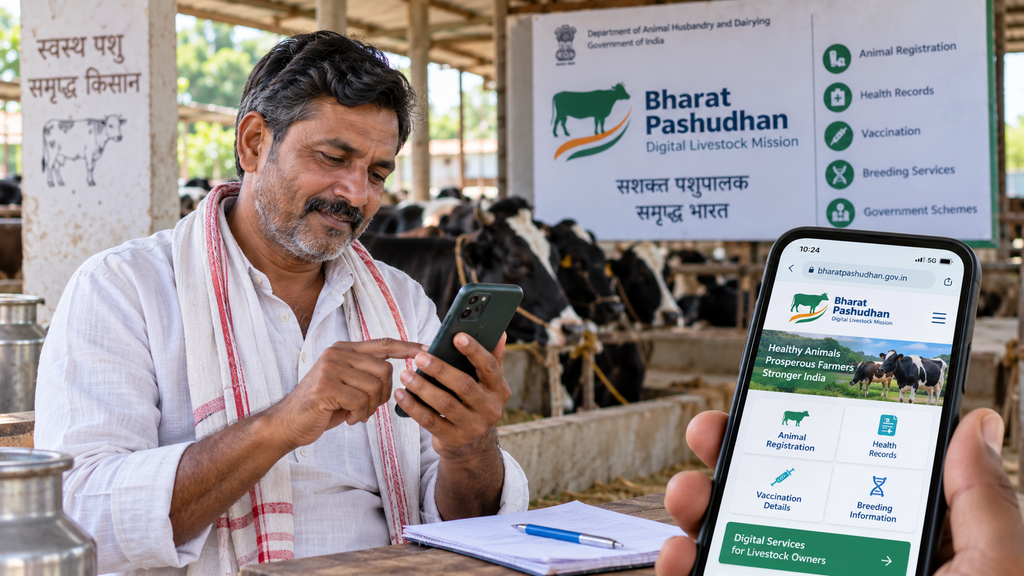
The Bharat Pashudhan platform is the official national livestock information initiative. The INAPH platform is another important system for livestock productivity and health records.
The government’s 2026 dairy-sector backgrounder also identifies the 1962 App and toll-free number 1962 as sources of authenticated livestock information and veterinary services through Mobile Veterinary Units.
Farmers should use the relevant official service for their location and purpose. A portal may provide information about an animal without necessarily offering every service online, and access to records may depend on the local implementation.
Competitive Advantage: What Pashu Aadhaar changes—and what it does not
The most useful way to assess Pashu Aadhaar is to separate identification, record-keeping and benefits.
| Question | What the system is intended to do | What it does not automatically prove |
|---|---|---|
| Identification | Give an animal a unique number through an ear tag. | That every animal has a physical identity card. |
| Records | Link breeding, health and other service information to the ID. | That all records are complete or updated. |
| Disease control | Support traceability and vaccination data. | That disease risk has been eliminated. |
| Government schemes | Provide a foundation for better livestock administration. | Automatic eligibility for every subsidy or benefit. |
| Farmer services | Improve access to relevant information and veterinary support. | That every service is available online in every state. |
This distinction is the main practical takeaway. The system can make livestock management more accountable and information-rich, but its benefits depend on accurate identification, proper data entry, local implementation and farmer access to services.
What the evidence suggests
The official record shows that Pashu Aadhaar is part of a substantial national effort to digitise livestock management. A January 2026 PIB backgrounder reported that more than 35.68 crore animals had been issued Pashu Aadhaar under the National Digital Livestock Mission, with more than 84 crore transactions recorded in Bharat Pashudhan as of the publication date. These are reported national programme figures, not a count of cards held by every farmer.
The evidence also suggests that the system is intended to improve traceability and support service delivery. Its success, however, should be judged not only by the number of tags issued, but by whether farmers can access useful records, receive timely veterinary assistance and see practical improvements in animal health and productivity.
Important limitations farmers should understand
A digital identity is valuable only when it is accurate and usable. An incorrect owner name, an unreadable tag or an unupdated vaccination record can reduce the usefulness of the system. Farmers should therefore ask for their animal’s identification number and clarify how corrections or updates are handled.
It is also important not to confuse registration with financial assistance. A Pashu Aadhaar number may be required for a particular programme, but each scheme can have its own eligibility conditions, documents and application process. The existence of an animal ID does not, by itself, establish entitlement to a subsidy.
Finally, access to digital information should not be assumed to be identical across India. The national framework may be common, while the way services are delivered at district and village level can differ.
Why Pashu Aadhaar matters beyond the tag
Livestock is a major part of rural livelihoods, and animal health has consequences for household income, food supply and agricultural resilience. A reliable identification system can help connect individual animals to broader public-health and productivity goals.
The larger opportunity is to move from fragmented records to a system where farmers and veterinary workers can make decisions using dependable information. But the measure of progress should remain practical: whether the data helps an animal receive better care and a farmer receive more effective services.
- FASTag KYV 2026: New Rules, KYV Update, Online Process and How to Get the FASTag Annual Pass
- Samagra Portal MP: SSSM ID, Search by Name, Apply Online, Download and Update Details
FAQ Section
What is Pashu Aadhaar Card 2026?
Pashu Aadhaar is the official term used for a unique animal identification number linked to an ear tag. It is part of the National Digital Livestock Mission and is intended to connect an animal with records such as vaccination, breeding and treatment. It should not be confused with an Aadhaar card issued to an individual.
Is Pashu Aadhaar the same as an Aadhaar card?
No. Pashu Aadhaar identifies livestock, while an Aadhaar card identifies an individual. The livestock system uses a unique ear-tag number to connect an animal with relevant records and services. The term “Aadhaar” in this context refers to identification, not to the personal Aadhaar system.
How many digits are in Pashu Aadhaar?
The official national description specifies a 12-digit bar-coded tag ID. The number is associated with the animal’s ear tag and is used as the primary identifier for recording livestock-related transactions.
Is there an online application for a Pashu Aadhaar card?
The official material describes a field-based animal-identification process supported by veterinarians and extension workers. Farmers should contact their local animal husbandry department or authorised veterinary service provider to confirm the registration process. A universal online application for a physical card should not be assumed.
What benefits does Pashu Aadhaar provide?
It is intended to improve animal identification, connect health and breeding records, support disease-control programmes and strengthen access to relevant livestock services. However, registration alone does not guarantee a subsidy or other benefit. Individual schemes may have separate eligibility requirements.
Which animals can receive Pashu Aadhaar?
The national identification system covers livestock such as cattle, buffaloes, sheep, goats and pigs. The exact animals covered in a particular registration drive can depend on the programme and local implementation instructions.
Where can farmers get help with livestock identification?
Farmers can contact their nearest government veterinary hospital, animal husbandry office or authorised livestock service worker. The official livestock information ecosystem also includes Bharat Pashudhan and INAPH, while the 1962 App and toll-free number 1962 are identified in government material as sources of livestock information and veterinary support.
Does Pashu Aadhaar automatically make a farmer eligible for a subsidy?
No. An animal’s identification number can support the administration of livestock programmes, but eligibility for any particular subsidy or benefit depends on that programme’s own rules. Farmers should check the relevant official scheme guidelines rather than assume that registration alone creates entitlement.
Conclusion
Pashu Aadhaar is best understood as a digital identity for livestock, not simply a new card. Its significance lies in connecting an animal to reliable records and making those records useful for veterinary care, disease control and livestock management. The next stage of its success will depend less on the number of tags issued than on whether farmers can use the system to obtain accurate information and better services. For readers, the most important practical step is to verify the animal’s tag number, understand which records are linked to it, and seek guidance from the relevant local authority when a specific service or scheme is involved.







One Comment