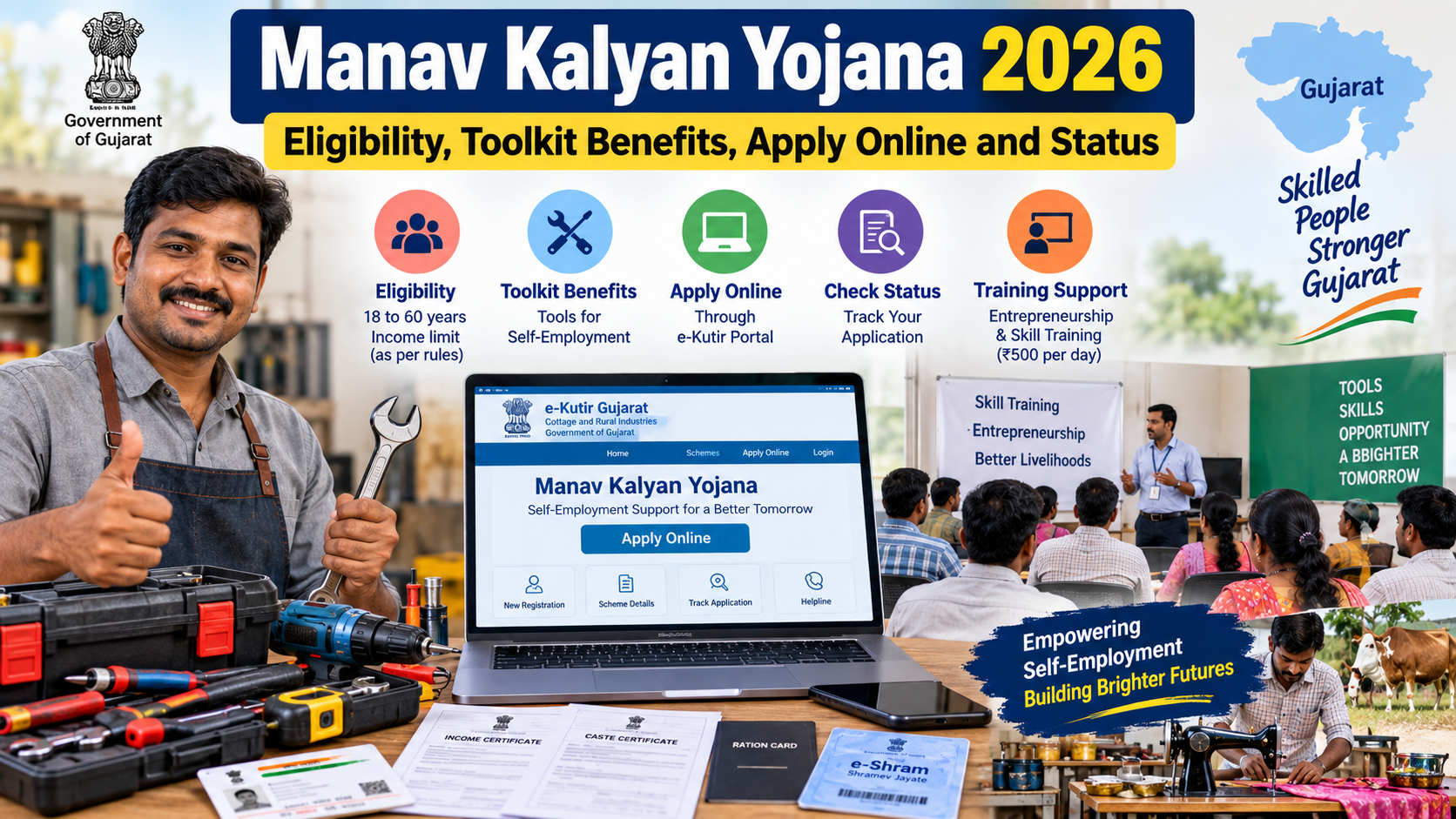
Manav Kalyan Yojana 2026 : For lots of people wanting to be self-employed, the first hurdle is not necessarily the lack of a business idea. It is the cost of the basic tools needed to begin. A plumber needs equipment, a tailor needs a sewing machine, and a small repair worker needs suitable instruments. Gujarat’s Manav Kalyan Yojana addresses this entry barrier by supporting eligible applicants with trade-specific toolkits rather than treating a loan as the starting point.
The scheme is implemented by the Commissioner of Cottage and Rural Industries, Industries and Mines Department, Government of Gujarat. Its purpose is to support self-employment among economically disadvantaged sections of society. The assistance is therefore best understood as a means of beginning or improving a livelihood activity, not as an unconditional cash-payment programme.
This distinction matters because applicants often search for “Manav Kalyan money” when the actual benefit is connected to tools and equipment. A careful application begins with understanding the approved trade, the current eligibility rules and the documents required.
What is Manav Kalyan Yojana?
Manav Kalyan Yojana is a Gujarat Government self-employment assistance scheme that provides eligible beneficiaries with toolkits for selected trades. The scheme is intended to help people establish or strengthen small income-generating activities. The current implementation also includes a training component for beneficiaries selected through the online draw.
The programme is not simply a general business grant. Assistance is connected to particular occupations, and the toolkit is meant to support the activity selected by the applicant. This makes the choice of trade an important part of the application rather than a minor formality.
The official scheme information identifies the Commissioner of Cottage and Rural Industries as the implementing authority. Applications and related services are associated with Gujarat’s e-Kutir system, which is the relevant starting point for applicants seeking current instructions.
What benefits are available?
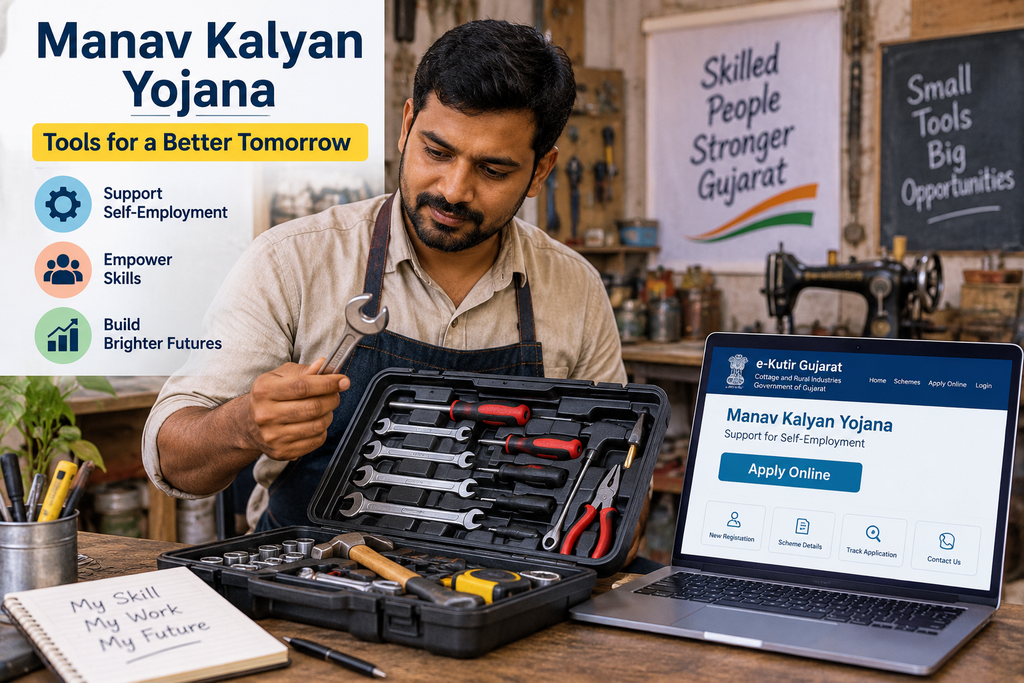
The principal benefit is toolkit assistance for an approved trade. The scheme’s published descriptions include activities such as dairy product selling, plumbing, embroidery, centering work, beauty parlour work, electrical appliance repair, papad making, pickle making, vehicle servicing and puncture-kit work. The exact list and the toolkit specifications should be checked against the current application notice.
This support has a practical advantage: it can reduce the initial equipment cost of a small enterprise. However, a toolkit alone does not guarantee income. The applicant still needs the skills, working space, customers and operating discipline required to sustain the activity.
Does the scheme provide cash?
The published scheme description focuses on toolkit assistance through an e-voucher system, rather than a general cash transfer. Beneficiaries selected for assistance can use the voucher with approved dealers for the relevant toolkit, subject to the scheme’s prescribed limits.
Applicants should not assume that every expense of starting a business is covered. Consumables, rent, transport, additional equipment or costs beyond the approved toolkit may still require the applicant’s own resources. The precise limits and purchasing conditions should be confirmed before making business plans.
Is training included?
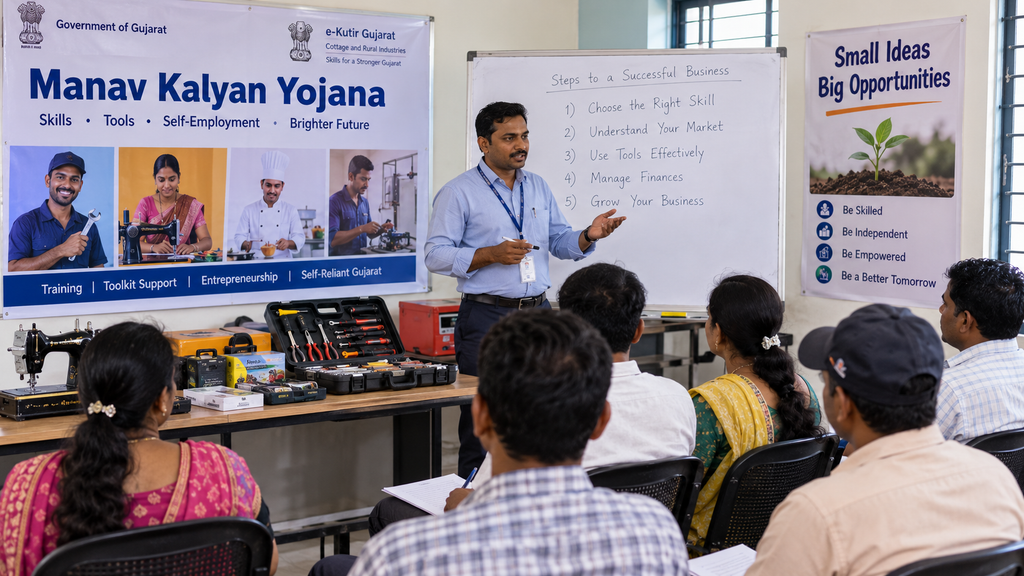
The Gujarat Matikam Kalakari & Rural Technology Institute states that beneficiaries selected through the online draw receive five days of training in entrepreneurship, soft skills, marketing and online payment systems. It also states that trainees receive a stipend of ₹500 per day. This training component is linked to the implementation of the scheme from the financial year 2024–25.
The significance of this provision is that the programme is not limited to distributing equipment. Training can help beneficiaries understand how to use the toolkit commercially, communicate with customers and manage basic business operations. Nevertheless, training should be seen as a foundation, not a substitute for practical experience.
Who can apply?
The published eligibility information identifies 18 to 60 years as the age range for the scheme. It also states that the general annual family-income ceiling is ₹6 lakh, with specific exemptions for certain eligible communities. Because income and category provisions can be amended, applicants should rely on the current official notice before submitting their forms.
For applicants in the general category, an income certificate is generally relevant. The published guidance also identifies special provisions for certain Scheduled Caste, Scheduled Tribe and SEBC-related categories, including exemptions from income proof for specified groups. These exemptions are not a blanket rule for every applicant belonging to one broad category; the exact qualifying category and documentary requirement matter.
Why the income rule needs careful reading
A common mistake is to treat a headline income limit as the only eligibility condition. In practice, applicants should consider:
- Whether they fall within the stated age range.
- Whether their family income is within the applicable limit.
- Whether their caste or community certificate is required.
- Whether their selected trade is included in the scheme.
- Whether they have already received benefits under a related or previous application, if the current rules restrict repeat assistance.
Documents required for application
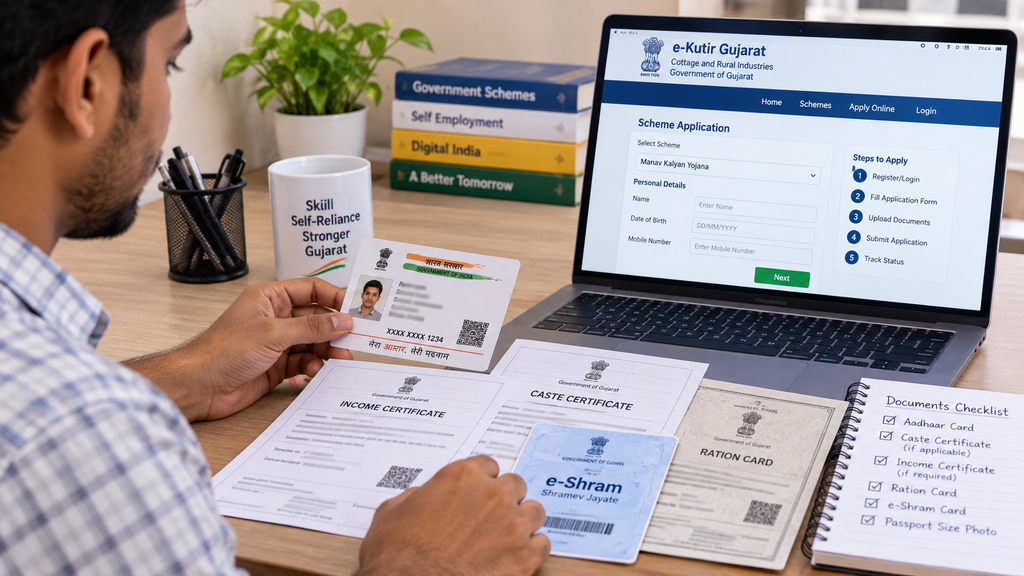
Published application guidance lists documents such as an Aadhaar card, caste certificate where applicable, income certificate where required, ration card, passport-size photograph and e-Shram card details. The exact list may vary by applicant category and the current application form.
A practical approach is to prepare clear scans before beginning the application. The name, date of birth and other identity details should match across documents. Applicants should also keep the application number and a copy of the submitted form, since these are useful for later status checks.
The presence of an e-Shram requirement in published guidance also reflects the wider effort to connect self-employment assistance with worker identification. Applicants should not, however, infer that an e-Shram card automatically establishes eligibility for every other condition.
How to apply online through e-Kutir
The e-Kutir portal is the main online route associated with Manav Kalyan Yojana applications. The published process involves registration, profile completion, selection of the scheme, document upload and submission. Applicants should use the current portal instructions because the layout and application windows may change.
Step-by-step application process
- Visit the official e-Kutir portal: e-kutir.gujarat.gov.in .
- Register or log in using the portal’s current citizen-registration process.
- Complete the profile details and verify the information requested by the system.
- Select Manav Kalyan Yojana and choose the relevant trade.
- Fill in the application form carefully, including category, income and identity details.
- Upload the required documents in the prescribed format.
- Review the application before final submission.
- Save the application number and retain a print or digital copy of the submitted form.
The important practical point is to select a trade that matches the applicant’s actual intention and capacity. A toolkit may be useful only if the recipient is prepared to use it for the stated occupation. Applicants should therefore consider their existing skills, local demand and the cost of continuing the business after the initial assistance.
How to check Manav Kalyan application status
Applicants can check their application through the official application-status page: View Application Status . Published instructions indicate that the applicant number and date of birth are used to retrieve the status.
A status check is useful for understanding whether an application is still under consideration, requires revision or has reached a later stage. It should not be confused with approval. An application number confirms that a form has been submitted or recorded; it does not, by itself, establish that the applicant has been selected.
Applicants should also be alert to messages requesting corrections or additional information. If the portal returns an application for revision, the applicant should follow the prescribed process rather than submitting an entirely new form without understanding the reason.
Competitive Advantage: What should applicants understand before applying?
The most useful way to assess Manav Kalyan Yojana is to ask what problem the toolkit solves—and what problem it does not solve.
The toolkit can address the immediate equipment barrier. It does not necessarily provide a ready-made customer base, business premises, raw materials, transport or working capital. This distinction is particularly important for applicants who want to begin a service business. A plumber, for example, may benefit from a toolkit but still need local contacts and a way to travel to customers.
The scheme also has a wider economic significance. Small enterprises often begin with modest equipment and informal work arrangements. Assistance that reduces the initial capital requirement can make self-employment more accessible, especially for people who would find conventional borrowing difficult. At the same time, the effectiveness of such support depends on whether beneficiaries can turn the equipment into regular economic activity.
A sensible decision framework is therefore:
- Need: Is there a genuine local demand for the selected service?
- Skill: Can the applicant already perform the work, or obtain suitable training?
- Tools: Does the approved toolkit cover the essential equipment?
- Sustainability: Can the applicant meet recurring expenses after receiving the assistance?
- Compliance: Can the applicant provide the required documents and follow the scheme’s conditions?
- Widow Pension Scheme 2026: Eligibility, Pension Amount, Application Process, and State-Wise Benefits
- Vetri Payanam Scheme 2026: Free Bus Travel, Eligibility, Buses Covered and Launch Date
- Pashu Aadhaar Card 2026: Complete Guide to Animal Identification, Registration and Benefits
Manav Kalyan Yojana vs Manav Garima Yojana
The names are similar, but the schemes should not be mixed up. Manav Kalyan Yojana is associated with the Commissioner of Cottage and Rural Industries and focuses on toolkit assistance for self-employment. Manav Garima Yojana, meanwhile, is a separate scheme administered under Gujarat’s Scheduled Caste Welfare system.
The distinction is important for searchers because a result about one scheme may contain eligibility rules, application routes or benefit descriptions that do not apply to the other. Applicants should check the implementing department and the scheme name before relying on any published information.
What the evidence suggests
The available official information supports a clear conclusion: Manav Kalyan Yojana is designed to reduce the equipment barrier to self-employment, with eligibility and assistance governed by specific scheme conditions. Its training component further suggests that the programme is intended to connect tools with basic entrepreneurial capability.
What remains important for applicants is the current implementation notice: the active application window, the final trade list, the applicable documents and the terms governing selection and toolkit distribution. Those details should be confirmed before applying or making financial commitments.
Conclusion
Manav Kalyan Yojana is best understood as a public intervention at the starting point of a small enterprise. By supporting the tools needed for selected trades, it can lower an important barrier to self-employment. But the value of the scheme ultimately depends on what happens after the toolkit is received: whether the beneficiary has the skills, market access and discipline to convert equipment into sustained work.
For applicants, the central lesson is simple: choose the trade first, verify the current eligibility rules second, and treat the toolkit as a foundation for livelihood—not as a promise of income.
FAQ Section
1. What is Manav Kalyan Yojana 2026?
Manav Kalyan Yojana is a Gujarat Government scheme that supports eligible applicants with toolkits for selected self-employment trades. The programme is intended to help people establish or strengthen small income-generating activities. Its assistance is connected to the approved trade and scheme conditions, so applicants should verify the current notice before applying.
2. Who is eligible for Manav Kalyan Yojana?
Published guidance identifies an age range of 18 to 60 years and an annual family-income ceiling of ₹6 lakh, with specified exemptions for certain eligible communities. Applicants should also satisfy the category, document and trade-related conditions in the current application notice.
3. Is Manav Kalyan Yojana a cash-transfer scheme?
The scheme is primarily described as toolkit assistance, with eligible beneficiaries receiving an e-voucher that can be redeemed through approved dealers for the relevant toolkit. It should not be assumed to provide unrestricted cash or cover every expense of starting a business.
4. How can I apply for Manav Kalyan Yojana online?
Applicants should use the official e-Kutir portal, complete registration and profile details, select the scheme and trade, upload the required documents and submit the application. The current portal instructions should be followed because the application process and windows can change.
5. How can I check my Manav Kalyan application status?
The official application-status page allows applicants to retrieve their application using the application number and date of birth. The application number should be saved after submission because it is important for future tracking.
6. Is training provided under the scheme?
The Gujarat Matikam Kalakari & Rural Technology Institute states that beneficiaries selected through the online draw receive five days of training in entrepreneurship, soft skills, marketing and online payment systems. It also states that trainees receive a stipend of ₹500 per day.
7. Is Manav Kalyan Yojana the same as Manav Garima Yojana?
No. They are separate Gujarat Government schemes with different implementing authorities and purposes. Manav Kalyan Yojana is associated with Cottage and Rural Industries and toolkit assistance, while Manav Garima Yojana is a separate Scheduled Caste Welfare scheme.
8. What should I do before applying?
Applicants should first identify the trade they want to pursue, check the current eligibility rules, prepare the required documents and understand the practical costs of operating the activity after receiving assistance. A toolkit can reduce the equipment barrier, but it does not guarantee customers or income.



2 Comments