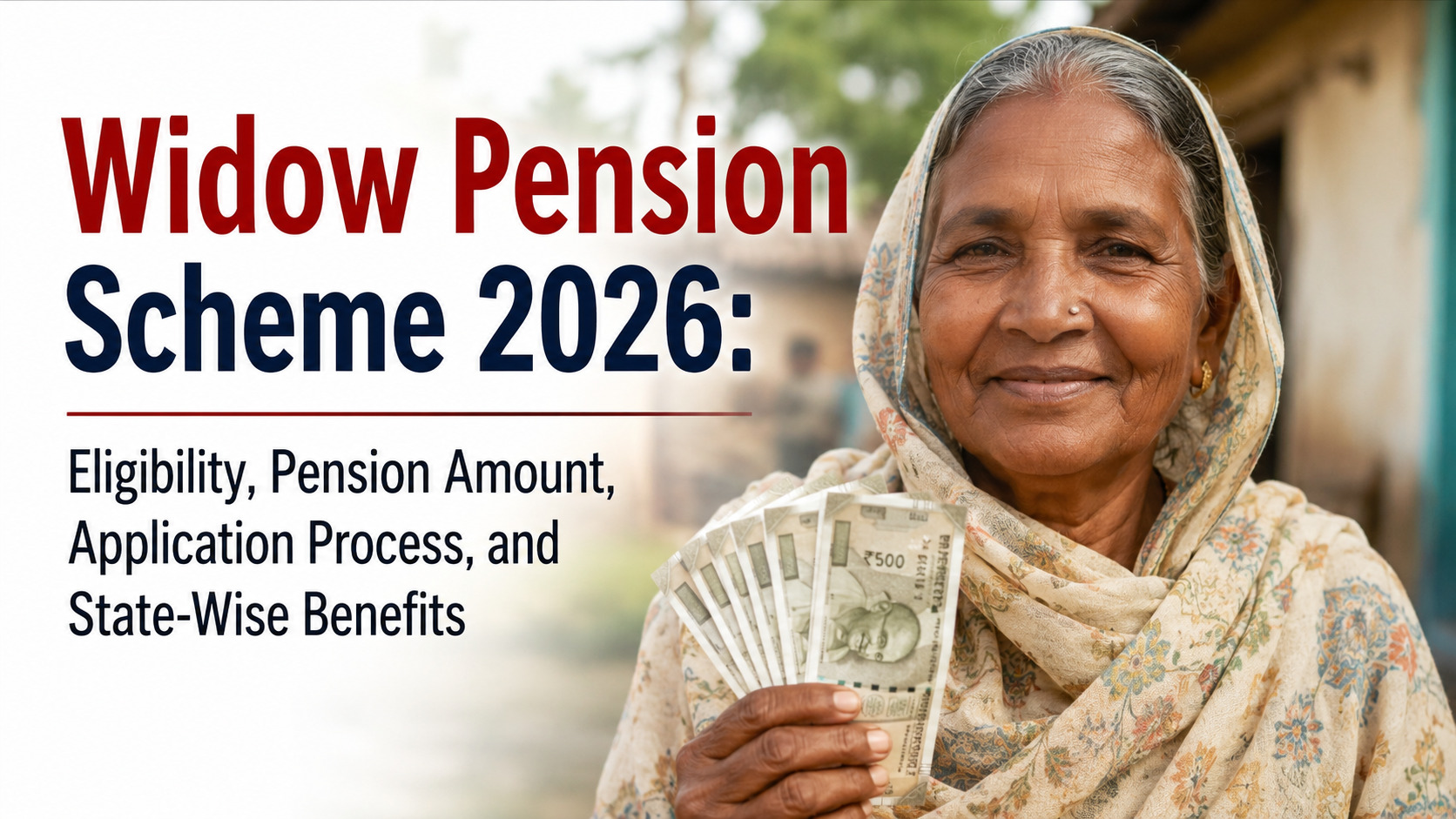
Widow Pension Scheme 2026 :The Widow Pension Scheme 2026 is one of the most important social welfare programs in India for women who have lost their husbands and do not have a stable source of income. The scheme provides monthly financial assistance to eligible widows so that they can manage basic household expenses and live with dignity.
Many women across India depend on widow pension support for food, healthcare, medicines, and other daily needs. Both the Central Government and State Governments operate widow pension schemes, and the amount of assistance varies from state to state.
Widow Pension Scheme 2026 Overview
| Feature | Details |
|---|---|
| Scheme Name | Widow Pension Scheme 2026 |
| Central Scheme | Indira Gandhi National Widow Pension Scheme (IGNWPS) |
| Beneficiaries | Eligible widowed women |
| Financial Assistance | Monthly pension amount (varies by state) |
| Age Criteria | Usually 40–79 years under IGNWPS |
| Income Requirement | Must belong to an economically weaker household |
| Application Mode | Online or offline through state authorities |
| Implemented By | Central Government and State Governments |
| Objective | Financial support and social security for widows |
What Is the Widow Pension Scheme 2026?
The Widow Pension Scheme 2026 is a government financial assistance program created to support women whose husbands have passed away and who have limited or no regular income. The purpose of the scheme is to provide social security, reduce financial hardship, and help widows meet their basic living expenses.
The pension is generally paid every month and is transferred directly into the beneficiary’s bank account through the Direct Benefit Transfer (DBT) system. This helps reduce delays and improves transparency. The scheme is especially helpful for women living in rural areas, economically weaker households, and those who do not receive support from other family members.
Central Scheme: Indira Gandhi National Widow Pension Scheme (IGNWPS)
The Indira Gandhi National Widow Pension Scheme (IGNWPS) is the central government component of widow pension support. It operates under the National Social Assistance Programme (NSAP) and is intended for widowed women belonging to poor households.
Under IGNWPS, eligible women generally receive a central pension contribution, while many state governments add an additional amount from their own budget. As a result, the final pension received by a widow depends on the state in which she lives. The central scheme is designed to provide a basic level of financial assistance, and states often enhance this support through their own widow pension programs.
Widow Pension Scheme Eligibility Criteria
The eligibility rules may differ slightly from one state to another, but most states follow similar conditions. A woman is generally eligible if she meets the following requirements.
Basic Eligibility
- She must be a widow.
- She should be a resident of the state where she is applying.
- She should belong to a low-income or economically weaker household.
- She must have a valid bank account linked with Aadhaar where required.
- She should not be receiving another pension that makes her ineligible under state rules.
Age Requirement
For the Indira Gandhi National Widow Pension Scheme (IGNWPS), the common age range is 40 to 79 years. However, some states provide widow pension benefits to women outside this range under separate state pension schemes.
Income Requirement
Many states require the applicant to belong to a household that falls below a specified income limit or is listed under eligible welfare categories. The exact income criteria vary from state to state.
Documents Commonly Required
Applicants are usually asked to submit:
- Aadhaar Card
- Residence certificate
- Husband’s death certificate
- Bank account details
- Passport-size photograph
- Income certificate (where applicable)
- Mobile number
- Ration card or other supporting identity documents
Providing accurate documents is important because incomplete applications may be delayed or rejected.
Widow Pension Scheme Pension Amount
The pension amount under the Widow Pension Scheme 2026 is not the same across India. The central government provides a base contribution under IGNWPS, and states may add their own financial support. In many states, widows receive between ₹300 and ₹2,000 or more per month, depending on state policy and budget allocations. The pension is generally credited monthly, although some states may release payments at fixed intervals such as every two or three months.
State-Level Variations: How Much Widows Actually Receive?
The most important point to understand is that widow pension benefits vary significantly by state. While the central contribution remains limited, states often increase the total pension amount substantially.
Uttar Pradesh
Uttar Pradesh operates a dedicated widow pension scheme under which eligible widows receive regular monthly financial assistance. The amount is generally higher than the central contribution alone because the state government provides additional support.
Maharashtra
Maharashtra also offers widow pension assistance through its social welfare programs. Eligible women receive monthly pension support subject to the state’s income and eligibility rules.
West Bengal
West Bengal provides financial assistance to eligible widows through state welfare initiatives aimed at improving social security for vulnerable women.
Gujarat
Gujarat offers widow pension benefits under state social assistance schemes. The amount may differ depending on local welfare policies and administrative guidelines.
Delhi and Uttarakhand
Delhi and Uttarakhand have their own widow pension programs, and eligible beneficiaries may receive higher pension amounts compared with the basic central contribution.
The Broader Pattern
Across India, the pattern is clear: the final pension received by a widow is usually a combination of the central contribution and the state government’s additional assistance. Therefore, applicants should always check the latest amount announced by their respective state government.
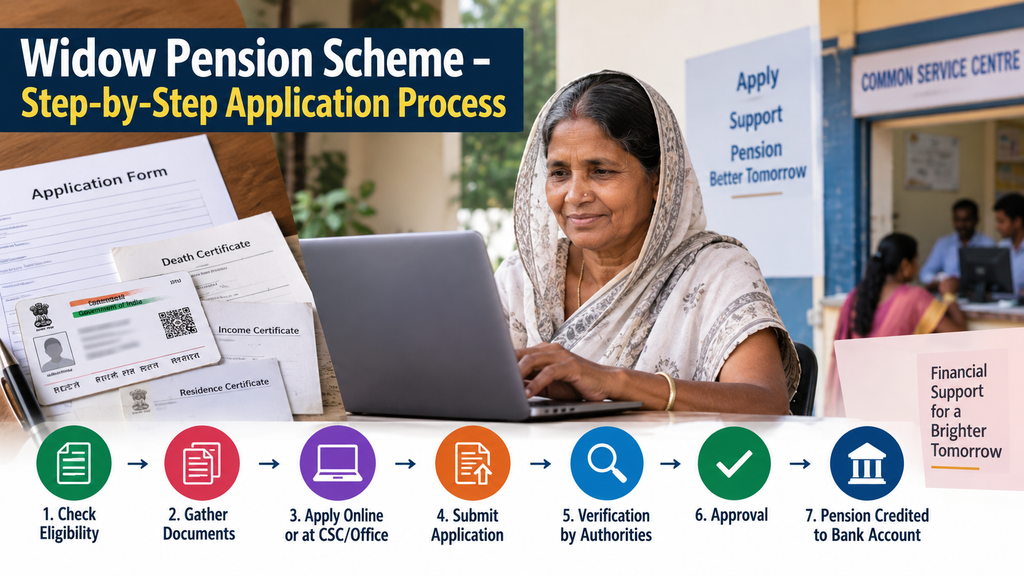
Widow Pension Scheme – Step-by-Step Application Process
Applying for the Widow Pension Scheme 2026 is usually a straightforward process. Most states now allow online applications, while offline applications remain available through local government offices.
Step 1: Check Eligibility
Before applying, verify that you meet the age, income, residence, and widow status requirements applicable in your state.
Step 2: Collect Required Documents
Keep all necessary documents ready, including the death certificate of your husband, Aadhaar card, bank account details, photograph, and income or residence certificates if required.
Step 3: Visit the Official Portal or Office
You can apply through:
- The official state social welfare or pension portal
- The district social welfare office
- The block office
- The municipal office
- A designated Common Service Centre (CSC)
Step 4: Fill Out the Application Form
Enter your personal details, address, Aadhaar number, bank account information, and other required information carefully.
Step 5: Upload or Submit Documents
Attach scanned copies online or submit photocopies of the required documents at the office.
Step 6: Verification
The concerned authorities verify the documents and eligibility. This may include verification by local officials.
Step 7: Approval and Pension Transfer
After approval, the widow pension is transferred directly to the beneficiary’s bank account through DBT (Direct Benefit Transfer).
Applicants can usually track their application status through the state pension portal.
Widow Pension Scheme
Although the application process may vary slightly across states, the overall procedure remains almost the same.
- Confirm eligibility according to state guidelines.
- Gather all required documents.
- Apply online through the official portal or visit the nearest social welfare office.
- Fill in the application form carefully.
- Submit supporting documents.
- Wait for document verification and approval.
- Receive pension directly in the bank account after approval.
Keeping copies of all submitted documents and the application acknowledgement receipt can help during future verification or status checks.
Also Read:
- Rani Durgavati Yojana Online Registration 2026: Online & Offline Process, PDF Download, Documents Required & Application Guide
- Samagra Portal MP: SSSM ID, Search by Name, Apply Online, Download and Update Details
Interaction With Other Schemes
One important question many applicants ask is whether a widow can receive benefits from other government schemes along with widow pension. In many cases, yes. Eligibility depends on the rules of the individual schemes. A widow receiving widow pension may still be eligible for benefits under programs such as:
- Public Distribution System (ration benefits)
- Ayushman Bharat (where eligible)
- State healthcare assistance schemes
- Housing schemes such as PMAY (subject to eligibility)
- Other welfare programs for women, senior citizens, or economically weaker families
However, some pension schemes may not allow a person to receive multiple social security pensions of the same category simultaneously. Applicants should check the rules applicable in their state.
Benefits of the Widow Pension Scheme
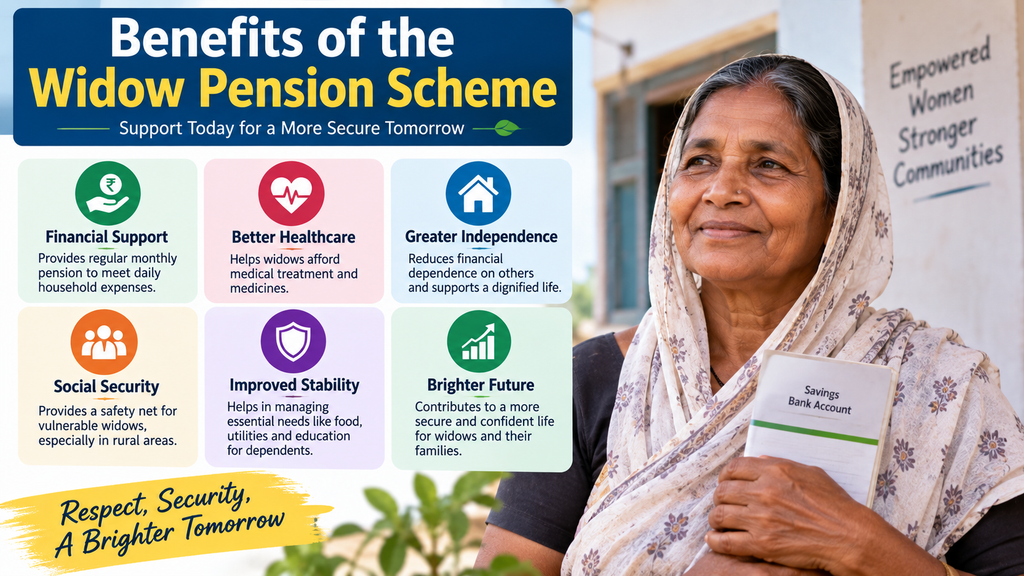
The scheme provides several important benefits beyond the monthly pension amount.
Financial Support
Regular pension helps widows manage essential expenses such as food, electricity bills, medicines, and household needs.
Social Security
Government recognition under the pension scheme provides a measure of social protection for vulnerable women.
Direct Bank Transfer
DBT reduces middlemen, improves transparency, and ensures that money reaches beneficiaries directly.
Support for Rural Women
The scheme is particularly valuable for widows living in villages where employment opportunities may be limited.
Improved Independence
A regular pension, even if modest, can help women become less dependent on relatives for daily expenses.
Common Reasons for Application Rejection
Applications may be rejected for several reasons, including:
- Incomplete documents
- Incorrect bank account details
- Mismatch in Aadhaar or identity information
- Income above the prescribed limit
- Failure to meet age criteria
- Duplicate pension records
- Residence-related verification issue
Frequently Asked Questions About Widow Pension Scheme 2026
1. What is the Widow Pension Scheme 2026?
The Widow Pension Scheme 2026 provides financial assistance to eligible widowed women who meet the income, age, residence, and other conditions prescribed by the government. Support may come through the central IGNWPS program and separate state-level pension schemes.
2. Who can apply for the Widow Pension Scheme?
Generally, a woman whose husband has passed away and who meets the applicable age, income, residence, and other eligibility conditions can apply. The exact rules depend on the state and the particular pension scheme.
3. What is the age limit for IGNWPS?
Under the Indira Gandhi National Widow Pension Scheme, the commonly applicable age range is 40 to 79 years. State-level widow pension schemes can have different age requirements, so applicants should check their state’s latest rules.
4. How much pension is given under the Widow Pension Scheme?
There is no single pension amount applicable to every widow across India. The amount depends on the scheme and state. State governments may provide additional assistance along with the central contribution.
5. Is widow pension paid every month?
Widow pension is generally intended as regular financial assistance, often paid monthly. However, the actual payment schedule can vary according to the state’s pension system and payment process.
6. Can I apply for widow pension online?
Yes, many states provide online application facilities through their official social welfare or pension portals. Where online application is not available or convenient, applicants may be able to apply through designated government offices or service centres.
7. Which documents are required for widow pension?
Commonly requested documents include Aadhaar or another identity document, the husband’s death certificate, bank account details, residence proof, photograph, and income-related documents where required. The exact document list can vary by state.
8. Is a bank account necessary for receiving widow pension?
A valid bank account is generally required because pension payments are commonly transferred directly to the beneficiary through the Direct Benefit Transfer system. Applicants should provide accurate account details during registration.
9. Can a widow receive other government scheme benefits?
In many cases, receiving widow pension does not automatically prevent a woman from receiving benefits from other welfare programs. However, each scheme has separate eligibility conditions, and some pension benefits may have restrictions on receiving another pension of the same category.
Widow Pension Scheme Conclusion
The Widow Pension Scheme 2026 is an important welfare initiative that provides financial assistance and social security to widowed women across India. Through the Indira Gandhi National Widow Pension Scheme (IGNWPS) and various state-level pension programs, eligible widows receive monthly support that helps them meet basic living expenses and maintain dignity and independence.
Although the pension amount differs from state to state, the scheme remains a valuable source of financial relief for economically vulnerable women. The application process has also become easier with online portals, Aadhaar-linked bank accounts, and direct benefit transfers.If you or a family member is eligible, it is worth checking the latest guidelines issued by your state government and submitting an application with the required documents. A small monthly pension can make a meaningful difference in ensuring financial stability and social protection during difficult times.

2 Comments