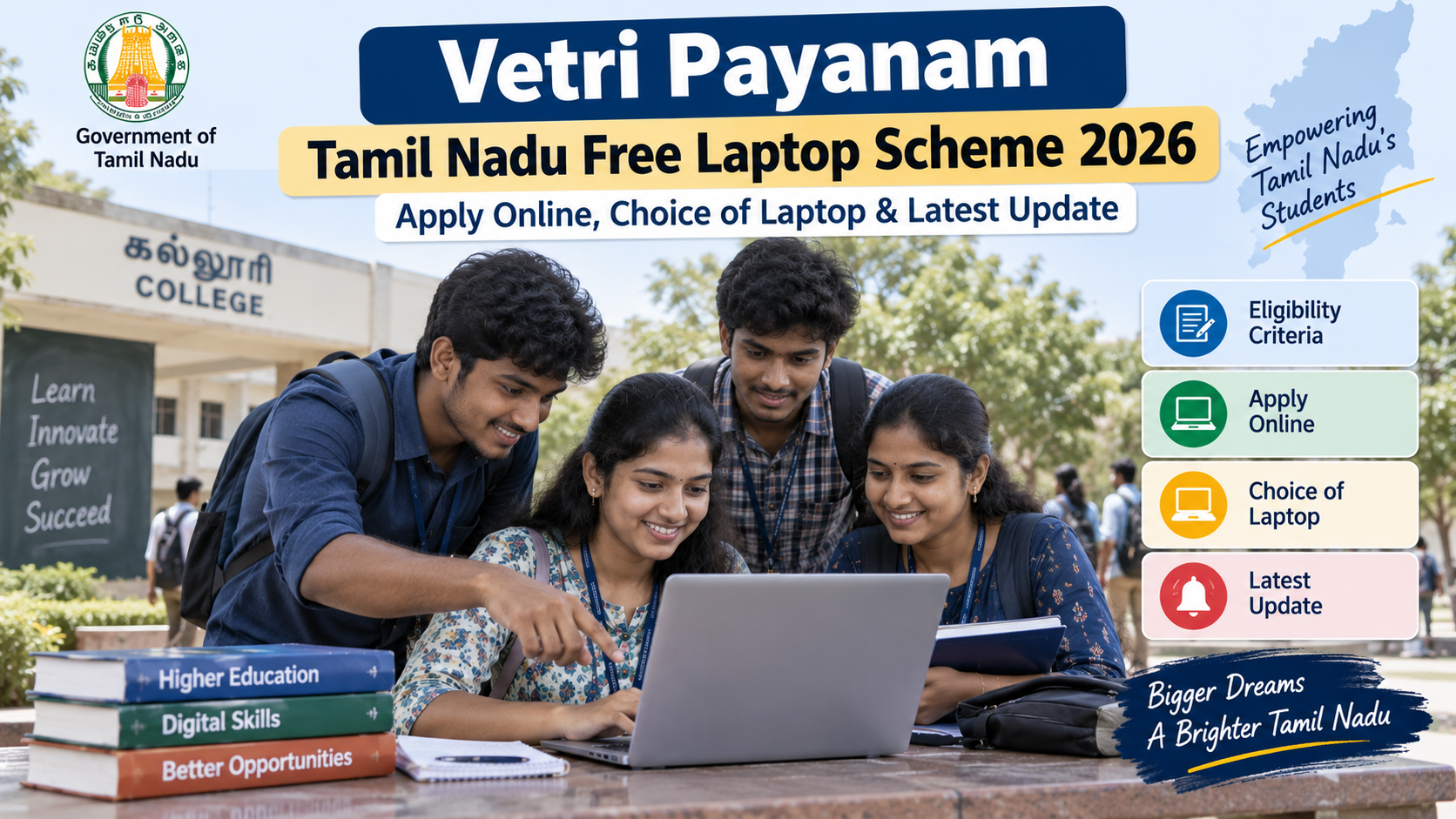
TheVetri Payanam Tamil Nadu Free Laptop Scheme 2026: The Tamil Nadu government’s free-laptop programme for college students has moved from an announcement into actual distribution, but its public identity has changed. The programme launched in January 2026 as “Ulagam Ungal Kaiyil” (World in Your Hands), with a first-phase target of distributing 10 lakh laptops to students pursuing higher education. In August, the 2026–27 revised budget presented the programme under the name Vetri Laptop Scheme, with a ₹2,000-crore allocation. These developments matter, but they do not establish that every student can now apply through a public online form or choose a laptop model.
For students searching for Vetri Payanam Tamil Nadu Free Laptop Scheme 2026, the central question is therefore not simply whether a free laptop scheme exists. It is whether the student is covered by the applicable distribution arrangements, whether their institution has been included, and whether the latest instructions have been issued. This guide explains what is confirmed, what remains to be verified, and how students should approach the process.
What is the Vetri Laptop Scheme?
The Vetri Laptop Scheme is the renamed or rebranded continuation of Tamil Nadu’s college-student laptop programme. It follows the earlier Ulagam Ungal Kaiyil initiative and is intended to support digital learning and skill development. The revised budget announced an allocation of ₹2,000 crore, while the earlier programme had a stated first-phase target of 10 lakh laptops.
The programme’s importance extends beyond the device itself. A laptop can help students access digital course material, complete assignments, attend online learning sessions, develop technical skills and use employment-oriented platforms. Tamil Nadu’s wider higher-education policy has also emphasised skill development through initiatives such as Naan Mudhalvan, which offers learning and upskilling opportunities across engineering, arts and science, polytechnic and ITI streams.
However, a device-distribution programme should not be confused with a universal cash benefit. The available official announcements describe laptops being distributed to students; they do not establish a general ₹25,000 payment or a cash alternative for every beneficiary.
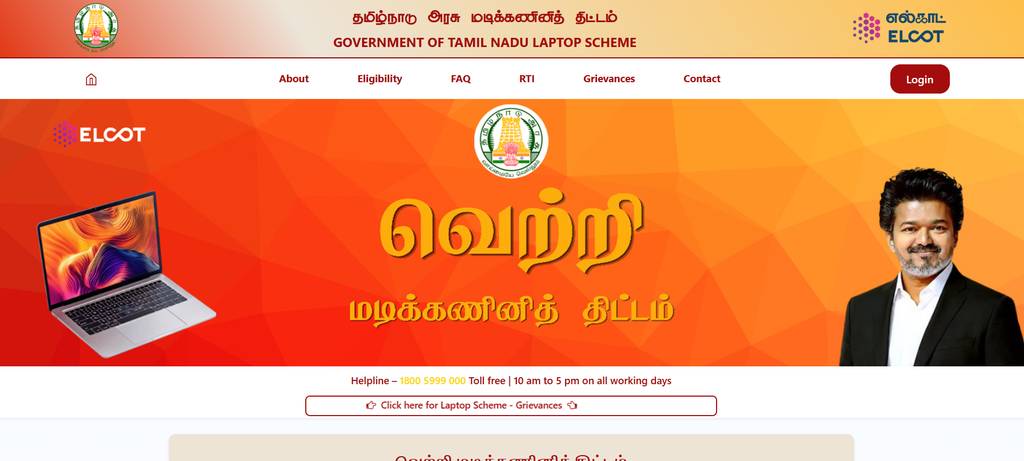
Latest update: What has actually happened?
The January 2026 launch was accompanied by real distribution activity. The Tiruvallur district administration reported that 821 students received laptops at a government function on January 5. A later district announcement recorded the distribution of laptops to 4,481 students from private colleges. Another January update reported that 1,464 students received laptops at Ulaganatha Narayanasamy Government College in Ponneri.
These reports establish that the programme is not merely a proposal. They also show that distribution has involved different institutions and student groups. Yet a distribution announcement does not automatically tell an individual student whether their college is included in the next phase.
The August 2026 revised budget is the most important recent policy development. It identified the programme as the Vetri Laptop Scheme and allocated ₹2,000 crore to it. The reported rebranding does not, by itself, provide a complete application calendar, a final list of eligible courses, or a public model-selection procedure. Those details should be checked against the latest official instructions.
Who is eligible for the free laptop?
The programme is aimed at college students, but eligibility should be confirmed through the institution and the applicable government notification. The January launch announcement describes the scheme as supporting students pursuing higher education. District-level distribution reports also refer to college students, including students in private colleges.
A useful distinction is between the intended beneficiary group and the confirmed beneficiary list. The former explains the purpose of the scheme; the latter determines whether a particular student is covered. Students should not assume that being enrolled in any college automatically guarantees a laptop.
Before relying on a claim, students should check:
- Whether their institution has received instructions about the programme.
- Whether their course and year of study are included in the applicable phase.
- Whether the college has verified their student details.
- Whether a distribution list, schedule or collection instruction has been issued.
- Whether the announcement comes from an official government or institutional source.
Is there an online application form?
A general, verified public application link should not be assumed merely because a website uses the scheme’s name. The official district announcements confirm distribution, but they do not provide a universal student-facing application portal in the material reviewed for this article.
For this reason, the safest practical route is to begin with the college office. Students should ask whether the institution has received a circular, whether details have been collected, and whether any application or verification is being handled through an authorised system.
This approach is not a substitute for an official online process if one is later announced. It is a way of avoiding a common mistake: treating an unofficial form, social-media post or promotional webpage as proof of government approval.
Students should also be cautious about pages that ask for payment, promise an immediate cash benefit, or claim that a laptop can be selected and delivered without institutional verification. Such claims require evidence from an official notification before they should be trusted.
Can students choose the laptop model?
There is no confirmed evidence in the sources reviewed here that students have a universal right to choose a laptop model. The programme’s official announcements focus on distribution, while the earlier Tamil Nadu laptop scheme documentation explains that specifications and procurement were handled through the government’s procurement process.
This distinction matters. A government-procured laptop programme generally involves common specifications, procurement decisions and institutional distribution. It is therefore different from a consumer purchase in which a student chooses among several brands and configurations.
Students should ask their college whether the latest instructions specify:
- The laptop’s technical specifications.
- The procurement or distribution authority.
- Whether a common model is being supplied.
- Whether any choice is permitted within an approved range.
- Whether accessories or warranty support are included.
- Tamil Nadu Free Tablet Computers Scheme 2026: What Students and Parents Should Know
- MP Laptop Yojana 2026: ₹25,000 Payment Status, Eligibility and Official Portal
What is the purpose of the scheme?
The programme’s stated purpose is to support higher education, digital advancement and skill development. The January launch announcement explicitly connects the laptop distribution with digital advancement for college students.
The broader policy context is significant. Tamil Nadu has invested in higher-education access and skill development through programmes such as Naan Mudhalvan. Its official portal lists skills and learning opportunities for students in engineering, arts and science, polytechnic, ITI and other streams. A laptop can complement such programmes by enabling students to practise skills, access online resources and build digital familiarity outside the classroom.
Yet the educational value of a device depends on more than distribution. Students also need reliable internet access, relevant course material, technical support and opportunities to use the equipment meaningfully. A laptop scheme can reduce one barrier to learning, but it cannot by itself resolve every digital-access problem.
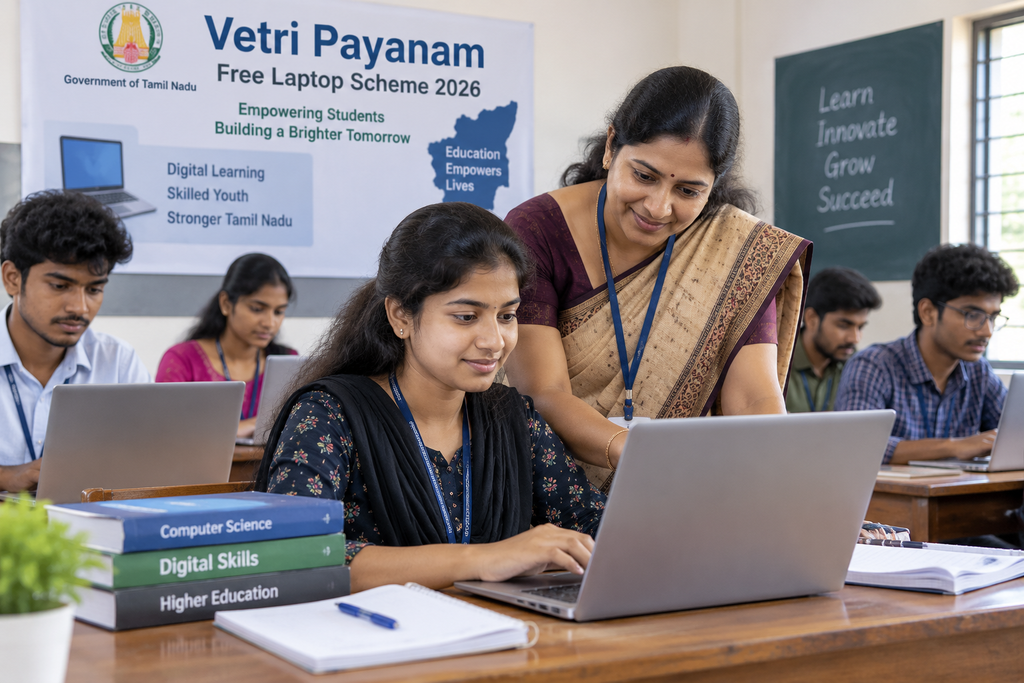
Competitive Advantage: What should students verify before believing an update?
The most useful way to evaluate a laptop-scheme announcement is to separate policy, eligibility, distribution and device specifications. These are related but distinct questions.
| Question | What should count as reliable evidence? |
|---|---|
| Does the scheme exist? | An official government announcement or budget document |
| Is it active in 2026? | A current official update or distribution report |
| Am I eligible? | Applicable rules and institutional verification |
| Can I apply online? | A verified official application process |
| Can I choose the laptop? | Written specifications or official selection instructions |
| When will I receive it? | A confirmed institutional or government distribution schedule |
This framework is especially useful because scheme-related searches often mix genuine announcements with incomplete information. The existence of a programme is not the same as proof of a student’s eligibility. Similarly, a budget allocation is not a distribution date, and a distribution report is not a universal application notice.
The evidence suggests that the programme is real and has entered the distribution stage. The unresolved questions are more specific: the applicable eligibility rules for each phase, the complete student-facing process, and the precise specifications or choice arrangements. Students should seek answers to those questions from their college or the relevant department rather than infer them from headlines.
How to check the latest official update
- Start with the college office. Ask whether the institution has received the latest instructions for the Vetri Laptop Scheme or its earlier programme name.
- Check the institution’s official communication. Look for a notice, circular, student list or distribution schedule.
- Verify the source. Prefer government domains and official institutional announcements over forwarded messages.
- Ask about the applicable phase. A student who has not yet received a laptop may still need to wait for the relevant distribution arrangement.
- Confirm the device details. Ask whether the specifications and any choice provisions have been formally communicated.
Students should retain their admission details and other records needed by the institution, but should not submit personal information to an unverified website simply because it claims to offer a free laptop.
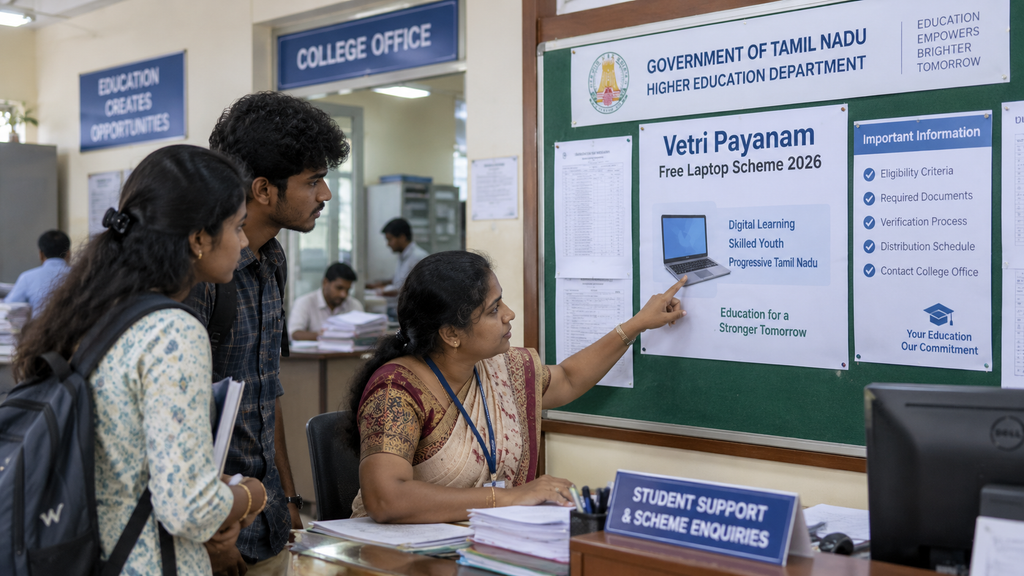
What does the scheme mean for Tamil Nadu’s digital education goals?
The programme reflects a broader policy question: how should public investment in education translate into actual learning outcomes? A laptop is a tangible intervention, but its effectiveness depends on whether students can use it for coursework, skills training and employment preparation.
Tamil Nadu’s existing digital-learning and skill-development ecosystem provides a useful context. Naan Mudhalvan’s official portal presents learning opportunities across several higher-education streams, while the laptop programme is intended to support students in their academic and digital work.
The programme’s long-term value will therefore be measured not only by the number of devices distributed, but also by whether students can use them effectively. That makes transparent eligibility rules, clear procurement specifications and accessible institutional support important parts of the scheme’s implementation.
FAQ Section
Is Vetri Payanam the official name of the Tamil Nadu free laptop scheme?
The programme was launched in January 2026 as “Ulagam Ungal Kaiyil” or “World in Your Hands”. The August 2026 revised budget referred to it as the Vetri Laptop Scheme. “Vetri Payanam” may be used in search queries, but students should rely on the latest official notification for the exact programme name and applicable instructions.
Is the Tamil Nadu free laptop scheme available to all college students?
The programme is intended for students pursuing higher education, but eligibility depends on the applicable rules and distribution arrangements. Official district reports confirm distribution to college students, including students in private colleges. Students should not assume that every college student is automatically covered without institutional confirmation.
How can I apply for the Vetri Laptop Scheme 2026?
The sources reviewed here confirm distribution but do not establish a universal public application portal. Students should first contact their college office and ask whether an official circular, verification process or application link has been issued for their institution. If a public portal is later announced, it should be verified through an official government source.
Can I choose a laptop brand or model?
There is no confirmed evidence in the reviewed sources that students have a universal right to choose a laptop model. The earlier Tamil Nadu scheme documentation describes government-led procurement and specification finalisation. Students should ask their institution for the latest written specifications before assuming that model choice is available.
Is the scheme a ₹25,000 cash payment?
The confirmed announcements describe the distribution of laptops, not a universal ₹25,000 cash payment. Students should distinguish a device-distribution programme from a direct financial-benefit scheme and should not treat an unverified cash-payment claim as an official entitlement.
Has laptop distribution already started?
Yes. The Tiruvallur district administration reported laptop distribution at the January 5, 2026 launch, and later announcements recorded distributions to students in different institutions. These reports confirm that the programme has moved into distribution, but they do not establish that every student has received a laptop or that all phases are complete.
What should I do if my college has not announced anything?
Ask the college office whether it has received instructions for the latest phase of the programme. Request the applicable eligibility information, student-verification process and distribution schedule. If the college has not received an official notice, students should avoid assuming that an unofficial application page or social-media claim represents the government’s current position.