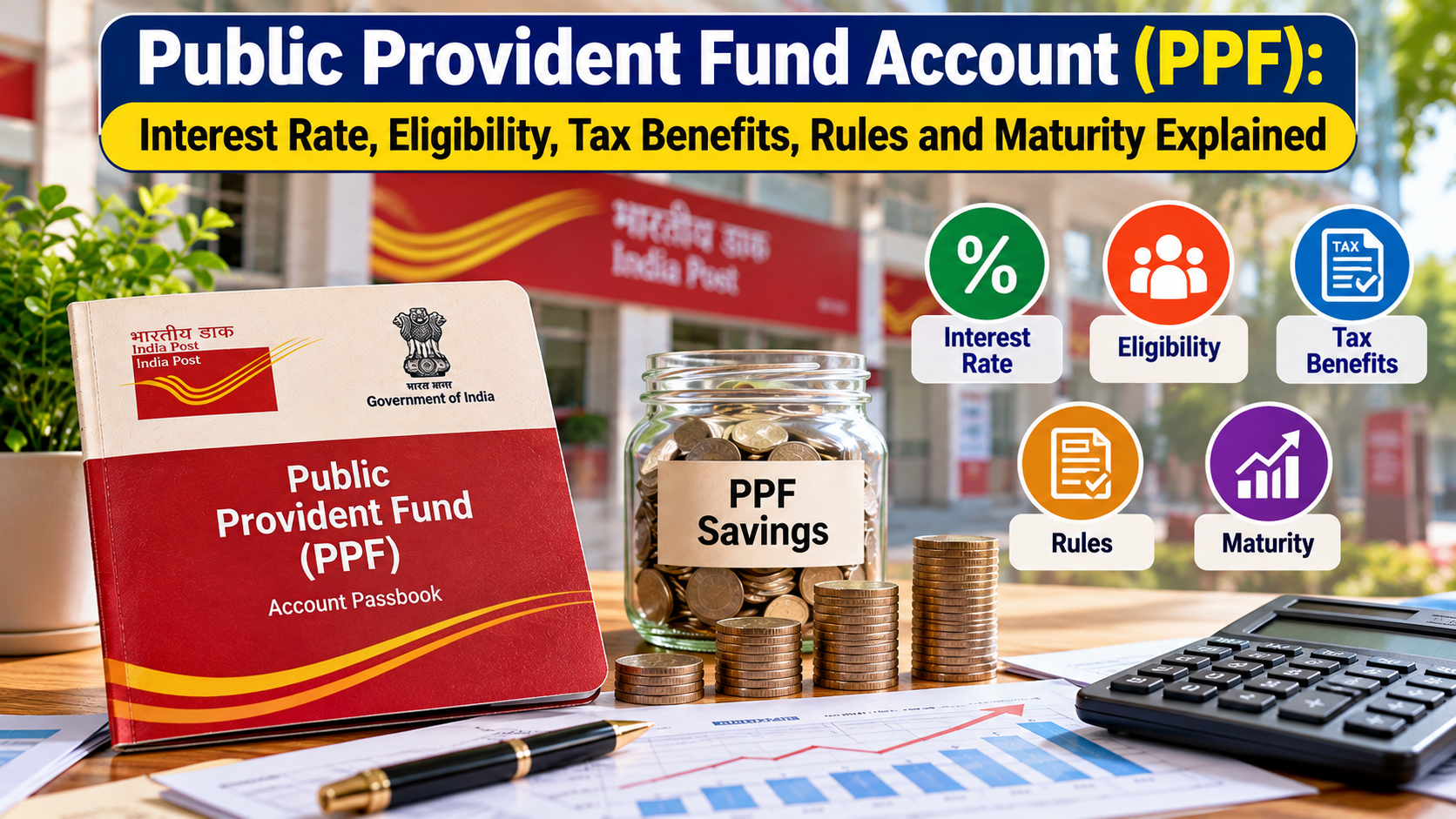
Public Provident Fund Account (PPF) : The Public Provident Fund Account (PPF) occupies a distinctive place in India’s small-savings system. It is designed for long-term saving rather than short-term liquidity, combining a government-notified interest rate with a structured maturity period and tax provisions. For a saver, however, the important question is not simply how much interest PPF offers. The more relevant issue is whether its long-term structure fits the purpose for which the money is being saved.
The Government of India continues to include PPF among the small-savings instruments for which interest rates are notified periodically. The Department of Economic Affairs published the revision for the third quarter of FY 2026-27 on September 30, 2026, making the current quarter particularly relevant for anyone reviewing the account in October 2026.
PPF is governed by the Public Provident Fund Scheme and forms part of the government’s small-savings framework. The Department of Economic Affairs lists the PPF Scheme among the rules governing small-savings instruments, while India Post also maintains the official PPF account rules.

What Is a Public Provident Fund Account?
A Public Provident Fund Account is a government-backed long-term savings account intended to encourage disciplined saving over an extended period. Unlike an ordinary savings account, it is not designed for frequent withdrawals or immediate access to money.
The structure is particularly relevant to people who can commit funds for many years. Contributions are made during the investment period, interest is credited according to the applicable government-notified rate, and the account normally reaches maturity after the prescribed tenure.The central attraction of PPF is therefore its combination of long-term compounding, defined rules and tax treatment rather than simply the headline interest rate.
PPF Interest Rate in 2026
The PPF interest rate is determined by the Government of India as part of the small-savings rate framework. Rates are reviewed periodically rather than being permanently fixed for the entire life of an account.The Department of Economic Affairs published the latest small-savings rate revision for Q3 of FY 2026-27 on September 30, 2026. The official notification should therefore be treated as the primary reference when publishing or updating the exact applicable PPF rate for the October–December 2026 quarter.
This distinction matters because an existing PPF account does not lock the investor permanently into the rate that applied when the account was opened. Future interest is governed by the rate applicable under the government’s prevailing small-savings framework.

How Does PPF Work?
PPF works through regular contributions and annual interest accumulation. The account has a long-term maturity structure, which makes consistency more important than attempting to time individual deposits.One of the practical features of PPF is that the investor can make deposits according to the scheme’s permitted rules rather than being required to invest a fixed amount every month. This gives some flexibility to people whose income varies during the year.
At the same time, the account has annual contribution conditions and a prescribed maximum investment limit. A saver should therefore plan contributions within the rules instead of treating PPF like an unrestricted bank account.The long investment horizon also means that compounding becomes an important part of the eventual maturity value. Small annual contributions made consistently for many years can produce a substantially larger corpus than the total amount deposited because interest itself contributes to future accumulation.
PPF Deposit Limit
The PPF framework places a minimum and maximum limit on annual subscriptions. The commonly relevant maximum subscription is ₹1.50 lakh in a financial year.The ₹1.50 lakh figure is particularly important from a tax-planning perspective because the tax deduction associated with eligible PPF contributions operates within the broader limit applicable to specified investments.
The Income Tax Department states that the aggregate deduction under Section 80C for eligible payments and investments is ₹1.50 lakh under the applicable tax framework referenced in its guidance.It is important not to interpret this as meaning that every taxpayer automatically receives a separate ₹1.50 lakh deduction solely for PPF. The applicable deduction is subject to the overall limit and the taxpayer’s chosen tax regime and circumstances.

PPF Tax Benefits
Tax treatment is one of the major reasons PPF continues to attract long-term savers.Under the tax provisions applicable to eligible taxpayers, contributions to qualifying provident-fund investments can fall within the specified deduction framework. The Income Tax Department’s current guidance identifies provident fund payments among the items covered under Section 80C and places them within the combined ₹1.50 lakh deduction limit.
However, tax planning around PPF should be handled carefully because the tax regime selected by a taxpayer can affect which deductions are available.This is particularly important in 2026 because taxpayers should not assume that an older explanation of Section 80C automatically describes their current tax position. The Income Tax Department’s updated guidance should be checked for the relevant assessment year and tax regime before making a tax decision.
The interest and maturity treatment of PPF is also an important consideration when comparing it with taxable fixed-income products. Rather than looking only at the nominal interest rate, investors should compare the amount that remains after applicable taxation.

PPF Maturity Period
PPF is fundamentally a long-term savings instrument. Its standard maturity period is 15 years, calculated according to the scheme’s rules.This is one of the biggest differences between PPF and short-duration bank deposits.
A 15-year horizon can make PPF useful for goals such as building a long-term financial reserve or creating a corpus for a future requirement. At the same time, it means that PPF may not be appropriate for money that a person expects to need in the immediate future.The maturity date should therefore be considered before opening an account. A person who requires frequent access to savings may find the restrictions inconvenient.
Can PPF Be Extended After Maturity?
PPF provides an option to continue the account beyond the initial maturity period under the conditions prescribed by the scheme.This is significant for long-term investors because maturity does not necessarily mean that the relationship with the account must end immediately. Subject to the applicable rules, an account holder can continue the investment structure for additional periods.
The decision to extend should nevertheless be based on financial objectives rather than habit. A person should review liquidity requirements, other investments, tax circumstances and future financial goals before choosing whether to continue.
PPF Withdrawal Rules
PPF is not designed as an unrestricted savings account. Withdrawals are governed by specific rules and become possible subject to the applicable conditions and timing.This restriction serves an important purpose: it protects the long-term character of the account and reduces the temptation to repeatedly use retirement or long-term savings for routine expenses.
At the same time, the scheme does provide mechanisms for accessing funds under prescribed circumstances. Readers should consult the current PPF rules before making a withdrawal request because eligibility and calculation depend on the account’s age and the specific transaction involved.The Department of Economic Affairs separately maintains material concerning premature closure of PPF accounts, demonstrating that premature access is subject to defined conditions rather than being an ordinary withdrawal facility.
Who Can Open a PPF Account?
PPF is intended for individual savers under the applicable scheme rules. Accounts can also be maintained in circumstances involving minors, with the account being operated according to the rules applicable to a guardian and minor.
The exact eligibility conditions, account-opening requirements and documentation should be checked with the authorised bank or post office at the time of opening because operational requirements can change.PPF should not be treated as an investment product available without conditions to every type of entity. Its rules specify who may hold and operate an account.
Where Can You Open a PPF Account?
A PPF account can be opened through authorised banking channels and post-office savings facilities that offer the scheme.The important point is that the account is governed by the central PPF framework, so the underlying scheme rules are not different simply because the account is opened through one authorised channel rather than another.
PPF and the Power of Compounding
The real strength of a long-duration account such as PPF becomes clearer when compounding is considered.Suppose a person contributes consistently every year instead of making occasional deposits. Each year’s contribution has the opportunity to earn interest, while earlier accumulated interest remains part of the growing balance under the scheme’s rules.
This produces a compounding effect over time.The important lesson is that the maturity corpus should not be judged by adding up annual deposits alone. The final value reflects both the money contributed and the interest accumulated over the investment period.
Actual maturity calculations, however, depend on contribution timing and the interest rates applicable during the relevant years. A calculation based on today’s rate should therefore be treated as an illustration, not a guaranteed 15-year return.
What Makes PPF Different From a Bank Fixed Deposit?
PPF and fixed deposits can both be used for conservative savings, but their structures are different.A bank fixed deposit generally has a specified tenure and an interest rate determined by the bank for that deposit. PPF, by contrast, operates under a government small-savings framework with periodically notified rates.
Liquidity is another major difference. Fixed deposits can have premature-withdrawal provisions depending on the bank and product, whereas PPF withdrawals are governed by the specific PPF rules.Tax treatment can also differ significantly. Therefore, comparing only the advertised interest rate can produce an incomplete picture.A meaningful comparison should consider tenure, liquidity, tax treatment, contribution flexibility, risk, and the purpose for which the money is being saved.
Advantages and Limitations of PPF
PPF’s principal strength is its long-term structure. It encourages disciplined saving while providing a government-backed framework and access to a tax deduction mechanism where the taxpayer and tax regime make that deduction applicable.Its long maturity can also be an advantage for people who want to separate long-term savings from their everyday bank balance.
But the same feature creates a limitation. Money placed into PPF is not intended for frequent access. Investors who may need their savings within a short period should therefore avoid assuming that PPF offers the same liquidity as a savings account.Another consideration is interest-rate uncertainty over a very long period. The government periodically determines small-savings rates, so today’s rate should not automatically be projected unchanged for the next 15 years.
Competitive Advantage: The Question Most PPF Articles Miss
The most important question about PPF is not “What is the interest rate?” It is “What job is this money supposed to perform?”
If the purpose is long-term wealth accumulation with limited need for liquidity, PPF’s structure can make sense.
If the purpose is to maintain an emergency fund, the long-term restrictions make it a poor substitute for readily accessible savings.
Similarly, if a taxpayer is considering PPF primarily for a tax deduction, the overall tax regime and the combined deduction limit need to be examined before assuming that a contribution will create an additional tax saving.
In other words, PPF should be viewed as a component of a broader financial plan rather than as a product that automatically becomes suitable simply because its interest rate is attractive.
Also Read:
- Salt Distribution Scheme 2026: What Jharkhand Ration Card Holders Need to Know
- Janani Suraksha Yojana 2026: Eligibility, Benefits, Amount, Registration & Payment Details
What the Evidence Suggests
Official government sources establish PPF as part of India’s small-savings framework, with its rules administered under the relevant government savings regulations. The Department of Economic Affairs continues to publish periodic interest-rate revisions, while the Income Tax Department provides current guidance on the applicable deduction framework.
The evidence therefore supports a more measured understanding of PPF: it is a structured, long-term savings instrument whose usefulness depends on tenure, liquidity requirements, contribution discipline and tax circumstances.
Final Thought
The Public Provident Fund Account remains important not because it promises a permanently fixed return, but because it combines long-term discipline with a government-regulated savings structure. Its 15-year horizon, contribution rules, withdrawal restrictions and tax treatment make it fundamentally different from an ordinary bank savings account or short-term deposit.
The most sensible way to evaluate PPF is therefore to start with the financial goal and work backwards. A saver should check the latest government-notified interest rate, understand the applicable tax regime, consider how much liquidity may be required and then determine whether the long-term structure fits.
Frequently Asked Questions
What is a Public Provident Fund Account?
A Public Provident Fund Account is a long-term government-backed savings account governed by the PPF scheme. It is designed for disciplined savings over an extended period rather than frequent withdrawals.
What is the PPF interest rate in 2026?
The PPF interest rate is notified by the Government of India as part of the small-savings interest-rate framework. The Department of Economic Affairs publishes periodic revisions. For the October–December 2026 quarter, the relevant notification was issued on September 30, 2026.
What is the maximum PPF investment in one year?
The PPF scheme permits annual subscriptions subject to its prescribed limits, with the commonly applicable maximum being ₹1.50 lakh in a financial year.
Is PPF tax-free?
PPF has significant tax advantages, but taxpayers should distinguish between the treatment of contributions, interest and maturity proceeds and the availability of deductions under the applicable tax regime.
Can money be withdrawn from PPF before maturity?
Yes. The PPF framework provides for continuation beyond the initial maturity period subject to its rules.
Can a PPF account be extended after maturity?
Yes. The PPF framework provides for continuation beyond the initial maturity period subject to its rules. An account holder should consider future financial requirements, liquidity needs and the prevailing tax and interest-rate environment before deciding whether to continue the account.