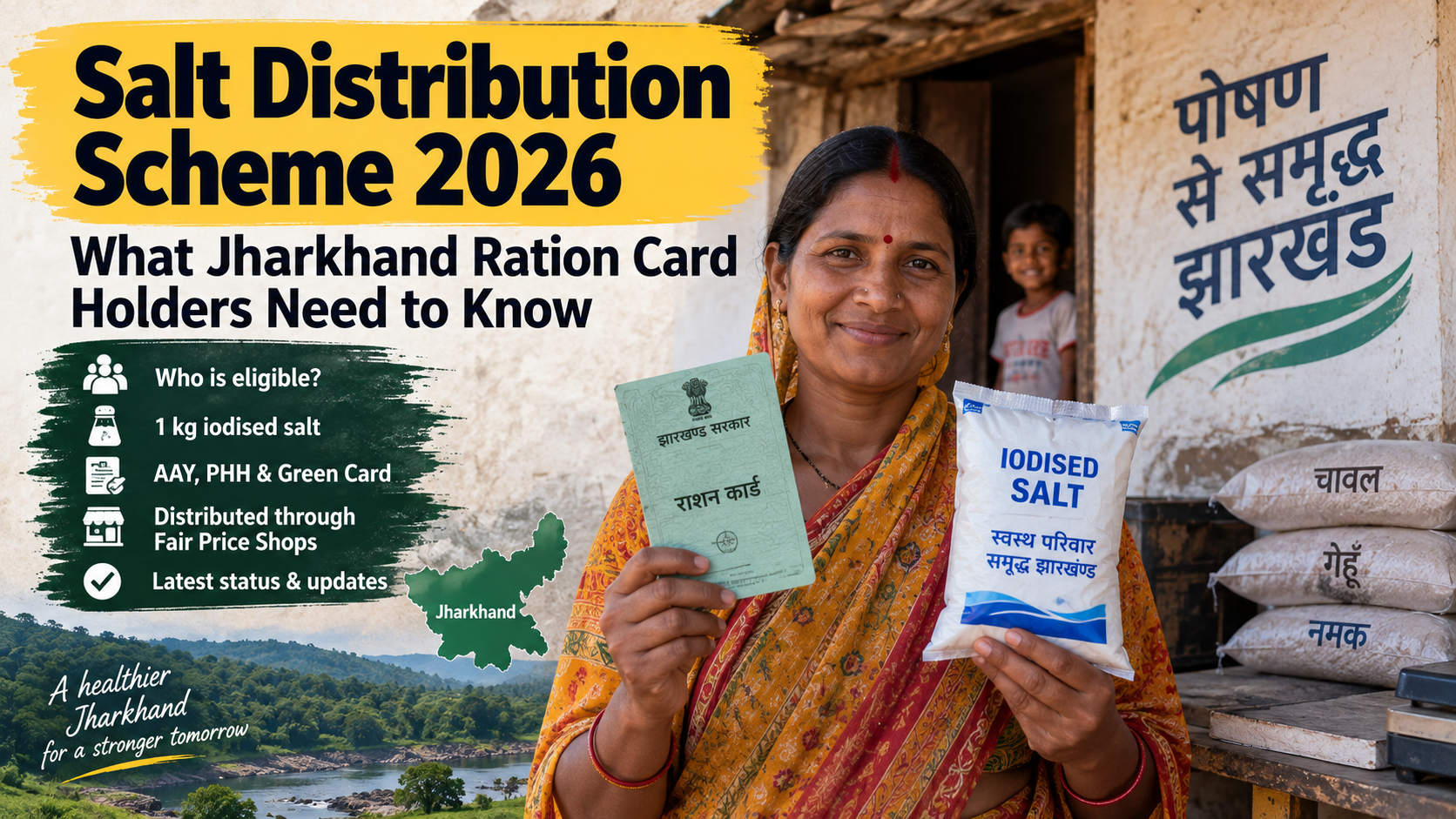
Salt Distribution Scheme 2026: the Salt Distribution Scheme 2026 is part of Jharkhand’s wider food-security system, where the state supplements the regular Public Distribution System with selected essential commodities. For eligible households, the scheme provides iodised salt through the ration-distribution network rather than requiring a separate commercial purchase.
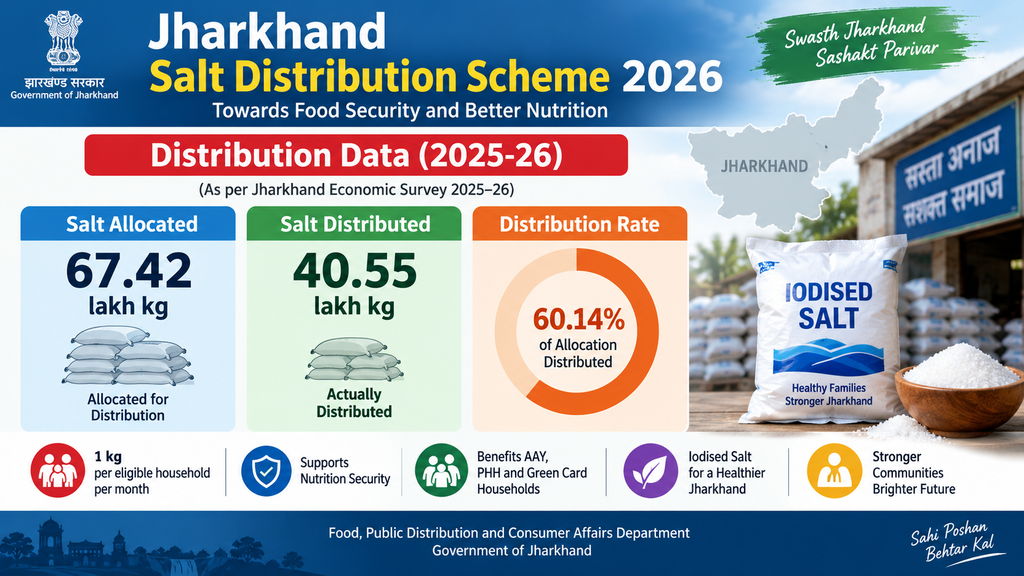
The latest Jharkhand Economic Survey 2025–26 describes the Mukhyamantri Salt Distribution Scheme as providing 1 kg of free iodised salt per month to eligible households. The same survey records an allocation of 67.42 lakh kg and distribution of 40.55 lakh kg during the reported period, representing an offtake of about 60.14%.
The scheme therefore needs to be understood as more than a simple free-food announcement. Its significance lies in how an inexpensive but nutritionally important commodity is incorporated into the state’s ration architecture.
What Is the Salt Distribution Scheme in Jharkhand?
The Salt Distribution Scheme is a Jharkhand government food-security programme administered through the state’s Food, Public Distribution and Consumer Affairs Department. Its purpose is to make iodised salt available to eligible ration-card households through the public distribution system.
A government notification issued in 2023 formally described the scheme as providing salt to eligible beneficiaries covered under the National Food Security Act (NFSA), 2013, and the Jharkhand State Food Security Scheme (JSFSS). At that time, the notified benefit was described as salt at a subsidised price of ₹1 per kg for eligible AAY, PHH and Green Card beneficiaries.
However, the latest Jharkhand Economic Survey 2025–26 describes the current supplementary entitlement as 1 kg of free iodised salt per month. This distinction is important for anyone searching older articles or scheme summaries, because older descriptions may continue to mention the ₹1 rate.In practical terms, the scheme is connected to the ration-card system and is not simply an open application programme available to every resident of Jharkhand.
How Much Salt Is Provided in 2026?
The latest available state economic-survey information indicates an entitlement of 1 kg of free iodised salt per eligible household per month under the Mukhyamantri Salt Distribution Scheme.
The Jharkhand Economic Survey 2025–26 provides a useful measure of the scheme’s actual operation. It records:
| Particular | Latest reported figure |
|---|---|
| Eligible households receiving entitlement | 24,812 |
| Salt allocated | 67.42 lakh kg |
| Salt distributed | 40.55 lakh kg |
| Distribution/offtake | 60.14% |
| Monthly entitlement | 1 kg iodised salt |
These figures also reveal an important policy issue. Allocation and actual distribution are not the same thing. A government may make stock available for distribution, but beneficiaries must ultimately receive the commodity through the ration network.
Who Is Eligible for the Salt Distribution Scheme?
The scheme is linked to specific categories of ration-card beneficiaries rather than being universally available to every Jharkhand resident.
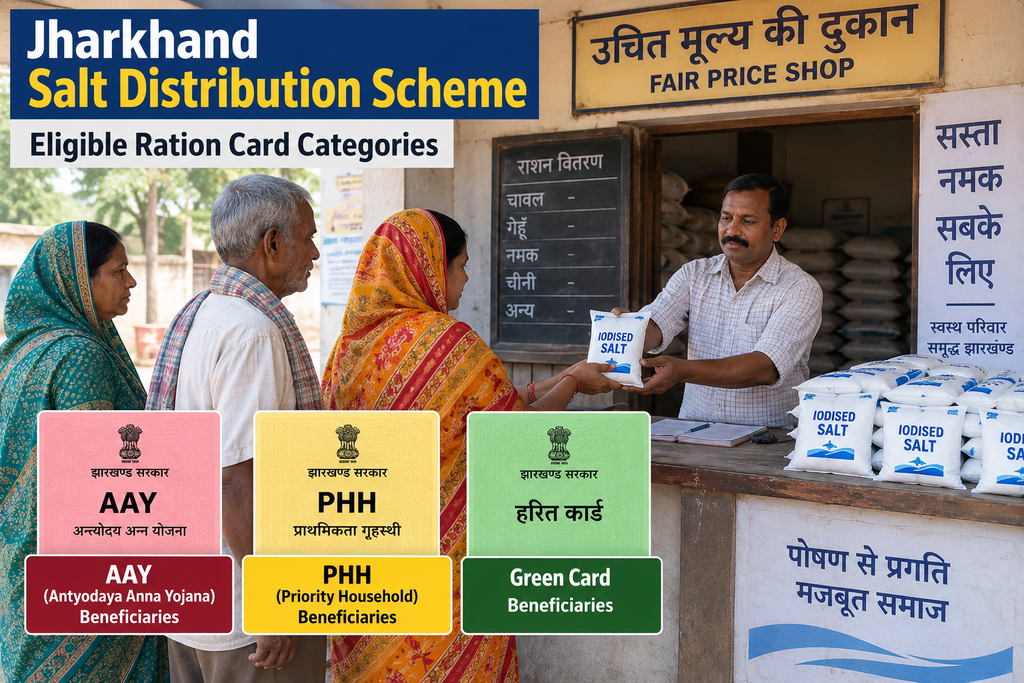
The principal categories identified in the government’s scheme notification are:
- Antyodaya Anna Yojana (AAY) cardholders
- Priority Household (PHH) cardholders under NFSA
- Green Cardholders under the Jharkhand State Food Security Scheme (JSFSS)
The 2023 government notification explicitly identifies AAY and PHH beneficiaries under NFSA and Green Card beneficiaries under JSFSS as beneficiaries of the Salt Distribution Scheme.
This means that simply living in Jharkhand does not, by itself, establish eligibility. The household’s ration-card category and active status within the relevant food-security system are important.
AAY Cardholders
AAY, or Antyodaya Anna Yojana, is intended for the most economically vulnerable households covered under the targeted food-security framework.
If an AAY household is active in the applicable state PDS system, it falls within the beneficiary category identified for the salt scheme.
PHH Cardholders
PHH means Priority Household under the National Food Security Act. These households receive food-grain entitlements under the NFSA framework and are also identified for the salt benefit under Jharkhand’s scheme.
Green Cardholders
Jharkhand’s Green Card is associated with the state’s own food-security programme, the Jharkhand State Food Security Scheme. The government’s notification includes Green Card beneficiaries among those covered by the salt scheme.
Is the Salt Free or Available at ₹1 Per Kg?
This is one of the most important points to clarify because different online pages may show different prices.
The government’s 2023 notification described the scheme as providing salt at a subsidised rate of ₹1 per kg.
The more recent Jharkhand Economic Survey 2025–26, however, describes the Mukhyamantri Salt Distribution Scheme as providing 1 kg free iodised salt per month.
Therefore, readers checking the 2026 position should give greater weight to the latest state government reporting rather than assuming that an older ₹1/kg figure remains unchanged.
Where there is a discrepancy between an old scheme notification and a current distribution practice, beneficiaries should verify the entitlement shown against their ration card and the latest instructions issued through the Food, Public Distribution and Consumer Affairs Department.
Key Highlights
| Detail | Information |
|---|---|
| Scheme Name | Salt Distribution Scheme |
| State | Jharkhand |
| Main Department | Department of Food, Public Distribution and Consumer Affairs |
| Implementing Authority | Directorate of Food and Consumer Affairs, Ranchi |
| Benefit | Salt at ₹1 per kilogram* |
| Eligible Beneficiaries | AAY, PHH and Green Card holders |
| Distribution Mode | Through Fair Price Shops under the PDS |
| Application Mode | No separate application for eligible ration-card beneficiaries |
| Official Website | Jharkhand Government portal |
How Is Salt Distributed?
The Salt Distribution Scheme works through the established Public Distribution System (PDS) rather than creating a completely separate delivery network.Jharkhand’s district supply offices list the Salt Distribution Scheme alongside other commodities and programmes administered through the food-supply system. The Ramgarh district administration, for example, lists Salt Distribution Scheme among its public food-distribution programmes.
This arrangement has a practical advantage: households that already use the ration system do not necessarily have to navigate an entirely separate welfare programme.The broader distribution chain involves government allocation, movement to the appropriate supply network, stocking and delivery through Fair Price Shops, and authentication or transaction recording at the point of distribution.
Is Aadhaar Required?
Aadhaar authentication has been incorporated into the delivery framework for the scheme.
The Jharkhand government’s 2023 notification states that an individual eligible for the benefit is required to furnish proof of possession of an Aadhaar number or undergo Aadhaar authentication. It also contains provisions for people who had not yet obtained Aadhaar, including enrolment-related procedures.This should not be interpreted as meaning that an Aadhaar number replaces the ration card. The ration-card category establishes the household’s eligibility within the relevant food-security programme, while Aadhaar-based authentication is part of the beneficiary-identification and delivery mechanism.
Beneficiaries should therefore ensure that their ration-card and Aadhaar details are correctly linked or authenticated wherever required by the current PDS system.Is There a Separate Online Application for Salt?Generally, the key issue is existing eligibility under the ration system, rather than submitting a fresh application simply to obtain the monthly salt entitlement.
The government’s framework identifies the benefit with eligible AAY, PHH and Green Card households. District-level food-supply information also directs citizens to the relevant ration-card and PDS systems for food-distribution services.This is an important distinction because many scheme searches online create the impression that every government benefit requires a new online form.
For the Salt Distribution Scheme, an eligible household should first check:
- Whether its ration card is active.
- Which category the card belongs to.
- Whether the household appears in the relevant PDS beneficiary database.
- Whether Aadhaar or required authentication has been completed.
- Whether the monthly commodity has been allocated to the household’s Fair Price Shop.
What Does the 2025–26 Distribution Data Tell Us?
The most revealing aspect of the latest data is not simply the 1 kg entitlement but the gap between allocation and actual distribution.
According to the Jharkhand Economic Survey 2025–26, 67.42 lakh kg of salt was allocated against which 40.55 lakh kg was distributed, producing an offtake rate of 60.14%.In other words, roughly four-tenths of the reported allocation had not translated into recorded distribution during the period covered by the data.
That does not automatically prove that beneficiaries were denied their entitlement. There can be several operational reasons for a gap between allocation and offtake, including beneficiary participation, timing of transactions, stock movement, shop-level operations and reporting cycles.
Why Does Iodised Salt Matter?
Salt is inexpensive compared with many other food items, but iodisation gives it a wider public-health significance.Iodine is required for normal thyroid function, and inadequate iodine intake can contribute to iodine-deficiency disorders. A public distribution mechanism can therefore serve two purposes simultaneously: reducing the household cost of an essential food item and making iodised salt more consistently available.Jharkhand’s wider nutrition challenge reinforces the relevance of this approach. The 2025–26 Economic Survey reports child stunting, underweight and wasting levels above the corresponding national averages cited in the survey, while anaemia among children aged 6–59 months is also identified as a major concern.
Salt alone cannot solve these problems. Nutrition security depends on dietary diversity, adequate protein, micronutrients, healthcare, sanitation and maternal and child nutrition services.The sensible interpretation is therefore that salt distribution is one supporting intervention within a larger nutrition and food-security system.
Salt Distribution Scheme vs Regular PDS Foodgrains
The Salt Distribution Scheme should not be confused with the basic food-grain entitlement under the NFSA.Foodgrains such as rice and wheat are governed by the national food-security framework and related state arrangements. Salt is an additional commodity provided through Jharkhand’s state-level distribution architecture.
This distinction matters because eligibility for one commodity does not necessarily mean that every household receives every commodity under identical rules.Jharkhand has used its PDS infrastructure to provide additional commodities beyond the central food-grain framework. Research on India’s PDS has also identified iodised salt distribution among the state-specific additions that supplement the national food-security structure.
What Should a Beneficiary Do If Salt Is Not Received?
If an eligible household does not receive the expected monthly salt entitlement, it should avoid assuming immediately that the scheme has been cancelled.
A practical verification sequence is:
First :check the ration card category and active status.
Second : confirm whether the household’s Aadhaar authentication or other required beneficiary authentication is complete.
Third : ask the Fair Price Shop dealer whether salt has been allocated and whether the current month’s transaction has been recorded.
Fourth : check the relevant state PDS or district food-supply information.
Finally : if the entitlement is still unavailable despite confirmed eligibility, approach the appropriate food-supply authority or grievance channel.
Also read :
- PM YASASVI Scholarship 2026: Apply Online, Eligibility, Last Date, Scholarship Amount & Status Check
- Lado Lakshmi Yojana Payment 2026: 11th Installment, ₹2,100 Payment, Eligibility and Latest Update
What the Evidence Suggests About the Scheme in 2026
The available evidence supports three conclusions.
First, the Salt Distribution Scheme remains part of Jharkhand’s food-security architecture in 2026. The state Economic Survey continues to identify the Mukhyamantri Salt Distribution Scheme as a supplementary nutrition-support programme.
Second, the latest state reporting describes the benefit as 1 kg of free iodised salt per month, although older official material described a ₹1/kg subsidised rate.
Third, distribution performance remains an important issue. The reported 60.14% offtake indicates that policy effectiveness cannot be judged only by the entitlement announced on paper. Last-mile delivery determines whether the intended household actually receives the commodity.
FAQ Section
Is the Salt Distribution Scheme available in Jharkhand in 2026?
Yes. The Jharkhand Economic Survey 2025–26 continues to list the Mukhyamantri Salt Distribution Scheme as a supplementary food and nutrition programme. The survey describes an entitlement of 1 kg of free iodised salt per month for eligible households.
Who gets salt under the Jharkhand Salt Distribution Scheme?
The scheme covers eligible AAY and PHH ration-card holders under NFSA and Green Cardholders under the Jharkhand State Food Security Scheme. Eligibility depends on the household’s status in the applicable food-security and PDS database.
How much salt is provided every month?
The latest Jharkhand Economic Survey 2025–26 describes the benefit as 1 kg of free iodised salt per month under the Mukhyamantri Salt Distribution Scheme. Older government documentation described the scheme as providing salt at ₹1 per kg, so current beneficiaries should rely on the latest official distribution instructions.
Is the salt free or ₹1 per kg in 2026?
The latest Economic Survey describes the entitlement as free iodised salt, while a 2023 government notification described the scheme at a subsidised rate of ₹1 per kg. Because the policy description has changed over time, readers should verify the current entitlement recorded by the Jharkhand PDS rather than relying on an older article.
Do I need to apply separately for the Salt Distribution Scheme?
The scheme is tied to eligible ration-card categories, so it should not be treated like a conventional cash-benefit application. A beneficiary should first have an eligible AAY, PHH or Green Card and meet the applicable PDS authentication requirements.
Is Aadhaar authentication required for the scheme?
The Jharkhand government’s notification provides for Aadhaar-based identification or authentication for eligible beneficiaries. It also includes provisions for people who had not yet obtained Aadhaar. Beneficiaries should follow the latest authentication procedure prescribed by the state PDS.
Where can eligible beneficiaries collect the salt?
The Salt Distribution Scheme operates through Jharkhand’s public distribution network, including Fair Price Shops. District administration information lists the Salt Distribution Scheme among the state’s food-supply programmes.
What if I am eligible but do not receive the monthly salt?
First verify that the ration card is active and that the household’s authentication details are correct. Then ask the Fair Price Shop whether the month’s salt allocation has arrived and whether the transaction has been recorded. If the problem remains, the beneficiary should approach the relevant food-supply or PDS grievance authority rather than assuming that the scheme has ended.
Conclusion
The Salt Distribution Scheme 2026 illustrates a broader principle in welfare policy: a small household entitlement can have significance when it is delivered consistently through an established public system.For eligible Jharkhand ration-card households, the latest government survey points to 1 kg of free iodised salt per month. But the more consequential question is not merely whether the entitlement exists. It is whether the supply chain, authentication process and Fair Price Shop network convert that entitlement into a reliable monthly benefit.
For beneficiaries, the safest approach is therefore to rely on the latest official PDS information, keep ration-card details current and verify the actual monthly transaction rather than relying on outdated scheme descriptions circulating online.