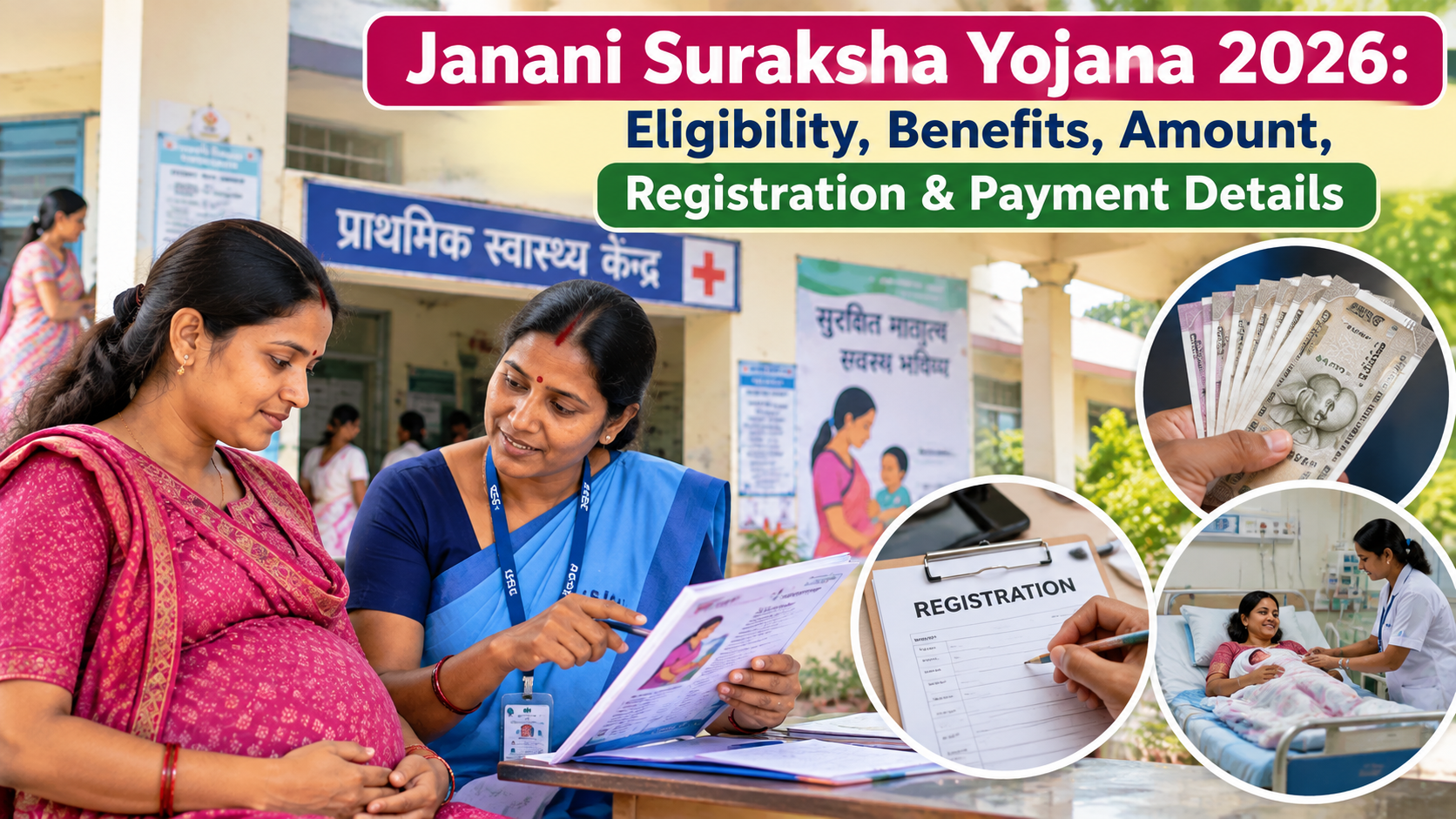
Janani Suraksha Yojana 2026: janani Suraksha Yojana (JSY) is a centrally sponsored safe-motherhood scheme under the National Health Mission (NHM). It was launched on 12 April 2005 with the objective of reducing maternal and neonatal mortality by encouraging institutional deliveries among poor pregnant women. The scheme combines financial support with access to institutional delivery and related maternal healthcare services and uses ASHA workers as an important link between pregnant women and the public health system.
The important point for applicants is that JSY is not simply a universal cash-payment programme for every pregnant woman. Eligibility and the amount of assistance depend on factors such as the state’s JSY classification, the place of delivery and, in specified cases, categories such as BPL, Scheduled Caste and Scheduled Tribe.
JSY is implemented across India, with particular emphasis on states identified under the scheme as Low Performing States (LPS) because of historically lower institutional-delivery rates. The official NHM page lists Uttar Pradesh, Uttarakhand, Bihar, Jharkhand, Madhya Pradesh, Chhattisgarh, Assam, Rajasthan, Odisha and Jammu and Kashmir in this category.
What Is Janani Suraksha Yojana?
Janani Suraksha Yojana is a maternal-health intervention designed to encourage pregnant women to choose institutional delivery, meaning childbirth at an eligible health facility rather than an unassisted home delivery.
The scheme was introduced by modifying the earlier National Maternity Benefit Scheme. Its approach combines financial assistance with maternal healthcare and institutional delivery. Government documents describe its broader purpose as reducing maternal and infant or neonatal mortality by increasing access to institutional childbirth and related care.
The programme is administered within the National Health Mission framework. ASHA workers play a significant field-level role by helping identify eligible women, facilitating registration and connecting beneficiaries with maternal-health services.
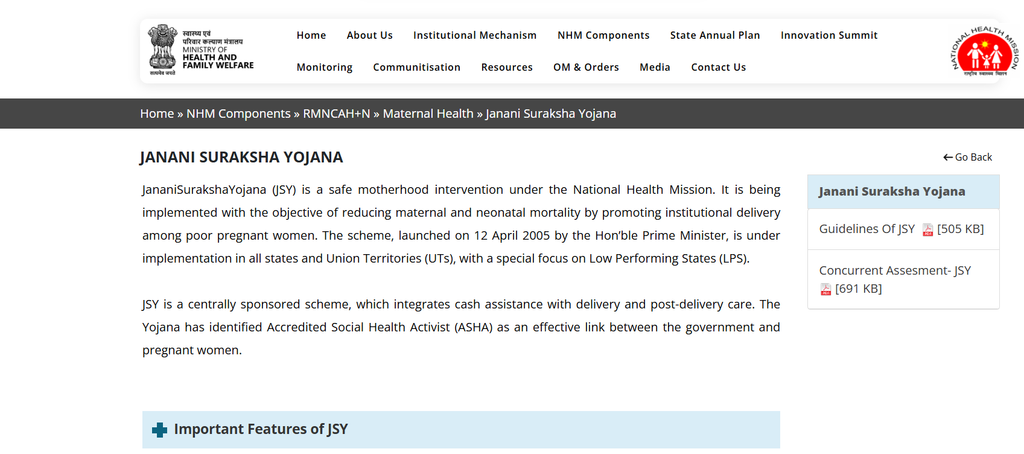
When Was Janani Suraksha Yojana Launched?
Janani Suraksha Yojana was launched on 12 April 2005. It was introduced under the National Rural Health Mission framework and subsequently continued under the National Health Mission. The scheme is centrally sponsored and has been implemented in all States and Union Territories.
Its design reflects an important public-health principle: financial assistance is linked with the use of institutional maternal-health services rather than being treated as an unrestricted maternity payment.
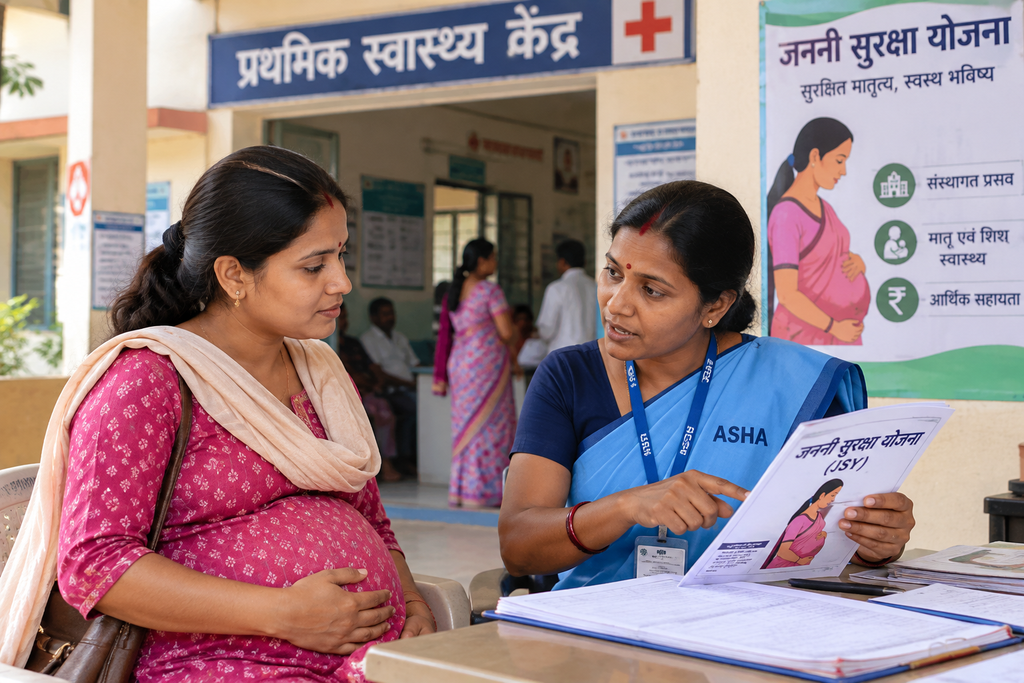
Janani Suraksha Yojana Eligibility 2026
Eligibility is one of the most important parts of JSY because the rules differ according to the official LPS and HPS categories.Under the JSY framework, pregnant women in Low Performing States may receive cash assistance when they deliver at specified government health facilities, subject to the scheme’s applicable conditions.. These facilities include Sub-Centres, Primary Health Centres, Community Health Centres, First Referral Units and general wards of district or state hospitals.
For High Performing States, the official eligibility framework specifies BPL, Scheduled Caste and Scheduled Tribe women delivering in government health centres.There are also provisions for eligible BPL, SC and ST women delivering in accredited private institutions in both categories of states.
Eligibility at a Glance
| Category | Official JSY eligibility framework |
|---|---|
| LPS | Pregnant women delivering in specified government health facilities |
| HPS | BPL/SC/ST women delivering in specified government health facilities |
| LPS & HPS | BPL/SC/ST women delivering in accredited private institutions may receive money under the scheme |
These rules come from the official NHM description of JSY and should not be confused with eligibility rules of other maternity schemes.
How Much Financial Assistance Is Available Under Janani Suraksha Yojana?
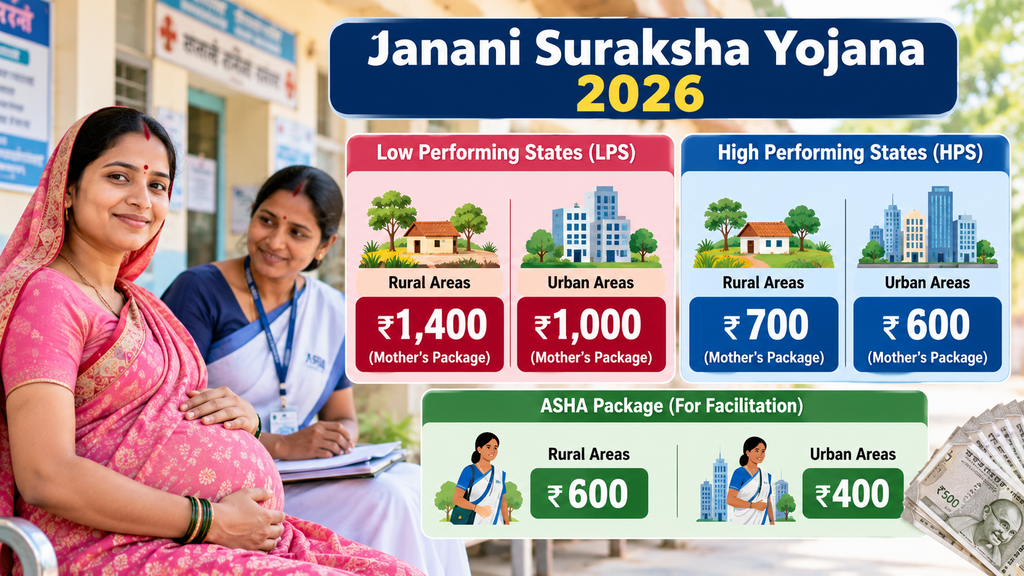
The official NHM JSY page currently lists different cash-assistance amounts according to the state’s LPS/HPS category and whether the delivery occurs in a rural or urban area.
For the mother’s package, the listed amounts are:
| Category | Rural Mother’s Package | Urban Mother’s Package |
|---|---|---|
| LPS | ₹1,400 | ₹1,000 |
| HPS | ₹700 | ₹600 |
The same official table separately lists an ASHA package of ₹600 in rural areas and ₹400 in urban areas. The ASHA component is not the mother’s cash entitlement; it represents payments associated with the ASHA’s role in antenatal care and facilitating institutional delivery.
Janani Suraksha Yojana Benefits
The principal benefit of JSY is financial assistance connected with institutional delivery. But the scheme’s importance goes beyond the cash component.
Encourages Institutional Delivery
One of the central objectives of JSY is to encourage childbirth in recognised health facilities. Institutional delivery allows pregnant women to have access to trained health professionals and appropriate medical infrastructure.
Links Cash Support With Maternal Care
JSY is designed as a combined intervention rather than an isolated financial-transfer programme. The scheme integrates cash assistance with delivery and post-delivery care.
ASHA-Based Support
ASHA workers act as an important connection between government health services and pregnant women. The official JSY framework assigns them responsibilities related to identification, registration and facilitation of maternal-health services.
Focus on States With Lower Institutional Delivery Rates
The scheme provides special emphasis to states designated as Low Performing States. This allows the programme to target areas where institutional delivery historically required greater policy attention.
How Does Janani Suraksha Yojana Work?
The process is built around the pregnant woman’s contact with the public health system. A pregnant woman can be identified and supported through frontline health workers such as an ASHA. Registration for antenatal care and other required maternal-health services forms part of the service pathway.
The woman then receives appropriate antenatal and delivery-related care and, where she meets the applicable JSY conditions, cash assistance is processed according to the scheme’s rules.The official JSY FAQ describes an important role for ASHA and associated health workers in identifying beneficiaries, facilitating ANC registration and helping women obtain necessary certifications and services.

Janani Suraksha Yojana Registration Process
JSY should not be treated like a typical online scheme where every applicant simply fills out an independent application form on a public website.In practice, access to the scheme is connected with the maternal-health system, health facilities and frontline health workers. The appropriate process can therefore depend on the state and health facility.
A pregnant woman should contact the ASHA worker, ANM, government health centre or relevant maternal-health facility in her area and ask for JSY beneficiary registration and documentation requirements.The official programme framework specifically recognises ASHA workers as a link between eligible pregnant women and government health services.
What Documents May Be Required?
The exact documentation can vary according to the applicable state process and beneficiary category. Applicants should therefore confirm the current requirements with the concerned health facility or ASHA/ANM.
Depending on the process, beneficiary identification and eligibility verification may involve personal identification, bank-account information and documents establishing the applicable category, where such category-based eligibility applies.It is better to verify the current requirements locally than to rely on an old online checklist because administrative procedures can change.
Janani Suraksha Yojana Payment
JSY payments are part of the government’s health-benefit delivery system. The Ministry of Health and Family Welfare maintains a DBT Health Portal that lists Janani Suraksha Yojana among the schemes handled through the health DBT framework.
Beneficiaries who are waiting for payment should first check with the relevant health facility or ASHA/ANM regarding registration, beneficiary details and payment processing.A payment delay does not necessarily mean that the beneficiary has been rejected. Verification or administrative processing may need to be completed.
JSY and the Role of ASHA Workers
The ASHA component is an important feature that distinguishes JSY from a simple cash-transfer programme.The official framework describes ASHA’s role in identifying pregnant women, helping with ANC registration and facilitating access to institutional delivery. In the rural package, the official table assigns ₹600 to the ASHA component, including amounts associated with antenatal-care and institutional-delivery facilitation. In urban areas, the listed ASHA package is ₹400.
This distinction matters because the ASHA package should not be added to the mother’s entitlement when explaining the amount the pregnant woman receives.
Janani Suraksha Yojana in Chhattisgarh
Chhattisgarh is among the states identified in the official JSY framework as a Low Performing State (LPS).This classification has significance for JSY eligibility because the official LPS framework provides for cash assistance to pregnant women delivering in specified government health facilities.
For a woman in Chhattisgarh, the practical route is to contact the local ASHA, ANM or government health facility and confirm registration and current documentation requirements before delivery.
Also Read :
- Pradhan Mantri Matru Vandana Yojana 2026: Eligibility, Benefits, Registration and Payment
- Pradhan Mantri Jan Dhan Yojana 2026: Eligibility, Benefits, ₹10,000 Overdraft & Account Opening
What Is the Difference Between JSY and JSSK?
JSY and Janani Shishu Suraksha Karyakram (JSSK) are related maternal and child-health initiatives, but they are not the same programme.JSY primarily combines cash assistance with institutional delivery and maternal-care objectives. JSSK, by contrast, is associated with entitlements and services for pregnant women and sick newborns in public health facilities.Confusing the two can lead to incorrect claims about which services or payments a beneficiary should expect.
What the Evidence Suggests
JSY’s policy design shows that the government has treated institutional delivery as a major component of reducing maternal and neonatal risk. The programme therefore connects financial assistance with health-system contact rather than providing cash independently of healthcare utilisation.
The Ministry of Health and Family Welfare continues to maintain systems for maternal and child-health tracking, while the JANANI platform is designed for identification and tracking of beneficiaries and related reproductive, maternal, newborn and child-health services.
Important Points Before Applying
Before expecting a JSY payment, a beneficiary should verify three things: whether she meets the applicable eligibility category, whether the delivery is taking place at an eligible facility, and whether her beneficiary and payment information has been properly recorded.
The safest source for current implementation details is the local government health facility, ASHA/ANM network or official National Health Mission information.JSY also should not be confused with unrelated maternity-benefit schemes. Different schemes can have different eligibility rules, benefits and application mechanisms.
FAQ Section
What is Janani Suraksha Yojana?
Janani Suraksha Yojana is a centrally sponsored safe-motherhood scheme under the National Health Mission. Launched on 12 April 2005, it aims to reduce maternal and neonatal mortality by encouraging institutional delivery and combines cash assistance with delivery and post-delivery care.
How much money is given under Janani Suraksha Yojana?
The amount depends on the JSY category and whether the beneficiary is in a rural or urban area. The official NHM page lists the mother’s package as ₹1,400 in rural LPS areas and ₹1,000 in urban LPS areas, while the corresponding HPS amounts are ₹700 and ₹600.
Is Janani Suraksha Yojana available in Chhattisgarh?
Yes. Chhattisgarh is included among the states identified as Low Performing States under the official JSY framework. The LPS eligibility rules therefore apply to the scheme’s cash-assistance framework in the state.
Is JSY available for private hospital delivery?
The official JSY eligibility framework provides for BPL, SC and ST women delivering in accredited private institutions in both LPS and HPS categories. The facility must meet the applicable accreditation and programme conditions.
What is the role of an ASHA worker in JSY?
An ASHA worker serves as an important link between the government health system and pregnant women. Her responsibilities can include identifying beneficiaries, facilitating antenatal-care registration and helping women access institutional delivery and related services.
Is JSY the same as PMMVY?
No. JSY and Pradhan Mantri Matru Vandana Yojana are separate government programmes with different objectives, eligibility conditions and benefit structures.
Where can I ask about JSY registration?
The practical first point of contact is the local ASHA worker, ANM or government health facility. They can explain the current beneficiary-registration process and documents applicable in the particular state and category.