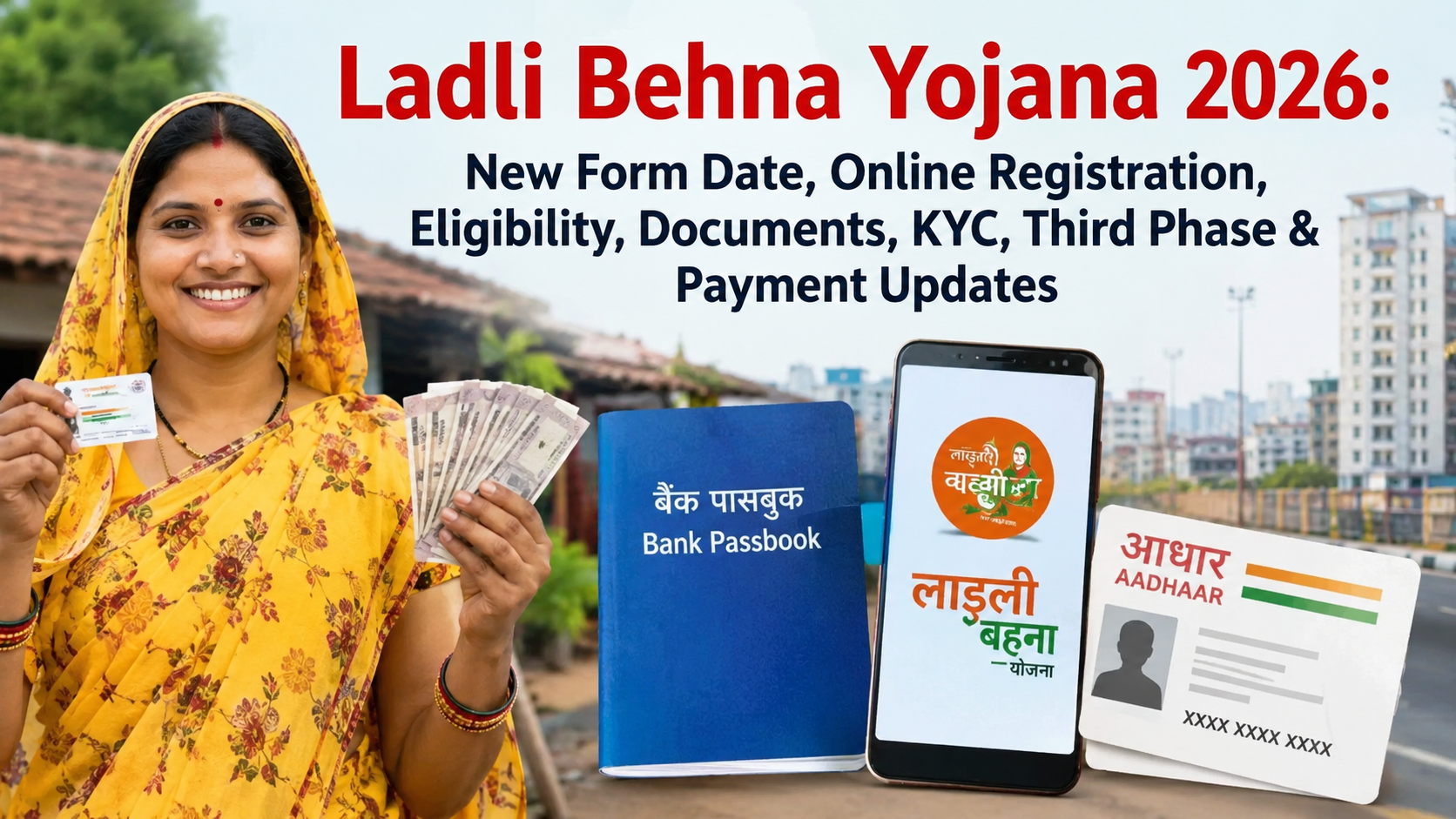
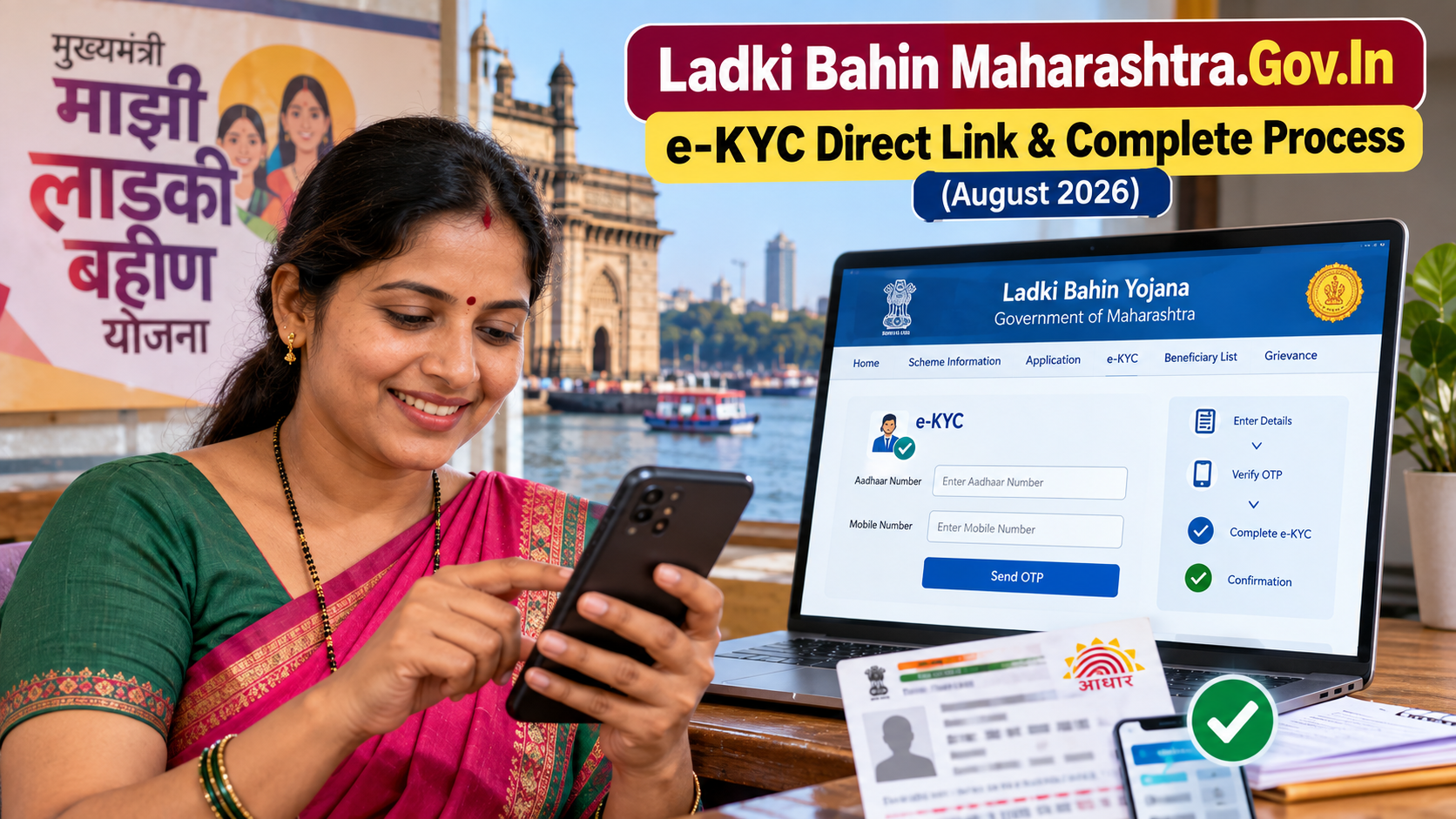
Ladki Bahin Maharashtra e-KYC: The most important question about Ladki Bahin e-KYC in August 2026 is not whether a message circulating online promises another instalment. It is whether the beneficiary’s verification can be completed through the correct government portal and whether the resulting record is consistent with her eligibility. The official Maharashtra government flowchart identifies the scheme website as the starting point for e-KYC and sets out an Aadhaar-based verification process.
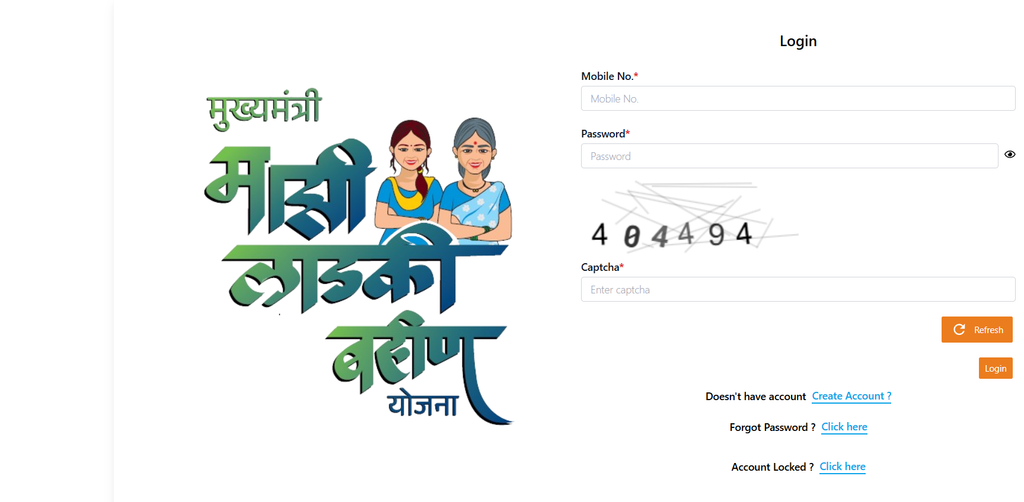
The Maharashtra government’s September 2025 circular confirms that e-KYC is carried out through this website. Its flowchart begins with the official portal, followed by the e-KYC banner, Aadhaar number, CAPTCHA and consent for Aadhaar authentication.
What is Ladki Bahin e-KYC, and why does it matter?
e-KYC, or electronic Know Your Customer verification, is the process of confirming a beneficiary’s identity and scheme-related details through electronic authentication. In this scheme, the government’s published process uses Aadhaar authentication and may require additional information relating to the beneficiary’s husband or father. The purpose is to help the department maintain an accurate beneficiary record rather than rely only on an earlier application.
The practical importance is that an application record, an e-KYC record and a payment record are not necessarily the same thing. A woman may have applied previously, may have completed verification, or may be waiting for a correction to be reflected in the scheme’s records. Those are different questions. Treating them as one status can create unnecessary confusion.
The scheme’s official circular also provided for a one-time opportunity to correct certain e-KYC mistakes. That is a reminder that accurate declarations matter: selecting the wrong option can affect how the record is reviewed.
Ladki Bahin e-KYC: Complete process
The following sequence is based on the Maharashtra government’s published e-KYC flowchart. The exact screens may change as the portal is updated, but the basic verification logic is clear.
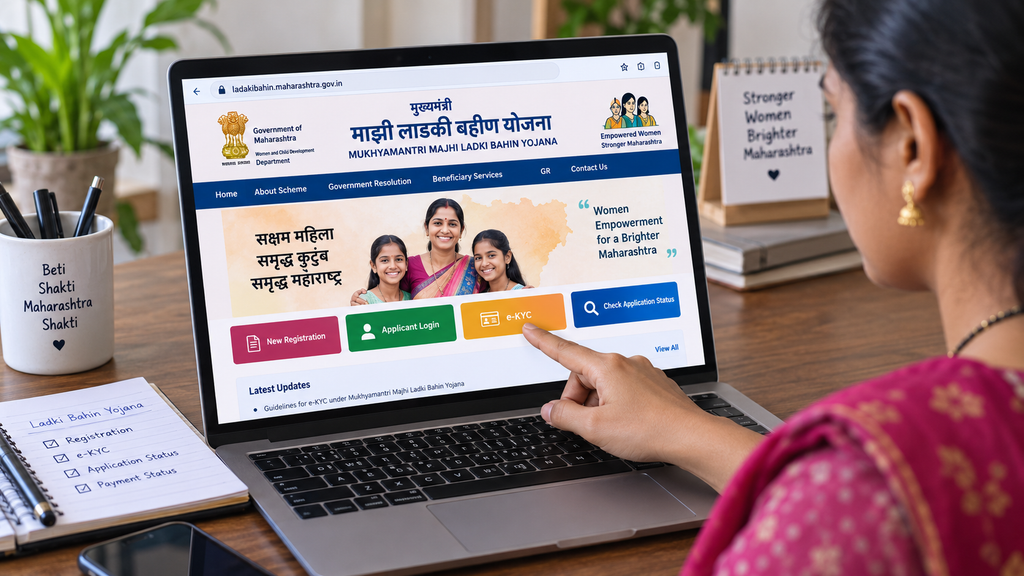
Step 1: Open the official website
Visit the Ladki Bahin Maharashtra government portal using the link above. On the homepage, look for the e-KYC banner and select it. The government’s process does not begin with a third-party payment-status page or a social-media form.
Step 2: Enter the beneficiary’s Aadhaar details
The e-KYC form asks for the beneficiary’s Aadhaar number and the CAPTCHA shown on the screen. The applicant must also give consent for Aadhaar authentication before selecting Send OTP.
This is an important distinction: entering a number into a form is not itself proof of verification. The portal must authenticate the details and return a result.
Step 3: Check whether e-KYC is already complete
The official flowchart says the system checks whether e-KYC has already been completed. If it has, the beneficiary receives a message indicating that e-KYC is already complete. If not, the process continues to the next verification stage.
Step 4: Confirm the Aadhaar is in the eligible beneficiary list
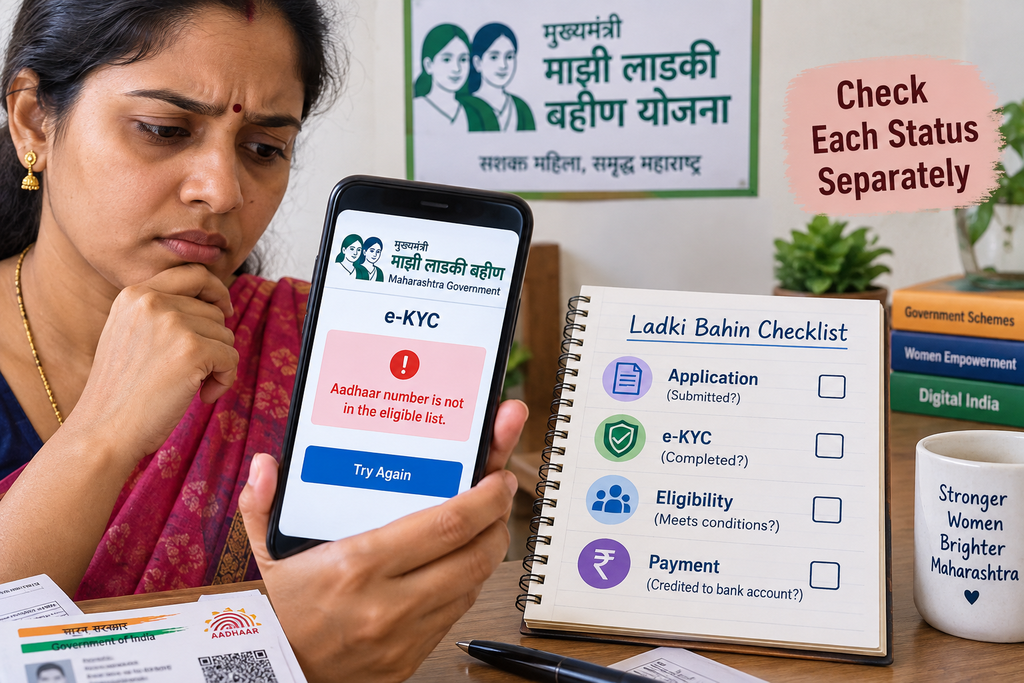
The portal checks whether the Aadhaar number is present in the approved beneficiary list. If it is not found, the system may display a message that the Aadhaar number is not in the eligible list of the scheme.
This is one of the most useful points in the entire process: a failed list check is not the same as a failed OTP. Repeating OTP attempts cannot, by itself, establish that an Aadhaar record is present in the approved scheme list.
Step 5: Complete OTP authentication
If the Aadhaar is in the eligible list, the portal proceeds with the OTP sent to the Aadhaar-linked mobile number. The beneficiary enters the OTP and submits it.
The OTP should be entered only on the official portal. It should not be shared with a caller, an agent or anyone claiming to “complete” the process on the beneficiary’s behalf.
Step 6: Complete the additional authentication
The published flowchart then asks the beneficiary to enter the Aadhaar number of her husband or father, along with the CAPTCHA and consent for Aadhaar authentication. A second OTP is sent to the linked mobile number for that authentication step.
This additional requirement is particularly important for applicants who may not have access to the relevant family member’s details. The process should not be treated as a single OTP form.
Step 7: Submit the remaining declarations
The government’s flowchart shows that the e-KYC page then asks for the remaining scheme-related details and declarations. The published process includes selections relating to caste category and family circumstances.
The correct approach is to read each question carefully and select the answer that reflects the beneficiary’s actual circumstances. The purpose of verification is to maintain an accurate record, not to make a declaration simply to move to the next screen.
What if the beneficiary’s father or husband is deceased?
This is a significant practical issue because the ordinary flow may require the relevant Aadhaar authentication. The Maharashtra government’s December 2025 circular addressed cases where the father or husband is deceased, or where the beneficiary is divorced. It provided for the beneficiary to complete her own e-KYC and then submit the applicable official documents to the concerned Anganwadi worker by 31 December 2025, while also requiring the online e-KYC process to be completed on the scheme portal.
That deadline belongs to the cited circular, not a new August 2026 deadline. Readers should therefore avoid assuming that an old deadline automatically applies to a new verification window. If the current portal gives a different instruction, the latest official direction should be checked before taking action.
Common e-KYC problems and how to interpret them
“e-KYC already completed”
This message means the portal has identified an existing completed e-KYC record. It is not the same as a payment receipt. If a payment is missing, the beneficiary should keep the e-KYC result separate from the payment-status question.
“Aadhaar number is not in the eligible list”
This indicates that the portal did not find the Aadhaar in the scheme’s eligible beneficiary list. It is not evidence that the Aadhaar itself is invalid. The next step is to verify the application or beneficiary record through the official scheme channel rather than repeatedly attempting OTP authentication.
OTP does not arrive
OTP delivery depends on the linked mobile number and the authentication process. If the OTP is delayed, the beneficiary should avoid sharing details with an agent or repeatedly submitting incorrect information. The official portal’s available instructions should be followed.
A declaration was selected incorrectly
The Maharashtra government has previously provided a one-time edit option for certain e-KYC errors. That does not mean every mistake can always be changed or that the same correction window remains open indefinitely. Readers should verify the current portal instructions before assuming a correction facility is available.
Competitive Advantage / Unique Angle: The verification-first checklist
A useful way to understand the process is to separate four records:
1. Application record
Was the woman’s application submitted and is it present in the scheme’s record?
2. e-KYC record
Did the portal authenticate the required details and return a completed result?
3. Eligibility record
Does the beneficiary continue to meet the scheme’s applicable conditions?
4. Payment record
Has the relevant benefit actually been credited to the beneficiary’s bank account?
This distinction is the central practical insight: e-KYC completion is evidence of a verification step, not a guarantee that every other scheme condition has been met or that a payment has been credited.
What the evidence suggests
The available government documents establish the official portal and the verification sequence. They also show that the department has had to address errors in the process, including the need for correction opportunities.
Recent reporting also indicates that e-KYC has created practical difficulties for some beneficiaries, particularly where family authentication is difficult or where portal errors occur. Those reports are useful context, but they should not replace the official record for an individual beneficiary.
For readers, the implication is straightforward: the safest way to handle a payment-related question is to establish the exact e-KYC result, then verify the application and payment status separately. This is more reliable than relying on a screenshot, a forwarded message or a claim that a new instalment is “guaranteed”.
Is e-KYC mandatory every year?
The answer should be based on the current official instruction for the relevant verification period. The Maharashtra government has issued e-KYC-related circulars and correction instructions, but a past circular should not automatically be treated as a new annual deadline.
For August 2026, readers should check the portal for the active e-KYC instructions and any current deadline. A date mentioned in an old article or a forwarded message is not sufficient evidence of a current deadline.
Also Read:
- Vetri Payanam Scheme 2026: Free Bus Travel, Eligibility, Buses Covered and Launch Date
- Tamil Nadu Free Tablet Computers Scheme 2026: What Students and Parents Should Know
How to avoid fake e-KYC websites
A beneficiary should use the official scheme domain rather than a link sent by an unknown person. The government’s published process identifies the official portal as the starting point.
A practical safety checklist is:
- Type or bookmark the official website rather than relying on shortened links.
- Check that the address belongs to the Maharashtra government scheme portal.
- Do not share Aadhaar-linked OTPs with anyone claiming to complete the process.
- Do not assume that a payment claim is genuine because it uses the scheme’s name.
- If a page asks for information unrelated to the published process, stop and verify it
FAQ Section
What is the official Ladki Bahin e-KYC direct link?
The official starting point is the Maharashtra government’s Ladki Bahin scheme website, ladakibahin.maharashtra.gov.in. The government’s published flowchart directs beneficiaries to open the e-KYC banner on the homepage and complete the Aadhaar-based verification process. Readers should use the official portal rather than relying on an unrelated website that claims to provide a payment or e-KYC service.
How can I complete Ladki Bahin e-KYC online?
Open the official portal, select the e-KYC banner, enter the beneficiary’s Aadhaar number and CAPTCHA, give consent for Aadhaar authentication, and select Send OTP. The process then checks whether e-KYC is already complete and whether the Aadhaar is in the eligible beneficiary list. If required, it continues with the husband’s or father’s Aadhaar authentication and remaining declarations.
What should I do if my Aadhaar is not in the eligible list?
If the portal says the Aadhaar is not in the scheme’s eligible list, repeating OTP attempts is unlikely to resolve that particular list check. The message should be treated as a scheme-record issue requiring verification through the official channel. It is important not to assume that the message means the Aadhaar itself is invalid.
What if e-KYC is already completed but my payment is missing?
An “e-KYC already completed” message confirms the verification record, not necessarily the payment status. Keep the e-KYC result separate from the application and bank-payment records. If the payment has not been credited, the beneficiary should check the relevant official status information and seek clarification through the scheme’s authorised support channel.
Can I correct an e-KYC mistake?
The Maharashtra government’s December 2025 circular provided a one-time edit opportunity for certain errors, with a deadline of 31 December 2025. That does not establish that the same correction facility is open in August 2026. Beneficiaries should check the current official portal for the applicable instructions before assuming that an edit option is available
What documents are needed if my father or husband is deceased?
The government’s December 2025 circular provided a specific process for beneficiaries whose father or husband is deceased, or who are divorced. It required the beneficiary to complete her own e-KYC and then submit the applicable official documents to the concerned Anganwadi worker by 31 December 2025. That was a circular-specific deadline, so the current portal instructions should be checked for the relevant verification period.
Does completing e-KYC guarantee the next instalment?
No. e-KYC completion is one part of the scheme’s verification process. It does not, by itself, establish that all eligibility conditions are satisfied or that a payment has been credited. The beneficiary should treat the verification result and payment record as separate pieces of information.
Is the August 2026 e-KYC deadline confirmed?
A current deadline should be confirmed through the official Maharashtra government portal or a new government notification. Earlier circulars establish the process and earlier correction windows, but they should not be presented as proof of a new August 2026 deadline. Readers should be cautious about dates circulating in social-media messages unless they can be verified through an official source.
Conclusion
The value of Ladki Bahin e-KYC is not in the existence of a direct link alone. It lies in whether the beneficiary can establish a reliable, accurate record through the official portal. The most useful approach is therefore to verify the Aadhaar authentication result, distinguish it from the application and payment records, and use the current government instructions when a correction or special case arises. That discipline is more likely to protect genuine beneficiaries than treating every online update as a promise of payment.