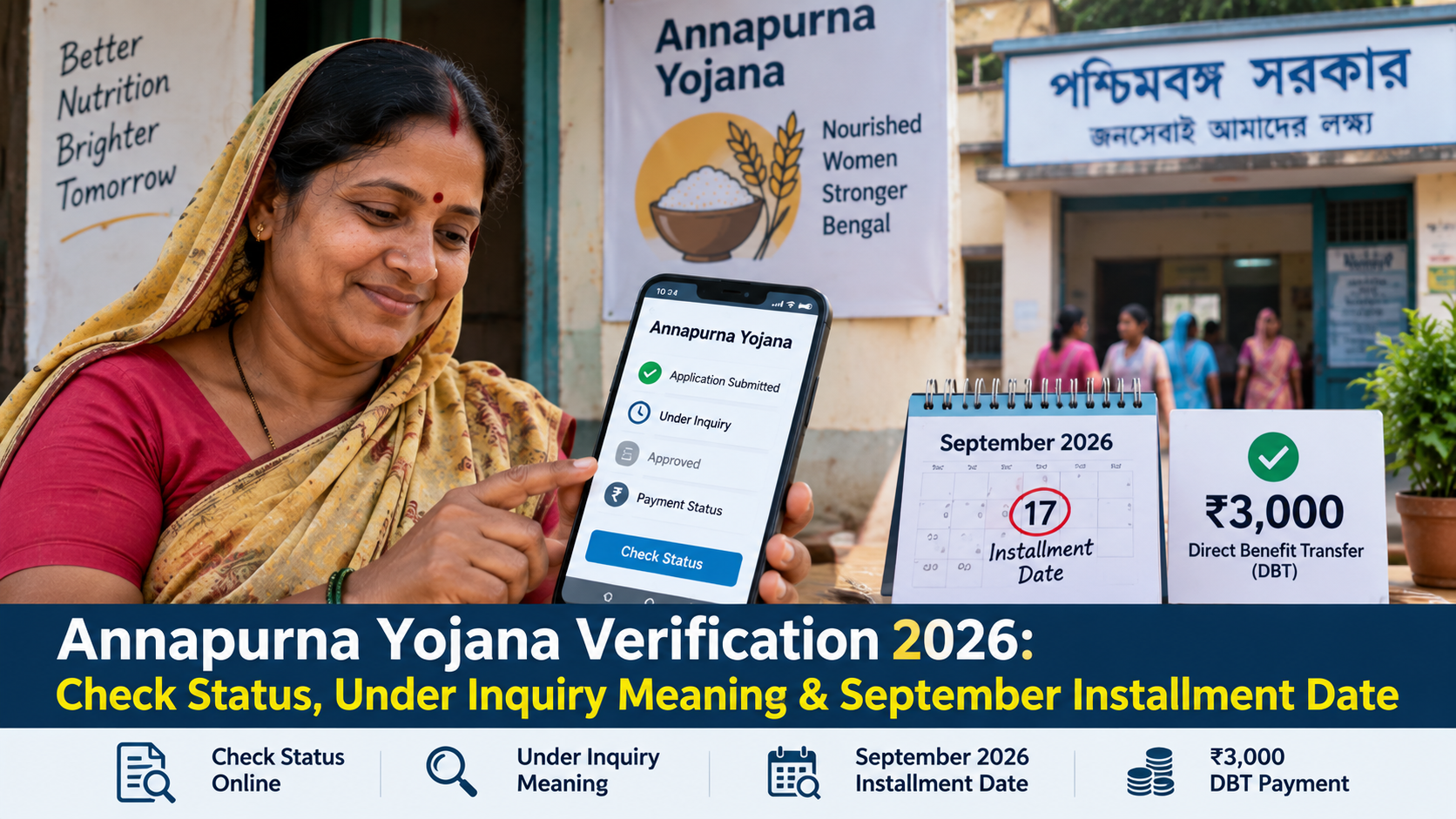
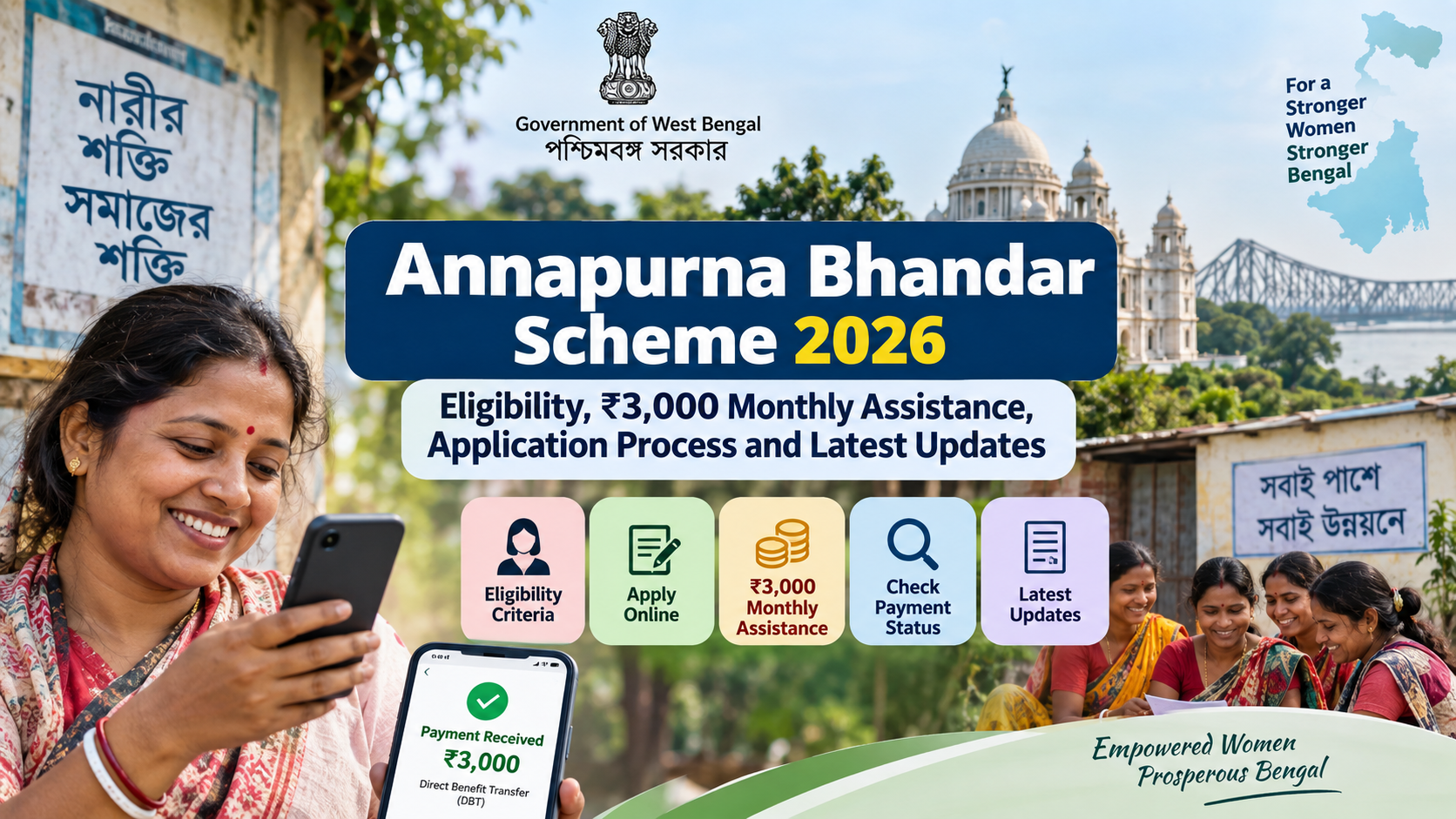
Annapurna Bhandar Scheme 2026:The Annapurna Bhandar Scheme 2026 refers to the West Bengal government’s women-focused welfare programme that provides eligible women with ₹3,000 per month through Direct Benefit Transfer (DBT). The scheme came into effect from June 1, 2026, and is designed to replace the earlier Lakshmir Bhandar programme. Existing eligible Lakshmir Bhandar beneficiaries were to be migrated to the new scheme.
Annapurna Bhandar Scheme 2026: Key Highlights
| Particular | Details |
|---|---|
| Scheme Name | Annapurna Yojana / Annapurna Bhandar |
| State | West Bengal |
| Implementing Government | Government of West Bengal |
| Main Beneficiaries | Eligible women |
| Monthly Assistance | ₹3,000 |
| Payment Method | Direct Benefit Transfer (DBT) |
| Effective Date | June 1, 2026 |
| Age Group | 25 to 60 years |
| Previous Scheme | Lakshmir Bhandar |
| Bank Account | Aadhaar-linked bank account |
| Official Portal | West Bengal government Annapurna Yojana portal |
The official portal states that its content, data and operations are owned and maintained by the Government of West Bengal.
What Is Annapurna Bhandar Scheme 2026?
The Annapurna Bhandar Scheme 2026 is a financial assistance programme introduced by the West Bengal government for eligible women. Under the scheme, qualifying beneficiaries receive ₹3,000 every month, with the money transferred directly into their bank accounts through DBT.
The programme represents a significant change in the state’s women-focused welfare architecture because it succeeds the earlier Lakshmir Bhandar programme. According to reports on the scheme’s rollout, the new assistance became effective from June 1, 2026, and existing Lakshmir Bhandar beneficiaries were moved into the new arrangement.
The underlying policy objective is straightforward: provide regular financial support to women while using direct bank transfers to make payments more transparent and reduce dependence on intermediaries.
This also means that beneficiaries should not treat social-media claims about automatic approval, guaranteed payments or unofficial registration links as authoritative. Eligibility and payment remain subject to government records and verification.
Annapurna Bhandar Scheme 2026 Eligibility
Eligibility is one of the most important aspects of the scheme because not every woman living in West Bengal automatically qualifies for the monthly assistance.
The reported core eligibility conditions include the following.
Age Requirement
The beneficiary must generally be between 25 and 60 years of age. This age criterion forms part of the government’s eligibility framework for Annapurna Yojana.
Employment Restrictions
A beneficiary should not be in permanent government employment or receiving a regular government salary or pension from specified government bodies.
The restrictions extend to employment with central or state government organisations, statutory bodies, government undertakings, panchayats, municipal corporations and other specified local authorities. Government-aided educational institutions are also covered by the restrictions reported for the scheme.
Income-Tax Status
The eligibility framework also excludes income-tax payers. Therefore, applicants should check their own status carefully before submitting an application or relying on information from third-party websites.
Verification of Beneficiary Records
Government verification is another important component. Reports on the scheme state that people who are deceased, have shifted residence, or have been removed from electoral records following the relevant verification process may not remain eligible.
This is significant because welfare payments are increasingly linked to verified beneficiary databases. A person who previously received a benefit should not assume that the payment will continue indefinitely without record verification.
How Much Money Is Available Under Annapurna Bhandar Scheme?
The principal benefit under Annapurna Yojana is ₹3,000 per month.
The assistance is intended to be transferred directly to the beneficiary’s bank account through the Direct Benefit Transfer system. Reports on the scheme specify that the bank account should be linked appropriately with Aadhaar for the DBT process.
At ₹3,000 per month, the annual assistance amounts to ₹36,000, provided the beneficiary remains eligible and receives the payment for all 12 months.
However, it is important not to confuse the annual calculation with an unconditional government promise of ₹36,000 to every applicant. Actual payment depends on eligibility, verification and continued inclusion in the beneficiary database.
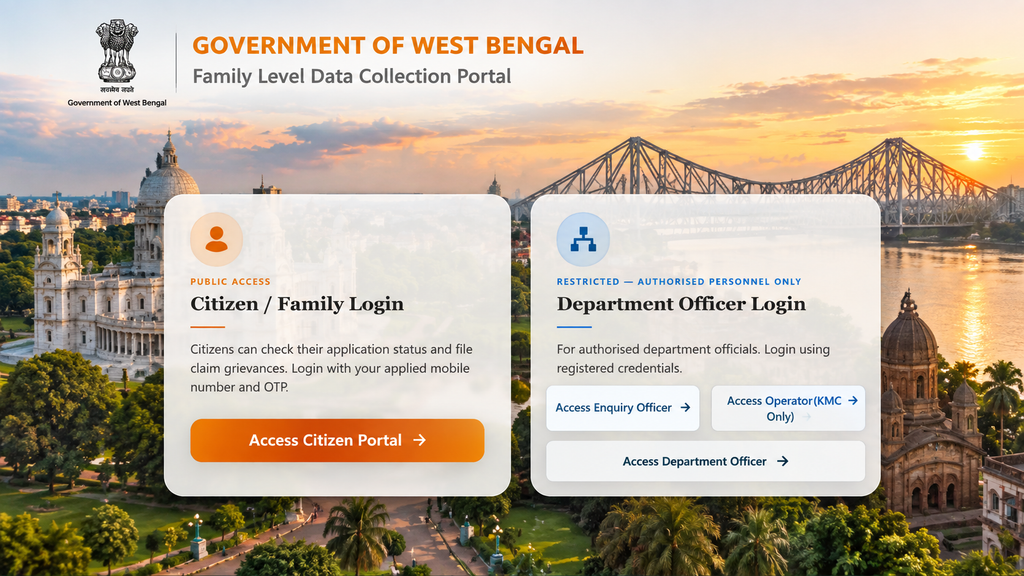
Annapurna Bhandar Scheme 2026: Existing Lakshmir Bhandar Beneficiaries
One of the most important features of the 2026 transition is the treatment of existing Lakshmir Bhandar beneficiaries.
According to reports on the scheme, eligible existing beneficiaries of Lakshmir Bhandar were to be automatically migrated to Annapurna Yojana when the new scheme came into effect.
This means that an existing beneficiary should not automatically assume that a completely new application is required simply because the scheme name has changed.
At the same time, beneficiaries should keep their bank and identity details updated and use the official government system for checking any issue concerning payment or eligibility.
Annapurna Bhandar Scheme 2026 Application Process
For new applicants, the government has provided an application mechanism for Annapurna Yojana. Contemporary reports stated that an online application facility was to be made available through the official portal.
A practical application process generally involves these stages:
Step 1: Visit the official government portal
Applicants should use the official West Bengal government Annapurna Yojana portal rather than private websites claiming to process applications.
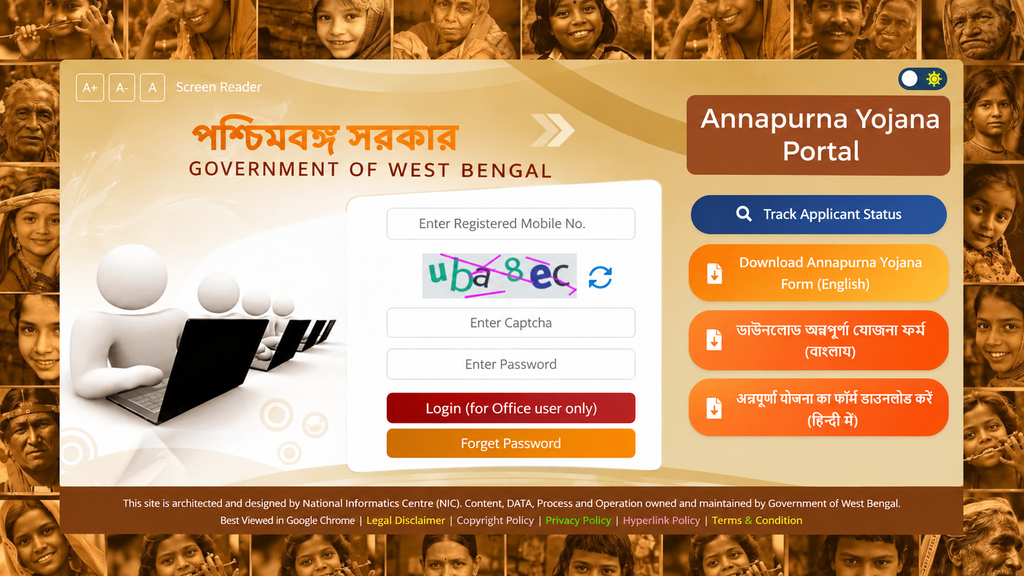
Step 2: Check eligibility
Before beginning the application, carefully read the applicable eligibility requirements, especially age, employment and income-tax conditions.
Step 3: Enter personal details
The applicant should provide the required personal information exactly as it appears in the relevant government records.
Step 4: Provide bank information
Since the benefit is transferred through DBT, accurate bank-account information is essential.
Step 5: Complete verification
The application may be subject to database and identity verification. Applicants should therefore ensure that the information submitted is accurate and consistent with their official records.
Step 6: Save the acknowledgement or reference details
After submitting an application, applicants should retain the acknowledgement or reference information. It can become important if the application later needs to be checked or corrected.
The exact application interface can change as the government updates its portal, so applicants should rely on the live instructions displayed on the official website rather than an old screenshot or third-party guide.
Documents Required for Annapurna Bhandar Scheme 2026
Applicants should keep their basic identity and banking documents available before beginning the application process.
Commonly relevant documents and details may include:
- Aadhaar or another officially accepted identity document
- Bank account details
- Aadhaar-linked bank information where applicable
- Residential details
- Beneficiary-related government records
- Other documents specifically requested by the government during verification
It is important to distinguish between documents generally useful for verification and documents officially declared mandatory for every applicant. The final requirement should always be determined from the current government application instructions.
Applicants should also avoid handing over Aadhaar copies, bank information or other sensitive documents to unverified agents merely because a website claims that an application can be completed faster.
Annapurna Bhandar Payment Through DBT
The use of DBT is central to the Annapurna Yojana.
Instead of requiring beneficiaries to collect cash from an intermediary, the government transfers the approved assistance electronically to the beneficiary’s bank account. This approach is intended to improve transparency and make the payment trail easier to verify.
The reported monthly amount is ₹3,000, beginning with the scheme’s implementation from June 1, 2026.
If an eligible beneficiary does not see a payment, it is better to investigate the reason rather than assuming that the scheme has been discontinued. Possible issues can include verification, bank-account details, beneficiary-record discrepancies or administrative processing.
How to Check Annapurna Bhandar Payment Status
Beneficiaries looking for their payment status should use the official government portal and the relevant status-check facility, where available.A sensible process is:
- Open the official Annapurna Yojana government portal.
- Look for the beneficiary or application-status section.
- Enter the required application or beneficiary information.
- Complete any verification requested by the portal.
- Check the displayed application or payment information.
- If the information is unclear, use the official government grievance or assistance mechanism.
The key point is that a third-party website should not be treated as proof that a payment has been approved or rejected.
What Happened to Lakshmir Bhandar?
The transition from Lakshmir Bhandar to Annapurna Yojana is an important part of understanding the 2026 scheme.
Lakshmir Bhandar was already a major women-focused welfare programme in West Bengal. Annapurna Yojana was introduced as its successor, with the monthly assistance under the new programme set at ₹3,000 for eligible beneficiaries. Existing beneficiaries were reported to be migrated into the new system.
For beneficiaries, the practical issue is therefore not simply the change in name. The important questions are whether their records remain valid, whether their bank details are correct and whether they continue to satisfy the applicable conditions.
Is Annapurna Bhandar Scheme Available Across India?
No. The 2026 Annapurna Yojana discussed in this article is a West Bengal government scheme.
It should not be confused with the older Annapurna Bhandar Yojana of Rajasthan, which was a different initiative associated with the state’s public distribution system and fair-price shops. Rajasthan’s programme was designed around transforming selected fair-price shops into Annapurna Bhandars and making additional daily-use consumer goods available through them.
This distinction matters for SEO readers because searches for “Annapurna Bhandar Scheme” can produce information about both programmes. The 2026 ₹3,000 monthly assistance programme is the West Bengal scheme, while the Rajasthan Annapurna Bhandar initiative has a different policy purpose.
Important Warning About Fake Annapurna Bhandar Websites
The popularity of the scheme has also created an opportunity for misleading websites and unofficial agents.
Applicants should be particularly cautious if a website:
- asks for money to “activate” the monthly benefit;
- promises guaranteed approval;
- asks for unnecessary banking credentials;
- claims that a government payment can be released instantly;
- asks for an OTP or password;
- presents itself as an official government portal without a verifiable government domain.
The official West Bengal Annapurna Yojana portal identifies itself as a Government of West Bengal website and states that the content and operations are maintained by the state government.
For official information, readers should start with the Government of West Bengal Annapurna Yojana portal rather than relying on websites using similar scheme names.
- PM SVANidhi Scheme 2026: ₹15,000, ₹25,000 & ₹50,000 Loan, Eligibility, Apply Online, Interest Subsidy and Latest Updates
- Sukanya Samriddhi Yojana 2026: Interest Rate, Eligibility, Calculator & Latest Rules
Why the Annapurna Bhandar Scheme Matters
The significance of Annapurna Yojana goes beyond the ₹3,000 monthly payment.
Regular cash support can provide women with greater control over household spending and can help meet recurring expenses. From a public-policy perspective, however, the effectiveness of such a scheme depends on more than the headline amount.
Accurate beneficiary identification, timely DBT payments, reliable grievance redressal and transparent eligibility rules are equally important. A welfare programme can only deliver its intended impact when eligible households can access the benefit without unnecessary administrative barriers.
The shift from Lakshmir Bhandar to Annapurna Yojana also illustrates the broader movement towards direct and digitally recorded welfare transfers.
Frequently Asked Questions
What is Annapurna Bhandar Scheme 2026?
Annapurna Bhandar, officially referred to as Annapurna Yojana in West Bengal, is a state welfare programme providing eligible women with ₹3,000 per month through DBT.
How much money is given under Annapurna Bhandar?
Eligible beneficiaries receive ₹3,000 per month, subject to the applicable eligibility and verification rules.
Who is eligible for Annapurna Bhandar Scheme 2026?
The reported eligibility framework covers women aged 25 to 60 years, subject to additional conditions concerning employment, government benefits, income-tax status and beneficiary verification.
Is Annapurna Bhandar the same as Lakshmir Bhandar?
No. Annapurna Yojana succeeds Lakshmir Bhandar in West Bengal, with existing eligible beneficiaries reported to have been migrated to the new scheme.
When did Annapurna Yojana start?
The scheme came into effect on June 1, 2026.
Is Annapurna Bhandar a Rajasthan scheme?
There is an older Rajasthan programme called Annapurna Bhandar Yojana, but it is different from the 2026 West Bengal women-focused financial assistance scheme. Rajasthan’s programme was associated with fair-price shops and the public distribution system.
Conclusion
The Annapurna Bhandar Scheme 2026 is a significant women-focused welfare initiative of the West Bengal government, providing ₹3,000 per month through DBT to eligible women. The programme became effective on June 1, 2026, and represents the transition from the earlier Lakshmir Bhandar system.