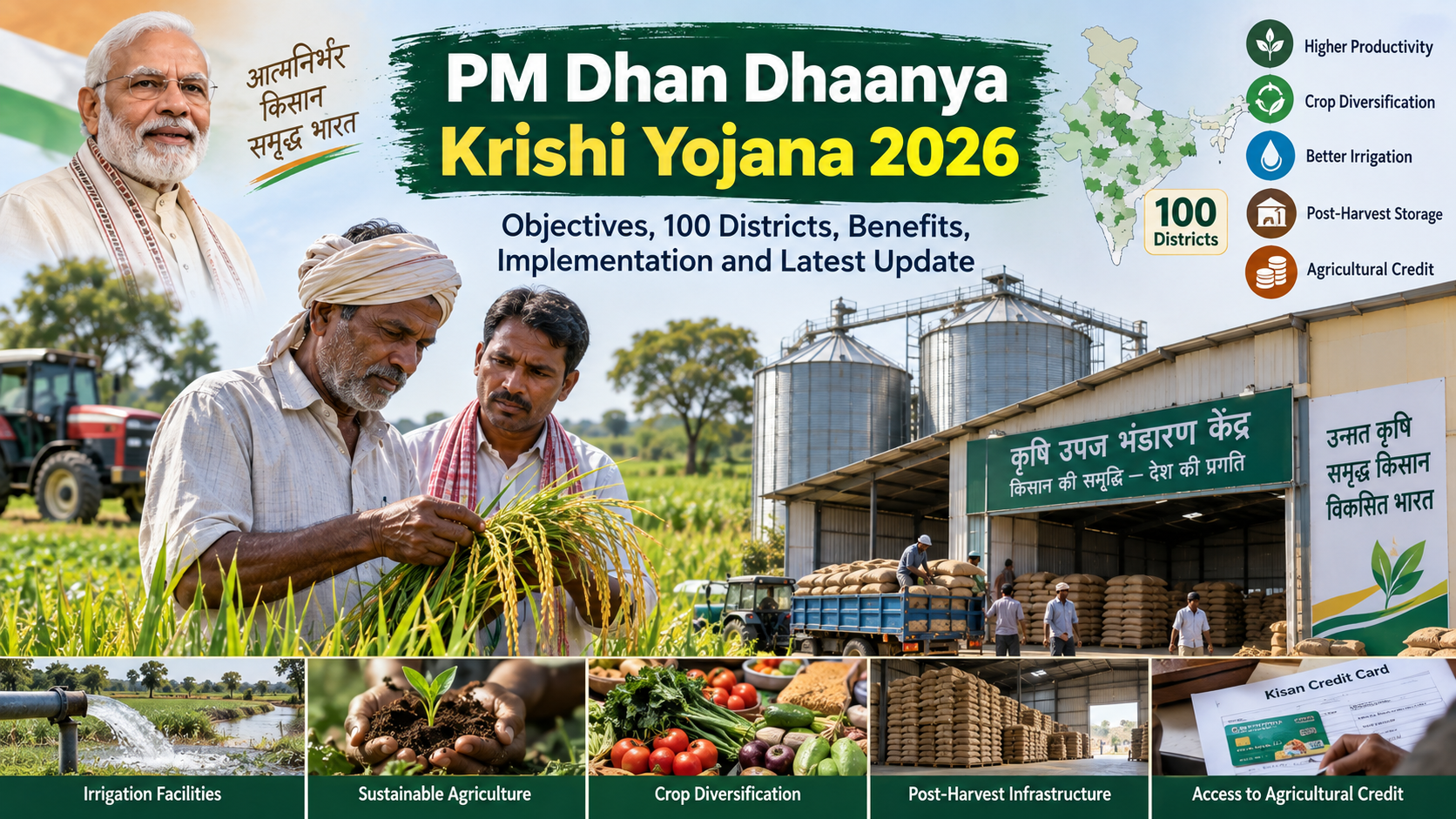
Agricultural PM Dhan Dhaanya Krishi Yojana 2026 : Agricultural policy in India often struggles with a familiar problem a scheme may exist on paper, yet its impact can remain uneven because productivity, irrigation, storage, credit and market access are interconnected. The PM Dhan Dhaanya Krishi Yojana 2026 attempts to address that problem by concentrating administrative attention and existing resources in 100 selected districts.
Announced in the Union Budget 2025-26, the programme was approved by the Union Cabinet in July 2025 and formally launched on 11 October 2025. It is designed for six years beginning with 2025-26 and has an annual outlay of ₹24,000 crore. Rather than creating one standalone benefit for every farmer, the programme brings together interventions from 36 existing schemes across 11 Central departments, along with State schemes and local private-sector participation.
That distinction matters. A farmer searching for “PM Dhan Dhaanya Krishi Yojana 2026” may reasonably expect an application form, a fixed cash payment or a universal subsidy. The official design is different. PM-DDKY is primarily a district-focused agricultural development framework, with benefits reaching farmers through the schemes and interventions converged under each district’s action plan.
| Point | Details |
|---|---|
| Scheme Name | PM Dhan Dhaanya Krishi Yojana (PMDDKY) |
| Scheme Type | Central Sector scheme |
| Announced In | Union Budget 2025-26 |
| Cabinet Approval Date | 16 July 2025 |
| Launch Date | 11 October 2025 |
| Duration | 6 years from 2025-26 to 2030-31 |
| Yearly Budget | Rs. 24,000 crore per year |
| Total Indicative Outlay | About Rs. 1.44 lakh crore over 6 years |
| Coverage | 100 districts across India with at least one district from each State and UT |
| Main Focus | Agriculture and allied sectors in low-performing districts |
| Expected Direct Beneficiaries | About 1.7 crore farmers |
| Working Model | Joint work of 36 schemes across 11 ministries and departments |
| Monitoring System | 121 indicators with dashboard-based monthly review – Check latest scheme progress |
| Nodal Ministry | Ministry of Agriculture and Farmers Welfare |
What is PM Dhan Dhaanya Krishi Yojana 2026?
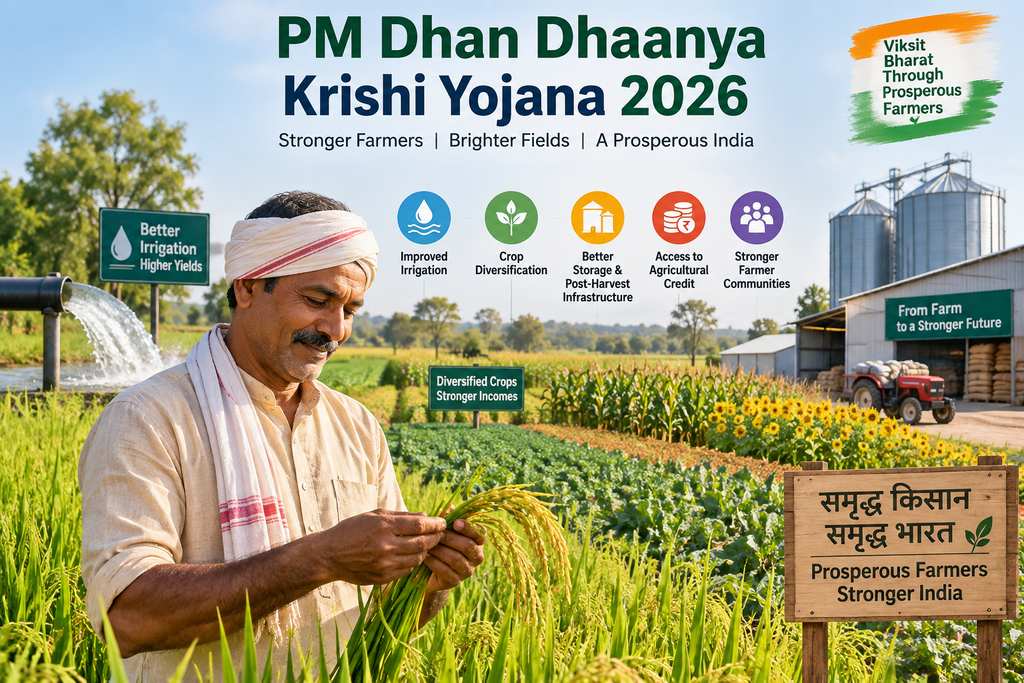
PM Dhan Dhaanya Krishi Yojana is a six-year Central government programme focused on improving agricultural performance in 100 selected districts. Its principal objectives are higher agricultural productivity, crop diversification, sustainable farming, stronger post-harvest infrastructure, improved irrigation and better access to short- and long-term agricultural credit.
The programme was inspired by the approach of the NITI Aayog Aspirational Districts Programme, but its focus is specifically agriculture and allied activities. Instead of treating individual interventions separately, PM-DDKY seeks to coordinate them around the needs of a particular district.
This is an important policy shift. Low farm productivity is rarely caused by only one missing input. A district may need better seeds, irrigation, extension services, storage, credit and market linkages simultaneously. The convergence model is intended to address these gaps together.
Why was the scheme introduced?
The original Union Budget announcement identified 100 districts with low productivity, moderate cropping intensity and below-average credit parameters. The programme was expected to benefit around 1.7 crore farmers.
The policy logic is straightforward. If agricultural performance remains weak in districts where farming is a major source of livelihood, simply expanding individual schemes may not be sufficient. Public investment also needs to address the local infrastructure and institutional constraints that prevent farmers from benefiting fully from those schemes.
The government therefore designed PM-DDKY around five broad agricultural priorities:
- Increasing agricultural productivity
- Promoting crop diversification and sustainable agriculture
- Expanding post-harvest storage at Panchayat and Block levels
- Improving irrigation facilities
- Facilitating access to long-term and short-term agricultural credit
How are the 100 Dhan Dhaanya districts selected?
The selection is not based simply on a district being economically backward. The government has specified three principal indicators:
- Low crop productivity
- Low cropping intensity
- Low agricultural credit disbursement
The allocation of districts among States and Union Territories also takes into account net cropped area and the number of operational holdings. The government has stated that every State is represented by at least one selected district.
This methodology is significant because it makes the scheme more targeted. A district may have substantial agricultural activity but still face low productivity, inadequate cropping intensity or insufficient institutional credit. Those characteristics can make it a candidate for focused intervention.The government has also said that States identifying additional districts with similar problems can replicate the framework using their existing administrative mechanisms and available scheme resources.
What are the main benefits of PM Dhan Dhaanya Krishi Yojana?
The benefits should be understood at two levels: district-level infrastructure and services, and farmer-level improvements resulting from those interventions.
1. Higher agricultural productivity
Productivity is at the centre of the programme. District Action Plans can identify local constraints and coordinate measures intended to improve farm output.
The objective is not simply to increase production through higher input use. The programme also emphasises better farming practices, crop diversification, sustainable agriculture and improved access to technical support.
2. Crop diversification
Heavy dependence on a limited number of crops can expose farmers to climatic, price and resource-related risks. PM-DDKY encourages districts to consider crop diversification alongside local agro-ecological conditions.
The idea is not that every farmer should immediately abandon an existing crop. Rather, district planning can identify where alternative crops, horticulture or other agricultural activities make economic and ecological sense.
3. Better irrigation
Irrigation is one of the programme’s five core objectives.
The practical value can be substantial in areas where rainfall is uncertain or irrigation infrastructure is inadequate. District plans can bring together relevant schemes to address irrigation gaps instead of treating each intervention as an isolated project.For example, the District Action Plan for Yavatmal in Maharashtra includes micro-irrigation among its proposed interventions.
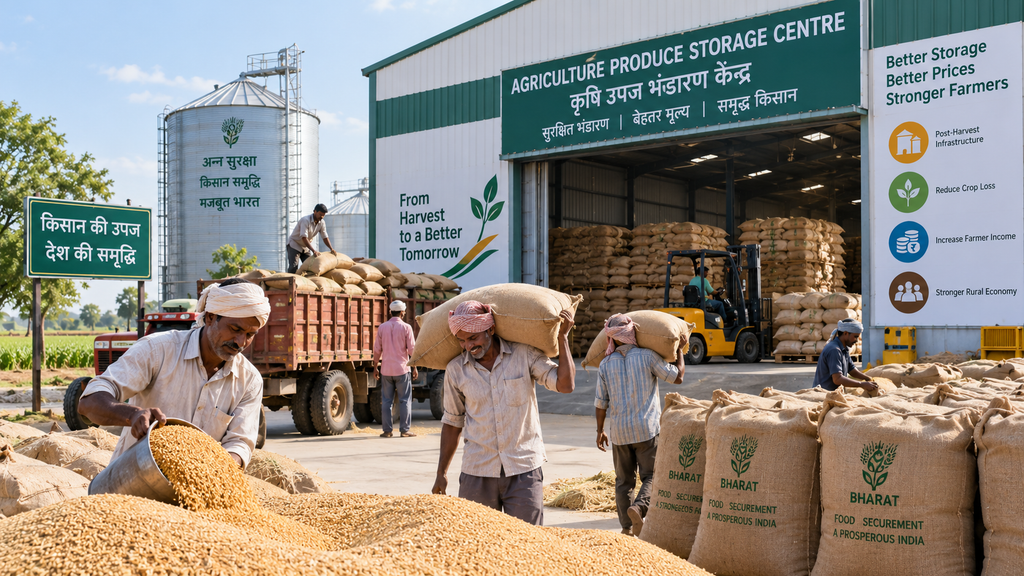
4. Post-harvest storage and processing
A productive harvest does not automatically translate into better farm income. Farmers can face losses or weak bargaining positions when adequate storage, cold storage or local processing facilities are unavailable.
PM-DDKY district plans are therefore intended to identify gaps in warehouses, cold storage and farm-gate processing infrastructure and address them through convergence with appropriate schemes.
This is one of the more important aspects of the programme because agricultural development is not only about what happens before harvest.
5. Improved agricultural credit access
The scheme also aims to facilitate both short-term and long-term credit.
This is particularly relevant because inadequate institutional credit was itself one of the indicators used to identify the 100 districts. Improving credit availability can help farmers finance inputs, equipment and productive investments where formal credit channels are appropriate.However, PM-DDKY should not be interpreted as a promise that every farmer in a selected district automatically receives a loan.
Is PM Dhan Dhaanya Krishi Yojana a direct cash-benefit scheme?
No. PM-DDKY should not be described as a universal fixed-cash payment scheme for individual farmers.Its design is based on district-level planning and convergence of existing schemes. Farmers may receive benefits from specific agricultural interventions implemented through the converged schemes, but the programme itself is primarily a development and coordination framework.
This distinction is particularly important in 2026 because online searches can sometimes mix PM-DDKY with unrelated farmer-support programmes.Therefore, readers should be cautious about claims promising a guaranteed PM Dhan Dhaanya payment simply for completing an online registration.
Is there an online application for PM Dhan Dhaanya Krishi Yojana?
PM-DDKY is not structured around a single nationwide application form through which every farmer independently applies for the entire scheme.Implementation takes place through District Action Plans, prepared and implemented by the District Dhan-Dhaanya Krishi Yojana Samiti. These plans bring together relevant Central and State schemes according to local requirements.
In practical terms, a farmer’s access to a particular benefit will depend on the underlying scheme, eligibility conditions and the interventions being implemented in the selected district.Farmers should therefore identify the specific benefit they need—such as irrigation support, crop-related assistance, training, storage or credit—and check the applicable government scheme rather than relying on a generic PM-DDKY registration claim.
How is PM-DDKY implemented at district level?
The district is the central administrative unit.
A District Dhan-Dhaanya Krishi Yojana Samiti prepares the District Action Plan. The plan is designed around local agricultural conditions and brings together Central schemes, State schemes and other interventions. District-level monitoring is supported by Central Nodal Officers and the wider State and national institutional structure.
This approach also allows the programme to differ from one district to another.For instance, a district facing irrigation constraints may prioritise water infrastructure, while another may place greater emphasis on storage, improved seeds, horticulture or crop diversification.The Yavatmal example illustrates this district-specific approach: its action plan includes improved sowing methods, improved seeds, horticulture, storage godowns and micro-irrigation.
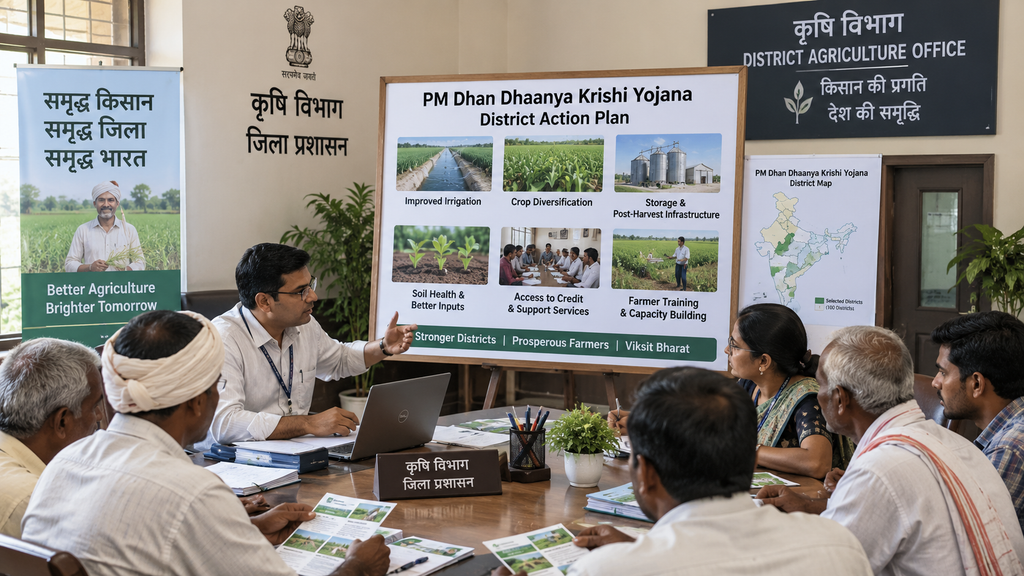
PM Dhan Dhaanya Krishi Yojana latest update 2026
The programme moved beyond the announcement stage during 2026 and entered a more measurable implementation phase.
According to the Agriculture Ministry’s September 2026 review, all 100 districts had uploaded their District Action Plans, and data had been submitted against output indicators through July 2026. The government also reported that the average score across the 100 districts increased from 22.54 in April 2026 to 38.85 in July 2026.
The improvement was reported across several objectives, including agricultural productivity, crop diversification and sustainable farming, post-harvest storage, irrigation, agricultural credit, and governance and service delivery.The numbers should nevertheless be interpreted carefully. A higher programme score is evidence of progress against the government’s monitoring framework; it is not, by itself, proof that every farmer has experienced a proportional increase in income.
Farmer training is becoming a major component
Implementation in 2026 has also included capacity building.Between January and July 2026, the government reported that 6,90,530 farmers and 88,961 extension workers had received training in various skills. It also reported natural-farming training involving 2,20,683 farmers and extension workers during the same period. Krishi Vigyan Kendras are being used as technical partners for capacity building and field-level interventions.
This matters because infrastructure alone cannot guarantee better agricultural outcomes. Farmers need information, technical support and extension services to use new practices and facilities effectively.
What is the ₹24,000 crore outlay?
The scheme has an annual outlay of ₹24,000 crore and is designed for six years beginning with 2025-26. The government’s launch announcement described the total programme outlay in terms of this annual allocation.The figure should not be interpreted as ₹24,000 crore being transferred directly to farmers.
The programme operates through convergence with existing schemes and interventions. Therefore, its financial significance lies partly in how effectively different sources of public spending are coordinated within the selected districts.
What this means for ordinary farmers
For a farmer living in one of the selected districts, the most meaningful question is not simply whether the district appears on a PM-DDKY list. The more useful question is: What has the District Action Plan identified as the local agricultural constraint, and which existing scheme is being used to address it?
A farmer may therefore encounter PM-DDKY indirectly through improved irrigation, training, storage infrastructure, crop diversification initiatives, access to agricultural credit or another linked government programme.This is also why two farmers in different Dhan-Dhaanya districts may experience very different interventions.The scheme is deliberately designed to be locally responsive rather than to distribute one identical benefit everywhere.
What the evidence suggests
The evidence available by September 2026 points to a programme that has progressed from policy announcement to structured district-level implementation.
Three developments are particularly notable.
First, the 100 districts have been formally identified using defined agricultural and credit indicators.
Second, District Action Plans have been established across the selected districts. Third, the government has begun strengthening monitoring to capture not only activities and expenditure but also beneficiary-level outcomes.
The third point may ultimately determine the credibility of the programme.
Agricultural schemes are easier to judge when they can demonstrate whether farmers actually gained from better irrigation, higher productivity, improved storage, diversified production or stronger access to institutional credit.The government has said that a Beneficiary Progress Module was targeted for implementation by mid-September 2026, which could make farmer-level assessment more systematic.
PM Dhan Dhaanya Krishi Yojana 2026: What farmers should check
Farmers in selected districts should avoid relying on generic social-media claims about a PM-DDKY cash payment or a single universal application.
Instead, they should:
- Check whether their district is among the officially identified Dhan-Dhaanya districts.
- Follow information issued by the district agriculture administration.
- Identify the particular agricultural benefit being offered under the District Action Plan.
- Check the eligibility requirements of the underlying Central or State scheme.
- Use recognised government or departmental channels for applications and documentation.
- Treat claims of guaranteed payments or unofficial registration fees with caution.
FAQ Section
What is PM Dhan Dhaanya Krishi Yojana 2026?
PM Dhan Dhaanya Krishi Yojana is a six-year agricultural development programme covering 100 selected districts from 2025-26. It focuses on productivity, crop diversification, sustainable farming, irrigation, post-harvest storage and agricultural credit. The programme works mainly through convergence of existing Central and State schemes rather than as one standalone cash-payment scheme.
How many districts are covered under PM Dhan Dhaanya Krishi Yojana?
The scheme covers 100 districts across India. Districts were selected using indicators relating to low crop productivity, low cropping intensity and lower agricultural credit disbursement. The allocation among States and Union Territories considers net cropped area and operational holdings, with at least one district selected from each State.
What is the annual budget of PM Dhan Dhaanya Krishi Yojana?
The programme has an annual outlay of ₹24,000 crore and is planned for six years beginning with financial year 2025-26. This amount should not be interpreted as a direct ₹24,000-crore payment to farmers. The funding supports coordinated implementation through existing schemes and district-level interventions.
Does PM Dhan Dhaanya Krishi Yojana provide ₹24,000 to every farmer?
No. The ₹24,000 crore figure refers to the programme’s annual outlay, not an individual farmer payment. PM-DDKY is a district-development and convergence programme. Specific benefits depend on the schemes and interventions included in the relevant District Action Plan and the eligibility conditions of those underlying schemes.
Is there a separate PM-DDKY online application form?
PM-DDKY itself is not structured as one universal application through which every farmer claims a fixed benefit. District Action Plans coordinate different government interventions. Farmers should therefore check the particular agricultural scheme or facility being implemented in their district and follow the official eligibility and application process for that intervention.
How are Dhan Dhaanya districts selected?
The government selected the 100 districts using three principal indicators: low crop productivity, low cropping intensity and low agricultural credit disbursement. The number of districts assigned to each State is linked to net cropped area and operational holdings. Every State has at least one selected district.
What is the latest PM Dhan Dhaanya Krishi Yojana update in 2026?
As of the September 2026 government review, all 100 districts had uploaded their District Action Plans. The reported average score across the districts increased from 22.54 in April to 38.85 in July 2026. The government is also strengthening beneficiary-level monitoring to assess whether interventions are translating into measurable benefits for farmers.
Can farmers outside the 100 districts benefit from PM-DDKY?
The formal PM-DDKY programme covers 100 identified districts. However, the government has stated that States identifying additional districts with similar agricultural challenges may replicate the framework through their existing administrative mechanisms and available scheme resources. Such replication should not be confused with formal inclusion in the original 100-district PM-DDKY programme.
Conclusion
PM Dhan Dhaanya Krishi Yojana 2026 is best understood not as another standalone farmer payment scheme but as an attempt to make agricultural policy more place-specific, coordinated and measurable. Its success will depend less on the announcement of ₹24,000 crore or the creation of a list of 100 districts than on whether convergence actually solves the constraints that farmers face on the ground.
The early implementation figures are encouraging in terms of planning, monitoring and capacity building, but they are not the final measure of success. The more consequential test will be whether farmers ultimately see sustained improvements in productivity, irrigation, storage, diversification, credit access and farm-level economic outcomes. The government’s move towards beneficiary-level monitoring in 2026 is therefore particularly important. If that evidence becomes robust, PM-DDKY could offer a useful model for how agricultural development programmes can move from fragmented interventions towards district-specific, outcome-oriented planning.


One Comment