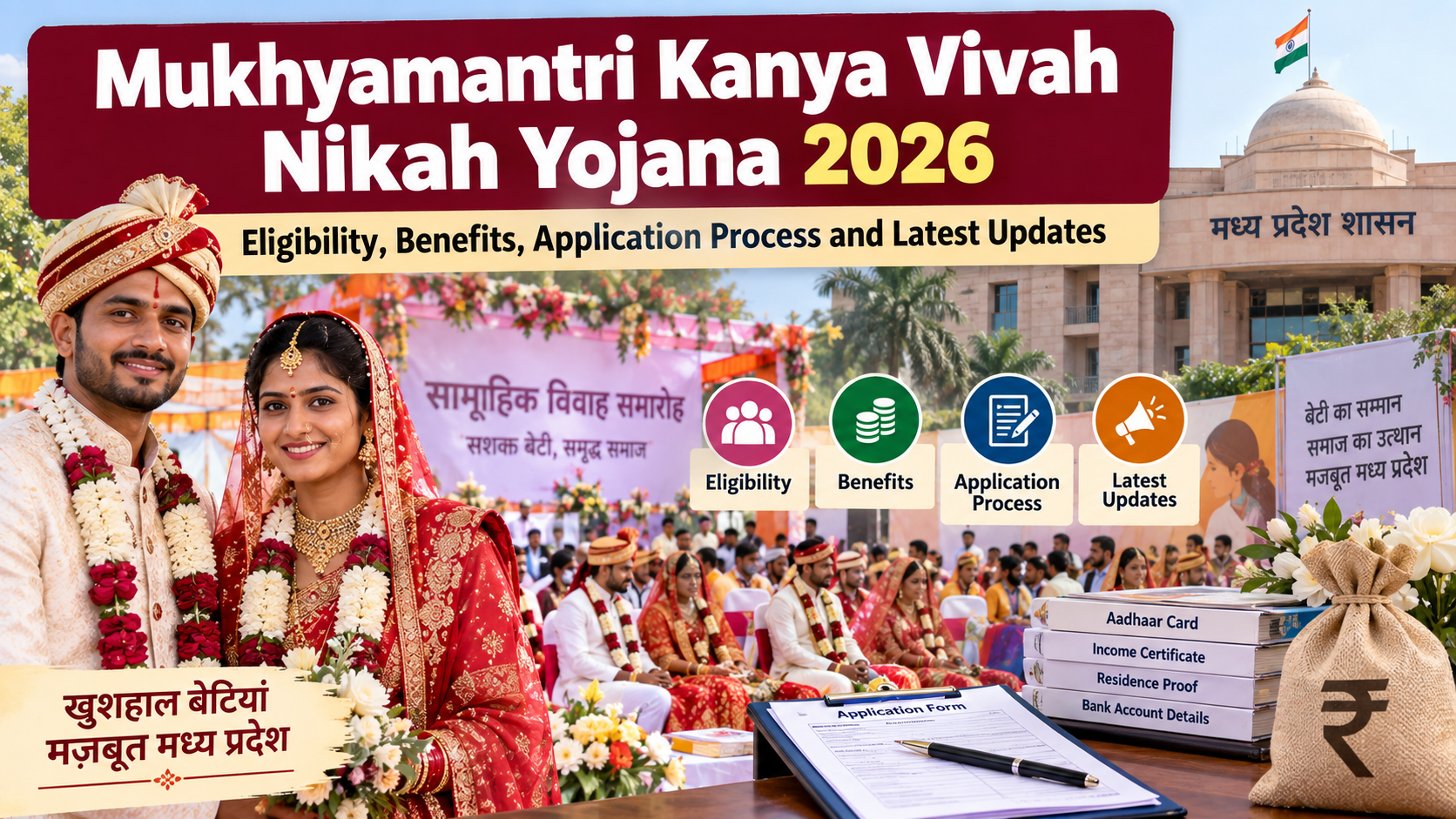
Mukhyamantri Kanya Vivah Nikah Yojana 2026: For economically weaker families, marriage expenses can become a significant financial burden. Madhya Pradesh’s Mukhyamantri Kanya Vivah Nikah Yojana is designed around a different approach: instead of treating marriage assistance simply as an individual cash transfer, the state supports eligible beneficiaries through organised mass marriage and nikah programmes.
The scheme has been operating in Madhya Pradesh for years. The government records trace the Mukhyamantri Kanya Vivah Yojana to 1 April 2006, while the separate Mukhyamantri Nikah Yojana was introduced for eligible Muslim beneficiaries and later brought within the combined administrative framework.
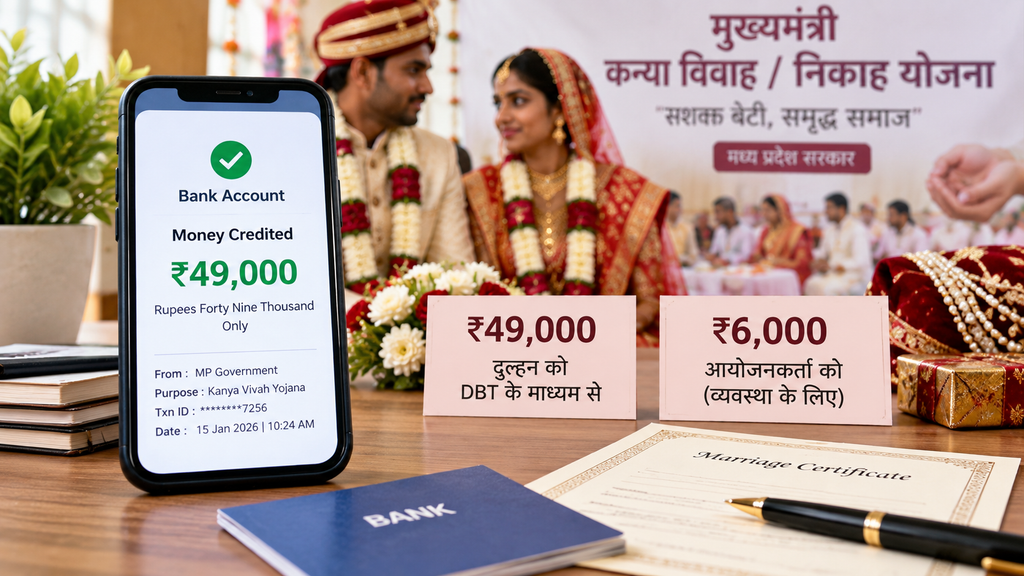
For 2026, one of the most important points for applicants is the assistance structure. Under the government information available for the current framework, ₹49,000 is transferred to the eligible bride through DBT, while ₹6,000 is provided to the organising body for arrangements. Thus, the government expenditure associated with one participating couple can be described as ₹55,000, but it should not be interpreted as ₹55,000 being deposited directly into the bride’s account.
Mukhyamantri Kanya Vivah Nikah Yojana Highlights 2026
| Detail | Information |
|---|---|
| Scheme Name | Mukhyamantri Kanya Vivah / Nikah Yojana |
| Launched By | Social Justice and Disabled Persons Welfare Department, Madhya Pradesh |
| Started In | Kanya Vivah Yojana – 2006; Nikah Yojana – 2012 |
| Eligible People | Eligible daughters from poor/BPL families; applicable provisions also cover widows and divorced women |
| Total Government Support | ₹55,000 per participating couple |
| Direct Benefit to Bride | ₹49,000 through DBT |
| Organising Support | ₹6,000 to the organising body |
| Application Mode | Through the prescribed local-body process and Vivah Portal, as applicable |
| Rural Application Authority | Gram Panchayat / Janpad Panchayat |
| Urban Application Authority | Nagar Palika / Nagar Parishad / Nagar Nigam |
| Official Portal | vivahportal.mp.gov.in |
What is Mukhyamantri Kanya Vivah Nikah Yojana 2026?
The scheme is a Madhya Pradesh government initiative intended to provide assistance to eligible economically weaker families participating in organised collective marriage or nikah programmes.The Social Justice and Disabled Persons Welfare Department of Madhya Pradesh lists the Mukhyamantri Kanya Vivah/Nikah Yojana among its schemes and provides government orders and implementation directions relating to its operation.
The underlying idea is broader than financial assistance alone. Collective marriage programmes can reduce the organisational burden on families and bring eligible beneficiaries together under an officially coordinated event.The scheme therefore combines three elements: eligibility verification, collective marriage/nikah and financial assistance.
How much assistance is available in 2026?
This is one of the most searched questions about the scheme, but it is also where misleading summaries can create confusion.
According to the Madhya Pradesh government’s 2025-26 budget documentation, the applicable arrangement provides:
| Component | Amount |
|---|---|
| Assistance to eligible bride through DBT | ₹49,000 |
| Amount for organising arrangements | ₹6,000 |
| Total government support associated with one couple | ₹55,000 |
The government document specifically states that ₹49,000 is transferred to the bride’s account through DBT and ₹6,000 is provided to the organiser.
The distinction matters because headlines sometimes describe the scheme simply as a ₹55,000 marriage assistance scheme. A reader could reasonably assume that the entire amount is deposited into the beneficiary’s bank account. That is not what the current government description says.The January 2026 implementation reported from Jabalpur also reflected the ₹49,000 beneficiary payment, while the associated ₹6,000 was meant for programme arrangements.
Who can benefit from the scheme?
Eligibility depends on the applicable government rules and verification process. The core requirements reported in the current implementation include Madhya Pradesh residency, prescribed marriage age and economic eligibility.
For the general Kanya Vivah/Nikah programme, government-linked information specifies that the bride or her parents should be Madhya Pradesh residents. The marriage must also comply with the applicable legal minimum age: 18 years for the bride and 21 years for the groom.
The 2025-26 government documentation also makes BPL Portal verification mandatory for eligible families covered by the poverty-based component of the scheme.Applicants should therefore avoid relying solely on a social-media post or an unofficial website stating that everyone can receive the benefit. Eligibility is determined through the prescribed government process and documentary verification.
Basic eligibility conditions
Generally, applicants should check the following before applying:
- The bride or eligible family should satisfy the Madhya Pradesh residency requirement.
- The bride must be at least 18 years old.
- The groom must be at least 21 years old.
- Where applicable, the family’s BPL status must be verified through the designated government system.
- The marriage/nikah must take place under the authorised collective programme.
- Required identity, residence, age, banking and other records must be available for verification.
The precise documentation and programme conditions can vary according to the latest departmental directions and the organising local body. Applicants should therefore confirm the requirements with the authority organising the particular marriage programme.
Is the scheme only for first-time marriage?
This is an important area where applicants should be careful.
The scheme is fundamentally structured around eligible beneficiaries participating in the designated collective marriage or nikah programme. Current programme notices have specified that a marriage should not already have taken place through another ceremony before participation in the scheme’s mass-marriage event.
That means a family should not assume that an ordinary private wedding followed by an application for the scheme will automatically qualify.Special categories, such as widows or legally divorced women seeking remarriage, can be governed by separate provisions. Such cases should be checked against the latest departmental rules rather than inferred from the general Kanya Vivah conditions.
Also Read:
- Mukh Mantri Mawan Dheeyan Satkar Yojana 2026: Eligibility, Payment, Registration and Latest Update
- Lado Lakshmi Yojana 2026: Eligibility, ₹2,100 Monthly Benefit, Registration & Latest Update
What documents may be required?
Applicants should prepare their documents before the local authority’s deadline because collective marriage programmes are organised on fixed dates.
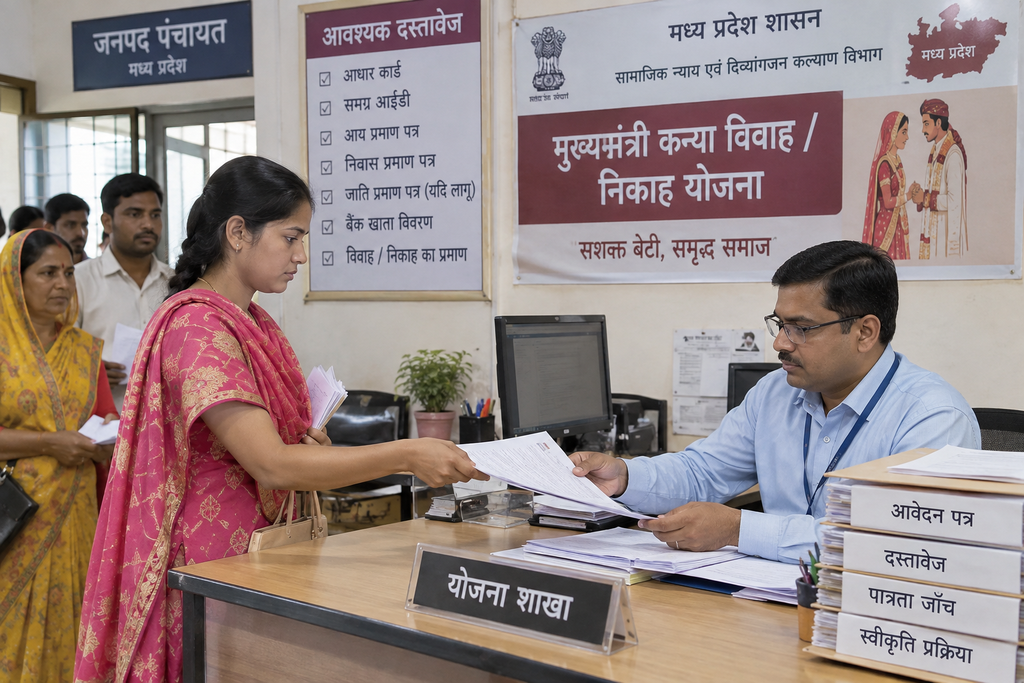
Commonly requested records can include identity and age documents, Samagra ID, bank-account details, photographs, residence-related documents and records supporting economic/BPL eligibility.
Local programme notices have also listed documents such as Aadhaar, Samagra ID, bank passbook, age proof, residence proof, BPL-related documentation, photographs and mobile number among the records required during application and verification.
The exact list should not be treated as permanently fixed. Applicants should follow the checklist issued by their Gram Panchayat, Janpad Panchayat, Nagar Palika, Nagar Parishad or Nagar Nigam, depending on where they live and which body is conducting the programme.
How to apply for Mukhyamantri Kanya Vivah Nikah Yojana 2026?
The application process is closely connected with the local organising authority rather than being simply a conventional online cash-benefit application.
For rural beneficiaries, applications are generally handled through the relevant Gram Panchayat/Janpad Panchayat structure. In urban areas, the concerned Nagar Palika, Nagar Parishad or Nagar Nigam may handle applications and verification. The Madhya Pradesh government has also introduced online processes through its marriage-related portal framework.
Practical application process
First, check the local programme notice.
The date of the collective marriage or nikah and the deadline for applications are important because applications are tied to specific events.
Second, obtain or complete the prescribed application.
The local authority will provide the applicable form or application route for the programme.
Third, submit the required documents.
Identity, age, residence, Samagra and banking information should be consistent. Where BPL verification is required, that status must be reflected in the designated system.
Fourth, undergo verification.
The local administration checks eligibility and documents before including the couple in the collective event.
Finally, participate in the authorised marriage/nikah programme.
The financial assistance is linked to the scheme’s prescribed conditions and successful participation.
Where is the money deposited?
The current government documentation states that the ₹49,000 beneficiary assistance is provided through DBT to the bride’s account.
This makes correct banking information particularly important. Applicants should ensure that the bank details submitted during the process are accurate and that the account is capable of receiving the applicable transfer.
The ₹6,000 component is different. It is intended for the organising body to meet expenses associated with conducting the collective marriage/nikah programme.
What is the role of BPL verification?
BPL verification is more than a formality under the current implementation.The Madhya Pradesh government’s 2025-26 documentation specifically states that BPL Portal verification is mandatory for families covered under the poverty-based eligibility requirement.
For applicants, this means that possession of a ration card or simply considering oneself economically weak should not automatically be treated as sufficient proof. The status required under the scheme needs to be verified through the prescribed government mechanism.
Why does the government conduct mass marriages?
The policy rationale extends beyond direct financial support.
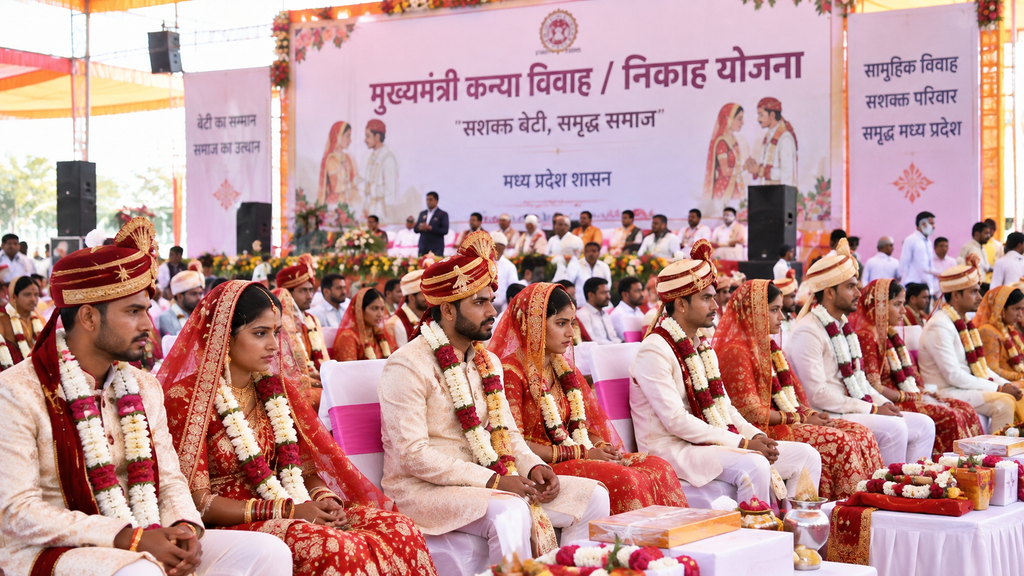
Marriage can involve expenditure on venue, food, clothing, household goods and ceremonies. A collective event allows the government and local bodies to coordinate several aspects of the programme while providing assistance to eligible families.
The scheme also attempts to reduce the pressure on economically weaker households to organise expensive individual ceremonies.However, the effectiveness of such programmes depends on implementation quality. Accurate beneficiary verification, transparent procurement, proper delivery of promised materials and timely payment are as important as announcing financial assistance.
What the evidence suggests about the scheme’s scale
The scheme remains an active part of Madhya Pradesh’s welfare architecture.The government’s 2025-26 documentation records 50,208 beneficiaries under the Mukhyamantri Kanya Vivah/related assistance category for that financial year, with expenditure of approximately ₹283.02 crore.
The scale indicates that the scheme is not a small local programme. It is a statewide welfare mechanism requiring coordination among the state department, district administration, local bodies and beneficiaries.At the same time, beneficiary numbers should not be interpreted as proof that every applicant receives assistance automatically. Eligibility, verification, programme scheduling and compliance with the scheme’s conditions remain important.
Competitive Advantage: What applicants should verify before believing a ₹55,000 claim
The most useful way to understand the scheme is to separate headline value from actual beneficiary benefit.
If an article says simply, “Get ₹55,000 directly in your bank account,” that wording can be misleading under the current government structure. The official 2025-26 document describes ₹49,000 as the amount transferred to the bride and ₹6,000 as support to the organiser.
Applicants should therefore verify four things before proceeding:
First, whether their family meets the current eligibility conditions.
Second, whether BPL verification is required and correctly reflected.
Third, whether the proposed marriage event is officially authorised.
Fourth, whether the ₹49,000 beneficiary payment and ₹6,000 organisational component are being described separately.
Is online application available?
The Madhya Pradesh Social Justice Department’s official scheme page includes directions concerning the online implementation of the Mukhyamantri Kanya Vivah/Nikah Yojana and references the marriage portal.
However, the practical process can still involve the local body conducting the marriage programme. Therefore, applicants should not assume that filling out an online form alone completes the entire process.The safest approach is to follow the current notification issued by the concerned local authority and confirm whether the particular event is accepting applications online, offline or through both routes.
Important caution for applicants
Applicants should be particularly careful with websites or social-media posts promising guaranteed payments, asking for unnecessary fees or presenting outdated assistance figures.
Government schemes can change through departmental orders. The Madhya Pradesh Social Justice Department’s scheme page itself lists multiple implementation directions and amendments, including directions issued in 2025.
FAQ Section
What is Mukhyamantri Kanya Vivah Nikah Yojana 2026?
It is a Madhya Pradesh government scheme supporting eligible economically weaker families through organised collective marriage and nikah programmes. The scheme provides financial assistance subject to prescribed eligibility and verification conditions. It is administered through the state department and authorised local bodies.
How much money is given under Mukhyamantri Kanya Vivah Nikah Yojana?
Under the current government framework, ₹49,000 is provided to the eligible bride through DBT, while ₹6,000 is provided to the organising body for arrangements. Therefore, ₹55,000 represents the total support associated with one participating couple rather than a ₹55,000 direct bank transfer to the bride.
Who is eligible for the MP Kanya Vivah Yojana?
Eligibility generally requires compliance with Madhya Pradesh residency requirements, the minimum legal marriage age of 18 years for the bride and 21 years for the groom, and the applicable economic/BPL verification requirements. The marriage must also take place through the authorised collective programme.
Is BPL verification compulsory?
For the poverty-based eligibility component described in the government’s 2025-26 documentation, BPL Portal verification is mandatory. Applicants should therefore verify their status through the prescribed government system rather than relying only on an informal declaration or an old document.
Can the assistance be received for a private marriage?
The scheme is structured around authorised collective marriage/nikah programmes. Applicants should not assume that a private marriage automatically qualifies for the assistance. Current programme conditions indicate that the marriage must be completed through the designated scheme event.
Where can applicants apply?
Depending on the location and programme, applicants can approach the relevant local authority. Rural applicants may be directed to the Gram Panchayat or Janpad Panchayat, while urban applicants may deal with the Nagar Palika, Nagar Parishad or Nagar Nigam. The state also has an online implementation framework through its marriage portal.
Is ₹55,000 deposited directly into the bride’s account?
No. This is an important distinction. The government document states that ₹49,000 goes to the bride through DBT, while ₹6,000 is provided to the organiser for arrangements. Therefore, describing the entire ₹55,000 as a direct beneficiary payment would be inaccurate.
When should applicants submit their application?
Applicants should follow the deadline announced for the specific collective marriage or nikah programme in their district or local body. Dates can vary by event, so an old programme date should not be treated as the current application deadline.
conclusion
The broader significance of the Mukhyamantri Kanya Vivah Nikah Yojana lies less in the headline amount than in how effectively financial assistance, eligibility verification and collective-event administration work together. For families considering the scheme in 2026, the most important point is therefore straightforward: verify eligibility first, confirm the authorised marriage event, understand that ₹49,000 is the direct beneficiary assistance, and rely on the latest government notification rather than an outdated ₹55,000 headline.