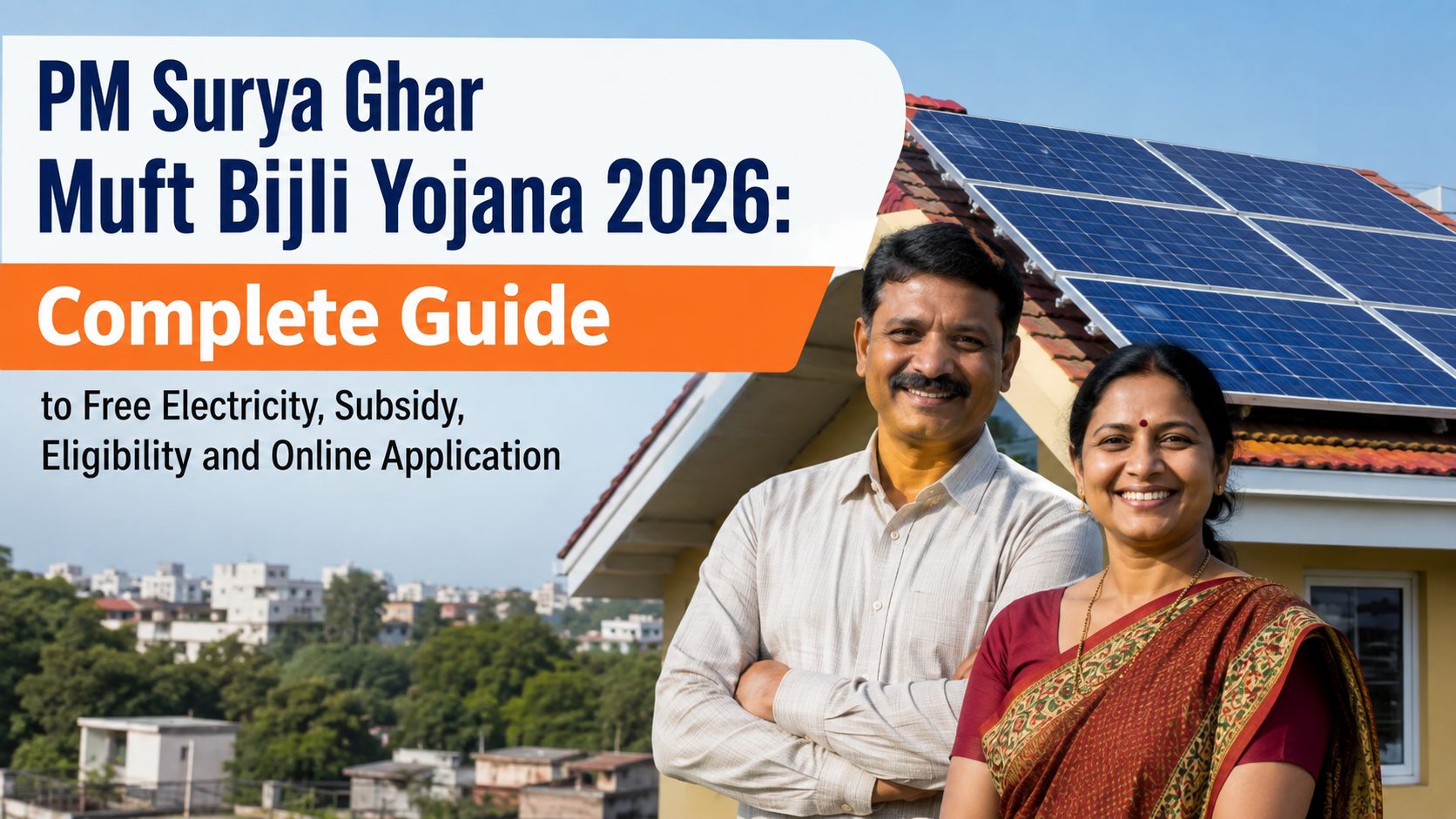
The PM Surya Ghar Muft Bijli Yojana 2026 is one of the biggest rooftop solar schemes launched by the Government of India. The main aim of the scheme is to help households install rooftop solar panels and reduce their monthly electricity bills. Under this scheme, eligible families can receive a government subsidy of up to ₹78,000, and many households may significantly reduce or even eliminate their electricity bills depending on their solar generation and power usage.
This guide explains PM Surya Ghar Muft Bijli Yojana 2026, including the subsidy structure, eligibility, required documents, application process, loan options, common mistakes, and long-term financial benefits in simple English.
PM Surya Ghar Muft Bijli Yojana Overview
| Feature | Details |
|---|---|
| Scheme Name | PM Surya Ghar Muft Bijli Yojana |
| Launched By | Government of India |
| Launch Year | 2024 |
| Ministry | Ministry of New and Renewable Energy (MNRE) |
| Target | 1 crore residential households |
| Maximum Subsidy | ₹78,000 |
| Suitable For | Residential households with rooftop space |
| Electricity Benefit | Up to 300 units of solar-generated electricity per month (depending on system size and usage) |
| Official Portal | https://pmsuryaghar.gov.in |
What Is PM Surya Ghar Muft Bijli Yojana?
PM Surya Ghar Muft Bijli Yojana is a government scheme that encourages Indian households to install rooftop solar systems. Instead of depending completely on electricity supplied from the grid, homeowners can generate electricity from sunlight using solar panels installed on their rooftops.
The government provides a one-time subsidy directly to the beneficiary’s bank account after the solar system is installed and approved. The scheme aims to make solar power affordable and reduce the electricity expenses of ordinary families. According to the government, the scheme is designed to benefit 1 crore households across India and promote clean energy generation. The official subsidy structure provides support of ₹30,000 per kW up to 2 kW and ₹18,000 per kW for the additional capacity up to 3 kW, with a maximum subsidy of ₹78,000.
PM Surya Ghar Muft Bijli Yojana Progress and Scale as of 2026
The scheme has expanded rapidly since its launch. As of 2026, more than 50 lakh households have already adopted rooftop solar under PM Surya Ghar Muft Bijli Yojana, making it one of the fastest-growing residential solar programs in India. The government has also reported that a large number of participating families have seen their electricity bills fall sharply, and many households have reached zero monthly electricity bills after installing rooftop solar systems.
Also Read:
- PM Kisan Status Check 2026: Complete Beneficiary Status, Installment & eKYC Guide
- PM Internship Scheme 2026 Registration: Apply Online, Last Date, Eligibility, Stipend & Financial Benefits
PM Surya Ghar Muft Bijli Yojana Subsidy Structure: How Much Can You Get?
The subsidy depends on the size of the rooftop solar system installed.
| Solar System Capacity | Subsidy Amount |
|---|---|
| 1 kW | ₹30,000 |
| 2 kW | ₹60,000 |
| 3 kW or above | ₹78,000 (maximum) |
For example, if a family installs a 3 kW rooftop solar system, they can receive ₹78,000 as a government subsidy. The subsidy is transferred directly to the beneficiary’s bank account after installation and approval of the solar system through the official process.
Free Electricity: The “Muft Bijli” Component
The phrase “Muft Bijli” refers to the electricity generated by the rooftop solar system. A properly sized solar installation can generate enough electricity to meet a significant portion of a household’s daily energy needs.
Many households can offset their electricity consumption through net metering, where excess electricity generated by the solar panels is sent back to the electricity grid and adjusted against future electricity bills. Depending on location, sunlight availability, and electricity consumption, households may receive the benefit of up to around 300 units of solar-generated electricity per month.

PM Surya Ghar Muft Bijli Yojana Eligibility Criteria
To apply for the scheme, the applicant must meet certain conditions. Basic Eligibility are
- The applicant must be an Indian citizen.
- The applicant should own a residential house with a suitable rooftop.
- A valid electricity connection must be available in the applicant’s name.
- The applicant should not have already received a subsidy for rooftop solar under another government residential solar subsidy scheme.
- The applicant must provide a bank account linked with Aadhaar for subsidy transfer.
- The scheme is primarily meant for residential households, not commercial establishments.
Documents Required for PM Surya Ghar Muft Bijli Yojana
Applicants should keep the following documents ready before starting the online application process:
- Aadhaar card
- PAN card (if required)
- Recent electricity bill
- Proof of residence
- Proof of ownership of the house
- Bank account details
- Passport-size photograph
- Mobile number linked with Aadhaar
- Any additional documents requested by the local electricity distribution company (DISCOM)
Uploading clear and accurate documents helps avoid delays during verification.
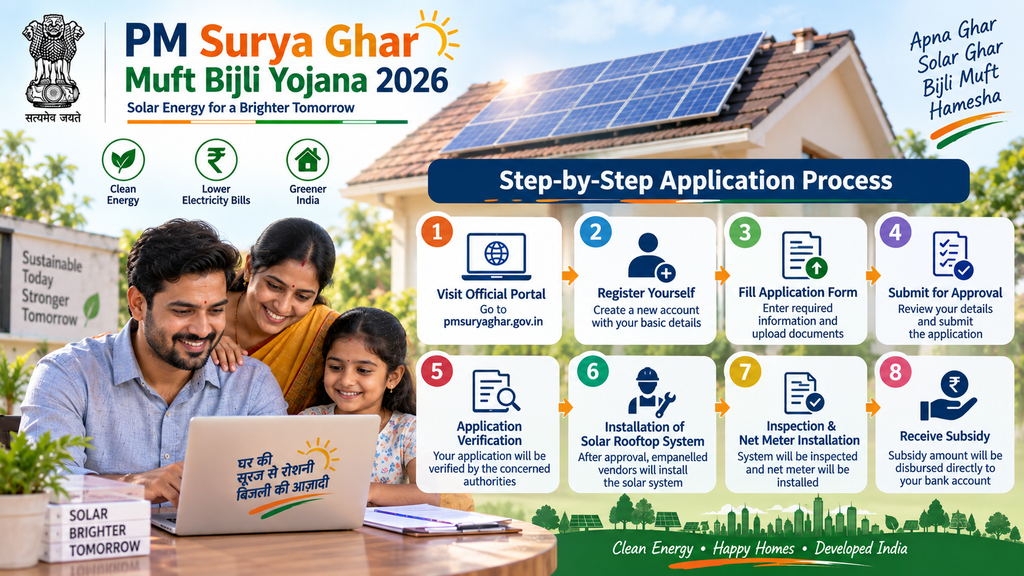
PM Surya Ghar Muft Bijli Yojana 2026 – Step-by-Step Application Process
Step 1: Visit the Official Portal
Go to https://pmsuryaghar.gov.in.
Step 2: Register
Create an account on the official portal by entering your state, electricity provider (DISCOM), electricity consumer number, and mobile number. After entering these details, verify your mobile number using the OTP sent to your phone.
Step 3: Login
Use the registered mobile number to log in to the portal.
Step 4: Apply for Rooftop Solar
Fill in the application form with details such as rooftop type, electricity consumption, and proposed solar system capacity.
Step 5: Approval from DISCOM
The electricity distribution company reviews the application and provides approval for installation.
Step 6: Install Solar Panels
Choose an empanelled vendor listed on the portal and get the rooftop solar system installed.
Step 7: Net Meter Installation and Inspection
After installation, the DISCOM conducts an inspection and installs a net meter if applicable.
Step 8: Submit Commissioning Details
Upload installation and commissioning documents through the portal.
Step 9: Receive Subsidy
Once the system is approved, the subsidy amount is transferred directly to the applicant’s bank account.
Loan Options for Financing the Upfront Cost
Although the subsidy reduces the cost significantly, households still need to pay the remaining amount for the solar system. To make installation affordable, several banks and financial institutions offer rooftop solar loans.
Common features of solar financing include:
- Low-interest loan options
- Flexible repayment periods
- Minimal documentation
- Financing for the remaining amount after subsidy
- EMI payments that may be partly offset by electricity bill savings
Some lending institutions have also introduced special solar loan products linked with PM Surya Ghar installations.
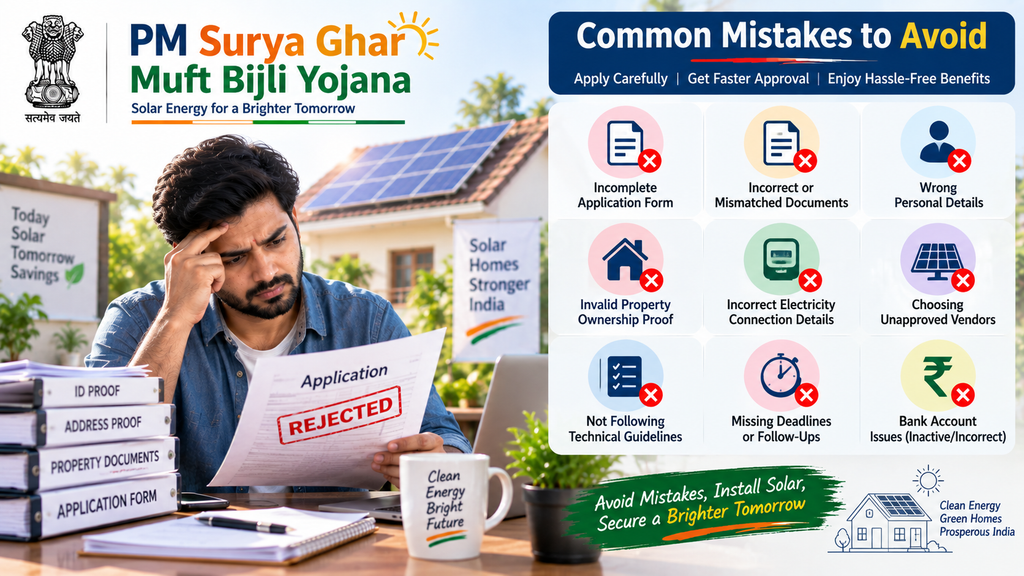
Common Mistakes to Avoid
Many applicants face delays because of avoidable errors. Keep these points in mind:
- Do not apply through unofficial websites.
- Ensure the electricity consumer number is entered correctly.
- Upload clear copies of all required documents.
- Use only government-approved empanelled vendors for installation.
- Check whether your rooftop has sufficient sunlight exposure.
- Verify bank account details before submitting the application.
- Complete each stage of the process on the official portal.
Careful documentation and using approved installers can help speed up subsidy approval.
Environmental and Long-Term Financial Benefits
Installing rooftop solar panels provides both financial and environmental advantages.
Lower Electricity Bills
Solar panels generate electricity every day, reducing dependence on grid power and lowering monthly electricity expenses.
Protection from Future Tariff Increases
As electricity prices rise over time, households with rooftop solar are less affected because they generate a large part of their own electricity.
Long-Term Savings
A rooftop solar system can continue producing electricity for 20–25 years or more, allowing families to recover the installation cost over time and enjoy years of reduced electricity bills.
Increased Property Value
Homes with installed rooftop solar systems may become more attractive to future buyers because of lower running costs.
Clean Energy
Solar power reduces the use of fossil-fuel-based electricity and helps lower carbon emissions, supporting India’s renewable energy goals.
PM Surya Ghar Muft Bijli Yojana – Conclusion
The PM Surya Ghar Muft Bijli Yojana 2026 is an excellent opportunity for Indian homeowners who want to reduce electricity bills and adopt clean energy. With a government subsidy of up to ₹78,000, simplified online registration, and financing options through banks, rooftop solar has become more affordable than ever before.
If you own a house with a suitable rooftop and have a valid electricity connection, applying through the official PM Surya Ghar portal can help you save money for many years while contributing to a greener future. Before applying, always verify the latest subsidy rules and empanelled vendors through the official government website.