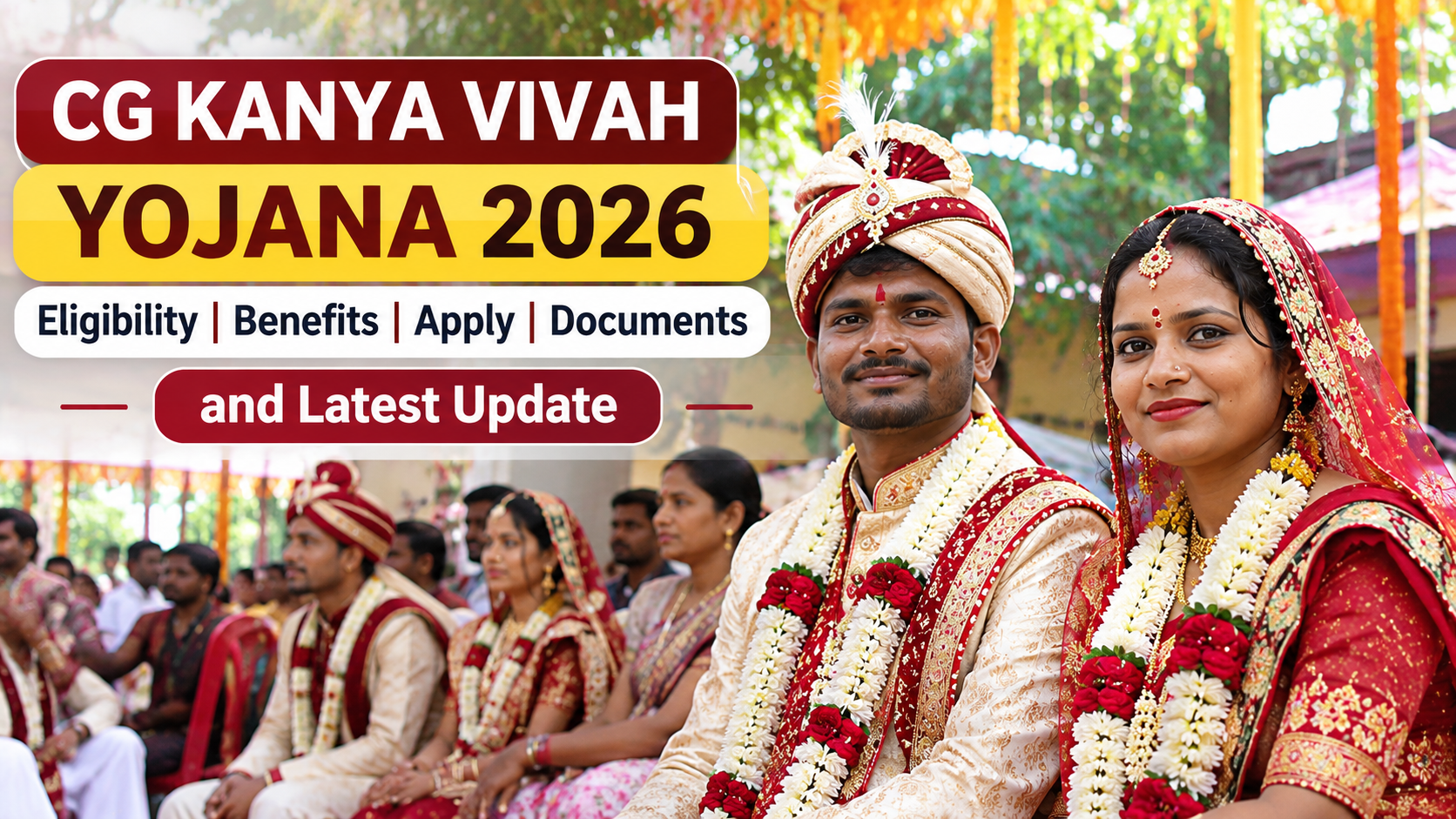
CG Mukhyamantri Kanya Vivah Yojana 2026 : The CG Mukhyamantri Kanya Vivah Yojana 2026 is a Chhattisgarh government initiative designed to support economically weaker families with the marriage expenses of their daughters. The scheme focuses on reducing the financial pressure associated with marriage, encouraging simple and dignified ceremonies, and promoting collective marriages without dowry.
Under the revised assistance structure reported for the scheme, eligible brides can receive support of up to ₹50,000 per marriage. This includes financial assistance for the bride, essential marriage-related materials and arrangements for the collective wedding ceremony. The scheme is administered by the Women and Child Development Department, Government of Chhattisgarh.
What Is CG Mukhyamantri Kanya Vivah Yojana 2026?
The Mukhyamantri Kanya Vivah Yojana is a social welfare programme implemented by the Government of Chhattisgarh through its Women and Child Development Department. It addresses the financial difficulties faced by economically weaker households when arranging their daughters’ marriages.
Marriage expenses can place considerable pressure on families with limited incomes. Expenditure on wedding arrangements, clothing, household necessities and other traditional requirements can become difficult to manage. The scheme seeks to reduce this burden through government-supported marriage assistance and organised mass marriage ceremonies.
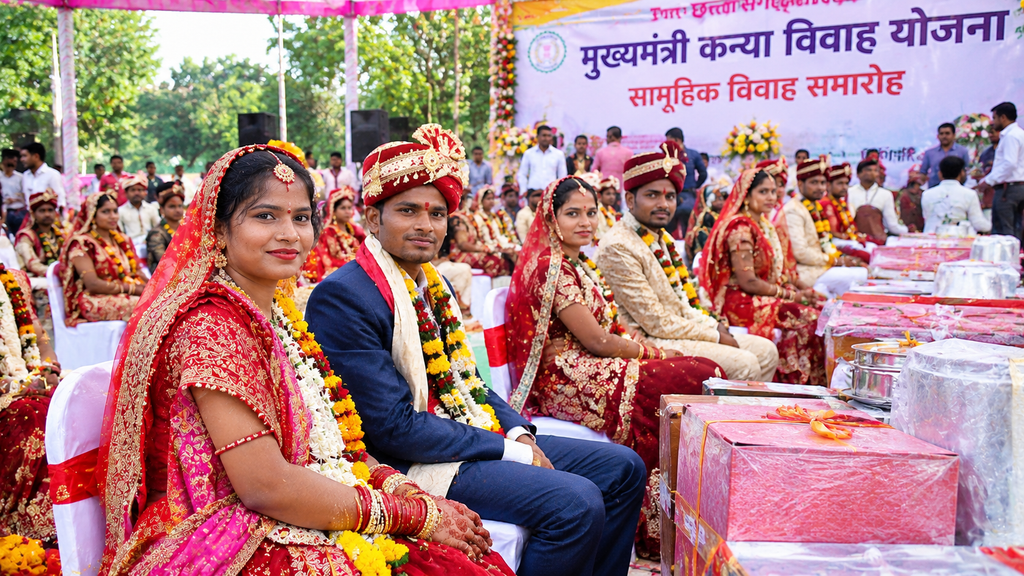
An important feature of the programme is its emphasis on collective marriages. Instead of requiring every family to organise a separate and expensive wedding, the government facilitates ceremonies in which several eligible couples can marry together.According to the Chhattisgarh government’s published scheme description, its objectives include reducing unnecessary wedding expenditure, improving the social standing of economically weaker families and discouraging dowry transactions.
CG Kanya Vivah Yojana 2026: Key Highlights
The following table summarises the principal scheme details.
| Particulars | Details |
|---|---|
| Scheme name | Mukhyamantri Kanya Vivah Yojana |
| State | Chhattisgarh |
| Implementing department | Women and Child Development Department |
| Scheme category | Marriage assistance |
| Main beneficiaries | Eligible economically weaker families |
| Bride’s minimum age | 18 years |
| Groom’s minimum age | 21 years |
| Financial assistance | Up to ₹50,000 per eligible marriage |
| Direct assistance to bride | ₹35,000 |
| Material assistance | Up to ₹7,000 |
| Mass marriage arrangements | Up to ₹8,000 |
| Application method | Through the designated local department |
| Official website | cgwcd.gov.in |
The ₹50,000 assistance structure is reported in updated scheme listings. Applicants should confirm the applicable distribution and conditions with their district department before registration.
What Is the Objective of Mukhyamantri Kanya Vivah Yojana?
The scheme is intended to address more than the immediate cost of a wedding. Its broader objective is to make marriage arrangements more accessible to families who might otherwise struggle to meet the associated expenses.
Reducing the financial burden on families: The programme provides financial and material assistance to eligible households. This can help families manage essential marriage-related expenses without relying entirely on personal savings or borrowing.
Encouraging simple marriages: Expensive wedding arrangements can create unnecessary financial pressure. The programme promotes relatively simple and organised ceremonies.
Promoting mass marriages: Collective ceremonies allow several couples to participate in an organised event. This also helps the administration coordinate beneficiary verification and arrangements.
Discouraging dowry practices: The programme promotes marriages without dowry-related transactions and supports a more socially responsible approach to marriage.
These objectives are consistent with the scheme description published by the Chhattisgarh district administration.

How Much Financial Assistance Is Available Under the Scheme?
One of the most important questions for applicants is how much financial assistance is provided under CG Mukhyamantri Kanya Vivah Yojana 2026.The revised assistance structure reported for the programme provides for expenditure of up to ₹50,000 per eligible bride.
Total assistance provision per eligible marriage
₹50,000
Maximum reported scheme allocation per beneficiary
Financial assistance to bride
₹35,000
Marriage-related materials
Up to ₹7,000
Mass marriage arrangements
Up to ₹8,000
The figures represent the reported allocation structure, not ₹50,000 deposited directly into the bride’s bank account.
₹35,000 Direct Financial Assistance
Under the reported revised structure, ₹35,000 is allocated as financial assistance for the bride. The updated scheme descriptions identify a bank draft as the payment method.Eligible families should confirm the payment procedure and account-related requirements with the responsible district office.
Up to ₹7,000 for Marriage Materials
A provision of up to ₹7,000 is reported for essential marriage-related materials and gifts. These provisions are intended to support the couple with necessary items.
Up to ₹8,000 for Mass Marriage Arrangements
The remaining provision of up to ₹8,000 is intended for the organisation of the collective marriage ceremony. This may cover arrangements associated with conducting the programme.
Important: The total provision should not be interpreted as an unconditional cash payment of ₹50,000 to every applicant. The assistance is subject to eligibility, departmental approval and applicable government instructions.
CG Mukhyamantri Kanya Vivah Yojana 2026 Eligibility Criteria
Before submitting an application, families should understand the eligibility requirements. The scheme is primarily intended for economically weaker households in Chhattisgarh.
The published scheme information identifies BPL families and eligible families holding ration cards under the Chief Minister’s food assistance arrangements as the principal beneficiary groups.
1. Permanent Resident of Chhattisgarh
The applicant should belong to Chhattisgarh and satisfy the applicable state residence requirements.
2. Economically Weaker Family
The family should fall under the eligible BPL category or the qualifying food-grain assistance category specified by the government.
Possession of a ration card alone should not automatically be treated as confirmation of eligibility. The relevant category and current departmental conditions must be checked.
3. Minimum Age of the Bride
The bride must have completed 18 years of age by the date of marriage. Age verification is an important part of the registration process.
4. Minimum Age of the Groom
The groom must have completed 21 years of age by the date of marriage. Applicants should provide valid age-related documents for verification.
5. Maximum Two Daughters Per Family
The published scheme guidelines specify a limit of two eligible daughters from a family.
6. Participation in a Mass Marriage Ceremony
The programme is based on government-organised collective marriages. Applicants should confirm the designated ceremony and registration requirements with the department.
7. Departmental Verification
The submitted application and supporting documents must be checked by the responsible officials. Registration alone does not guarantee approval or financial assistance.
Who Can Apply for the Scheme?
The scheme is designed for families that face financial difficulties in arranging their daughters’ marriages.
The following groups should contact their local Women and Child Development office to establish their eligibility:
- Families holding an eligible BPL card.
- Families covered under the qualifying state food-grain assistance category.
- Eligible households seeking assistance for their daughters’ first marriage.
- Families with up to two eligible daughters.
Some updated scheme listings also mention widows, orphan girls and destitute girls among potential beneficiaries. However, their applicable conditions and required supporting documents should be confirmed with the department rather than assumed to be identical to the general BPL eligibility conditions.
Documents Required for CG Kanya Vivah Yojana 2026
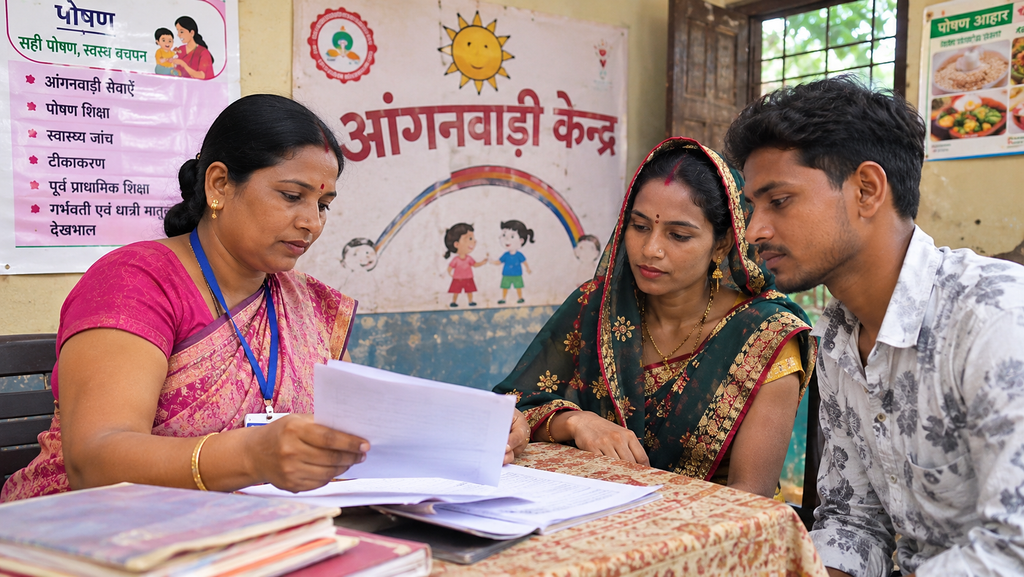
Applicants should prepare the necessary documents before contacting the local Anganwadi centre or departmental office.
The following is a practical preparation checklist based on the published application information. The district office may request additional documents depending on the applicant’s circumstances.
| Document | Purpose |
|---|---|
| Bride’s Aadhaar card | Identity verification |
| Groom’s Aadhaar card | Identity verification |
| Bride’s age proof | Verification of minimum age |
| Groom’s age proof | Verification of minimum age |
| BPL or eligible ration card | Family eligibility |
| Residence certificate | State residence verification |
| Bride’s bank details | Financial assistance procedure |
| Passport-size photographs | Application identification |
| Parent or guardian details | Family verification |
| Mobile number | Application communication |
Additional documents may be requested for special beneficiary categories, including applicable certificates for widows or orphan girls.
Why Is Document Verification Important?
The purpose of document verification is to establish that the applicant meets the scheme’s conditions. Incorrect personal information, mismatched names or incomplete age-related records can delay the process.
Families should ensure that the information provided in the application agrees with the supporting documents. They should also ask the responsible official whether photocopies, original documents or additional declarations are required.
How to Apply for CG Mukhyamantri Kanya Vivah Yojana 2026?
The application process is primarily handled through the local Women and Child Development Department and its field-level workers.The Chhattisgarh government district scheme page describes a process in which Anganwadi workers identify potential beneficiaries, supervisors verify the applications and the records are submitted to the departmental office.
Follow these steps to begin the application process.
Step 1: Visit the Nearest Anganwadi Centre
The family should first contact the Anganwadi worker in its area and ask about registration for the upcoming Mukhyamantri Kanya Vivah Yojana ceremony.The worker can provide information about the application requirements and the local registration process.
Step 2: Obtain Application Information
Ask the Anganwadi worker or the relevant Women and Child Development office about the prescribed application form.Confirm whether registrations are currently being accepted in the district and whether any specific deadline applies.
Step 3: Complete the Application Form
Provide the required information about the bride, groom and family.Names, dates of birth, residential details and other personal information should be entered carefully to avoid inconsistencies during verification.
Step 4: Attach the Required Documents
Attach the necessary identity, age, residence and family eligibility documents.The bride’s bank details should also be prepared if required under the applicable payment procedure.
Step 5: Submit the Application
Submit the completed application through the designated Anganwadi worker, supervisor or Child Development Project Officer (CDPO), following the instructions issued by the district department.
Step 6: Complete Document Verification
The responsible officials will examine the application and supporting records.If additional information or documents are required, the family should provide them through the official process.
Step 7: Wait for the Marriage Programme Information
Once the application has been examined, eligible families can obtain further information about the collective marriage ceremony, including the date, venue and reporting requirements.
Can applicants complete the entire process online?
The available government scheme description identifies an Anganwadi-based and departmental application process. It does not establish a fully online self-registration and approval facility. Therefore, families should not assume that filling in an online form alone completes registration.
Official department website: Chhattisgarh Women and Child Development Department.
How to Check CG Kanya Vivah Yojana Application Status 2026?
Families who have submitted their applications may want to know whether their documents have been verified and whether their names have been included in the upcoming marriage programme.
The available scheme information does not establish a separate public application-status tracking portal. Applicants can therefore follow up through the office handling their registration.
The following approach can help:
- Contact the Anganwadi worker through whom the application was submitted.
- Ask whether the application has been forwarded for verification.
- Contact the relevant supervisor or CDPO office if further clarification is needed.
- Provide the applicant’s details or acknowledgement information, if available.
- Confirm whether the bride’s name appears on the verified beneficiary list.
- Obtain the official marriage ceremony date and venue from the department.
Applicants should distinguish between application submission, document verification, beneficiary selection and final participation in the ceremony. These are separate stages.
CG Kanya Vivah Yojana 2026: Latest Update
2026 update :The scheme continues to receive attention as families seek government support for marriage-related expenses.
One notable development reported for 2026 was the organisation of a large collective marriage programme on 10 February 2026. An updated scheme information page reports that 6,412 couples were married across Chhattisgarh on that date. It also reports that each couple received ₹35,000 in financial assistance.
This development demonstrates the scale at which collective marriage programmes can be organised across the state.However, families planning to register for a later 2026 ceremony should not assume that the February programme’s schedule or arrangements automatically apply to subsequent events.
Has the Next Mass Marriage Date Been Announced?
A local report published in November 2026 states that applications were being invited while the next mass marriage date had not yet been finalised. However, this information should be confirmed with the relevant district office because an independently published report is not equivalent to a government notification. Families should contact the department for the latest confirmed date, venue, application deadline and beneficiary list.
What Makes This Scheme Different from Other Marriage Assistance Programmes?
The main distinction is the combination of individual assistance and collective marriage arrangements.Some marriage assistance programmes primarily provide a financial benefit to an eligible household. Mukhyamantri Kanya Vivah Yojana also uses organised community ceremonies as an important part of implementation.
This approach has several practical implications.
First, it can reduce the need for individual families to arrange every aspect of a wedding independently. Second, it gives the department an opportunity to verify beneficiaries through a common administrative process. Third, it promotes a simple marriage model that does not depend on expensive private arrangements.
There are also practical limitations. Families may have to coordinate their plans with the dates and locations selected by the district administration. Those who prefer a private ceremony should not assume that the same assistance will be available for an independently organised wedding.For this reason, understanding the collective-marriage requirement is just as important as knowing the financial assistance amount.
Also Check:
- Chhattisgarh Annapurti Grain ATM 2026: What Is the Annapurti Grain ATM and How Does It Work?
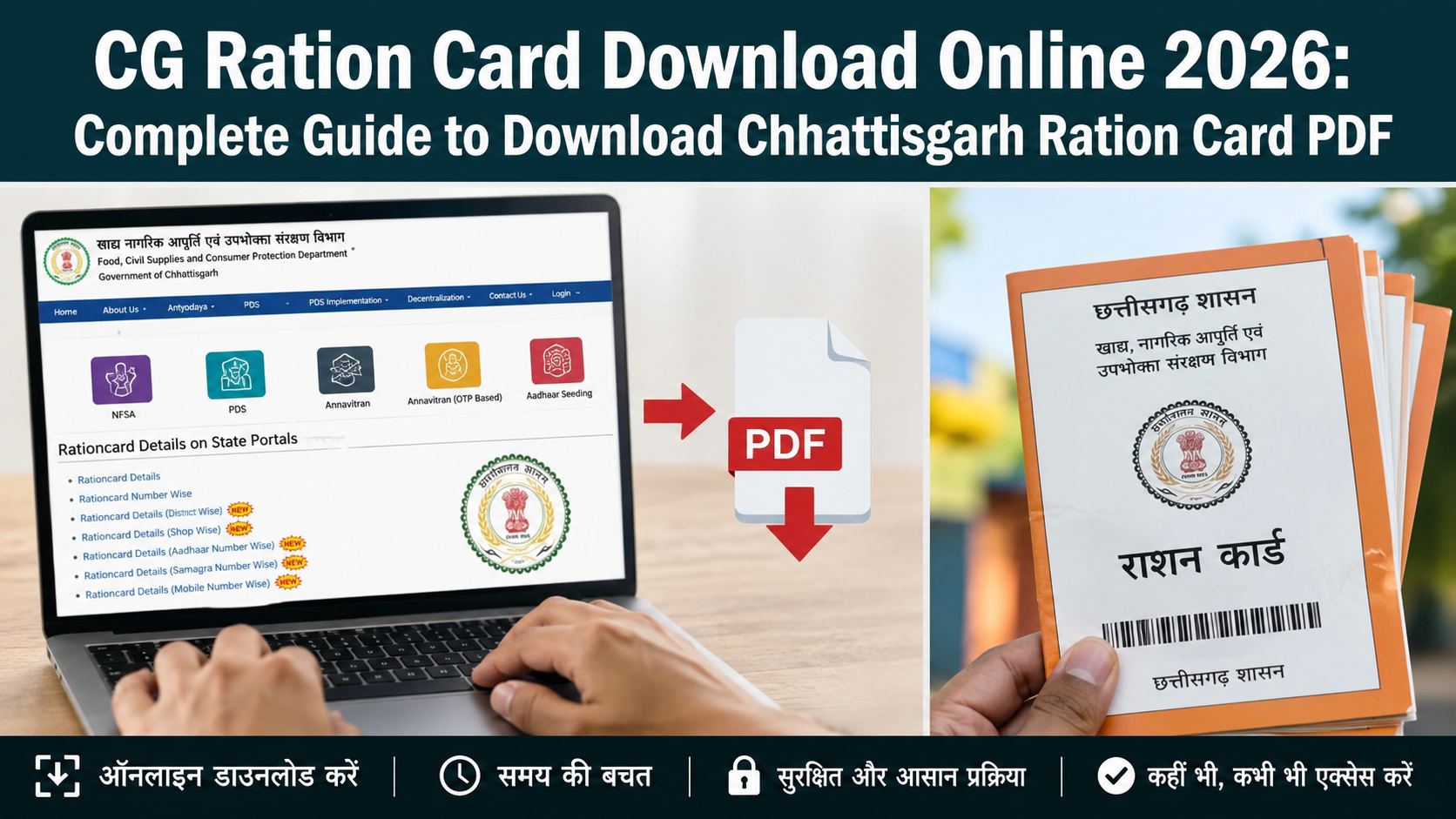
- CG Ration Card Download Online 2026: Check how to download the Chhattisgarh Ration Card PDF
Important Points Applicants Should Remember
Before registering, families should keep several practical considerations in mind.
Check the current assistance structure: The reported ₹50,000 provision includes different components. It should not be treated as a guaranteed direct payment of the entire amount.
Verify the age conditions: The bride must be at least 18 and the groom at least 21 at the time of marriage.
Confirm the family category: BPL and eligible food-grain card requirements should be checked against the current departmental guidelines.
Do not wait until the last moment: Contact the Anganwadi worker early to learn about the next registration period.
Keep application information accurate: Incorrect age, identity or residential details can create verification difficulties.
Confirm the ceremony date: Do not make travel or wedding arrangements based on unverified social media messages.
Use official channels: Families should obtain information from the Women and Child Development Department rather than relying on unofficial agents who promise guaranteed approval.

In Conclusion
The CG Mukhyamantri Kanya Vivah Yojana represents an important form of social assistance for economically weaker families in Chhattisgarh. Its approach combines financial support with organised marriage ceremonies, addressing both the immediate expenses of marriage and the wider social pressures that can affect low-income households.However, the usefulness of the programme depends on more than the amount allocated. Clear eligibility rules, timely registration, transparent beneficiary verification and proper communication of ceremony schedules are equally important.
Families considering the scheme should begin by contacting their local Anganwadi worker or Women and Child Development office. They should verify the latest assistance provisions, prepare the necessary documents and obtain confirmation of the next marriage programme before making arrangements. Accurate information and timely registration can help eligible families access the assistance available under the scheme.
Frequently Asked Questions (FAQs)
What is CG Mukhyamantri Kanya Vivah Yojana 2026?
It is a Chhattisgarh government marriage assistance programme implemented through the Women and Child Development Department. It supports eligible economically weaker families through financial and material assistance and organised mass marriage ceremonies.
How much money is given under Chhattisgarh Kanya Vivah Yojana?
The revised assistance structure provides for up to ₹50,000 per eligible marriage. This includes ₹35,000 in financial assistance for the bride, up to ₹7,000 for marriage materials and up to ₹8,000 for mass marriage arrangements.
Who is eligible for Mukhyamantri Kanya Vivah Yojana?
The scheme primarily covers eligible BPL families and qualifying food-grain cardholder households in Chhattisgarh. The bride must be at least 18 years old, and the groom must be at least 21 years old. Other conditions apply.
Can a family apply for two daughters under this scheme?
Yes. The published scheme guidelines provide assistance for a maximum of two eligible daughters from one family. Each daughter’s application must satisfy the applicable eligibility and verification requirements.
How can I apply for CG Kanya Vivah Yojana 2026?
Families can contact their nearest Anganwadi centre or the district Women and Child Development office. The application is processed through the designated officials, who verify the submitted documents and beneficiary eligibility.
Is online registration available for the scheme?
he published government process describes registration through Anganwadi workers and departmental offices. A complete online self-registration and approval facility has not been established by the available scheme information.
What is the minimum age required for the bride and groom?
The bride must have completed 18 years of age, while the groom must have completed 21 years of age at the time of marriage. Valid age-related documents are required for verification.
Has the CG Kanya Vivah Yojana 2026 marriage date been announced?
The February 2026 collective marriage programme has been reported, but the next ceremony date should be confirmed through the concerned district office.