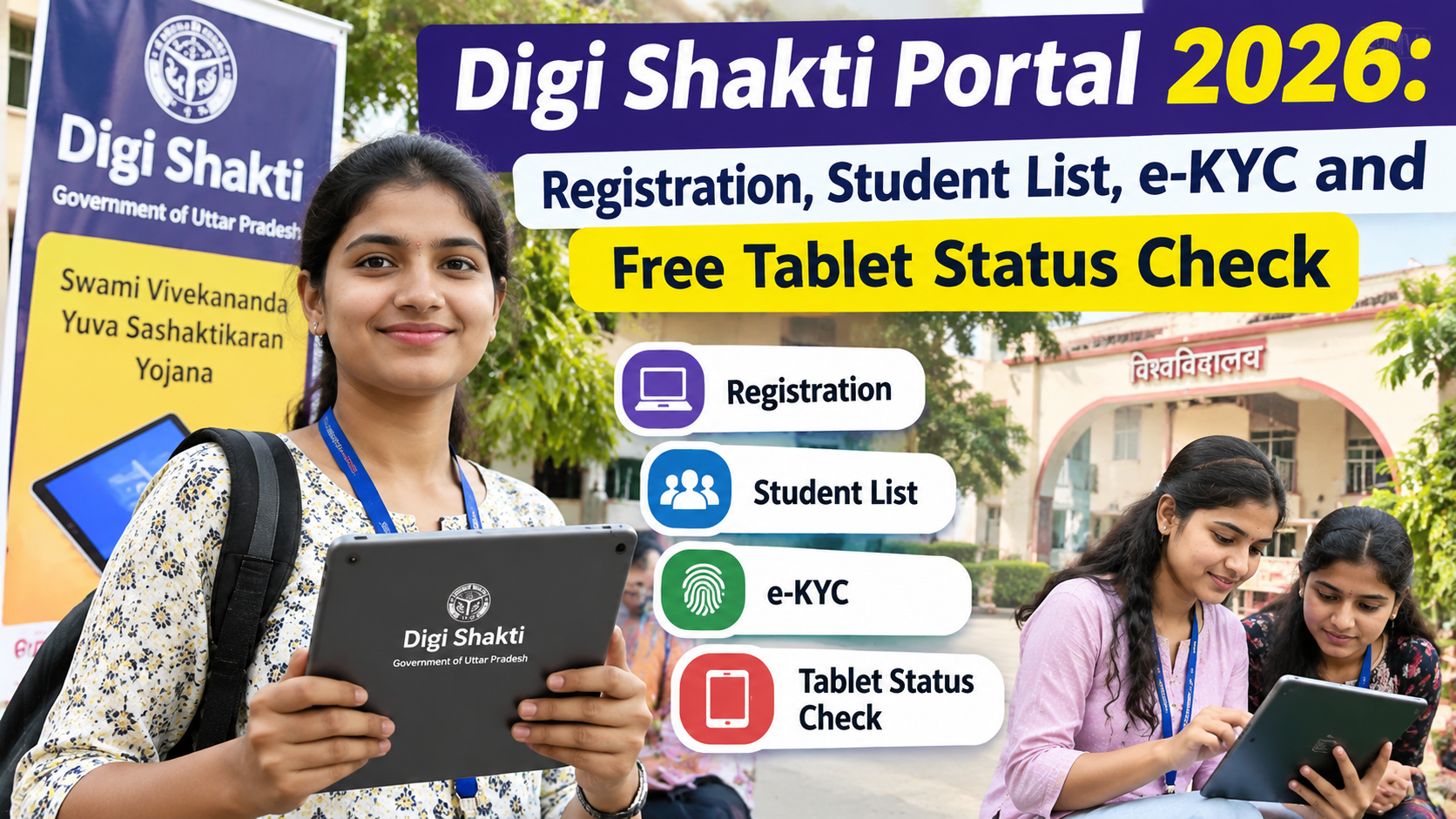
Digi Shakti Portal 2026: The Digi Shakti Portal is the official website for the free distribution of tablets and smartphones in Uttar Pradesh. Students can use the portal for Aadhaar e-KYC, beneficiary status checks and information about the verification process. Under the Swami Vivekananda Yuva Sashaktikaran Yojana, the state has started distributing another 25 lakh tablets from 15 November 2026. Chief Minister Yogi Adityanath inaugurated this distribution drive at Rashtra Prerna Sthal in Lucknow, where tablets were handed over to more than 50,000 students. The Uttar Pradesh government has allocated ₹2,374.60 crore for the scheme in the 2026–27 financial year.
The distribution of digital devices to students has become an important part of Uttar Pradesh’s efforts to improve access to higher education and technology. Students increasingly depend on online learning platforms, digital libraries, competitive examination resources and skill-development programmes. However, access to these facilities is not equally available to everyone.
The Uttar Pradesh government introduced the Swami Vivekananda Yuva Sashaktikaran Yojana to address this gap. The programme is administered through the Digi Shakti Portal, which helps educational institutions and government authorities manage student information and coordinate device distribution.
What Is Digi Shakti Portal 2026?
The Digi Shakti Portal is an online administrative platform developed for implementing Uttar Pradesh’s Swami Vivekananda Yuva Sashaktikaran Yojana. Its primary purpose is to facilitate the distribution of tablets and smartphones to eligible students enrolled in recognised educational institutions and programmes across the state.
The platform connects different stakeholders involved in the scheme, including UPDESCO, district authorities, universities, colleges, educational departments and device suppliers.
It also supports beneficiary-data management, distribution monitoring and the exchange of information between participating institutions. The Uttar Pradesh government’s Department of IT and Electronics describes DigiShakti as a system for monitoring scheme operations and coordinating the distribution proce
The programme is not simply about providing electronic devices. Its wider objective is to improve students’ access to educational content, online learning opportunities and employment-related information.
Digi Shakti Portal 2026: Latest Tablet Distribution Update
Latest update: 15 November 2026
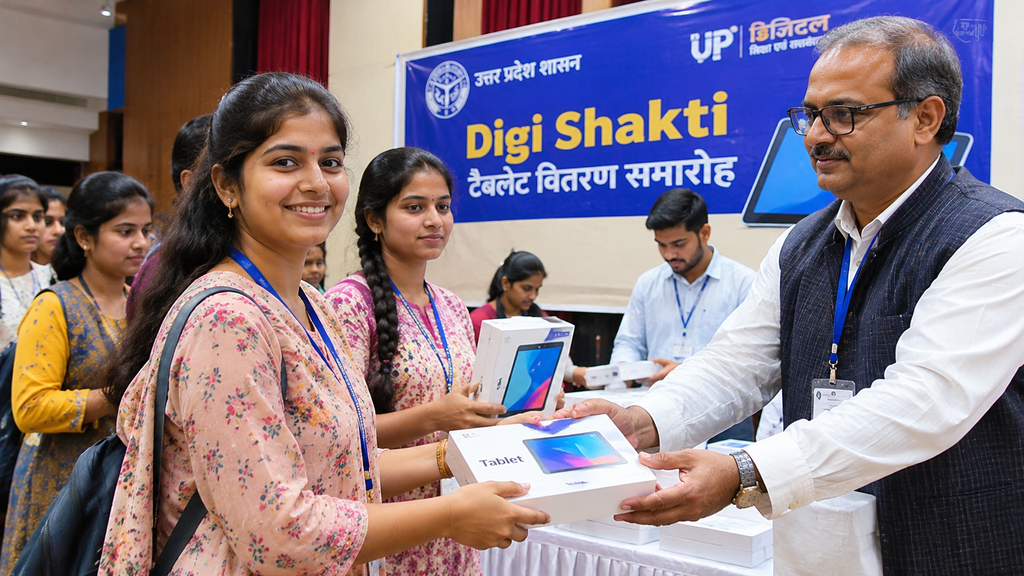
Uttar Pradesh started a fresh distribution phase under the Swami Vivekananda Yuva Sashaktikaran Yojana on 15 November 2026. The programme was inaugurated at Rashtra Prerna Sthal in Lucknow, with Chief Minister Yogi Adityanath participating in the event.
The latest phase covers 25 lakh additional tablets during the financial year 2026–27. Students from Lucknow, Hardoi, Sitapur and Unnao participated in the launch programme. News reports also stated that approximately 50,000 students attended the event.
The initiative builds on the earlier distribution programme, which began on 25 December 2021. According to the November 2026 reporting, more than 60 lakh tablets and smartphones had already been distributed under the scheme.
Important Scheme Details
| Particular | Information |
|---|---|
| Scheme Name | Swami Vivekananda Yuva Sashaktikaran Yojana |
| Popular Name | Digi Shakti Scheme |
| State | Uttar Pradesh |
| Implementing Government | Uttar Pradesh Government |
| Launch Year | 2021 |
| Main Objective | Digital empowerment of students |
| Latest Distribution Phase | 15 November 2026 |
| Additional Distribution Target | 25 lakh tablets |
| Financial Year | 2026–27 |
| Online Portal | Digi Shakti Portal |
| Beneficiary Verification | Aadhaar e-KYC |
| Official Website | digishakti.up.gov.in |
What Are the Objectives of the Digi Shakti Scheme?
The scheme aims to reduce the digital divide among students and improve their ability to access educational resources.A tablet can provide access to digital textbooks, online classes, educational videos, examination preparation materials and professional development courses. Students can also use digital platforms to explore employment opportunities and improve their technical knowledge.
Another important objective is to make digital education more accessible to students who may not have regular access to suitable devices.The government has also introduced educational applications and digital learning content through the scheme. Its Department of IT and Electronics has identified DigiShakti Adhyayan and Infosys Springboard among the applications associated with the initiative.

Digi Shakti Portal 2026 Eligibility Criteria
Students must satisfy the applicable scheme and institutional requirements to be considered for a tablet.The programme covers several educational streams, including higher education, technical education, vocational training, medical education and agricultural education. Central universities located in Uttar Pradesh have also been included in the reported coverage.The final beneficiary selection is carried out through participating institutions and the relevant government departments.
Who Can Benefit?
The reported categories include:
- Students pursuing undergraduate and postgraduate education.
- Students enrolled in technical education programmes.
- Students studying in vocational and skill-development institutions.
- Students enrolled in medical and nursing education programmes.
- Students pursuing agricultural education and research.
- Students enrolled in eligible central universities located in Uttar Pradesh.
- Students covered under other participating government departments and recognised programmes.
The Times of India reported that there was no income or age limit for eligible students under the scheme. Nevertheless, students should verify their course, institution and beneficiary status rather than assuming that enrolment in any college automatically guarantees a tablet.
Is There Any Income Limit?
According to the November 2026 reporting on the scheme, there is no income ceiling for eligible students. The initiative is intended to cover students across different economic backgrounds.
However, institutional coverage and the approved beneficiary records remain important. Students should confirm their eligibility with their college or university.
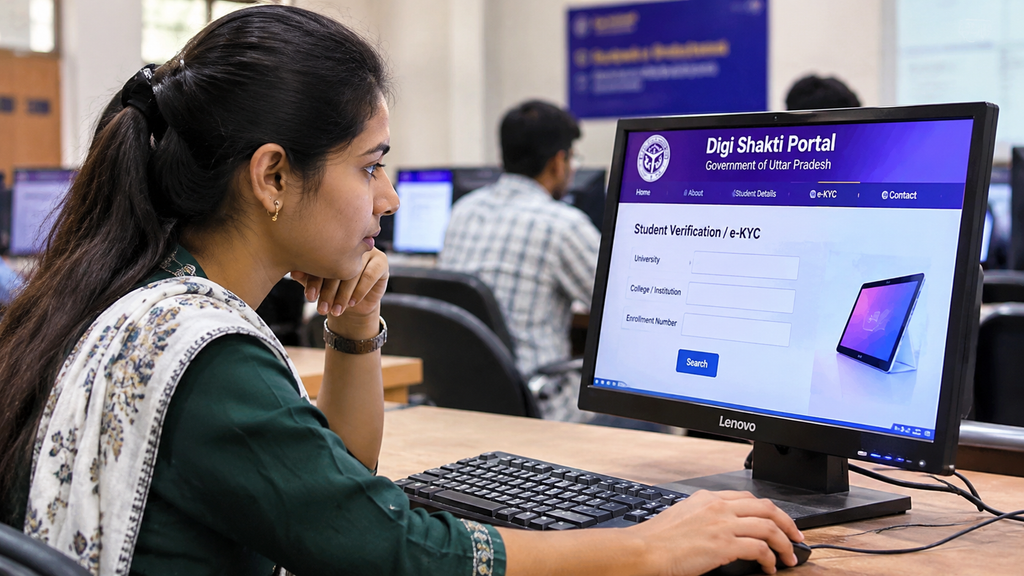
How to Check Your Name on Digi Shakti Portal 2026
Students can use the official Digi Shakti website to access the student information and e-KYC facility.
The following process explains how to search for student details:
- Visit the official Digi Shakti Portal.
- Find the student e-KYC facility on the homepage.
- Select the option labelled e-KYC through MeriPehchaan Portal.
- Open the student details search facility.
- Select the relevant university or educational institution.
- Enter your enrolment number as requested.
- Check whether your student information appears.
- If your record is available, follow the instructions for Aadhaar authentication.
The student verification procedure is also reflected in government-related instructions reproduced in institutional notices.
Important: The portal’s student search facility should not be confused with a final device-allotment confirmation. Your institution is responsible for confirming beneficiary selection and communicating the distribution schedule.
How to Complete Digi Shakti e-KYC 2026?
Aadhaar authentication is an important part of the beneficiary verification process. It helps the authorities verify the identity of the student whose information has been uploaded by the institution.Students should complete the process through the official Digi Shakti website and the linked MeriPehchaan service.
Step-by-Step e-KYC Process
Step 1: Open the Digi Shakti website
Visit the Uttar Pradesh government’s official Digi Shakti Portal.
Step 2: Select the e-KYC facility
Click on the option titled e-KYC through MeriPehchaan Portal.
Step 3: Search your student record
Select your university and institution, then provide the enrolment number requested by the portal.
Step 4: Open the MeriPehchaan service
If your student record is available, proceed to the linked e-Pramaan/MeriPehchaan authentication facility.
Step 5: Complete Aadhaar authentication
Follow the displayed identity-verification instructions. Use the authentication method offered by the official service.
Step 6: Check the verification result
After completing the process, check whether your authentication has been successfully recorded.Students should ensure that their name and other relevant details are consistent with their institutional records. If a mismatch appears, the college’s designated nodal officer should be contacted.
How to Check Digi Shakti Tablet Distribution Status 2026?
One of the most common questions among students is whether their tablet has been approved or when they will receive it.The answer depends on the stage of institutional verification and distribution.
Students should first check whether their information is available through the portal’s student search facility. They should then contact their college or university to confirm whether their name is included in the approved beneficiary records.The next step is to follow institutional notices regarding distribution dates, venues and collection arrangements.
The University of Lucknow, for example, maintains a dedicated DigiShakti distribution information page containing student-wise distribution notices, transportation arrangements, e-KYC instructions and other programme-related updates.
What If Your Name Is Not Showing?
If your student details do not appear, there may be an issue with the institutional data uploaded to the portal.Students should contact their college administration and request verification of their university, institution and enrolment details.
Entering incorrect information repeatedly is unlikely to resolve an institutional data issue. The concerned college or university should check whether the student’s records have been uploaded and processed correctly.
What Benefits Do Students Receive Under the Scheme?
The most visible benefit is access to a digital device that can support academic activities.Students can use tablets to access online educational material, digital libraries, virtual learning environments and career-related information. The device may also make it easier to participate in online training and develop familiarity with digital technology.
The scheme’s digital-learning component is particularly relevant for students pursuing technical, professional and skill-oriented courses.However, the practical benefit depends on more than device distribution. Reliable internet connectivity, relevant learning material, digital skills and regular academic guidance are also necessary for students to make effective use of the technology.
What Should Students Do If Digi Shakti e-KYC Fails?
An unsuccessful authentication attempt does not necessarily mean that a student has been permanently excluded from the scheme.The first step is to identify whether the issue relates to personal information, institutional records or the authentication service.
Students should check their enrolment details and confirm that the institution has uploaded the correct information. If the problem continues, they should approach their college’s DigiShakti nodal officer or administrative office.Students should not pay intermediaries who promise to correct records or guarantee tablet distribution.
Competitive Advantage: What Students Should Understand Before Waiting for a Tablet
The most important distinction in the Digi Shakti process is that registration, verification and distribution are separate administrative activities.A student may have an existing college record but still need to complete e-KYC. Similarly, successful Aadhaar authentication does not independently establish that a tablet has been allocated.
The Uttar Pradesh government’s own description of the portal assigns beneficiary selection and distribution responsibilities to districts and educational institutions. These institutions also have to update beneficiary and distribution information on the platform. This means students should follow three things together: the status of their student information, completion of identity verification and official college distribution notices.
For students, this approach is more reliable than depending on unverified social media announcements or unofficial websites claiming to publish a complete statewide beneficiary list.
Also Read:
- UP Free Laptop Yojana 2026: 25 Lakh Free Tablets Distribution Begins Under Digi Shakti Scheme
- UP Yuva Hub Yojana 2026: Benefits, Eligibility, Registration and Latest Updates
Is Digi Shakti Portal Registration Free?
Students should use the official government website for scheme-related information and verification. They should not treat the scheme as a paid application service.
The institution’s role in uploading and verifying student information is central to the process. Students should confirm the procedure with their college rather than paying an agent or submitting personal information to an unrelated website
In Conclusion
The Digi Shakti Portal represents an important administrative component of Uttar Pradesh’s efforts to extend digital access to students. Its value lies not only in the number of devices distributed but also in how effectively those devices are connected with meaningful educational opportunities.
The November 2026 distribution phase, with a target of 25 lakh additional tablets, gives the programme another significant expansion. For students, however, the immediate priority is to ensure that their institutional information is correct, Aadhaar verification is completed where required and college announcements are followed carefully.
A tablet can improve access to educational resources, but its contribution ultimately depends on how students are able to use it. The success of Digi Shakti will therefore be measured not merely by distribution figures, but by the quality of digital learning opportunities that follow.
Frequently Asked Questions (FAQs)
Who is eligible for the Digi Shakti Scheme?
Students enrolled in participating Uttar Pradesh educational institutions and eligible programmes may benefit. The coverage includes higher education, technical education, vocational training, medical education and agricultural education. Final selection depends on institutional and departmental records.
How can I check my name in the Digi Shakti student list?
Visit the official website, open the student e-KYC facility and select the MeriPehchaan option. Search your details using the university, institution and enrolment information requested by the portal.
Is Aadhaar e-KYC compulsory for Digi Shakti?
Aadhaar authentication is part of the beneficiary verification process before device distribution. Students whose records are available should follow the official e-KYC instructions through the Digi Shakti and MeriPehchaan services
When did the latest UP tablet distribution start in 2026?
The latest distribution phase began on 15 November 2026 at Rashtra Prerna Sthal in Lucknow. The state announced a target of distributing 25 lakh additional tablets during the 2026–27 financial year.
Can students apply directly for a free tablet?
The process is coordinated through participating educational institutions. Students should contact their college to confirm whether their information has been uploaded and whether they have been selected.
What should I do if my Digi Shakti e-KYC is unsuccessful?
Check whether your institutional details and enrolment information are correct. If the problem continues, contact your college’s DigiShakti nodal officer for assistance with the uploaded student record and verification process.
Is there any application fee for Digi Shakti Portal?
Students should use the official government portal and follow institutional instructions. They should not pay agents or unauthorised websites claiming to guarantee registration, beneficiary selection or tablet distribution.