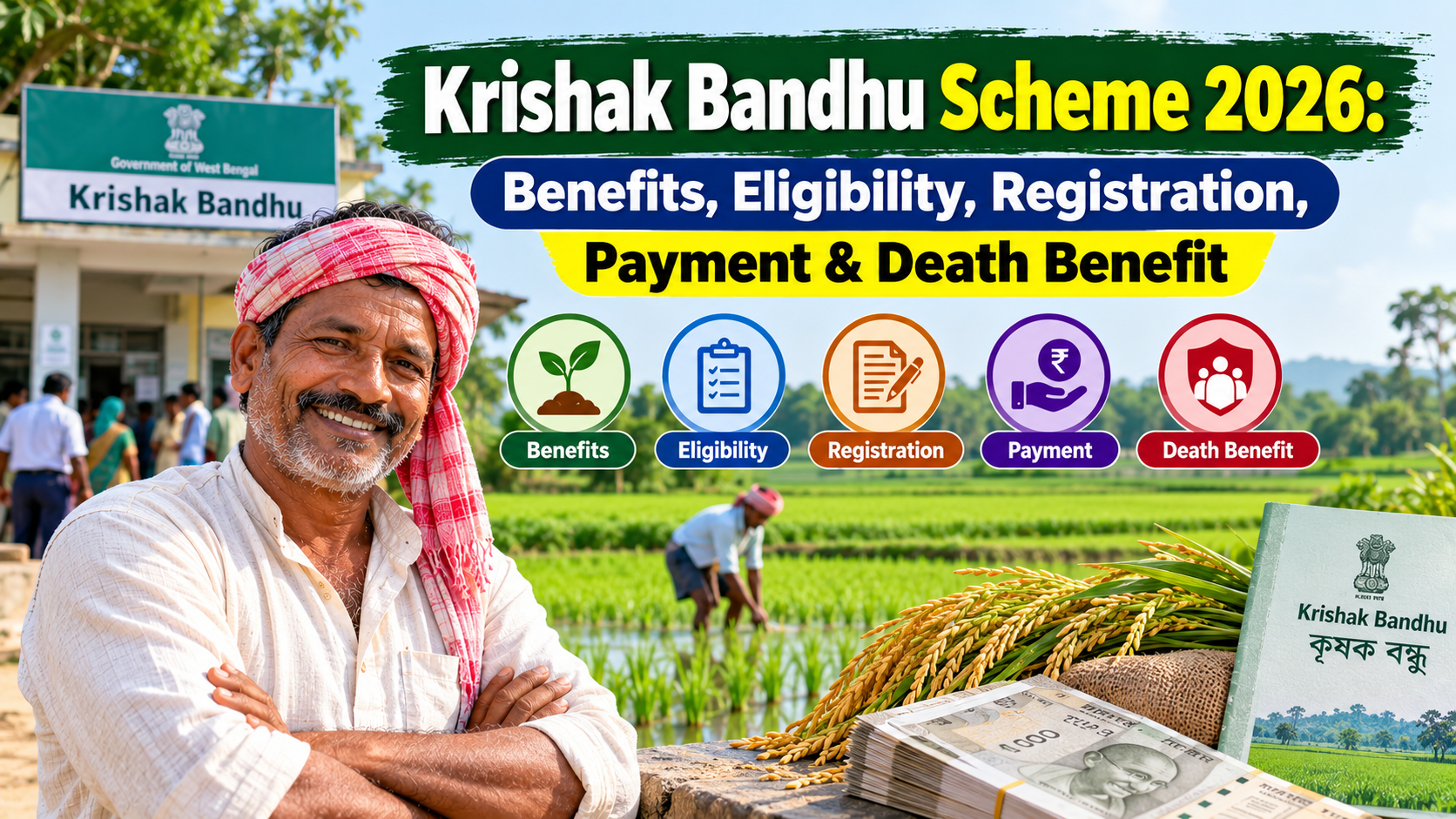
Krishak Bandhu Scheme 2026: For farmers in West Bengal, financial support at the beginning of a cropping season can influence decisions about seeds, fertilisers, cultivation inputs and other farm expenses. The Krishak Bandhu Scheme, now officially referred to as Krishak Bandhu (Natun), is a state government programme designed around this requirement while also providing financial protection to eligible farming families following the death of a farmer.
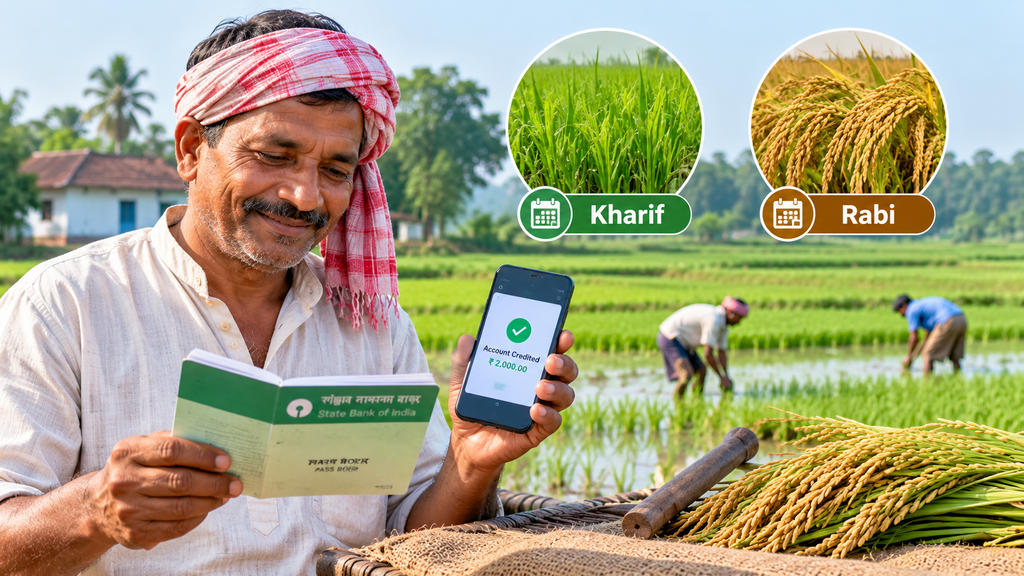
The scheme was originally introduced in January 2019 by the Department of Agriculture, Government of West Bengal. It was subsequently recast as Krishak Bandhu (Natun) and launched in its revised form on 17 June 2021. Under the current scheme guidelines, farmers with one acre or more of cultivable land can receive financial assistance of up to ₹10,000 per year. Those cultivating less than one acre are eligible for a proportionate amount, with the assistance subject to a minimum of ₹4,000 annually. The cultivation support is released in two instalments, covering the Kharif and Rabi seasons.
The scheme also includes a separate Krishak Bandhu Death Benefit. If an eligible farmer dies between the ages of 18 and 60 years, the family can receive a one-time ₹2 lakh financial assistance, irrespective of the cause of death under the current state scheme description.
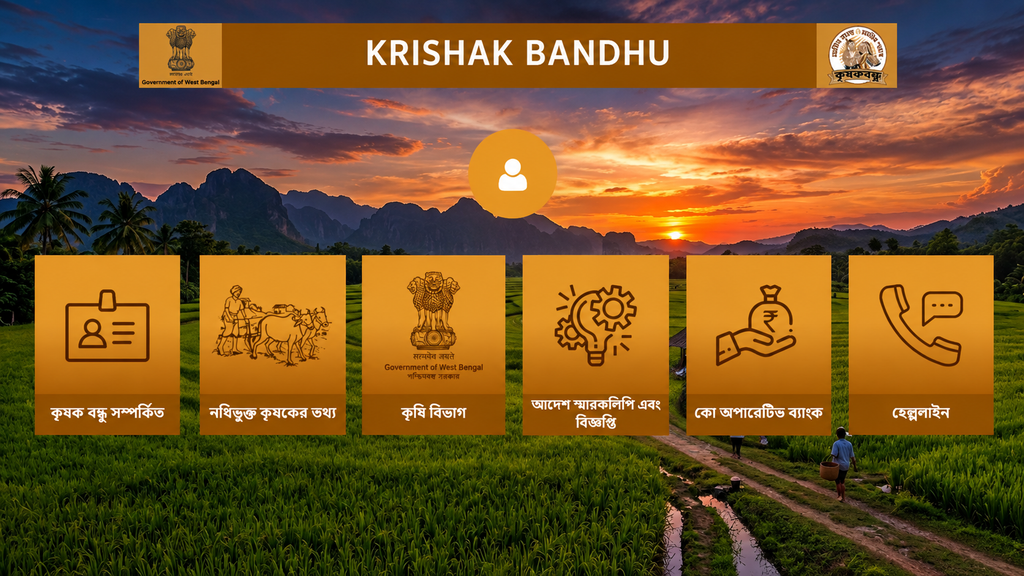
What Is Krishak Bandhu (Natun)?
Krishak Bandhu (Natun) is a farmer-support scheme of the Government of West Bengal administered through the state’s Agriculture Department.Its basic structure has two important dimensions. The first is direct financial assistance intended to help farmers meet cultivation-related expenses. The second is the Death Benefit component, which provides a one-time payment to the family of an eligible deceased farmer.
The West Bengal Agriculture Department describes the scheme as providing financial support at the beginning of each cropping season. The stated purpose includes helping farmers purchase agricultural inputs and make decisions relating to crop selection, input procurement and improved farming practices.
It is important to understand that the annual cultivation assistance and the Krishak Bandhu Death Benefit are two separate forms of support. The cultivation assistance is provided regularly to help eligible farmers with agricultural expenses, whereas the Death Benefit is a separate financial support provided to the family when an eligible farmer dies
| Detail | Information |
|---|---|
| Scheme Name | Krishak Bandhu Scheme |
| Level | State |
| Beneficiary State | West Bengal |
| Scheme Target | Families |
| Category | Agriculture, Rural & Environment, Social Welfare & Empowerment |
| Beneficiary Type | Individual, Family |
| Sub-Category | Financial Assistance, Agricultural Inputs, Crisis/Disaster/Accident Support |
| Benefit Type | Cash |
| DBT Scheme | Yes |
| Nodal Department | Department of Agriculture |
| Implementing Agency | Department of Agriculture, Government of West Bengal |
Krishak Bandhu Scheme Benefits 2026
Under Krishak Bandhu (Natun), the main benefit is annual financial assistance linked to the farmer’s cultivable landholding. Farmers with one acre or more of cultivable land can receive up to ₹10,000 per year. For farmers with less than one acre, the assistance is calculated on a pro-rata basis, with the minimum annual support set at ₹4,000.
The payment is divided into two equal instalments:
| Season | Payment period |
|---|---|
| Kharif | April–September |
| Rabi | October–March |
| Total annual assistance | Up to ₹10,000 |
For a farmer receiving the maximum ₹10,000 annual assistance, the two instalments work out to ₹5,000 each. The actual amount for a farmer with less than one acre is determined on the applicable pro-rata basis, subject to the ₹4,000 annual minimum.

Who Is Eligible for Krishak Bandhu 2026?
Eligibility is linked to agricultural landholding and the records recognised under the scheme.The current official Krishak Bandhu information states that farmers possessing one acre or more of cultivable land qualify for the maximum annual assistance, while those holding less than one acre receive pro-rata assistance subject to the minimum amount.
The scheme’s official portal and Agriculture Department materials should be used for individual eligibility verification because land records and beneficiary information are subject to departmental verification.Earlier government documentation for the scheme also refers to recognised land records and recorded sharecroppers, including relevant RoR and Bhagchasi records. However, applicants should rely on the latest verification requirements issued by the West Bengal Agriculture Department rather than assuming that an older document list is unchanged.
How Much Money Is Given Under Krishak Bandhu?
The current direct assistance ranges from a minimum of ₹4,000 to a maximum of ₹10,000 per year, depending on cultivable land holding.A farmer with one acre or more can receive ₹10,000 annually. A farmer with less than one acre receives a proportionate amount, with the scheme providing a minimum annual assistance of ₹4,000.
The payment is made in two seasonal instalments. Therefore, readers should not interpret the ₹10,000 figure as a single payment credited at one time.The exact credit date may depend on the government’s payment process and beneficiary verification.
Krishak Bandhu Payment Schedule 2026
The official Agriculture Department describes the two payment periods as:
Kharif: April to September
Rabi: October to March
The annual assistance is divided equally between these two seasons.
This means a farmer eligible for the maximum ₹10,000 annual assistance can expect the benefit to be structured as two ₹5,000 instalments, subject to the applicable beneficiary records and payment process.Farmers should also distinguish the payment season from the exact bank-credit date. A seasonal window does not necessarily mean that every beneficiary receives money on the same day.
Krishak Bandhu Death Benefit 2026
The Death Benefit is a separate and significant part of the scheme.According to the West Bengal Agriculture Department, if a farmer dies between 18 and 60 years of age, the family is eligible for a one-time ₹2 lakh financial assistance. The department describes the benefit as applicable irrespective of the cause of death.
The purpose is different from the regular cultivation assistance. While the annual payment helps with agricultural expenses, the Death Benefit is intended to provide financial support to the bereaved family.The department’s official information says that since the scheme’s inception, ₹3,441.80 crore had been provided to 1,72,090 families of deceased farmers under the Death Benefit component. This is a cumulative figure reported by the department and should not be interpreted as a 2026-only payment figure.
Who Can Receive the ₹2 Lakh Death Benefit?
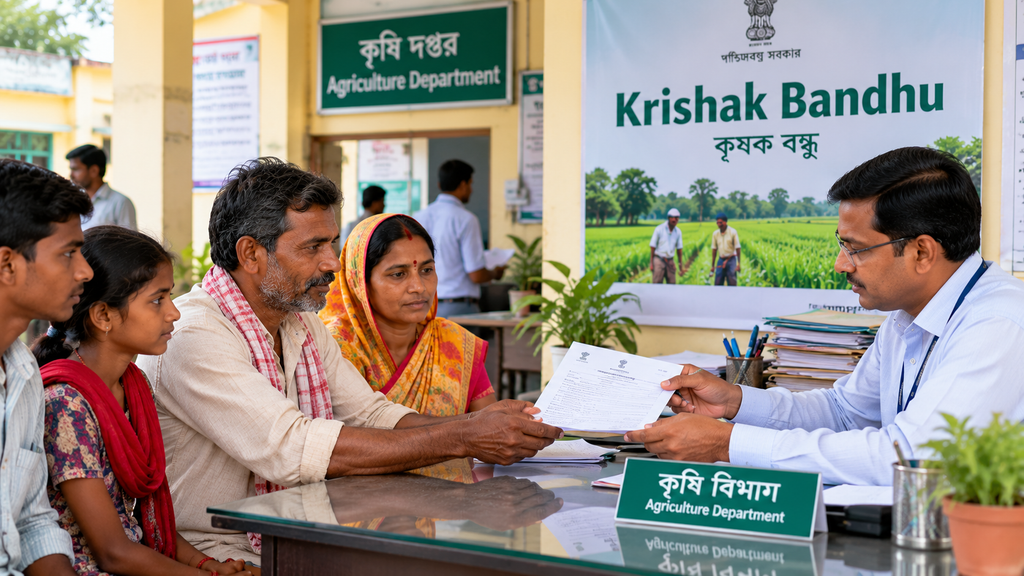
The current state description covers the death of a farmer within the 18–60 age group and provides a one-time ₹2 lakh grant to the family.The legal-heir and claim process requires verification. Older official SOP documentation specifies documents such as the deceased farmer’s identity proof, death certificate, claimant eligibility certificate, relevant land record and claimant declaration.
Because administrative requirements can be updated, families should confirm the latest document requirements with the concerned Agriculture Department office before submitting a claim.
Krishak Bandhu Registration 2026
Registration and verification are handled through the Krishak Bandhu system of the West Bengal Agriculture Department.The official Krishak Bandhu website provides scheme information, notifications and portal services. The scheme’s official information page directs farmers seeking registration and related information to the office of the Assistant Director of Agriculture at the block level.
Farmers should keep their land records, identity information and bank details consistent across official records. Errors or mismatches can affect verification and payment processing.The Agriculture Department’s portal also publishes updates and verification-related notices. A July 2026 notification, for example, lists Krishak Bandhu Natun verification materials and an updated annexure.

Krishak Bandhu Status Check
The official Krishak Bandhu portal provides a farmer-search facility through which beneficiary information can be searched using the available identification options on the portal.For status-related issues, farmers should use the official portal rather than relying on third-party websites that may display outdated information.
The official portal currently lists a Krishak Bandhu helpline number, 033-23570021, with stated working hours of 10 am to 5 pm, along with a helpdesk email.
Krishak Bandhu and Paddy Procurement
Registration under Krishak Bandhu can also have relevance beyond the direct cash assistance.The official Krishak Bandhu information page states that registered farmers receive preference in the state’s paddy procurement scheme implemented by the Food & Supplies Department. It also notes the state’s intention to extend other farmer-oriented schemes to registered Krishak Bandhu beneficiaries.
This should not be interpreted as a guarantee of eligibility for every other agricultural scheme. Each programme can have its own conditions and verification requirements.
Krishak Bandhu Scheme and Landless Agricultural Labourers
A significant development in West Bengal’s 2026 agricultural policy landscape is the separate support framework for landless agricultural labourers.The state’s 2026–27 Budget Speech proposed annual assistance of ₹4,000 to eligible landless agricultural labourers, paid in two ₹2,000 instalments, specifically for workers who do not own agricultural land and therefore are not covered by Krishak Bandhu (Natun), are not recorded sharecroppers and depend on others’ farm activities as wage earners.
The Agriculture Department’s current SOP similarly describes this as a separate scheme and says eligible workers would receive the assistance directly in their bank accounts.This distinction is useful because Krishak Bandhu should not simply be treated as a universal cash scheme for every person working in agriculture. Landholding and recorded agricultural status matter.
How Is Krishak Bandhu Different From PM-KISAN?
Krishak Bandhu and PM-KISAN are separate government programmes.Krishak Bandhu (Natun) is a scheme of the Government of West Bengal, while PM-KISAN is a Central Government scheme.A farmer may need to satisfy the eligibility requirements of each scheme independently. Receiving assistance under one programme does not automatically establish eligibility under another.
For readers researching agricultural support, it is therefore important to check state and Central schemes separately rather than combining their benefits into a single entitlement.
Krishak Bandhu 2026: What Farmers Should Check
For a farmer trying to understand why a payment has or has not been received, three issues are particularly important: land records, beneficiary verification and bank/payment details.The first is the agricultural land record associated with the beneficiary. The second is whether the application and land information have completed the required verification. The third is whether the banking information used for payment is accurate and operative.
The official portal’s notices and the local Agriculture Department office are the appropriate sources when a farmer needs clarification about an individual case.
What the Evidence Shows
The latest official Agriculture Department page reports that Krishak Bandhu (Natun) currently benefits approximately 1.10 crore farmers, while cumulative financial assistance under the scheme is reported at ₹30,049 crore since inception.These figures indicate the scale of the programme, but they should be understood as cumulative or current administrative figures reported by the state, rather than as a measure of the economic impact of the scheme.
The state’s 2026–27 budget documents also contain separate provisions for financial support to Krishak Bandhu and for the one-time grant to families of deceased farmers.
in conclusion
Krishak Bandhu (Natun) occupies an important place in West Bengal’s farmer-support architecture because it addresses two different financial pressures. The annual assistance is connected to cultivation and seasonal farm expenses, while the Death Benefit is designed to provide one-time support to the family when an eligible farmer dies.
For 2026, the headline figures are up to ₹10,000 annual cultivation assistance, a minimum of ₹4,000 for smaller eligible holdings on the applicable pro-rata basis, and ₹2 lakh under the Death Benefit component.Farmers should nevertheless verify their individual land records, beneficiary status and payment information through the official West Bengal Agriculture Department and Krishak Bandhu portal. Scheme rules and administrative procedures can change, so the latest official notification should take precedence over older articles or social-media claims.
FAQ Section
What is Krishak Bandhu Scheme 2026?
Krishak Bandhu (Natun) is a West Bengal government scheme that provides financial assistance to eligible farmers for cultivation-related expenses. Farmers with one acre or more of cultivable land can receive up to ₹10,000 annually, while eligible farmers with smaller holdings receive pro-rata assistance subject to a ₹4,000 minimum
How much money is given under Krishak Bandhu?
The annual assistance is up to ₹10,000 for farmers with one acre or more of cultivable land. Farmers with less than one acre receive a pro-rata amount, subject to a minimum annual assistance of ₹4,000. The payment is divided into two seasonal instalments.
When does Krishak Bandhu payment come?
The official Agriculture Department identifies two payment periods: Kharif from April to September and Rabi from October to March. The annual assistance is divided into two equal instalments. The exact bank-credit date can depend on beneficiary verification and the government’s payment process.
What is the Krishak Bandhu Death Benefit?
The Krishak Bandhu Death Benefit provides a one-time ₹2 lakh financial assistance to the family of an eligible farmer who dies between the ages of 18 and 60. The West Bengal Agriculture Department currently describes the benefit as applicable irrespective of the cause of death.
How can farmers register for Krishak Bandhu?
The official scheme information directs farmers to the Assistant Director of Agriculture at their block for registration and related information. The Krishak Bandhu portal also provides scheme information, notifications and beneficiary-related services.
How can I check Krishak Bandhu status?
The official Krishak Bandhu portal provides a farmer-search facility where users can select an available search option and enter the required identification information. Farmers should use the official portal for beneficiary-status information rather than relying on unofficial websites.
Is Krishak Bandhu available to landless agricultural labourers?
The current scheme is structured around eligible farmers and cultivable landholding. West Bengal has separately announced an annual financial-assistance scheme for eligible landless agricultural labourers who do not own agricultural land, are not recorded sharecroppers and depend on others’ farm activities for their livelihood.
Is Krishak Bandhu a Central Government scheme?
No. Krishak Bandhu (Natun) is a West Bengal Government scheme administered through the state’s Agriculture Department. It should therefore be distinguished from Central Government programmes such as PM-KISAN.