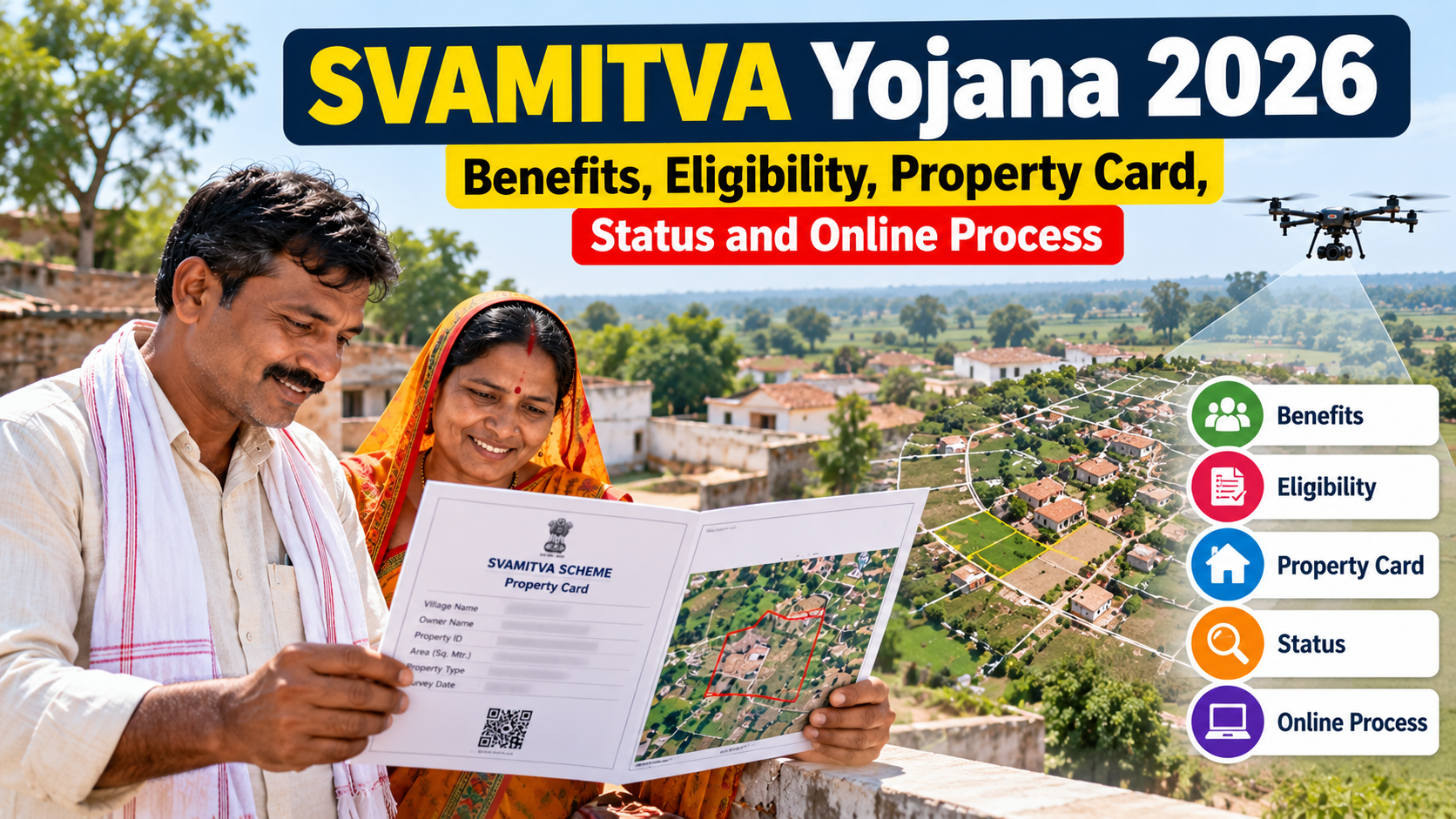
SVAMITVA Yojana 2026:Rural property ownership in India has often depended on a combination of local records, family documents and the ability to establish where one property ends and another begins. When boundaries are unclear or records are incomplete, property transactions, inheritance and access to formal credit can become more difficult. The SVAMITVA Yojana seeks to address this problem by using modern surveying technology to improve records of residential properties in village habitation areas.
The SVAMITVA Yojana, administered by the Ministry of Panchayati Raj, uses drone-based surveys and geospatial mapping to help establish a clearer record of rights for eligible rural property holders. Its purpose extends beyond issuing documents: accurate property records can also support village planning, local administration and access to institutional finance.
As of 4 August 2026, the government reported that drone surveys had been completed in 3.30 lakh villages, while 3.24 crore property cards had been prepared for 1.97 lakh villages. Approximately 2.72 crore cards had been distributed to property owners. These figures illustrate the scale of implementation, although survey completion does not necessarily mean that every property in a village has received a card.
What Is SVAMITVA Yojana?
SVAMITVA stands for Survey of Villages Abadi and Mapping with Improvised Technology in Village Areas. The scheme uses drone surveys and modern mapping technology to help record residential properties in rural villages and provide eligible property owners with property cards. It is a Central Sector Scheme designed to improve property records in rural inhabited areas, commonly known as abadi areas.
The scheme was launched nationwide on 24 April 2021, National Panchayati Raj Day, following a pilot phase conducted in nine states during 2020–21. It is implemented through cooperation between the Ministry of Panchayati Raj, state revenue departments, state Panchayati Raj departments and the Survey of India.
Unlike a programme that provides direct cash assistance, SVAMITVA focuses on property identification, mapping and documentation. Eligible property holders can receive a property card after the prescribed survey, verification and state-level processes are completed.SVAMITVA Yojana mainly focuses on documenting residential properties in rural villages. Unlike schemes that provide direct financial assistance, it helps eligible property owners obtain property cards and maintain clearer records of their properties.
SVAMITVA Yojana 2026: Key Highlights
| Scheme detail | Information |
|---|---|
| Full form | Survey of Villages Abadi and Mapping with Improvised Technology in Village Areas |
| Scheme type | Central Sector Scheme |
| Nodal ministry | Ministry of Panchayati Raj |
| Nationwide launch | 24 April 2021 |
| Main objective | Record of Rights for eligible rural inhabited properties |
| Main technology | Drone surveying, GIS mapping and CORS |
| Main document | SVAMITVA property card |
| Implementation partners | Survey of India and state governments |
| Official website | svamitva.nic.in |
| Latest cited national figures | 3.24 crore cards prepared as of 4 August 2026 |
Source: Ministry of Panchayati Raj and Press Information Bureau.
What Is a SVAMITVA Property Card?
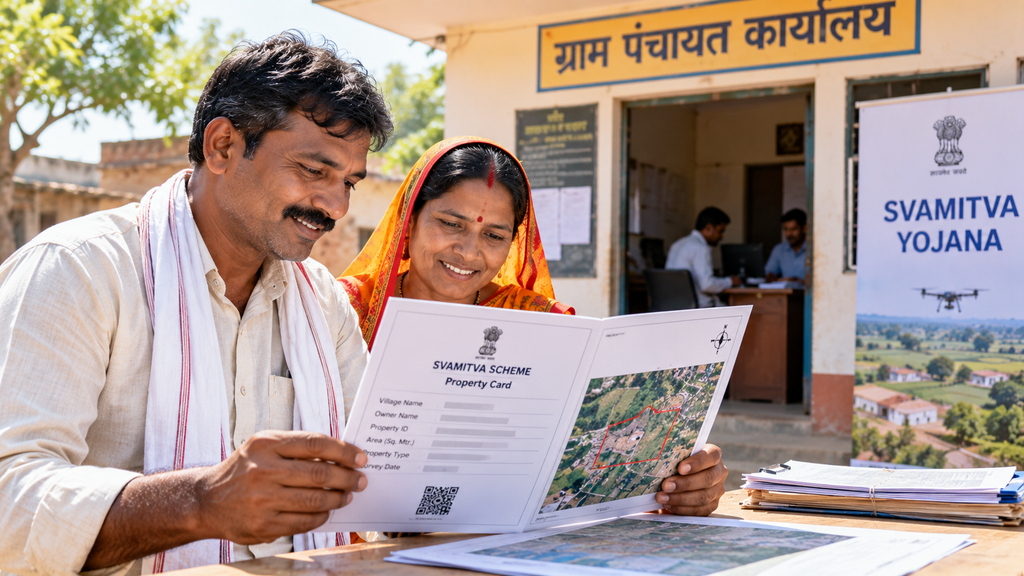
A SVAMITVA property card is a record of rights prepared through the scheme’s property-survey and verification process.
It provides details about eligible residential properties in village areas, including their mapped boundaries and ownership records, helping property owners maintain clear and organised documentation.
The card can be useful when a resident needs to refer to property information, resolve a boundary-related disagreement or approach a financial institution about a possible loan.
However, a property card should not automatically be treated as a guarantee that every possible ownership dispute has been resolved. Its legal effect and its relationship with existing land and revenue records depend on the applicable state framework and the circumstances of the property. Where records conflict, residents should seek clarification from the competent revenue authority.
Objectives of SVAMITVA Yojana
The scheme has several connected objectives. The scheme’s success depends on more than accurate land mapping. Property records must also be properly verified, issued to the owners and recognised by the relevant authorities.
1. Improve rural property records
Drone-based mapping helps create detailed records of residential plots in village habitation areas. Better documentation can make it easier for property holders and local authorities to identify the location and boundaries of individual properties.
2. Reduce property-related disputes
Disagreements over boundaries, overlapping claims and incomplete documentation can create difficulties for rural households. A survey supported by ground verification can provide a common reference for examining these issues. Disputes still require appropriate administrative or legal resolution where necessary.
3. Support access to bank loans
A documented property may help its holder approach a bank for institutional credit. However, a property card does not guarantee loan approval. Banks assess the property’s legal status, applicable rules, the applicant’s repayment capacity and their own lending requirements.
4. Improve Gram Panchayat planning
Accurate village maps can support infrastructure planning, identification of public assets and preparation of Gram Panchayat Development Plans. These records can help local authorities understand the distribution of properties and village resources.
5. Support property-tax administration
In states where the relevant authority has been empowered to levy property tax in the applicable areas, improved records can support assessment and administration. Property tax rules and charges vary from one state and local authority to another. SVAMITVA Yojana does not set a single property tax rate for the entire country.

Who Is Eligible for SVAMITVA Yojana?
Eligibility is linked to the property’s location, the coverage of the village and the applicable survey and ownership-verification process. SVAMITVA is intended for eligible properties in rural inhabited areas rather than every category of land throughout India.
A resident may need to establish that the property falls within the area notified for the scheme and provide information or documents requested by the local authorities.
The following points are useful when determining whether a property may be covered:
- Location: The property must fall within an eligible rural habitation area covered by the scheme.
- Property identification: The property must be identifiable through the relevant survey and mapping process.
- Ownership or rights: The claimant must provide information needed to establish their claim under applicable state rules.
- Verification: Property boundaries and claims may require verification by revenue officials and other authorised personnel.
- Objections: Competing claims or mapping errors may need to be addressed before the property card is finalised.
Which properties may require additional verification?
Properties with unclear boundaries, conflicting ownership claims, inheritance-related disagreements or differences between existing records and the survey map may require further examination.
Not having a SVAMITVA property card does not necessarily mean that a person has no ownership rights over their property. Existing property documents and applicable state records may still establish ownership. The next step is to check the existing records and ask the competent local authority about the status of the survey.
Benefits of SVAMITVA Yojana for Rural Families
The principal benefit of the scheme is the creation of a clearer, documented property record. Its wider value depends on how households, banks and local administrations use that information.
Better documentation of property
A property card gives the holder a formal document to refer to when dealing with property-related administrative matters. It can help reduce dependence on informal descriptions of boundaries, although it does not eliminate the need to check other relevant records.
Potential access to institutional credit
The government has reported that loans have been disbursed against SVAMITVA property cards. As of 4 August 2026, it reported 11,147 loans worth ₹1,713 crore based on these cards. This is evidence that the documents are being used for credit in some cases, not a promise that every holder can obtain a loan.
Greater clarity in property dealings
Documented boundaries and property details may help when families discuss inheritance, transfers or other property matters. The documents required for a transaction will still depend on the applicable registration, revenue and legal framework.
Improved village-level planning
The maps prepared under the scheme help Panchayats plan local development more effectively. They can use this information to identify roads, public facilities and other village assets that need improvement.
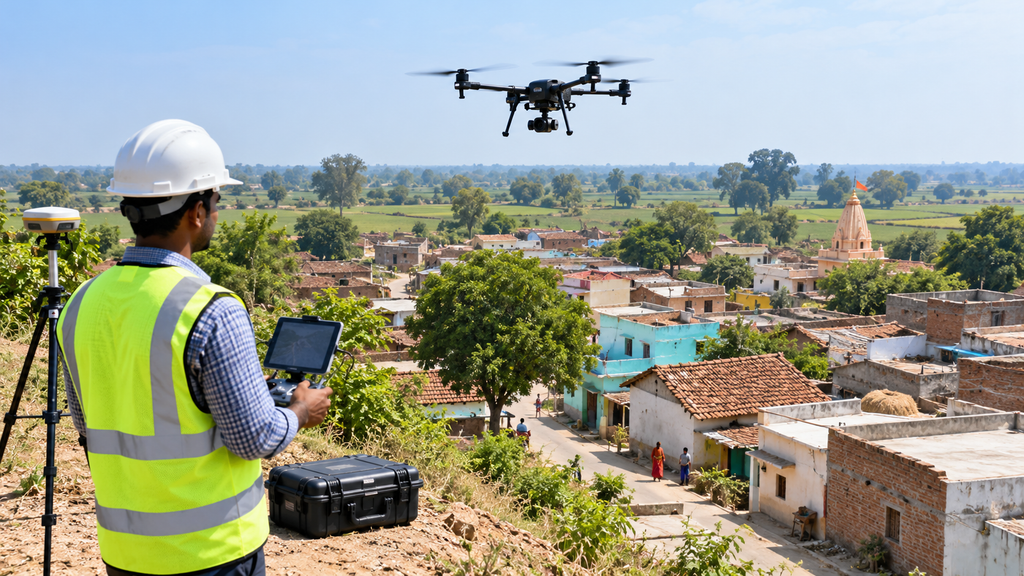
How Does the SVAMITVA Drone Survey Work?
The scheme combines aerial surveying with technical mapping and local verification. It is not simply a process in which a drone photographs houses and automatically issues ownership documents.
1. Drone-based survey
Survey teams capture aerial information about the eligible inhabited area. The collected imagery is used to identify and map property parcels.
2. Digital mapping
Survey data is processed into geo-referenced maps. The CORS network helps establish accurate geographic positioning for the mapping work.
3. Ground verification
Local authorities, property holders and relevant officials can help check mapped boundaries and identify discrepancies.
4. Property-card preparation and distribution
After the required verification and resolution of objections, the relevant state authorities proceed with preparing and distributing property cards.
The government has described the use of high-resolution mapping at a scale of 1:500, with positional accuracy of up to five centimetres under the specified surveying approach. This technical accuracy should not be confused with a guarantee that every ownership claim is undisputed.
How to Check SVAMITVA Property Card Status Online
Residents can begin by using the official SVAMITVA portal to check the available information about their state, village and property-card preparation or distribution.
Official SVAMITVA Portal
Ministry of Panchayati Raj, Government of India
Check property cards distributed
The precise online information available may vary by state and village. A village appearing in survey records does not necessarily mean every household’s property card has been distributed.
What to do if the property card is unavailable
If the portal does not show the expected record, contact the Gram Panchayat or the relevant state revenue office. Ask whether the village survey has been completed, whether the property has been mapped and whether the card is pending verification, preparation or distribution.
If the information displayed is incorrect, provide the relevant existing property documents and ask about the official correction or objection process. Do not rely on unofficial websites claiming to issue government property cards.
Is Online Application Required for SVAMITVA Yojana?
SVAMITVA generally follows a government-led survey and verification process rather than a conventional scheme application in which individuals independently submit an online form to receive a benefit.
The relevant authorities identify covered villages, conduct surveys, verify property information and facilitate property-card preparation and distribution. Residents may be asked to provide documents or participate in verification when required.
Therefore, before searching for an online application form, check whether the survey has taken place in your village and ask the local authorities how property claims are recorded. The official portal is the appropriate starting point for scheme information and available records.
SVAMITVA Yojana in Chhattisgarh
Chhattisgarh is among the states where the scheme’s drone-survey work has progressed substantially. According to a Ministry of Panchayati Raj update dated 4 August 2026, drone surveys had been completed in all 15,791 notified villages in the state, and 3,20,313 property cards had been prepared across 3,921 villages.
For residents of Chhattisgarh, the completion of a village’s drone survey does not necessarily establish that every property card is ready for collection. Property-card preparation, verification and distribution are separate stages.
Residents should contact their Gram Panchayat or the relevant revenue office to confirm the status of an individual property. They should also ask which state-specific records and correction procedures apply if the property details are incomplete or disputed.
Also Read:
- CG List Chhattisgarh Yojana List 2026: Complete guide for best Government Schemes in chhattishgarh
- CG Mahtari Vandana Yojana 2026: Online Registration, Eligibility, ₹1,000 Monthly Benefits, Payment Status & Complete Guide
Competitive Advantage: What Property Owners Should Understand
A common source of confusion is the assumption that a completed drone survey, a prepared property card and a legally settled ownership claim all mean the same thing. They do not.A drone survey creates the technical information used for mapping. Verification checks whether the mapped information corresponds with conditions on the ground. The property card records the resulting information after the required procedures. Disputes that remain unresolved may still need to be addressed through the competent administrative or legal process.
This distinction has practical consequences. A resident whose property is missing from the portal should first establish which stage has been completed. A resident whose boundaries appear incorrect should ask about the objection or correction procedure rather than assuming that the online record is final and beyond review.The same principle applies to bank loans. A property card may support a credit application, but the lending institution must determine whether the property and applicant satisfy its requirements.
The evidence suggests that SVAMITVA’s value depends on more than the number of cards prepared. Accurate verification, accessible correction procedures and acceptance of records by relevant institutions are equally important to its long-term usefulness.
In Conclusion
SVAMITVA Yojana represents an important effort to improve the documentation of rural residential properties through technology and administrative verification. Better property records can help households establish clearer boundaries, support local planning and potentially improve access to formal credit.
For residents, however, the most useful measure of progress is not simply whether a drone has surveyed their village. It is whether their individual property has been correctly mapped, the relevant claims have been verified and the resulting record is available for practical use. Checking the official portal and staying in contact with local revenue authorities remain the most reliable ways to establish the status of a particular property.
Frequently Asked Questions
What is SVAMITVA Yojana 2026?
SVAMITVA Yojana is a Central Sector Scheme of the Ministry of Panchayati Raj that uses drone surveys and digital mapping to improve property records in eligible rural inhabited areas.
Who can get a SVAMITVA property card?
Property holders whose properties fall within eligible village habitation areas may be covered, subject to the survey, ownership verification and applicable state procedures. The card is not automatically issued to every rural resident or every type of landowner. Residents should confirm their property’s status with the Gram Panchayat or relevant revenue authority.
Can I apply for SVAMITVA Yojana online?
The scheme primarily uses a government-led survey and verification process. It is not a conventional cash-benefit programme with a universal online application form. Depending on the state and the property’s status, residents may need to participate in verification or follow local procedures to establish or correct their property details.
Can a SVAMITVA property card be used to obtain a bank loan?
A property card may help support an application for institutional credit, and the government has reported loans disbursed against such cards. However, loan approval is not automatic. Banks may examine the property’s legal status, applicable rules, the applicant’s repayment capacity and other lending conditions before making a decision.
Is SVAMITVA Yojana available in Chhattisgarh?
Yes. Official government reporting confirms that the scheme is being implemented in Chhattisgarh. Although drone surveys have been completed across the state’s notified villages according to the August 2026 update, individual property-card preparation and distribution may still differ. Residents should verify their own property’s status locally.