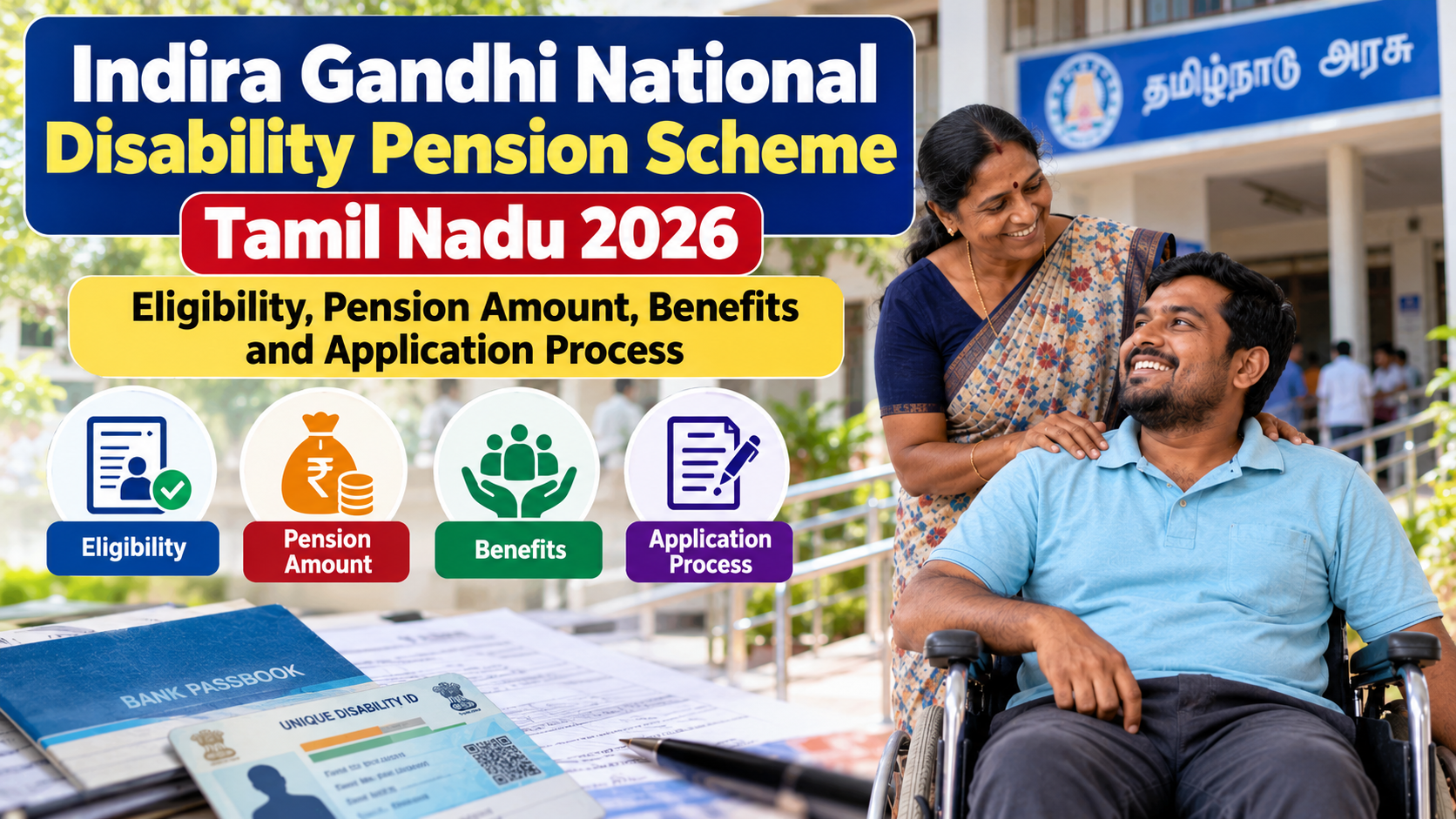
Indira Gandhi National Disability Pension Scheme Tamil Nadu 2026: Disability pension programmes are an important part of India’s social security system because they provide regular financial assistance to people who may face difficulties earning an independent income. For eligible households, even a modest monthly pension can help meet essential expenses and reduce dependence on family members.
The Indira Gandhi National Disability Pension Scheme (IGNDPS) was introduced under the National Social Assistance Programme (NSAP) to support people with severe disabilities belonging to economically weaker households. In October 2026, the Central Government approved a major revision and renamed this pension component the Pradhan Mantri Divyangjan Pension Yojana.
For residents of Tamil Nadu, understanding this change requires looking at two separate arrangements: the centrally sponsored disability pension and the state’s own Differently Abled Pension Scheme. Although both provide financial assistance, their eligibility conditions and administrative arrangements are not identical.

What Is the Indira Gandhi National Disability Pension Scheme?
The Indira Gandhi National Disability Pension Scheme was introduced in February 2009 as a component of the National Social Assistance Programme. It was designed to provide financial support to people with severe disabilities who belonged to Below Poverty Line (BPL) households.
The programme was administered by the Ministry of Rural Development, Government of India, with implementation involving state governments and their designated authorities.
Under the earlier framework, applicants generally had to be at least 18 years old, belong to a BPL household and have a disability level of 80% or above. The Central Government provided a monthly contribution, while states could provide additional assistance from their own resources.
Following the Union Cabinet’s decision of October 2026, the disability pension component has been renamed the Pradhan Mantri Divyangjan Pension Yojana. The revision also expands the proposed eligibility framework.
What Is the New Name of IGNDPS in 2026?
The new name of the Indira Gandhi National Disability Pension Scheme is Pradhan Mantri Divyangjan Pension Yojana.The change was approved by the Union Cabinet on 14 October 2026 as part of the restructuring and continuation of the National Social Assistance Programme for 2026–27 to 2030–31.The programme itself has also been renamed Pradhan Mantri Samajik Sahayata Yojana.
The following table explains the name changes:
| Earlier Scheme Name | New Approved Name |
|---|---|
| National Social Assistance Programme | Pradhan Mantri Samajik Sahayata Yojana |
| Indira Gandhi National Disability Pension Scheme | Pradhan Mantri Divyangjan Pension Yojana |
| Indira Gandhi National Old Age Pension Scheme | Pradhan Mantri Vridhavastha Pension Yojana |
| Indira Gandhi National Widow Pension Scheme | Pradhan Mantri Vidhawa Pension Yojana |
| National Family Benefit Scheme | Pradhan Mantri Parivar Labh Yojana |
The renaming is accompanied by specific changes to disability pension eligibility and central financial assistance
Latest Pension Amount Under the Scheme in 2026
The pension amount needs to be understood in two parts: the central government’s contribution and the additional amount provided by Tamil Nadu.
Revised central pension amount
According to the Union Cabinet’s approval dated 14 October 2026, the revised central assistance is as follows:
| Beneficiary Age | Approved Central Assistance |
|---|---|
| Birth to 79 years | ₹375 per month |
| 80 years and above | ₹625 per month |
These rates are part of the approved Pradhan Mantri Divyangjan Pension Yojana. However, the Central Government has stated that detailed guidelines, including the revised eligibility and implementation arrangements, will be issued within three months.
Existing Tamil Nadu pension amount
Before the October 2026 revision, Tamil Nadu’s Indira Gandhi National Disability Pension Scheme provided a combined monthly pension of ₹1,500, consisting of ₹300 from the Central Government and ₹1,200 from the Tamil Nadu Government.
A September 2026 report by DT Next also documented this payment structure. The revised central contribution may require corresponding changes to the existing payment arrangement. The final combined amount under the new framework should therefore be confirmed through an official Tamil Nadu government notification.
This distinction matters because the ₹375 and ₹625 figures are central assistance rates, not confirmed total monthly payments for Tamil Nadu beneficiaries.
Eligibility Criteria for Pradhan Mantri Divyangjan Pension Yojana
The eligibility framework has changed significantly following the October 2026 Cabinet decision. Earlier, the disability pension was restricted to adults with severe disabilities, but the approved revision expands the proposed coverage.
Earlier eligibility requirements
Under the previous IGNDPS framework in Tamil Nadu, applicants generally had to meet these conditions:
- The applicant had to be at least 18 years old.
- The disability level had to be 80% or above.
- The applicant had to belong to a Below Poverty Line household.
- The applicant had to be destitute and satisfy the applicable social security conditions.
- Disability certification and supporting documents were required.
Revised eligibility approved in October 2026
The Central Government has approved the following changes:
1. Disability requirement reduced to 40%
The benchmark disability requirement has been reduced from 80% to 40%. This is an important change because people with certified disabilities between 40% and 79% were outside the earlier central pension eligibility framework.
2. No minimum age requirement
The earlier minimum age of 18 years has been removed. Under the approved revision, eligible persons can receive assistance from birth, subject to the applicable disability certification and household conditions.
3. BPL household requirement
The revised programme continues to focus on economically weaker households. The official backgrounder identifies people from BPL households as beneficiaries of the expanded coverage.
4. Disability certificate
Applicants should have valid disability certification issued by the competent medical authority. A Unique Disability ID (UDID) can help establish and verify disability-related details.
Important: The revised eligibility provisions are Cabinet-approved. The detailed operational guidelines were still awaited as of 31 October 2026.
Difference Between IGNDPS and Tamil Nadu Differently Abled Pension Scheme
One important aspect of disability pension coverage in Tamil Nadu is that the state operates more than one pension arrangement.
The Indira Gandhi National Disability Pension Scheme is part of the central social assistance framework. Tamil Nadu also operates its own Differently Abled Pension Scheme (DAPS), which has separate eligibility conditions.
| Particular | IGNDPS / New Divyangjan Pension | Tamil Nadu DAPS |
|---|---|---|
| Administration | Central scheme implemented through the state | Tamil Nadu Government |
| Earlier disability requirement | 80% or above | 40% or above |
| Approved revised central requirement | 40% or above | Separate state criteria |
| Earlier minimum age | 18 years | 18 years |
| Revised central age | No minimum age approved | Separate state criteria |
| Household condition | BPL requirement under the programme | Income and destitution conditions |
| Application channel | Tamil Nadu social security pension system | Tamil Nadu e-Sevai |
Chennai District’s official eligibility information lists an annual income ceiling of ₹3 lakh for DAPS and requires disability certification of at least 40%. It separately lists IGNDPS with the earlier 80% disability and BPL conditions.
Applicants should not assume that qualifying for one scheme automatically establishes eligibility for the other. The responsible department must assess the application under the relevant scheme.
Benefits of the Disability Pension Scheme
The programme is intended to strengthen the financial security of people with disabilities who have limited household resources.
Monthly financial assistance
The principal benefit is regular financial assistance. Under the revised central framework, the approved assistance is ₹375 per month for beneficiaries up to 79 years and ₹625 for those aged 80 and above.
Tamil Nadu’s existing payment arrangement has also included a state contribution. The final combined payment following the 2026 revision will depend on the implementation instructions.
Wider eligibility coverage
Reducing the benchmark disability requirement from 80% to 40% is a significant policy change. It allows the revised central framework to cover people whose disabilities were not severe enough to meet the earlier threshold.
Support for children with disabilities
The removal of the minimum age requirement is another important development. Under the revised framework, children with benchmark disabilities can also fall within the eligible population, subject to the applicable household and certification conditions.
Direct financial assistance
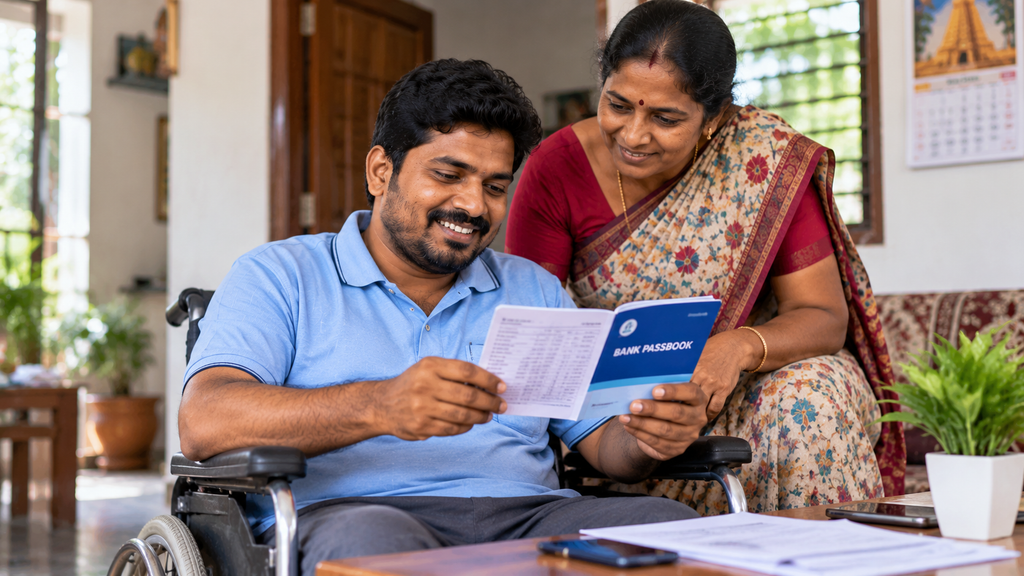
Tamil Nadu’s social security pension administration uses a system designed to transfer pension assistance to eligible beneficiaries. Applicants should ensure that their bank account details and identity information are accurate.
Improved social security
A regular pension cannot replace employment opportunities, accessible public services or specialised healthcare. However, it can contribute towards everyday expenses and provide some financial independence to eligible individuals.
Documents Required for the Disability Pension Scheme in Tamil Nadu
Applicants should prepare their documents before approaching the relevant government office or service centre.
The documents commonly required for Tamil Nadu’s disability pension applications include:
| Document | Purpose |
|---|---|
| Aadhaar Card | Identity verification |
| Smart Ration Card | Household and address details |
| UDID Card | Disability identification |
| Disability Certificate | Proof of disability percentage |
| Bank Passbook | Bank account information |
| Passport-size Photograph | Applicant identification |
| Age Proof | Verification of age, where required |
| BPL Certificate or Number | Proof of BPL status under the earlier IGNDPS framework |
| Voter ID | Additional identity verification, where required |
The Chennai District administration lists Aadhaar, ration card, voter ID, bank passbook, BPL number, UDID card and disability passbook among the documents required under the relevant pension categories.
The final document checklist should be checked with the concerned authority because the revised central guidelines may introduce updated documentation requirements.
How to Apply for Disability Pension in Tamil Nadu
Tamil Nadu provides an administrative system for processing social security pension applications. Its official OAP portal lists Indira Gandhi National Disabled Pension and Differently Abled Pension Scheme separately.
Applicants can use the following procedure to begin the application process.
Step 1: Visit the official Tamil Nadu social security pension portal
Open the Tamil Nadu Social Security Pension Portal.
The portal provides information about the state’s social security pension programmes, including disability-related pensions.
Step 2: Select the appropriate pension category
Identify the relevant scheme according to your eligibility.
The portal lists:
- Indira Gandhi National Disabled Pension.
- Differently Abled Pension Scheme.
- Other social security pension programmes.
Do not select a category solely because its name appears similar. Confirm the applicable disability percentage and household conditions.
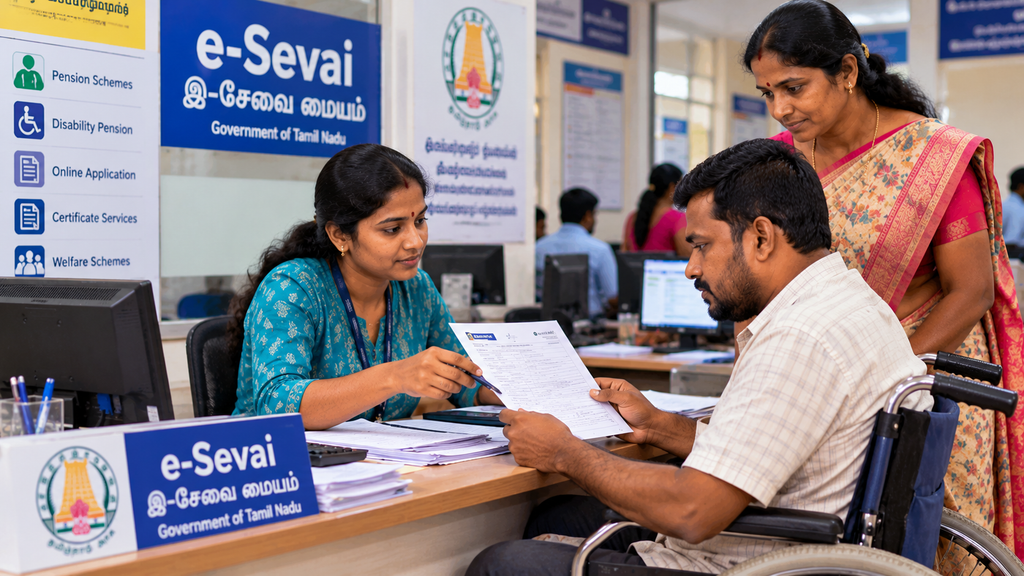
Step 3: Visit the authorised application service
The official portal provides a link to Tamil Nadu’s e-Sevai service for social security pension applications.
Visit the Tamil Nadu e-Sevai Portal or approach an authorised e-Sevai centre for assistance.
Step 4: Submit the required documents
Provide the relevant identity, residence, bank and disability documents. Under the earlier IGNDPS framework, BPL details were also required.
Make sure that the name, date of birth and other information are consistent across the documents.
Step 5: Complete the application
The authorised service operator can help submit the application under the appropriate pension category.
Keep the application acknowledgement or reference number for future communication.
Step 6: Wait for verification
The concerned Revenue Department or designated authorities examine the application and supporting records.Additional documents or clarification may be requested if any information is incomplete.
Step7:Check the application status
Use the available government service or contact the concerned department to enquire about the application.The Tamil Nadu social security pension administration lists the Commissioner of Social Security Scheme as a contact point for these services.
How to Check Disability Pension Status in Tamil Nadu
Applicants who have already submitted their applications should keep their acknowledgement details safely.
The following steps can help them obtain an update:
- Visit the official Tamil Nadu OAP portal.
- Look for the available application or pension enquiry service.
- Enter the requested application or beneficiary details, if the facility is available.
- Check the displayed application information.
- If the online status is unavailable, contact the relevant Taluk office or Special Tahsildar (Social Security Scheme).
The online portal is primarily an administrative platform, and the available public-facing services may differ from the facilities accessible to department officials. Applicants should not assume that every status function is available without logging in.
Who Is Responsible for Implementing the Scheme in Tamil Nadu?
The implementation of social security pensions involves different levels of government.At the central level, the Department of Rural Development oversees the National Social Assistance Programme framework.
In Tamil Nadu, the Revenue and Disaster Management Department operates the social security pension administration. The state’s official OAP portal identifies the Commissioner of Social Security Scheme at Ezhilagam, Chepauk, Chennai, as the relevant administrative office.
Applicants can approach the appropriate local authority for application-related assistance.
| Authority | Role |
|---|---|
| Government of India | Policy and central financial assistance |
| Tamil Nadu Government | State-level implementation |
| Commissioner of Social Security Scheme | Pension administration |
| District Administration | Local supervision and assistance |
| Special Tahsildar | Relevant pension sanctioning and administrative work |
| e-Sevai Centre | Application assistance and submission |
What Beneficiaries Should Know About the October 2026 Changes
The October 2026 decision is important, but applicants should distinguish between policy approval and actual implementation.The Cabinet has approved a broader disability pension framework, including higher central assistance, a lower disability threshold and removal of the minimum age requirement.
However, the official announcement also states that detailed guidelines will be issued and implemented within three months.This means that people who may qualify under the revised 40% threshold should not assume that their applications have automatically been approved or that payments have already started under the new rules.
Existing beneficiaries should continue following the instructions issued by the Tamil Nadu authorities. They should also avoid submitting duplicate applications unless the department specifically requests them.For new applicants, the practical approach is to keep their disability certificates, UDID details, bank information and household documents ready while checking the latest instructions with the relevant department.
Also Read:
- TVK Marriage Scheme 2026: 8 Gram Gold Coin, Silk Saree, Eligibility and Online Apply
- Vetri Magalir Loan Scheme 2026: Eligibility, Loan Amount, Interest Rate, Benefits and Application Process
Competitive Advantage: Why the Central and State Pension Distinction Matters
A common source of confusion in disability pension information is the tendency to combine central assistance and state-level pension benefits into a single amount.
Tamil Nadu’s system demonstrates why that approach can be misleading.Under the earlier arrangement, the central contribution for an eligible IGNDPS beneficiary was ₹300, while the Tamil Nadu Government contributed ₹1,200, bringing the combined monthly amount to ₹1,500.
The October 2026 decision changes the central contribution to ₹375 for people up to 79 years and ₹625 for those aged 80 and above. But these figures do not, by themselves, establish the new combined pension payable in Tamil Nadu.There is also a separate state Differently Abled Pension Scheme with its own eligibility conditions. A person with a disability level of 40% may be eligible for a state-level programme even if the person did not qualify under the earlier central IGNDPS threshold.
For applicants, the important questions are therefore not limited to the pension amount. They should establish which scheme applies to their circumstances, what disability certification is required and whether the revised central guidelines have become operational.This distinction helps prevent incorrect applications, unrealistic payment expectations and confusion between two different government programmes.
In Conclusion
The renaming of the Indira Gandhi National Disability Pension Scheme as Pradhan Mantri Divyangjan Pension Yojana marks an important change in India’s social security framework. The reduction of the disability threshold from 80% to 40%, removal of the minimum age requirement and revision of central assistance are intended to extend support to a wider population.
For Tamil Nadu residents, the distinction between central assistance and state-funded disability pensions remains particularly important. The existing state contribution has played a substantial role in determining the amount beneficiaries receive.
The next important step is the publication and implementation of the revised central guidelines, followed by the corresponding administrative instructions from Tamil Nadu. Applicants should rely on official notifications rather than assume that the revised central rates represent the final amount payable in the state.
Ultimately, the value of this policy change will depend not only on the amount announced but also on how effectively eligible people are identified, applications are processed and pension payments reach beneficiaries.
Frequently Asked Questions (FAQs)
What is the new name of Indira Gandhi National Disability Pension Scheme?
The Indira Gandhi National Disability Pension Scheme has been renamed Pradhan Mantri Divyangjan Pension Yojana following the Union Cabinet’s approval on 14 October 2026. It is now a component of the renamed Pradhan Mantri Samajik Sahayata Yojana.
What is the new disability pension amount in 2026?
The approved central assistance is ₹375 per month for beneficiaries from birth to 79 years and ₹625 per month for beneficiaries aged 80 years and above. These are central assistance rates.
What is the minimum disability percentage required under the new scheme?
The Central Government has approved reducing the benchmark disability requirement from 80% to 40%. This is a significant expansion of the earlier eligibility framework.
Can children apply for Pradhan Mantri Divyangjan Pension Yojana?
The October 2026 Cabinet decision removes the minimum age requirement.
How can I apply for disability pension in Tamil Nadu?
Applicants can visit the official Tamil Nadu Social Security Pension Portal or approach an authorised e-Sevai centre. They should select the relevant pension category and submit the required disability, identity, residence and bank documents for verification.
Is the UDID card required for disability pension?
Tamil Nadu’s district-level pension eligibility information lists the UDID card or disability passbook among the supporting documents for disability pension applications.