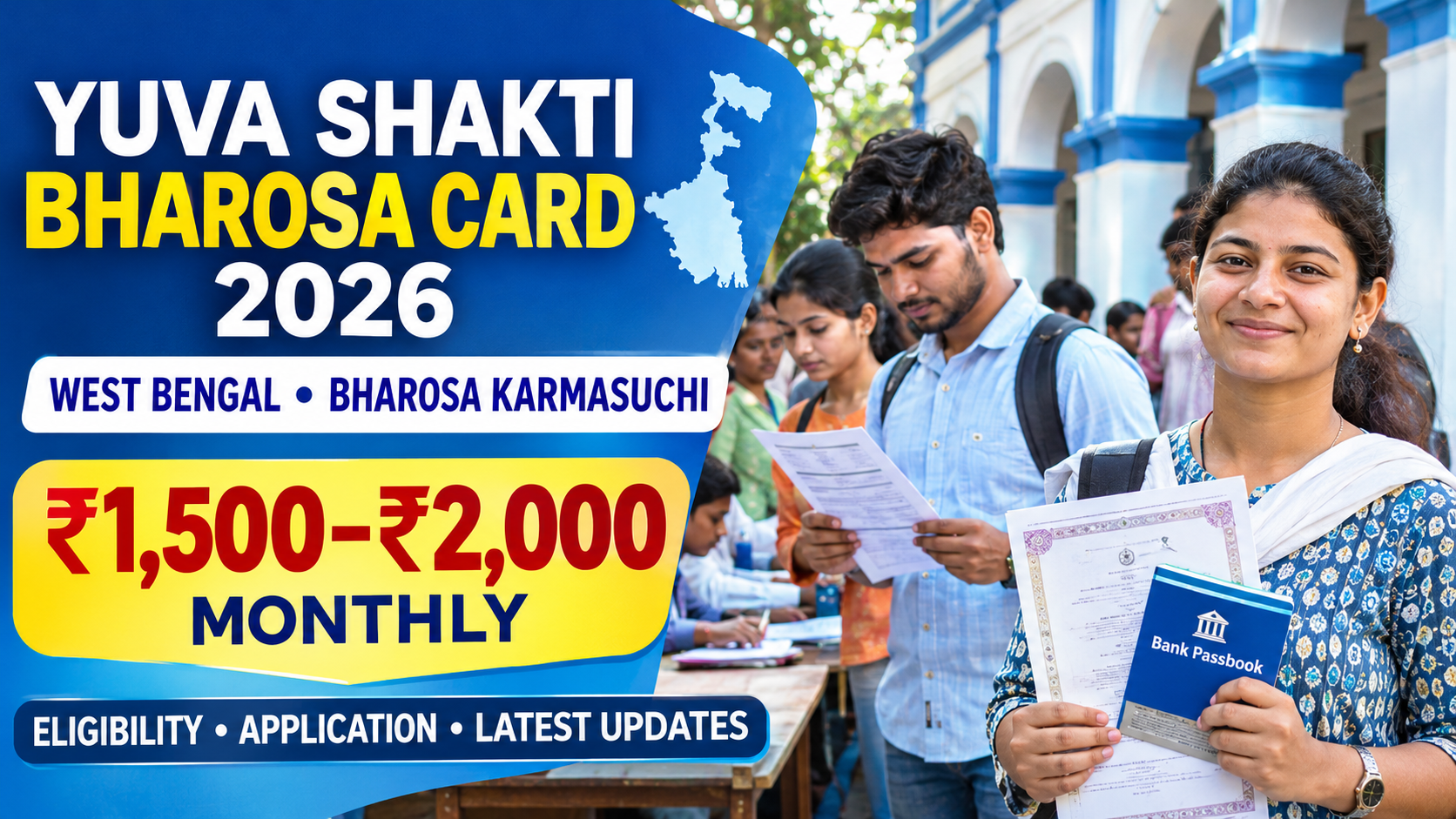
Yuva Shakti Bharosa Card Scheme 2026: West Bengal’s unemployment assistance programme has entered a new phase following the state government’s announcement of the Bharosa Karmasuchi. The initiative is intended to provide monthly financial assistance to eligible unemployed young people while they look for suitable employment or improve their professional qualifications.
On 23 November 2026, Chief Minister Suvendu Adhikari announced that the earlier Yuva Sathi unemployment allowance programme would be renamed and revised under the Bharosa scheme. Under the revised payment structure, unemployed graduates and eligible diploma holders from government vocational institutions and ITIs will receive ₹2,000 per month, while other eligible unemployed non-graduates will receive ₹1,500 per month from January 2027.
The announcement has attracted attention because financial support during unemployment can help young people manage everyday expenses while preparing for competitive examinations, attending interviews and developing employment-related skills.
However, the announcement also raises important questions about eligibility, the application procedure, verification and payment dates. Here is what is currently known about the Yuva Shakti Bharosa Card Scheme 2026, its connection with Bharosa Karmasuchi and the latest government announcements.
What Is Yuva Shakti Bharosa Card Scheme 2026?
The Yuva Shakti Bharosa Card Scheme is the commonly used name associated with West Bengal’s revised unemployment assistance initiative, officially announced as Bharosa or Bhorsha Karmasuchi.
Its primary objective is to provide temporary financial assistance to eligible unemployed young people in the state. The announced monthly assistance differs according to educational qualifications.The scheme replaces the earlier Yuva Sathi programme introduced by the previous government. According to the announcement made by the Chief Minister after the state Cabinet meeting, the revised assistance is expected to begin in January 2027.
An important distinction is necessary: Bharosa Karmasuchi is the name reported for the revised programme. A separate physical card called the Yuva Shakti Bharosa Card has not been established through the announcement alone. Applicants should wait for official instructions before assuming that a card-based registration system is available.
Yuva Shakti Bharosa Card Scheme 2026: Scheme Overview
| Particulars | Details |
|---|---|
| Scheme name | Bharosa Karmasuchi |
| Commonly used name | Yuva Shakti Bharosa Card Scheme |
| State | West Bengal |
| Announced by | Chief Minister Suvendu Adhikari |
| Announcement date | 23 November 2026 |
| Beneficiaries | Eligible unemployed youth |
| Graduate allowance | ₹2,000 per month |
| Non-graduate allowance | ₹1,500 per month |
| Future proposed allowance | ₹3,000 and ₹2,000 |
| Minimum age | 21 years |
| Maximum age | 45 years |
| Expected payment commencement | January 2027 |
| Application channel | Apnar Sarkar Apnar Pashe programme |
| Implementing department | Youth Welfare Department |
| Payment method | Direct bank transfer, as announced |
These details reflect the November 2026 announcement and media reporting. The final government guidelines will determine the complete eligibility and documentation requirements.
How Much Money Will Beneficiaries Receive?
The most important feature of Bharosa Karmasuchi is its revised monthly financial assistance. The government has announced different payment amounts for graduates and non-graduates.
Monthly allowance under Bharosa Karmasuchi
Unemployed graduates and eligible diploma/ITI candidates
₹2,000
Per month from January 2027
Other eligible unemployed non-graduates
₹1,500
Per month from January 2027
The revised payment structure recognises educational qualifications when determining the amount of assistance. Graduates and eligible diploma holders from government vocational institutions and ITIs are placed in the higher payment category.
Proposed increase from the 2028–29 financial year
The Chief Minister has also announced a further increase in monthly assistance from the 2028–29 financial year.
| Beneficiary category | January 2027 onwards | From 2028–29 |
|---|---|---|
| Graduates and eligible diploma/ITI candidates | ₹2,000 | ₹3,000 |
| Other non-graduates | ₹1,500 | ₹2,000 |
This means eligible graduates could receive ₹1,000 more per month under the proposed future structure, while the allowance for other non-graduates could increase by ₹500.The higher amounts should be understood as a future announced commitment, not as the payment available from January 2027.
What Is the Main Objective of the Bharosa Scheme?
Unemployment is not only a question of whether a person has a job. It also affects the ability of young people to prepare for employment opportunities.
Candidates often need to spend money on travelling to examination centres, purchasing books, accessing online learning facilities and attending interviews. Those expenses can become difficult to manage for young people from families with limited financial resources.Bharosa Karmasuchi is intended to provide some financial support during this period.
The scheme’s significance can be understood through three areas.
Financial support during unemployment: A monthly allowance can help eligible beneficiaries meet some everyday expenses while searching for employment.
Support for career preparation: Financial assistance may help candidates manage the costs associated with studying, vocational training and recruitment examinations.
A wider youth welfare approach: The revised programme places unemployment assistance within the state’s broader responsibilities towards education, skill development and employment.
However, an allowance cannot replace job creation. The long-term success of such a programme will depend on whether financial assistance is accompanied by better employment opportunities and accessible skill development.

Yuva Shakti Bharosa Card Scheme Eligibility Criteria
Eligibility is one of the most important questions for young people interested in Bharosa Karmasuchi.According to the November 23 announcement, applicants must fall within the age group of 21 to 45 years. The payment category also depends on their educational qualifications and employment status.
The following points reflect the eligibility information currently reported. Applicants should check the final government notification before submitting an application.
Age requirement
The announced age limit is 21 to 45 years. Applicants outside this age range should not assume that they qualify.
West Bengal residency
The scheme is intended for eligible young people in West Bengal. The final guidelines will clarify the residency documents required to establish eligibility.
Educational qualification
The announced assistance structure distinguishes between graduates, eligible diploma or ITI candidates and other non-graduates.Graduates and qualifying diploma holders from government vocational institutions or ITIs have been placed in the ₹2,000 monthly category.Other eligible non-graduates are expected to receive ₹1,500 per month.
Unemployment status
The programme is designed for unemployed young people. Candidates who are already employed should not assume that they qualify for the allowance.
Other government financial assistance
The Chief Minister has indicated that applicants should not be receiving another government allowance. The final rules will clarify which existing benefits result in exclusion.
Family-level limit
According to the announcement reported by PTI, a maximum of two members from one family can receive the assistance.The government has also indicated that people receiving the ₹3,000 monthly Annapurna Yojana allowance will not qualify for Bharosa assistance. The Tribune+2
Bharosa Karmasuchi: Required Documents
The complete official document checklist should be confirmed through the implementing department. Nevertheless, applicants can keep commonly required identity, residence, education and banking records organised.
| Document | Purpose |
|---|---|
| Aadhaar card | Identity verification |
| Voter ID | Supporting identity and residence information |
| West Bengal residence proof | Establishing state residency |
| Educational certificates | Verifying qualifications |
| Madhyamik certificate | Supporting education and date-of-birth details |
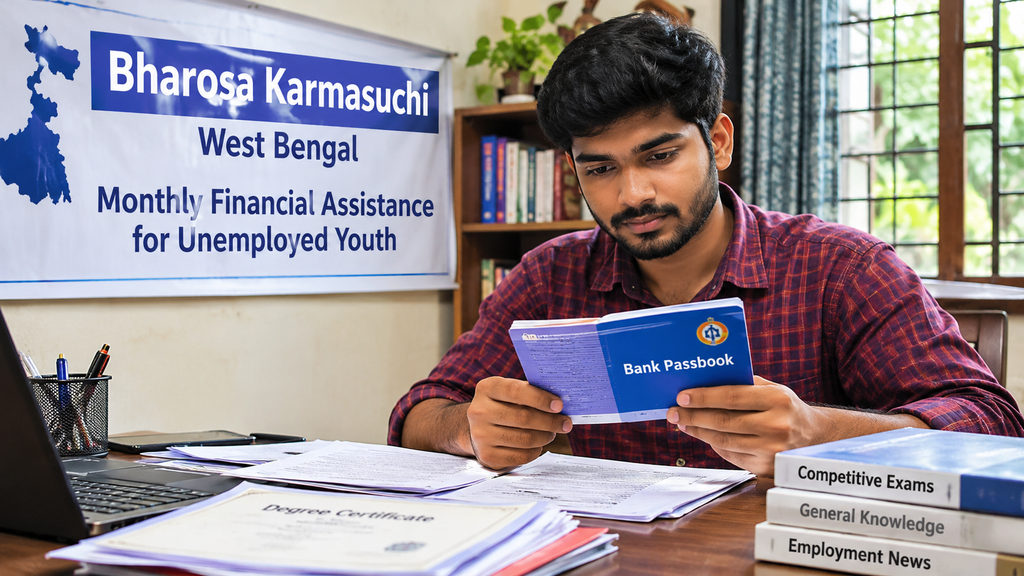
| Bank passbook | Bank account information |
| Passport-size photograph | Applicant identification |
| Mobile number | Communication and application updates |
| Unemployment declaration | Supporting employment-status verification |
| Income certificate, if required | Family financial verification |
This is a preparatory list, not a confirmed mandatory checklist. The final notification may specify additional or different documents.
Applicants should also ensure that their personal information is consistent across their official documents. Incorrect bank details or mismatched identity information can create problems during verification.
How to Apply for Yuva Shakti Bharosa Card Scheme 2026?
The state government has indicated that applications will be accepted through its Apnar Sarkar Apnar Pashe programme.This is important because applicants should not confuse the announcement of a scheme with the opening of a dedicated online registration portal.
According to the November 23 announcement, applications received through the programme will be forwarded to the Youth Welfare Department for further processing.
Expected application procedure
Step 1: Follow government announcements
Keep track of announcements from the West Bengal government and the Youth Welfare Department. Check for the official application instructions and camp schedules.
Step 2: Visit an authorised application camp
Applicants who have not previously registered can submit their applications through the Apnar Sarkar Apnar Pashe programme when the relevant facilities become available.
Step 3: Provide personal and educational information
Applicants should provide accurate information about their age, residence, educational qualifications and employment status.
Step 4: Submit supporting documents
Submit the documents requested by the authorised officials.. Keep a copy of the submitted application or acknowledgement if one is provided.
Step 5: Departmental verification
The application will be forwarded to the Youth Welfare Department. Submission at a local camp should not be interpreted as final approval.
Step 6: Wait for beneficiary confirmation
The applicant should wait for the official verification result and payment instructions before assuming that the monthly allowance has been approved.
Is online registration available?
A dedicated online registration portal and a downloadable application form have not been established by the November 23 announcement covered in the available reports.Therefore, applicants should not rely on unofficial websites claiming to provide instant Bharosa Card registration or guaranteed approval.
When Will the Bharosa Scheme Start? Expected Payment Date
The state government has announced January 2027 as the expected starting point for the revised monthly assistance.
According to the announcement reported after the Cabinet meeting:
- The revised allowance is expected to begin in January 2027.
- Payments are expected to reach beneficiaries during the second week of each month.
- The government plans to complete verification of approximately 54 lakh existing beneficiaries of the previous programme by 31 December 2026.
- A formal launch event is planned for February 2027.
The January payment schedule and February launch event refer to different stages of implementation. The formal launch event does not necessarily mean that payments will begin only in February.
Bharosa Karmasuchi timeline
- 23 November 2026 – Cabinet announcementThe Chief Minister announces the revised Bharosa programme and its monthly allowance structure.
- 31 December 2026 – Verification targetVerification of existing beneficiaries from the previous programme is expected to be completed.
- January 2027 – Expected payment commencementThe revised monthly assistance is expected to begin.
- February 2027 – Formal launchThe government plans to organise a formal launch event.
- Financial year 2028–29 – Proposed higher allowanceThe announced monthly assistance is expected to increase to ₹3,000 for graduates and eligible diploma/ITI candidates and ₹2,000 for other non-graduates.
How Will Beneficiaries Receive the Monthly Allowance?
The government has indicated that the monthly allowance will be transferred directly to beneficiaries’ bank accounts.This arrangement is generally known as Direct Benefit Transfer (DBT). Under DBT, financial assistance is sent electronically to the eligible beneficiary rather than being distributed through cash payments at local offices.
The reported payment arrangement is as follows:
- The applicant submits the required information.
- The application is forwarded to the Youth Welfare Department.
- The department conducts the necessary verification.
- Eligible applications are processed for payment.
- Financial assistance is transferred to the beneficiary’s bank account.
Applicants should keep their bank details accurate and follow the official instructions regarding Aadhaar and account verification.The government has indicated that payments are expected in the second week of each month. However, actual credit dates may depend on the completion of verification and payment processing.
Bharosa Karmasuchi vs Banglar Yuva Sathi Scheme: What Has Changed?
One of the most important aspects of the latest announcement is the change from the previous Yuva Sathi programme to Bharosa Karmasuchi.
The earlier Banglar Yuva Sathi scheme was introduced through a notification dated 13 February 2026 by the West Bengal Department of Youth Services and Sports. It provided ₹1,500 monthly assistance to eligible educated unemployed young people aged 21–40 years, subject to its conditions.
The revised Bharosa programme has a different announced age range and payment structure.
| Feature | Earlier Banglar Yuva Sathi | Revised Bharosa |
|---|---|---|
| Monthly allowance | ₹1,500 | ₹1,500–₹2,000 initially |
| Age range | 21–40 years | 21–45 years |
| Payment categories | Common allowance | Based on education category |
| Graduates | ₹1,500 | ₹2,000 |
| Other eligible non-graduates | ₹1,500 | ₹1,500 |
| Programme status | Earlier programme | Revised programme announced |
| Future increase | Not specified in the cited notification | Higher amounts announced from 2028–29 |
The earlier scheme’s official notification provides useful historical context, but its conditions should not automatically be treated as the final eligibility rules for Bharosa.
What Makes Bharosa Karmasuchi Important for West Bengal’s Youth?
Financial assistance programmes are often discussed in terms of their monthly payment amounts. But their broader value should be assessed by considering how they affect the employment journey of young people.
For someone preparing for a government recruitment examination, even a modest allowance can help with books, travel and internet expenses. A graduate searching for private-sector employment may also use the support to manage some basic costs while attending interviews.
The revised payment structure also recognises that educational qualifications can influence the resources required for career preparation.However, there is an important limitation. Monthly financial assistance does not automatically create employment. Its effectiveness will depend on transparent beneficiary selection, timely payments, clear eligibility rules and the availability of genuine employment opportunities.
The government will also need to ensure that applicants from rural areas, economically weaker households and less digitally connected communities can access the application process without unnecessary difficulty.
Also Check:
- Krishak Bandhu Scheme 2026: Benefits, Eligibility, Registration, Payment & Death Benefit
- CG Mukhyamantri Kanya Vivah Yojana 2026: Eligibility, Benefits, Online Apply, Documents and Latest Update
Important Things Applicants Should Know Before Applying
There are several points that prospective beneficiaries should understand before submitting their details.
First, the scheme announcement is not the same as final approval of an individual application. Applicants must complete the prescribed verification process.
Second, the ₹2,000 allowance is not available to every unemployed person. The announced category includes graduates and eligible diploma holders from government vocational institutions and ITIs.
Third, the future ₹3,000 allowance should not be confused with the initial payment. The higher amount has been announced for the 2028–29 financial year.
Fourth, the application process should be followed through authorised government channels. Applicants should avoid private websites that claim to issue official Bharosa cards or guarantee benefits.
Finally, the final notification matters. Detailed provisions concerning income limits, family eligibility, documents, exclusions and application deadlines should be checked against the government’s published guidelines.

What the Evidence Suggests: What Should Applicants Expect?
The November 2026 announcement establishes the broad payment structure, age range, application channel and intended rollout period. It also makes clear that the previous Yuva Sathi programme is being replaced.However, some administrative details remain important to confirm through the final guidelines. In particular, applicants should not assume that every condition of the earlier Yuva Sathi scheme will continue unchanged.
For a reliable understanding, readers should distinguish three stages: the Cabinet announcement, publication of detailed operational guidelines and individual beneficiary approval.This distinction is particularly important when financial assistance is involved. A programme can be announced before its application process is fully operational, and an application can be submitted without guaranteeing eligibility or payment.
In Conclusion
The Bharosa Karmasuchi represents an important change in West Bengal’s approach to unemployment assistance. By introducing different monthly payment levels for graduates, eligible diploma and ITI candidates, and other non-graduates, the government has outlined a revised support structure for unemployed young people.
The initial assistance of ₹1,500–₹2,000 per month may provide some relief to eligible households, particularly those facing the financial pressure of prolonged job searches. The proposed increase from the 2028–29 financial year also indicates a longer-term commitment to the programme.Nevertheless, the real test will be its implementation. Clear eligibility rules, accessible application facilities, timely payments and transparent verification will determine whether the programme reaches the young people it is intended to support.
For applicants, the most sensible approach is to prepare their documents, follow official announcements and avoid unverified registration websites. Financial assistance can provide temporary support, but sustainable employment opportunities must remain the larger objective.
Frequently Asked Questions (FAQs)
What is Yuva Shakti Bharosa Card Scheme 2026 in West Bengal?
It is the commonly used name for West Bengal’s revised unemployment assistance programme, announced as Bharosa Karmasuchi. The initiative is intended to provide monthly financial assistance to eligible unemployed young people, with payments based on educational qualifications.
How much money will unemployed youth receive under Bharosa Karmasuchi?
Eligible unemployed graduates and qualifying diploma or ITI candidates will receive ₹2,000 per month initially. Other eligible unemployed non-graduates will receive ₹1,500 per month. The government has also announced higher assistance from the 2028–29 financial year.
Who is eligible for the Yuva Shakti Bharosa Card Scheme?
The announced age range is 21–45 years. The programme is intended for unemployed young people in West Bengal. Educational qualifications, existing government assistance and family-level restrictions will also matter under the final eligibility rules.
When will the Bharosa Karmasuchi payments start?
The government has announced January 2027 as the expected beginning of payments. Assistance is expected to be transferred during the second week of each month. A formal launch event is planned for February 2027.
How can I apply for Bharosa Karmasuchi?
According to the Chief Minister’s announcement, new applications can be submitted through the Apnar Sarkar Apnar Pashe programme. Applications will subsequently be forwarded to the Youth Welfare Department for verification and processing.
Will graduates receive ₹3,000 every month?
Not initially. Eligible graduates and qualifying diploma or ITI candidates are expected to receive ₹2,000 per month from January 2027. The government has announced an increase to ₹3,000 per month from the 2028–29 financial year.
Can two members of the same family receive Bharosa assistance?
Yes. According to the announcement, a maximum of two members from one family can receive the benefit, subject to the applicable eligibility conditions. People receiving the ₹3,000 monthly Annapurna Yojana allowance have also been identified as ineligible.
Is the Yuva Shakti Bharosa Card online application form available?
A dedicated official online application portal and downloadable Bharosa Card form have not been established by the announcement covered in this article. Applicants should follow government instructions and use the authorised Apnar Sarkar Apnar Pashe application channel.