
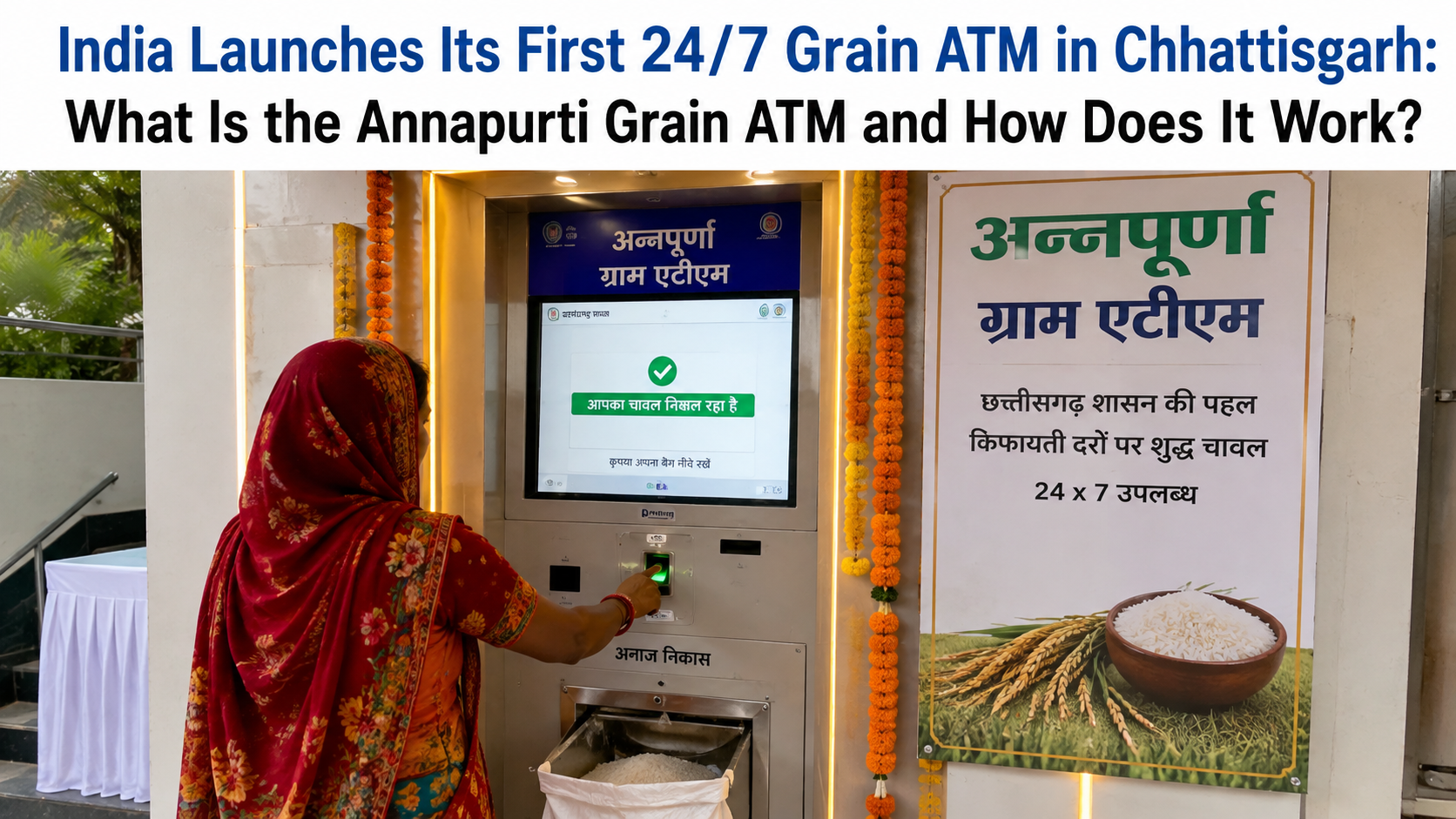
Chhattisgarh Annapurti Grain ATM 2026: India has taken a major step toward modernizing the public ration distribution system with the launch of its first 24/7 Grain ATM, officially called the Annapurti Grain ATM, in Raipur, Chhattisgarh. The facility has been introduced in the Birgaon area of Raipur and is designed to make ration distribution faster, easier, and available at any time of the day.
The Grain ATM works under the One Nation, One Ration Card (ONORC) system and allows eligible ration card holders to collect rice through biometric fingerprint authentication. Instead of waiting in long queues during fixed ration shop hours, beneficiaries can now collect their allotted food grain whenever it is convenient for them.
This new model is expected to improve transparency, reduce manual work, and provide better access to food grains for workers, senior citizens, and families who cannot visit ration shops during normal working hours.
Overview table
| Feature | Details |
|---|---|
| Scheme Name | Annapurti Grain ATM |
| State | Chhattisgarh |
| City | Raipur (Birgaon area) |
| Launch Significance | India’s first 24/7 Grain ATM |
| Operates Under | One Nation, One Ration Card (ONORC) |
| Authentication Method | Biometric fingerprint verification |
| Food Grain Distributed | Rice |
| Storage Capacity | Around 2,500 kg |
| Managed By | Jyoti Group (Women’s Self-Help Group) |
| Availability | 24 hours a day, 7 days a week |
In which state has India launched its first 24/7 Grain ATM?
India has launched its first 24/7 Grain ATM in the state of Chhattisgarh. The facility is located in Raipur’s Birgaon area and is known as the Annapurti Grain ATM.
This initiative is considered an important step in making ration distribution more efficient and accessible. Since the machine operates round the clock, beneficiaries no longer have to depend on the opening hours of a ration shop.
What is the 24/7 Grain ATM?
The 24/7 Grain ATM is an automated machine that dispenses food grains, mainly rice, to eligible ration card holders. It functions in a way similar to a banking ATM, but instead of cash, it provides ration grains.
Beneficiaries authenticate their identity through fingerprint-based biometric verification, after which the machine automatically dispenses the quantity of rice they are entitled to receive.
The system is designed to reduce crowding, minimize manual handling, and ensure that ration reaches beneficiaries quickly and accurately.
Why was the Annapurti Grain ATM launched?
The Annapurti Grain ATM was introduced to solve several common problems faced by ration card holders, including:
- Long waiting lines at fair price shops
- Limited distribution timings
- Manual weighing and handling of grains
- Delays during busy periods
- Difficulty for workers and daily wage earners who cannot visit during daytime
By allowing beneficiaries to collect rice 24 hours a day, the new system offers greater convenience and flexibility.
How does the Grain ATM work?
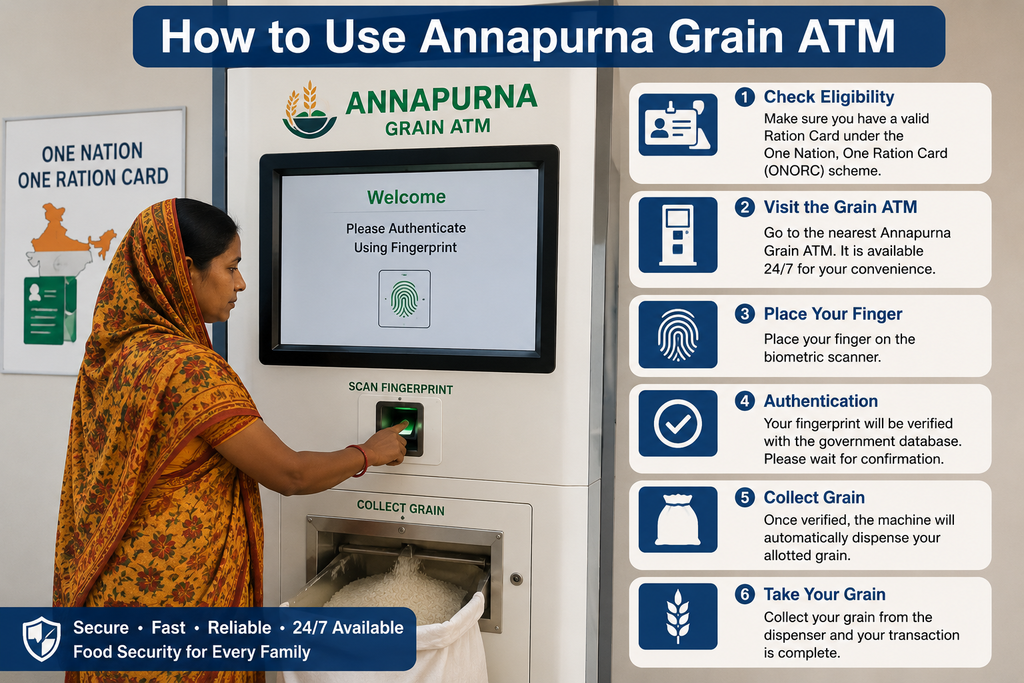
The process of collecting ration from the Grain ATM is simple and user-friendly.
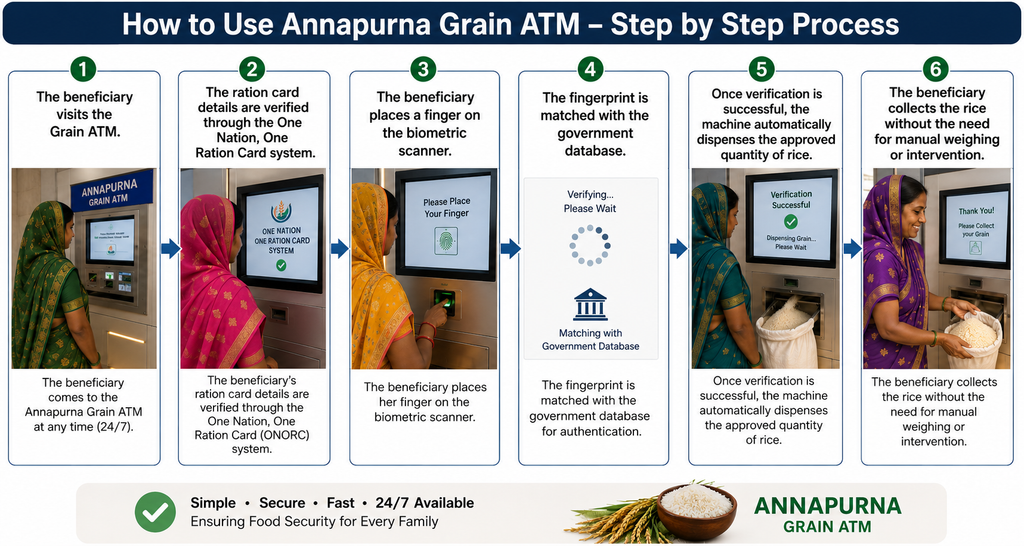
Step-by-step process
- The beneficiary visits the Grain ATM.
- The ration card details are verified through the One Nation, One Ration Card system.
- The beneficiary places a finger on the biometric scanner.
- The fingerprint is matched with the government database.
- Once verification is successful, the machine automatically dispenses the approved quantity of rice.
- The beneficiary collects the rice without the need for manual weighing or intervention.
The entire process takes only a few minutes.
What is the One Nation, One Ration Card (ONORC) scheme?
The One Nation, One Ration Card (ONORC) scheme allows eligible beneficiaries to receive subsidized food grains from any participating ration shop across India, regardless of the state in which their ration card was originally issued.
This is especially useful for:
- Migrant workers
- Daily wage earners
- People who move between states for employment
- Families temporarily living away from their home district
The Grain ATM in Chhattisgarh operates within this national ration distribution framework.
What is a BPL or NFSA ration card?
BPL ration card
A BPL (Below Poverty Line) ration card is issued to families whose income falls below the government’s poverty threshold. BPL card holders receive subsidized food grains and may also be eligible for various government welfare schemes.
NFSA ration card
The NFSA (National Food Security Act) ration card is issued under the National Food Security Act, 2013. It provides eligible households with subsidized food grains such as rice, wheat, and coarse grains through the Public Distribution System (PDS).
Under the NFSA, beneficiaries generally fall into categories such as:
- Priority Households (PHH)
- Antyodaya Anna Yojana (AAY)
These beneficiaries can receive food grains at highly subsidized rates.
What is the ration card scheme?
The ration card scheme is part of India’s Public Distribution System (PDS), which aims to provide essential food grains to eligible households at subsidized prices.
The scheme helps ensure food security for millions of families across the country.
Main objectives of the ration card system
- Provide affordable food grains to low-income households
- Improve food security
- Support economically weaker families
- Ensure fair distribution of essential commodities
- Reduce hunger and nutritional insecurity
Eligible beneficiaries receive food grains through authorized fair price shops or approved distribution systems such as the new Grain ATM.
Features of the Annapurti Grain ATM
The Annapurti Grain ATM includes several modern features that improve efficiency and convenience.
Round-the-clock access
The machine operates 24 hours a day and 7 days a week, allowing beneficiaries to collect ration at any time.
Biometric security
Fingerprint authentication helps ensure that food grains are distributed only to eligible beneficiaries.
Automated dispensing
The machine automatically measures and dispenses rice, reducing errors and manual handling.
Faster distribution
Beneficiaries spend much less time collecting ration compared to traditional distribution methods.
Reduced crowding
Since ration can be collected throughout the day and night, crowding during peak hours is expected to decrease significantly.
Storage capacity of the Grain ATM
The Annapurti Grain ATM has a storage capacity of approximately 2,500 kilograms of rice.
This capacity allows the machine to serve a large number of beneficiaries before requiring replenishment.
Who operates the Grain ATM?
One of the most notable aspects of this project is that it is operated by Jyoti Group, a local women’s self-help group (SHG).
This gives the initiative a strong community participation element while also creating local employment and management opportunities for women.
The involvement of women’s self-help groups can strengthen accountability and encourage better maintenance of the facility.
Benefits of the 24/7 Grain ATM
The new system offers several practical advantages.
Convenience for workers
Daily wage workers and people employed in factories, markets, or construction can collect ration after work hours.
Better service for senior citizens
Elderly beneficiaries can choose less crowded times for collecting food grains.
Improved transparency
Automated biometric verification reduces the chances of duplicate or fraudulent distribution.
Less manual work
Ration shop staff spend less time weighing and distributing grains manually.
Faster transactions
The automated process significantly reduces waiting time.
Digital integration
The system is linked with national food distribution databases, improving monitoring and record management.
Why is this launch important for India?
The launch of the first 24/7 Grain ATM represents an important experiment in digital public service delivery.
If successful, similar automated grain dispensing systems may be introduced in other districts and states.
The initiative demonstrates how technology can improve the efficiency of welfare schemes while making government services more accessible to ordinary citizens.
It also supports broader goals such as:
- Digital governance
- Transparent subsidy distribution
- Better public service delivery
- Inclusion of migrant and mobile populations
- Empowerment of women’s self-help groups
Challenges that may need attention
While the concept is promising, some practical issues will require careful management.
Regular maintenance
The machine must remain functional throughout the day and night.
Biometric authentication issues
Fingerprint verification may occasionally fail due to worn fingerprints or technical problems.
Power and connectivity
Reliable electricity and network connectivity are necessary for smooth operation.
Timely replenishment
Rice stocks must be refilled regularly to avoid shortages.
User awareness
Beneficiaries need proper guidance on how to use the machine independently.
Future possibilities
The Annapurti Grain ATM could become a model for modern ration distribution across India.
Future versions may include:
- Wheat and other grains
- QR code verification
- Mobile app integration
- SMS alerts after collection
- Real-time stock monitoring
- Multiple language interfaces
Such improvements could further strengthen the Public Distribution System and make ration delivery more efficient nationwide.
Frequently Asked Questions (FAQs)
Which state launched India’s first 24/7 Grain ATM?
Chhattisgarh launched India’s first 24/7 Grain ATM in Raipur’s Birgaon area.
What grain is currently distributed through the machine?
The machine currently distributes rice to eligible beneficiaries.
What is the storage capacity of the Grain ATM?
The machine can store around 2,500 kilograms of rice.
Who operates the Annapurti Grain ATM?
It is operated by Jyoti Group, a local women’s self-help group.
Conclusion
The launch of the Annapurti Grain ATM in Chhattisgarh marks a significant step in the modernization of India’s ration distribution system. By offering 24/7 access, biometric authentication, and automated grain dispensing, the facility aims to make food grain distribution faster, more transparent, and more convenient for eligible beneficiaries.
For daily wage workers, senior citizens, migrant families, and other ration card holders, the ability to collect rice at any time can make a meaningful difference in everyday life. If implemented successfully and expanded across other states, the Grain ATM model could become an important part of India’s future food security infrastructure and digital public distribution system.




One Comment