CG List Chhattisgarh Yojana List 2026: Chhattisgarh’s government welfare system is much broader than a handful of popular schemes frequently mentioned on social media. The state maintains programmes covering agriculture, food security, women, education, health, housing, employment, construction workers, livestock, rural development and other sectors.
For someone searching for the CG List Chhattisgarh Yojana List, the real challenge is therefore not finding names of schemes but understanding which scheme applies to which person and whether it is currently operational.
The official Chhattisgarh CM Helpline portal maintains a department-wise catalogue of citizen-oriented schemes. Its categories include agriculture, animal husbandry, rural development, food and civil supplies, health, labour, school and higher education, women and child development, tribal development, transport and several other departments.
The state’s 2026-27 budget also provides a useful indication of the government’s major spending priorities. Among the highlighted allocations are ₹10,000 crore for the Krishak Unnati Yojana, ₹8,200 crore for Mahtari Vandan Yojana, ₹6,500 crore for Mukhyamantri Khadyaan Sahayata, ₹600 crore for the Deendayal Upadhyaya Bhoomihin Krishi Majdoor Kalyan Yojana and ₹1,500 crore for Shaheed Veer Narayan Singh Ayushman Yojana.
That makes the 2026 list particularly relevant for residents trying to identify the schemes most closely connected with their household’s needs.
Chhattisgarh Yojana List 2026 at a Glance
| Scheme | Main Beneficiaries | Broad Purpose |
| Mahtari Vandan Yojana | Eligible women | Regular financial assistance |
| Krishak Unnati Yojana | Farmers | Agricultural income and productivity |
| Mukhyamantri Khadyaan Sahayata Yojana | Eligible ration-card households | Food security |
| Deendayal Upadhyaya Bhoomihin Krishi Majdoor Kalyan Yojana | Landless agricultural labourers | Financial welfare |
| Shaheed Veer Narayan Singh Ayushman Yojana | Eligible residents | Health coverage |
| PMAY-G / PMAY-Urban | Eligible households | Housing |
| Jal Jeevan Mission | Rural households | Tap-water access |
| PM Fasal Bima Yojana | Eligible farmers | Crop insurance |
| Labour Department schemes | Registered construction workers | Education, housing, tools and social security |
| Livestock development programmes | Farmers/livestock owners | Animal husbandry and livelihood support |
The table is a starting point rather than a substitute for scheme-specific eligibility. Eligibility can depend on factors such as income, age, landholding, occupation, registration status, ration-card category, residence and previous benefits.
1. Mahtari Vandan Yojana
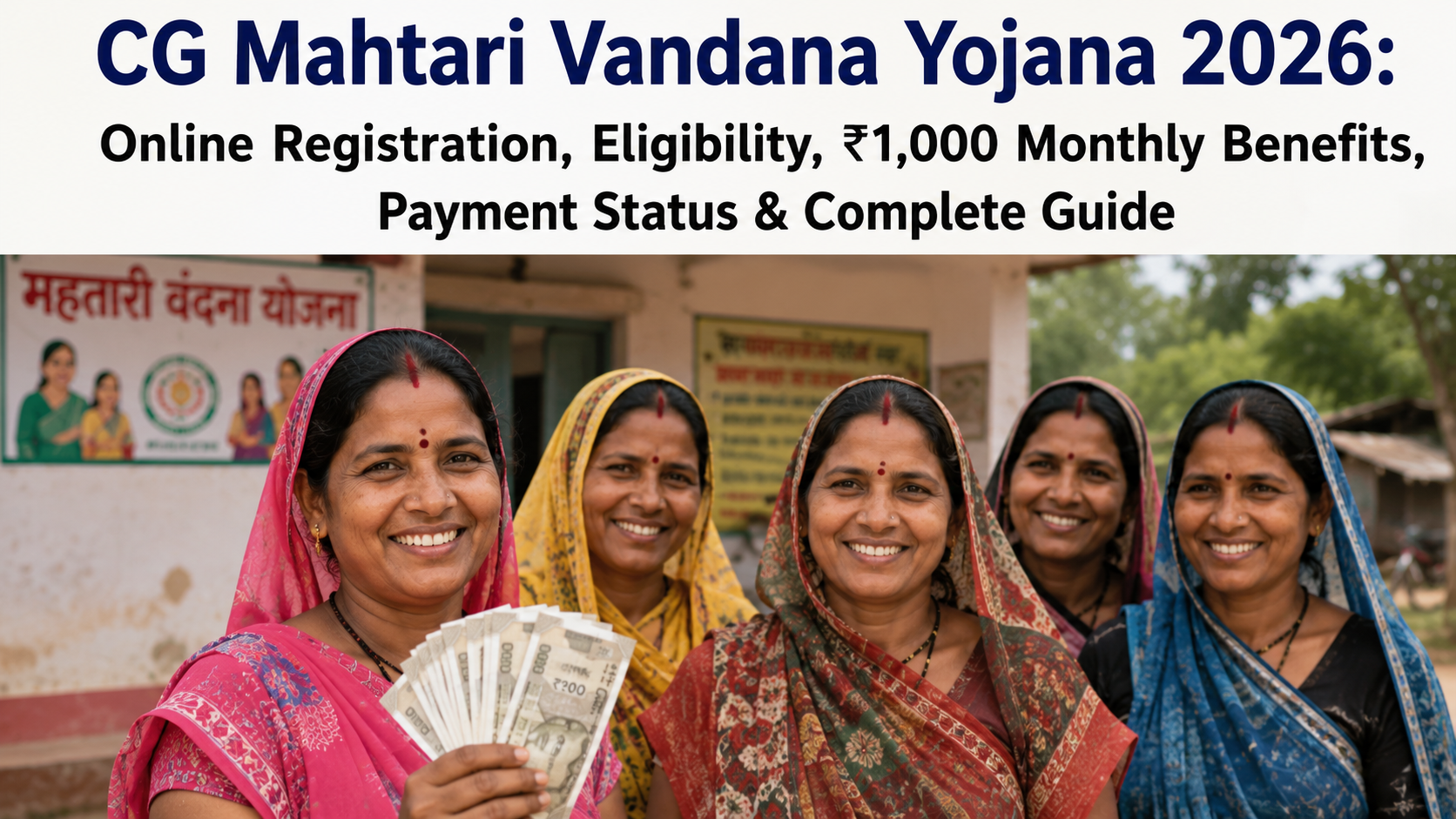
Direct answer: Mahtari Vandan Yojana is one of Chhattisgarh’s most prominent women-focused welfare programmes. Eligible women receive ₹1,000 per month, subject to the scheme’s eligibility and administrative requirements. Official state communications continue to report the scheme as an active programme in 2026.
The programme was introduced with an emphasis on women’s economic empowerment, health, nutrition and strengthening their role in household decision-making. The government’s 2026-27 budget provides ₹8,200 crore for the scheme.
The significance of the scheme goes beyond the nominal monthly amount. Regular direct financial assistance can give beneficiaries greater control over small household expenditures, savings and personal needs. At the same time, the payment should not be interpreted as a substitute for employment or a comprehensive income-support system.
For applicants, the important point is to verify current eligibility and beneficiary status through the official scheme machinery rather than relying on social-media posts about instalments or application dates. Check Official webite
2. Krishak Unnati Yojana
Direct answer: Krishak Unnati Yojana is a major agricultural support programme of Chhattisgarh intended to improve crop production, productivity and farm income while encouraging investment in inputs, technology and diversification.
The state government says the scheme is intended to reduce cultivation costs and encourage farmers to invest in improved seeds, fertilisers, pesticides, mechanisation and newer agricultural technologies. It also aims to promote crop diversification.
The 2026-27 budget allocates ₹10,000 crore to the scheme, making it one of the largest individual scheme allocations in the state’s budget.
The 2026 budget material also highlights crops and areas connected with the programme, including pulses, oilseeds, maize, minor millets such as kodo-kutki, ragi and cotton.
For farmers, the practical question is not simply whether they have heard of Krishak Unnati Yojana, but whether their crop, registration and transaction records meet the applicable conditions for a particular benefit.
3. Mukhyamantri Khadyaan Sahayata Yojana
Food security remains central to Chhattisgarh’s welfare architecture.
The Food, Civil Supplies and Consumer Protection Department lists the Mukhyamantri Khadyaan Sahayata Yojana among its schemes. The department provides different food-grain entitlements according to ration-card categories. For example, Antyodaya ration-card households are listed for 35 kg of rice per month, while different provisions apply to priority, single destitute, disability and general-family categories.
The 2026-27 budget allocates ₹6,500 crore to Mukhyamantri Khadyaan Sahayata.
This illustrates an important feature of the Chhattisgarh scheme system: some benefits are not distributed through an individual cash application. Instead, entitlement can be linked to a household’s ration-card category and food-distribution records.
Therefore, a person checking their eligibility should first establish which ration-card category applies to their household.
4. Deendayal Upadhyaya Bhoomihin Krishi Majdoor Kalyan Yojana
Landless agricultural workers occupy a different position from farmers who own or cultivate registered agricultural land. Chhattisgarh’s scheme architecture recognises this distinction through the Deendayal Upadhyaya Bhoomihin Krishi Majdoor Kalyan Yojana.
The scheme is specifically identified in the 2026-27 major scheme allocation, with ₹600 crore provided in the state budget.
Its importance lies in addressing a group whose income can depend heavily on agricultural labour while lacking the asset base associated with land ownership.
For potential beneficiaries, however, the correct approach is to check the current beneficiary definition and registration requirements applicable to their category rather than assuming that every agricultural labourer automatically qualifies.
5. Health Schemes
Healthcare support is another major component of the state’s welfare spending.
The 2026-27 budget highlights Shaheed Veer Narayan Singh Ayushman Yojana, with an allocation of ₹1,500 crore, alongside the National Health Mission.
Health-related programmes may involve eligibility determined through government databases, beneficiary categories, health cards or other administrative mechanisms. Because medical coverage rules and empanelled facilities can change, residents should verify the latest details before planning treatment around a particular benefit.
The broader lesson is important: a “scheme list” should not be treated as a static catalogue. Healthcare programmes can involve multiple layers of state and central government support.
6. Housing Schemes in Chhattisgarh
Housing is addressed through both state and centrally supported programmes.
The 2026-27 major scheme allocation includes:
- PMAY-G — ₹4,000 crore
- PMAY-Urban — ₹825 crore
- PM JANMAN — ₹720 crore
These programmes address different housing and vulnerable-community requirements.
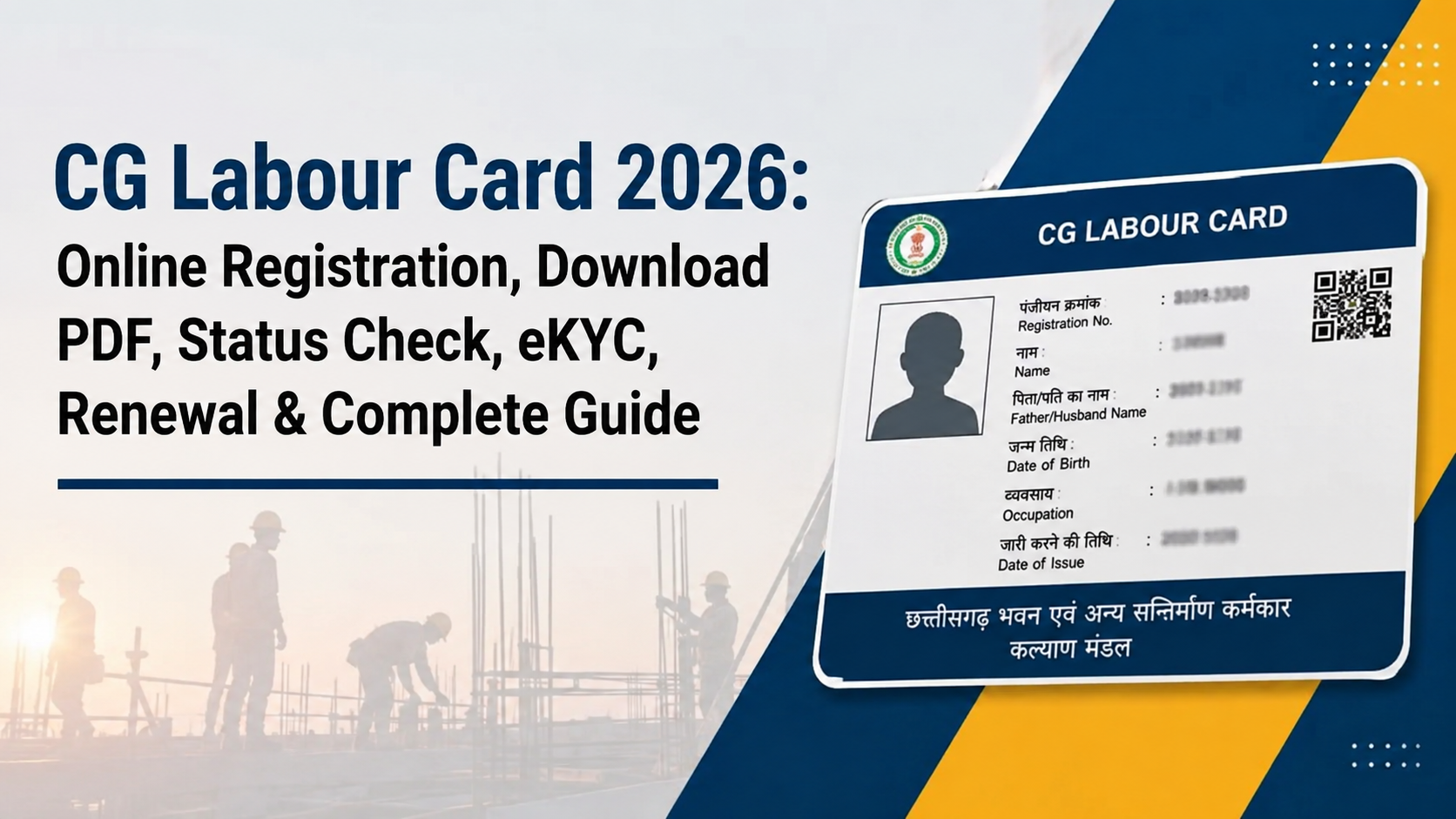
A particularly useful point for workers is that the Chhattisgarh Labour Department also operates a Mukhyamantri Nirman Shramik Awas Sahayata Yojana. According to the department, eligible registered construction workers meeting the prescribed conditions can receive ₹1 lakh as a one-time amount for construction or purchase of a house.
This is a good example of why checking only one generic “government scheme list” can be misleading. A construction worker may have access to benefits through a specialised labour department programme in addition to broader housing schemes.
7. Schemes for Construction Workers
The Chhattisgarh Labour Department provides one of the clearest examples of a detailed, beneficiary-specific scheme system.
Its current English scheme listing identifies active programmes including:
- Free uniforms and books assistance for children of construction workers
- Mukhyamantri Shramik Siyan Sahayata Yojana
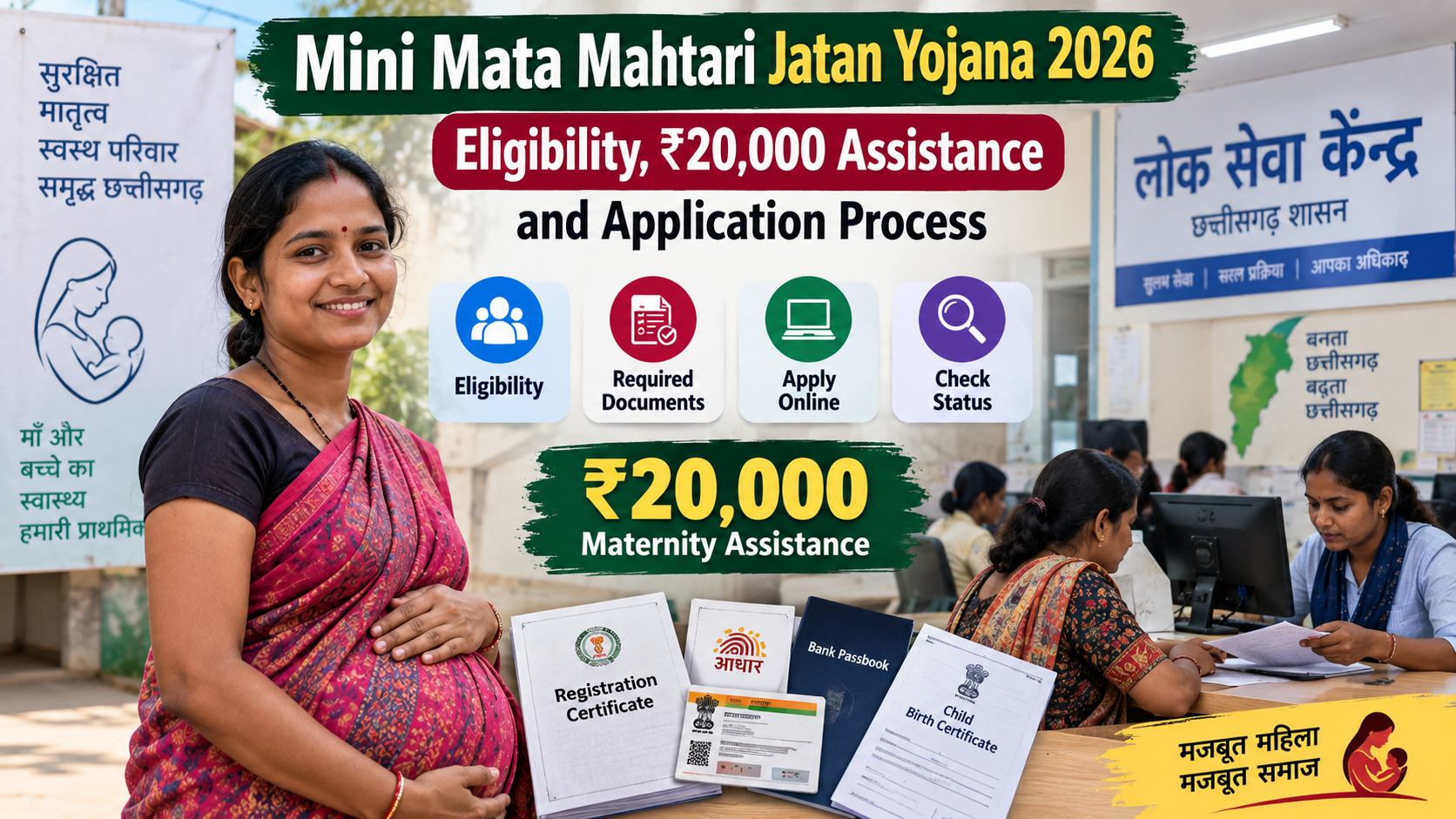
- Minimamata Mahtari Jatan Yojana
- Mukhyamantri Naunihal Scholarship Yojana
- Mukhyamantri Noni Babu Meritorious Education Assistance
- Sports incentive support for workers’ children
- Mukhyamantri Noni Sashaktikaran Sahayata Yojana
- Bicycle assistance
- Sewing-machine assistance
- Tool-kit assistance
- Safety-equipment assistance
- Skill-development and family empowerment
- Didi E-Rickshaw assistance
- Free coaching assistance
- Housing assistance
- Death and disability assistance
- Long-life assistance
- Construction-worker pension assistance.
The pension programme is particularly notable. The Labour Department lists a ₹1,500 monthly lifelong pension for eligible registered construction workers who meet the prescribed age and registration conditions, with a specified family pension provision for an eligible spouse after death.
At the same time, not every historical labour scheme remains operational. The department explicitly marks some programmes as closed. This distinction is essential when creating or reading a Chhattisgarh Yojana List.
8. Agriculture and Livestock Schemes
Agriculture-related support extends beyond direct farmer-income programmes.
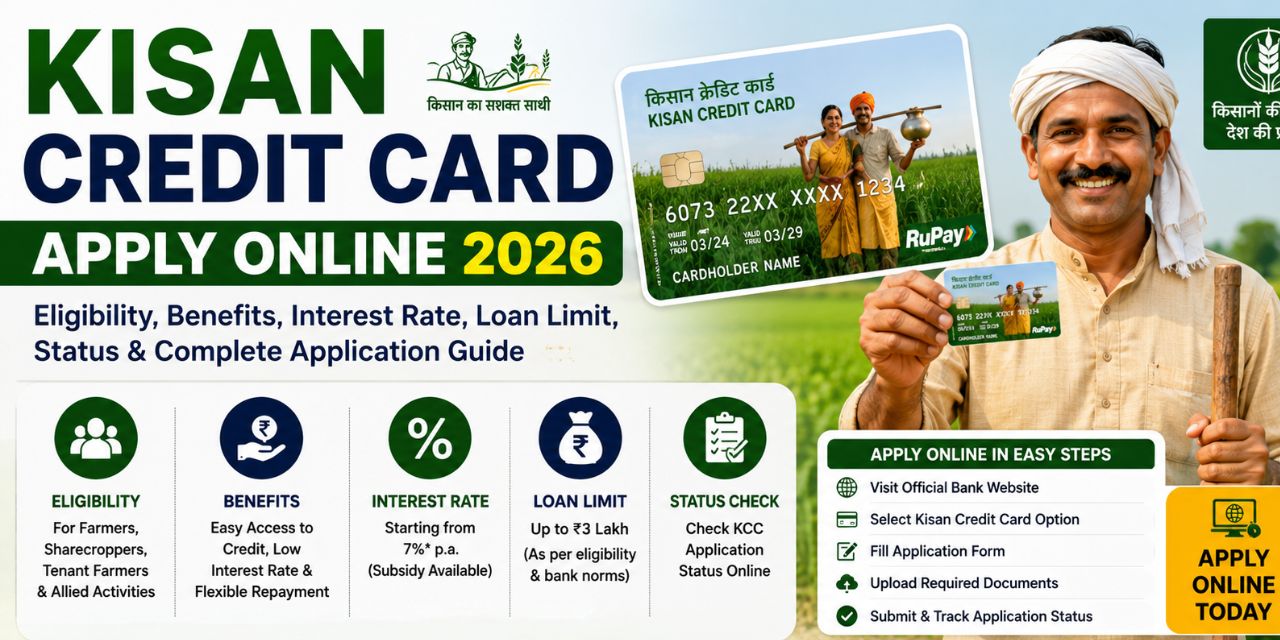
The official CM Helpline scheme catalogue includes livestock programmes such as poultry development, piggery units, goat distribution and breed improvement, improved-breed bull distribution, calf-rearing programmes and the National Livestock Mission. It also lists Kisan Credit Card support for animal husbandry.
This makes livestock programmes particularly relevant for rural households whose primary livelihood is not conventional crop cultivation.
The government’s 2026 budget also includes allocations for agricultural electricity, natural farming, oilseed and pulse initiatives and other agriculture-related interventions.
9. Food Procurement and Farmer Support
Chhattisgarh’s agricultural economy is closely connected with public procurement.
The Food Department describes the state’s Decentralised Foodgrain Procurement Scheme, under which authorised state agencies procure paddy from farmers and rice through designated agencies.
This is important context when assessing farmer-oriented schemes. Income support does not operate in isolation from procurement policy, crop registration, procurement centres and the wider public distribution system.
The state’s 2026-27 budget separately provides ₹6,000 crore for paddy procurement facilitation.
10. Education and Scholarship Schemes
Students can encounter Chhattisgarh government support through school education, higher education, scholarships and targeted welfare programmes.
The state’s citizen scheme portal includes education-related programmes, including scholarship-related services and support for government and non-government educational institutions.
Children of registered construction workers can also qualify for specialised assistance. The Labour Department currently lists the Mukhyamantri Naunihal Scholarship Yojana, meritorious education assistance and free coaching support for eligible workers and their children. The free coaching programme can cover competitive examinations such as PSC, CG Vyapam, SSC, banking, railway and police recruitment examinations subject to the scheme’s conditions.
For students, it is therefore useful to check both general education schemes and occupation-linked schemes available through a parent’s registration status.
11. Drinking Water and Rural Development
The scheme ecosystem also includes infrastructure-oriented programmes.
The Public Health Engineering Department states that rural drinking-water supply works are implemented under state schemes as well as centrally sponsored programmes. Urban local bodies can also receive state support for water-supply projects.
At the budget level, Jal Jeevan Mission receives ₹3,000 crore in the 2026-27 major scheme allocation.
This is a reminder that government schemes do not always mean direct money in an individual’s bank account. Some schemes create public infrastructure that benefits households collectively.
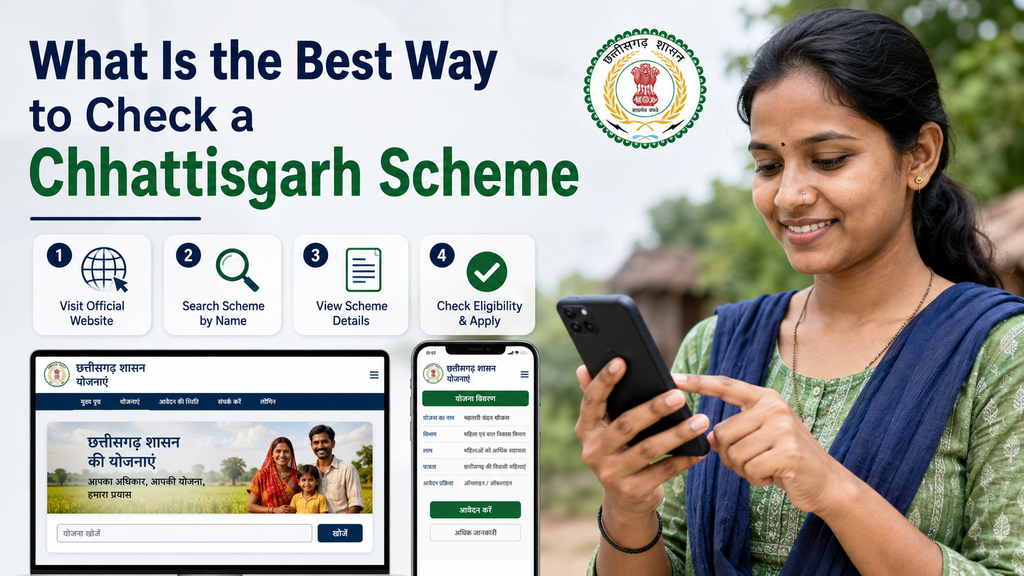
What Is the Best Way to Check a Chhattisgarh Scheme?
The safest approach is to begin with the official Chhattisgarh government scheme portal or the department responsible for the programme.
The CM Helpline scheme directory is particularly useful because it organises schemes by department and provides a citizen-facing entry point.
For a construction worker, the Labour Department’s dedicated portal is more useful than a general article because it provides scheme-specific eligibility, benefits, documents and application options.
The same principle applies to food schemes, agriculture programmes, scholarships and health benefits: verify the latest rule with the implementing department before submitting documents or paying anyone for assistance.
Important: A Scheme Being Listed Does Not Mean Everyone Is Eligible
This is perhaps the most frequently misunderstood aspect of government schemes.
A scheme can be active while an individual remains ineligible.
Eligibility may depend on:
- Age
- Gender
- Income
- Residence
- Occupation
- Ration-card category
- Land ownership
- Farmer registration
- Labour registration
- Family circumstances
- Educational qualification
- Previous benefits
- Application date
- Required documents
For example, the Labour Department’s schemes frequently require a worker to have been registered for a particular period before becoming eligible. Some benefits also apply only to a worker’s first one or two children.
Therefore, a reliable CG List Chhattisgarh Yojana List should always be read as a directory, not as a guarantee of benefits.
What the Evidence Suggests About Chhattisgarh’s Scheme Priorities
The 2026-27 budget provides a clearer picture than simply counting scheme names.
Large allocations are concentrated in agriculture, women’s financial support, food security, housing, energy, health and rural development. The largest highlighted allocation among individual schemes is ₹10,000 crore for Krishak Unnati Yojana, followed by ₹8,200 crore for Mahtari Vandan Yojana and ₹6,500 crore for Mukhyamantri Khadyaan Sahayata.
That suggests a welfare model combining direct household assistance with sector-specific economic support and public infrastructure.
The more difficult policy question is not whether these programmes exist. It is whether beneficiaries can find the correct programme, complete the required registration and receive the intended benefit without administrative friction.
For ordinary residents, accessibility and clarity are therefore almost as important as the size of a scheme’s budget.
How to Find the Right Scheme for Your Family
A practical method is to classify yourself first:
If you are a farmer:
Start with Krishak Unnati Yojana, crop insurance, procurement-related programmes, agricultural input support and livestock schemes where applicable.
If you are a woman:
Check Mahtari Vandan Yojana and women- and child-development programmes.
If you are a construction worker:
Check the Labour Department’s beneficiary schemes before looking only at general welfare programmes.
If you have a ration card:
Check the food department’s entitlement rules and ration-card category.
If you need housing:
Check PMAY-G or PMAY-Urban according to your location and household circumstances, as well as specialised housing support where applicable.
If you are a student:
Check school or higher-education scholarships and any occupation-linked educational benefits available through a parent.
This beneficiary-first approach is considerably more useful than scrolling through dozens of scheme names without knowing which department handles them.
- Widow Pension Scheme 2026: Eligibility, Pension Amount, Application Process, and State-Wise Benefits
- PM Har Ghar Jal Yojana 2026: Jal Jeevan Mission Online Apply, List, Status and Latest Updates
FAQ Section
What is the CG List Chhattisgarh Yojana List?
What is the CG List Chhattisgarh Yojana List? These programmes cover areas such as women’s welfare, agriculture, food security, health, education, housing, labour welfare and rural development. The official state scheme portal organises programmes by department.
Which is the main women’s scheme in Chhattisgarh?
Mahtari Vandan Yojana is one of Chhattisgarh’s major women-focused welfare programmes. Official state information states that eligible women receive ₹1,000 per month, subject to applicable eligibility conditions. The 2026-27 budget provides ₹8,200 crore for the scheme
Which Chhattisgarh scheme is for farmers?
Krishak Unnati Yojana is a major farmer-focused programme. It aims to support agricultural productivity, reduce cultivation costs, encourage investment in inputs and technology and promote crop diversification. The 2026-27 state budget allocates ₹10,000 crore to the scheme
Are all schemes in the Chhattisgarh Yojana List currently active?
No. A scheme list can contain programmes with different operational statuses. The Labour Department, for example, explicitly marks some schemes as currently running and others as closed. Readers should therefore verify the latest status with the implementing department before applying.
What schemes are available for construction workers in Chhattisgarh?
Registered construction workers can access several schemes depending on eligibility, including education assistance, scholarships, tool kits, safety equipment, housing assistance, skill development, death and disability support, coaching and pension assistance. The Labour Department’s current portal provides scheme-specific eligibility and benefit details.
How can I check whether I am eligible for a Chhattisgarh government
Start with the official Chhattisgarh government scheme directory and identify the department responsible for the programme. Then check the specific eligibility conditions, required documents and application process. Eligibility can depend on factors such as age, occupation, income, registration, ration-card category or landholding, so a general scheme list cannot establish eligibility by itself.
Which Chhattisgarh schemes are highlighted in the 2026-27 budget?
The 2026-27 major scheme allocation highlights Krishak Unnati Yojana at ₹10,000 crore, Mahtari Vandan Yojana at ₹8,200 crore, Mukhyamantri Khadyaan Sahayata at ₹6,500 crore, PMAY-G at ₹4,000 crore, Jal Jeevan Mission at ₹3,000 crore and Shaheed Veer Narayan Singh Ayushman Yojana at ₹1,500 crore, among others.
Where should I verify the latest Chhattisgarh scheme information?
The safest source is the relevant official Chhattisgarh government department. The state CM Helpline scheme portal provides a department-wise catalogue, while specialised departments such as Labour maintain their own detailed scheme pages. Information such as eligibility, application windows and operational status should be verified against these official sources before taking action.

2 Comments