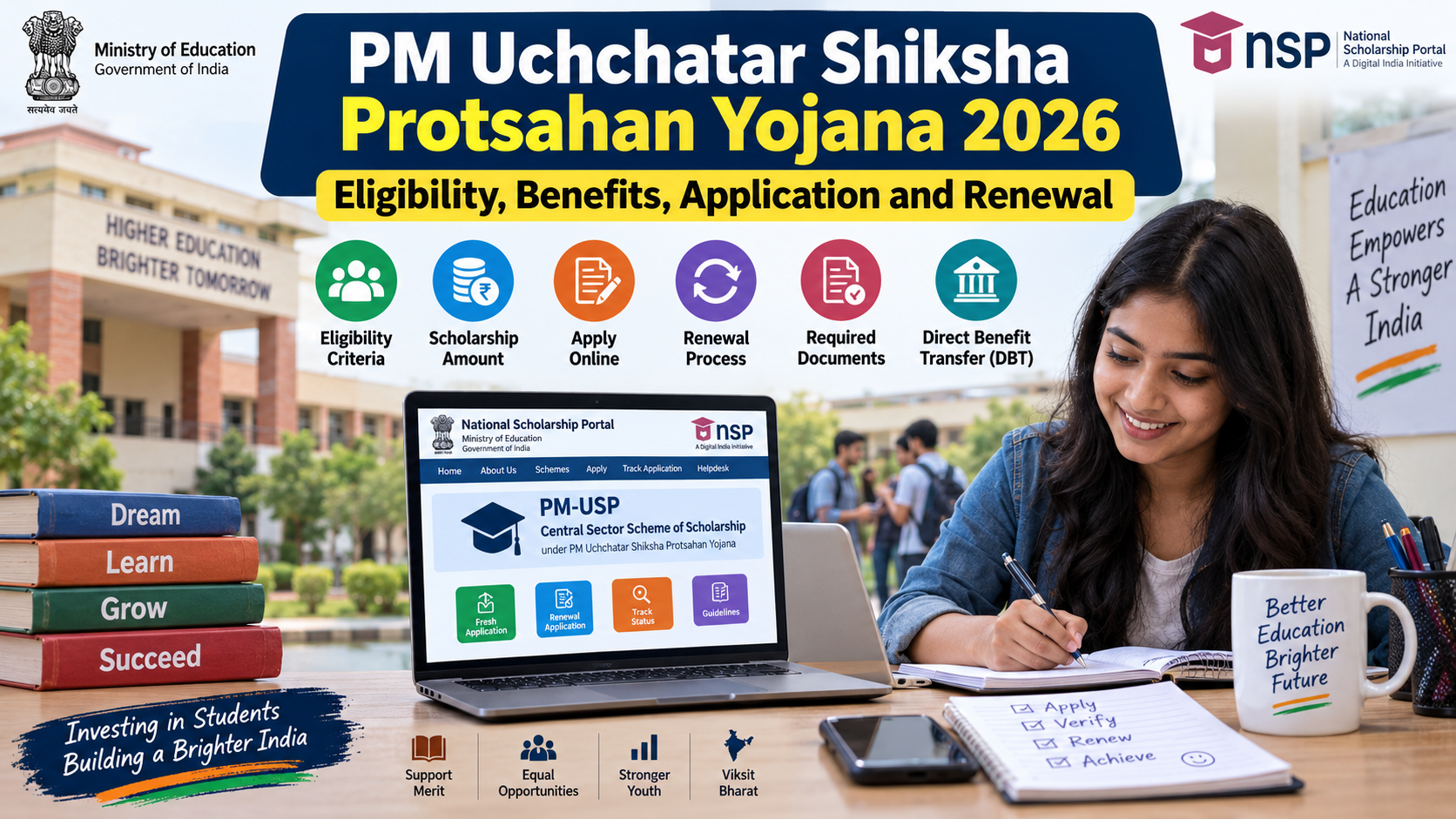
PM Uchchatar Shiksha Protsahan Yojana (PM-USP) :The PM Uchchatar Shiksha Protsahan Yojana is part of the Union Government’s framework for supporting students pursuing higher education. It is administered by the Department of Higher Education under the Ministry of Education and includes scholarship and education-finance components rather than being a single cash-transfer programme.
For most college students searching for PM-USP Scholarship 2026, the relevant component is the PM-USP Central Sector Scheme of Scholarship for College and University Students (CSSS). The scheme is designed to provide financial assistance to meritorious students from economically weaker families who continue into regular higher education. The scholarship is transferred through Direct Benefit Transfer (DBT).For the 2026-27 academic year, the National Scholarship Portal is operating and requires One Time Registration (OTR) for scholarship applications. The official portal currently specifically identifies PM-USP CSSS renewal applications as open.
That distinction is important. A student should not assume that every person who has completed Class 12 automatically receives PM-USP assistance. Eligibility depends on academic position, family income, course, institutional requirements and the applicable scholarship rules.
What is PM Uchchatar Shiksha Protsahan Yojana?
PM-USP is a Government of India higher-education assistance framework implemented by the Department of Higher Education. Official government material identifies components including the Central Sector Scheme of Scholarship for College and University Students, the Special Scholarship Scheme for Jammu & Kashmir and Ladakh, and education-loan interest subsidy-related assistance.The distinction between these components matters because their eligibility rules and benefits are not identical.
For students across most of India, the PM-USP CSSS is the component generally relevant when searching for a scholarship after Class 12. Its purpose is to help meritorious students from families with limited financial resources meet part of the cost associated with pursuing higher education.The scheme is merit-based but also includes an income condition. In other words, academic performance alone does not guarantee the scholarship.
PM-USP Scholarship 2026: What is the scholarship amount?
Under the published scheme structure, the PM-USP CSSS scholarship is ₹12,000 per year for the first three years of graduation. The rate rises to ₹20,000 per year for postgraduate study and for the fourth and fifth years of eligible five-year or integrated professional courses. Students in technical courses such as B.Tech/BE receive the scholarship according to the applicable course-duration provisions.
| Study stage | Scholarship rate |
|---|---|
| Graduation, first three years | ₹12,000 per year |
| Postgraduate level | ₹20,000 per year |
| Eligible 4th and 5th years of five-year/integrated professional courses | ₹20,000 per year |
| Eligible technical degree courses | As prescribed under the scheme |
The payment should not be interpreted as a universal ₹20,000 annual grant. The amount depends on the student’s level and type of course.The scholarship is also intended to contribute towards educational and day-to-day expenses; it is not generally a promise to cover the complete cost of college tuition, accommodation and other expenses.
Who is eligible for PM-USP CSSS in 2026?
The core eligibility conditions published by the Ministry of Education include academic merit, family income and enrolment in an eligible regular course.
A student generally needs to meet the following conditions:
- Be among the top 20th percentile of successful Class XII candidates in the relevant stream and examination board.
- Have gross parental/family income of up to ₹4.5 lakh per year.
- Take admission to a regular degree course.
- Study at an eligible recognised institution.
- Not simultaneously claim another scholarship or fee-reimbursement benefit where the scheme rules prohibit such overlap.
- Meet the applicable renewal requirements if continuing an existing scholarship.
The Ministry’s published scheme material states that 82,000 fresh scholarships are available annually, with 50% of the slots earmarked for girls. Allocation is made among State Education Boards using the scheme’s prescribed methodology.
Does scoring 80% automatically qualify a student?
No.The commonly used phrase “80% scholarship” can be misleading. PM-USP CSSS eligibility is not simply based on obtaining a fixed 80% mark in Class 12.The official criterion refers to being above the 80th percentile of successful candidates in the relevant stream from the respective board. This means the threshold can differ between boards and streams.
PM-USP Yojana 2026 Highlights
| Detail | Information |
|---|---|
| Scheme Name | Pradhan Mantri Uchchatar Shiksha Protsahan Yojana (PM-USP) |
| Session | 2026–27 |
| Launched/Implemented By | Ministry of Education, Government of India |
| Beneficiaries | Eligible meritorious students from economically weaker families |
| Scholarship Amount | ₹12,000 to ₹20,000 per year, depending on study level/course |
| Application Mode | Online through National Scholarship Portal (NSP) |
| Student Application Last Date | 31 October 2026 for the currently announced PM-USP CSSS renewal cycle |
| Official Website | National Scholership Portal |
Is PM-USP available to students from all categories?
The scholarship follows the applicable Central Reservation Policy. Government material specifies reservation for SC, ST and OBC students, along with horizontal reservation for students with benchmark disabilities as prescribed under the scheme.
Therefore, PM-USP CSSS should not be viewed as a scholarship restricted to one caste category. Eligibility begins with the scheme’s academic and income conditions, after which applicable reservation provisions are followed.
The practical implication is that a student should enter accurate category information on the National Scholarship Portal rather than selecting a category simply because it appears to provide a perceived advantage.
Which courses are covered?
The Central Sector Scholarship is intended for students pursuing eligible regular undergraduate, postgraduate and specified professional courses.The scheme excludes correspondence and distance-mode study in the published eligibility framework and does not function as a general diploma scholarship.
Professional and technical programmes can have different payment-duration rules. For example, the published structure provides ₹20,000 in the later years of eligible five-year or integrated professional courses, while technical degree students such as those pursuing B.Tech/BE are governed by the specific provisions applicable to their course.Students should therefore verify their exact course classification on NSP instead of assuming that every five-year or professional programme receives the same payment pattern.
How to apply for PM-USP Scholarship 2026?
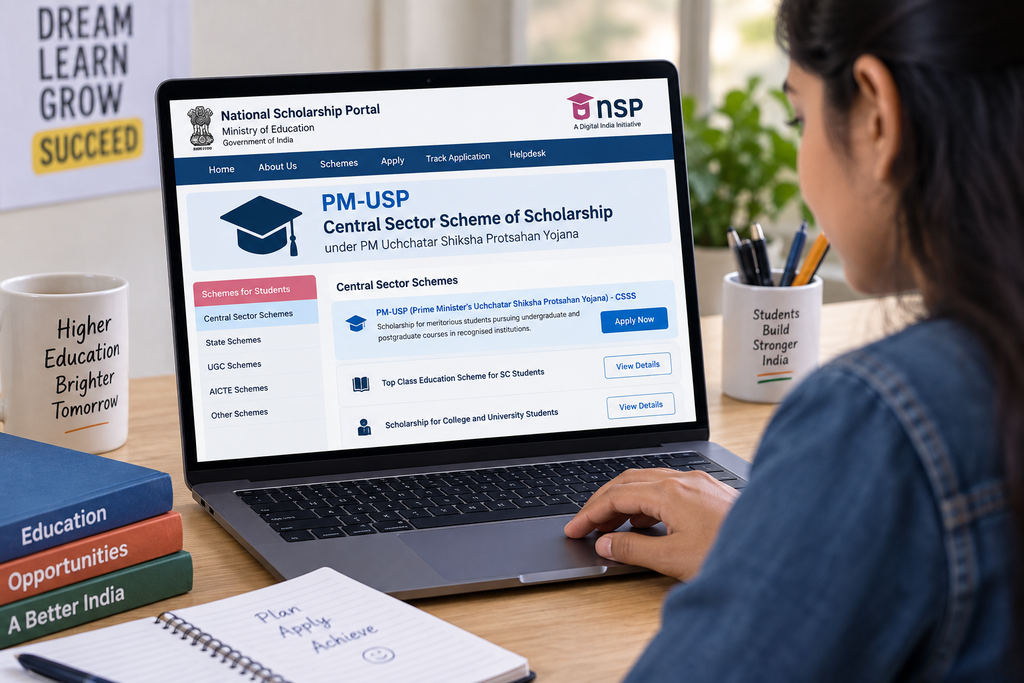
Applications for PM-USP CSSS are processed through the National Scholarship Portal (NSP).
For the scholarship system, OTR has become an important first step. The Ministry’s FAQ explains that One Time Registration generates a unique number intended to remain associated with the student’s scholarship journey.
Basic application process
Step 1: Complete OTR
Create the required One Time Registration through the National Scholarship Portal and complete the identity-verification process prescribed by NSP.
Step 2: Log in to NSP
Use the OTR credentials to access the scholarship application system.
Step 3: Select the appropriate scholarship
Search for PM-USP – Central Sector Scheme of Scholarship for College and University Students (CSSS).
Step 4: Enter academic and personal information
Provide details such as board examination information, college, course, category and family-income information as required.
Step 5: Check the application carefully
A small discrepancy in personal, academic or bank information can create verification problems. Students should review the form before final submission.
Step 6: Complete institutional verification
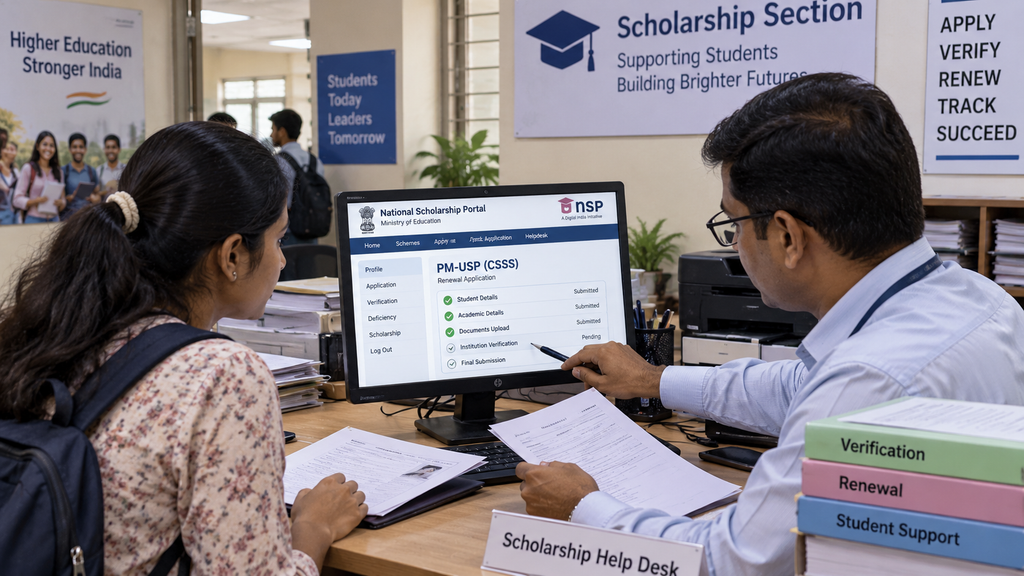
Scholarship applications are subject to verification. Students should therefore monitor the application status and respond to any defect or correction request within the prescribed period.
What documents may be required?
The exact document requirement can depend on the student’s application and verification process, but students should be prepared to provide or authenticate information relating to:
- Class 12 marksheet or academic record
- Income certificate, where required
- Aadhaar/identity details
- Bank-account details
- College admission or enrolment information
- Category certificate, where applicable
- Disability certificate, where applicable
- Other documents requested by NSP or the verification authority
How is PM-USP scholarship money paid?
The PM-USP CSSS uses Direct Benefit Transfer (DBT). Government material states that the scholarship is transferred directly to the beneficiary’s bank account.This makes bank-account accuracy particularly important.
Students should ensure that the account information submitted for scholarship purposes is correct and that the required Aadhaar-seeding or bank-mapping conditions are satisfied where applicable. The Ministry’s FAQ provides specific guidance concerning Aadhaar seeding and checking the related status.
A scholarship application being submitted does not necessarily mean payment will immediately appear in the bank account. Verification, sanction and DBT processing occur before the final credit.
PM-USP renewal 2026: What existing beneficiaries should know
The Ministry’s FAQ explains that students who received a fresh scholarship in previous academic years can apply for renewal through NSP, subject to the applicable renewal requirements.The published scheme information also indicates that renewal is linked to academic performance and attendance requirements. Available scheme guidance specifies at least 50% marks in the annual examination and adequate attendance of at least 75% for renewal.Students who already receive PM-USP should therefore not assume that the scholarship continues automatically. They need to complete the renewal process on NSP within the applicable period.
What is the PM-USP 2026 last date?
As of 10 September 2026, the official National Scholarship Portal states that PM-USP CSSS renewal applications are open for the 2026-27 academic year. Its announcement currently gives 31 October 2026 as the student-application closing date and lists later verification deadlines.
However, the official “All Scholarships” listing separately displays the PM-USP CSSS renewal window with a 30 September 2026 student deadline and subsequent verification dates.Because these official NSP pages currently show different dates, publishing one date without qualification would be misleading.
This is especially important for renewal applicants because institutional verification may need to happen after submission.
What the evidence suggests about PM-USP
Government records indicate that PM-USP CSSS is not a newly introduced scholarship created specifically for 2026. It has been operating as an established higher-education assistance mechanism.
Parliamentary data recorded 79,012 fresh PM-USP CSSS scholarships in 2025-26 up to 22 March 2026, compared with 77,200 in 2024-25. The same government data show substantial growth in funds allocated and utilised under the scheme over recent years.
This provides useful context. The scholarship is part of a continuing higher-education support system rather than a one-time announcement promising a fixed cash payment to every student.
Competitive advantage: What students often misunderstand
The most important distinction is between being academically eligible to be considered and actually receiving the scholarship.
A Class 12 student may perform well but still not appear in the relevant board’s top-percentile list. Another student may meet the percentile condition but fail the family-income or course requirements. An existing beneficiary may satisfy the basic conditions but fail to complete renewal or verification.
The scheme therefore works through several filters:
Board performance → eligible percentile → family-income condition → eligible course/institution → NSP application → verification → sanction → DBT
Understanding this chain is more useful than focusing only on the headline scholarship amount.It also explains why students should be cautious about social-media claims such as “₹20,000 PM scholarship for every college student”. PM-USP does not operate on such a universal basis.
- SSO ID Rajasthan 2026: Registration, Login, Find SSO ID and Government Employee Guide
- Goa High-Support Disability Scheme 2026: Eligibility, Benefits, Documents and Application Process
PM-USP versus other scholarships
PM-USP CSSS is only one of several scholarship options available to Indian students.Depending on category, course, region and family circumstances, a student may also encounter scholarships administered by the University Grants Commission, AICTE, Ministry of Social Justice and Empowerment, Ministry of Tribal Affairs and other government bodies.
The National Scholarship Portal itself states that from academic year 2026-27, students may apply for one merit-based scholarship and one or more welfare-based scholarship schemes, subject to the respective eligibility conditions.This change is significant because students should not automatically assume that receiving one welfare-based benefit makes them ineligible for every merit-based scholarship. At the same time, each individual scheme’s rules still need to be checked.
What students should do before submitting the form
A sensible checklist is:
- Confirm that the scholarship listed on NSP is the correct PM-USP component.
- Check whether the application is fresh or renewal.
- Verify Class 12 board and percentile eligibility.
- Confirm family-income eligibility.
- Check whether the course is regular and eligible.
- Complete OTR correctly.
- Check bank-account details and applicable Aadhaar seeding.
- Review every field before final submission.
- Keep acknowledgement/application details safely.
- Follow up with the institution for verification.
- Monitor NSP for defects or status changes.
FAQ Section
What is PM Uchchatar Shiksha Protsahan Yojana 2026?
PM Uchchatar Shiksha Protsahan (PM-USP) is a Government of India higher-education assistance framework implemented by the Department of Higher Education. Its components include scholarships and education-finance support. For most college students, the relevant component is the PM-USP Central Sector Scheme of Scholarship for College and University Students (CSSS).
How much scholarship is given under PM-USP CSSS?
The published PM-USP CSSS structure provides ₹12,000 per year for the first three years of graduation. The rate is ₹20,000 per year at postgraduate level and for the fourth and fifth years of eligible five-year or integrated professional courses. Course-specific rules can affect the payment duration.
Who can apply for PM-USP CSSS?
Eligibility generally requires the student to be above the 80th percentile among successful Class XII candidates in the relevant stream and board, have gross family income of up to ₹4.5 lakh annually and pursue an eligible regular degree course. Other conditions, including scholarship overlap and verification requirements, also apply.
Can a student with 80% marks get PM-USP?
Not necessarily. PM-USP CSSS does not simply use a universal 80% marks cutoff. The published criterion is based on being above the 80th percentile of successful candidates in the relevant stream and board. Therefore, the actual academic threshold can vary according to board and stream.
Is PM-USP scholarship available for postgraduate students?
Yes. Under the CSSS structure, eligible postgraduate students can receive ₹20,000 per year, subject to the scheme’s eligibility and renewal conditions. The scholarship is not automatically available to every postgraduate student; the student’s original eligibility and continuing scholarship status remain relevant.
What is the PM-USP renewal last date in 2026?
The official NSP pages currently show different deadline information. The portal’s announcement gives 31 October 2026, while its scholarship listing shows 30 September 2026 for PM-USP CSSS renewal. Students should therefore check the deadline displayed for their application and the latest official NSP instructions rather than relying on an older third-party deadline.
Is PM-USP scholarship paid directly into a bank account?
Yes. PM-USP CSSS operates through Direct Benefit Transfer. Government information states that scholarship payments are transferred directly to beneficiary bank accounts, subject to the required processing and verification conditions. Students should ensure their bank and applicable Aadhaar-seeding details are correct.
Is PM-USP the same as every other government scholarship?
No. PM-USP is a specific higher-education assistance framework with multiple components. PM-USP CSSS is the component commonly relevant to eligible college and university students. Other scholarships administered through NSP may have different academic, income, category, course or institutional conditions. Students should evaluate each scheme separate.
Conclusion
PM Uchchatar Shiksha Protsahan Yojana 2026 is best understood as a structured higher-education support framework rather than a universal cash benefit for every college student. Under its Central Sector Scholarship component, eligible meritorious students can receive financial assistance based on academic performance, family income, course and other prescribed conditions.
For students, the most important step is not simply checking the scholarship amount but verifying eligibility through the National Scholarship Portal, completing the required application or renewal process and ensuring that institutional verification and payment-related requirements are completed correctly. For the 2026–27 renewal cycle, the current NSP announcement gives 31 October 2026 as the student application closing date.