Atal Pension Yojana 2026: Retirement security remains a difficult question for millions of Indians who work outside formal pension systems. For such households, the Atal Pension Yojana 2026 remains relevant because it combines periodic contributions with a government-guaranteed minimum pension after the subscriber reaches 60 years of age.
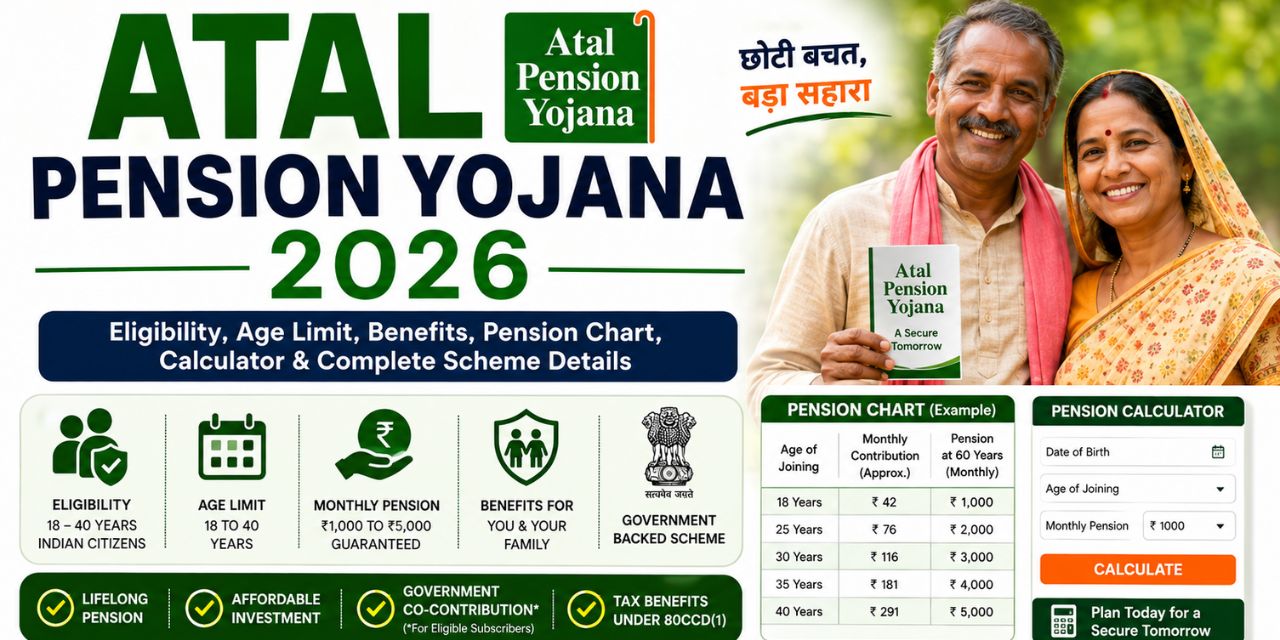
The scheme, introduced in 2015, is administered by the Pension Fund Regulatory and Development Authority (PFRDA). Eligible subscribers can choose a guaranteed minimum monthly pension of ₹1,000, ₹2,000, ₹3,000, ₹4,000 or ₹5,000 from age 60, subject to the applicable contribution structure.
There is also an important 2026 development. The Union Cabinet approved continuation of APY until 2030-31, along with continued funding support for promotional, developmental and gap-funding activities. PFRDA said the scheme had crossed 8.66 crore subscribers at the time of the January 2026 announcement.For prospective subscribers, however, the headline pension figure is only one part of the decision. Age at entry, contribution frequency, tax-payer status, continuity of contributions and the treatment of benefits after death all matter.
What is Atal Pension Yojana?
Atal Pension Yojana is a voluntary, contribution-based pension scheme introduced by the Government of India with effect from June 1, 2015. It is administered by PFRDA under the broader institutional framework of the National Pension System. The scheme is available through banks and the Department of Posts for eligible Indian citizens.
The central feature is a minimum guaranteed pension between ₹1,000 and ₹5,000 per month from age 60, depending on the pension option selected and the subscriber’s contributions. The scheme also provides for the same pension to the spouse after the subscriber’s death, subject to the scheme rules, followed by return of the accumulated pension wealth to the nominee after the death of both subscriber and spouse.
This makes APY different from a simple savings account. The purpose is not to provide unrestricted access to the money during working years, but to create a structured retirement-income arrangement.
Atal Pension Yojana 2026 — Key Information
| Detail | Information |
|---|---|
| Scheme Name | Atal Pension Yojana (APY) |
| Level | Central Government |
| Beneficiary States | All India |
| Nodal Ministry | Ministry of Finance |
| Regulator | Pension Fund Regulatory and Development Authority (PFRDA) |
| Implementing Agency | Banks and Post Offices |
| Launch Date | 9 May 2015 |
| Pension Amount | ₹1,000 to ₹5,000 per month |
| Pension Start Age | 60 years |
| Entry Age | 18 to 40 years |
| Official Website | financialservices.gov.in |
Atal Pension Yojana 2026: Latest Update
The most significant current update is the Union Cabinet’s decision in January 2026 to continue Atal Pension Yojana until financial year 2030-31. The decision also extends government support for promotional and developmental activities and gap funding.
This is significant because APY is built around a minimum pension guarantee. Government gap funding is intended to address potential shortfalls associated with that minimum guarantee based on actuarial assessment. PFRDA’s disclosure says that, as of March 31, 2025, the government had released ₹1,084 crore towards APY gap funding, while APY assets under management stood at ₹44,780.49 crore.
The scheme also crossed an important participation milestone. PFRDA reported more than 7.60 crore gross enrolments by March 31, 2025, while the January 2026 continuation announcement reported more than 8.66 crore subscribers.

Who Can Join Atal Pension Yojana in 2026?
A new subscriber generally needs to meet three key conditions:
- The person must be an Indian citizen.
- The applicant must be between 18 and 40 years of age.
- The applicant must have a savings bank account or post-office savings bank account.
There is one particularly important restriction. Since October 1, 2022, an individual who is or has been an income-tax payer is not eligible to open a new APY account. Existing subscribers who joined on or before September 30, 2022 are not affected merely because they are income-tax payers.
A person who was eligible when joining and subsequently becomes an income-tax payer can continue the APY account, according to PFRDA’s FAQ. The restriction concerns eligibility to open a new account.This distinction is important because online articles sometimes simplify the rule to say that taxpayers cannot have APY accounts. That is not an accurate description of the current position.
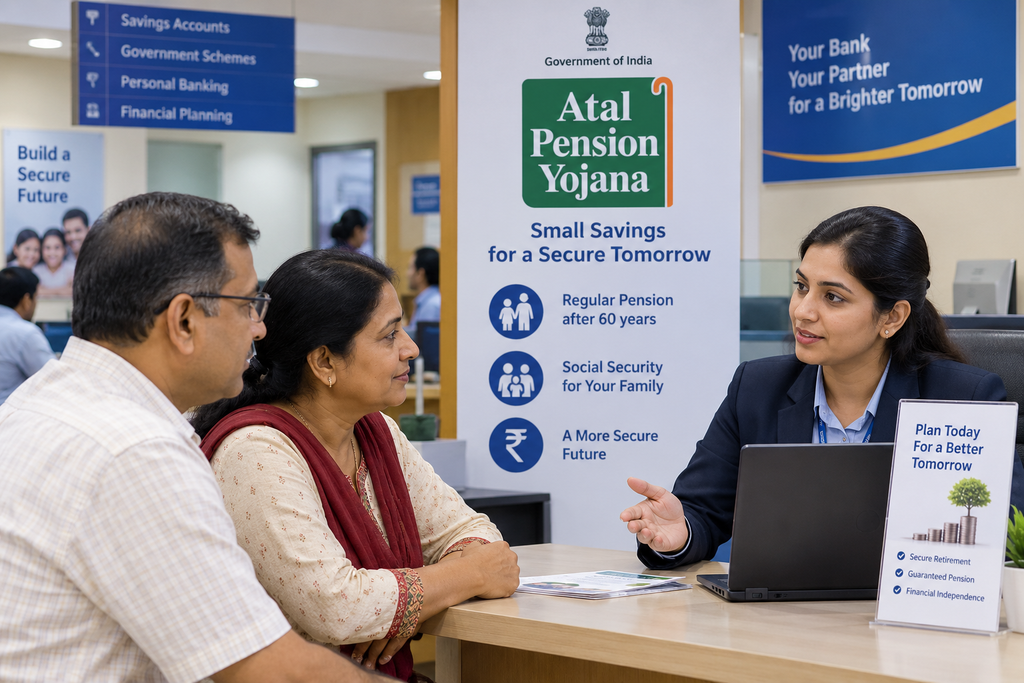
Atal Pension Yojana Pension Options
APY provides five minimum guaranteed pension choices:
| Pension option from age 60 | Minimum monthly pension |
|---|---|
| Option 1 | ₹1,000 |
| Option 2 | ₹2,000 |
| Option 3 | ₹3,000 |
| Option 4 | ₹4,000 |
| Option 5 | ₹5,000 |
The pension begins after the subscriber reaches 60, rather than immediately after opening the account. The selected pension level determines the required contribution, with the contribution also depending on the age at which the person joins.
For example, PFRDA’s published contribution information shows that an 18-year-old selecting the ₹5,000 pension option has an indicative monthly contribution of ₹210. At age 40, the corresponding monthly contribution is ₹1,454.
The difference illustrates one of the most important principles of APY: earlier entry generally means a lower periodic contribution for the same pension slab, because the contribution period is longer.
APY Contribution: Why Age Matters
The APY contribution is not one fixed amount for everybody. It depends primarily on the subscriber’s age at entry and the pension amount selected.
PFRDA’s FAQ gives the following examples:
| Entry age | ₹1,000 pension | ₹5,000 pension |
|---|---|---|
| 18 years | ₹42/month | ₹210/month |
| 20 years | ₹50/month | ₹248/month |
| 25 years | ₹76/month | ₹376/month |
| 30 years | ₹116/month | ₹577/month |
| 35 years | ₹181/month | ₹902/month |
| 40 years | ₹291/month | ₹1,454/month |
These are monthly contribution figures from the published APY contribution schedule; quarterly and half-yearly payment options are also available through the applicable auto-debit mechanism.
The figures should not be interpreted as a general investment return calculation. APY is designed around a minimum guaranteed pension structure, and the contribution schedule is determined by the scheme’s prescribed parameters.

Benefits of Atal Pension Yojana 2026
Subscribers who complete the required contribution period and reach the age of 60 can receive the following benefits under Atal Pension Yojana:
- Guaranteed Pension: The subscriber receives a minimum monthly pension of ₹1,000, ₹2,000, ₹3,000, ₹4,000 or ₹5,000, depending on the pension option selected and applicable contribution.
- Spouse Benefit: After the subscriber’s death, the spouse is entitled to receive the same monthly pension for life, subject to the applicable APY rules.
- Return of Corpus: After the death of both the subscriber and spouse, the accumulated pension wealth is payable to the nominee as per the scheme provisions.
Important: The ₹1,000–₹5,000 amount is a monthly pension payable from age 60; it is not an immediate payment after registration.
How to Apply for Atal Pension Yojana 2026
An eligible person can approach the bank branch or post office where the savings account is held and complete the APY enrolment process. PFRDA also provides for digital onboarding through channels made available by participating banks.
The enrolment process generally requires the subscriber to select the desired pension slab and contribution frequency and provide the required account, nominee and spouse details.
Aadhaar may be provided during enrolment, and the subscriber can provide a mobile number to receive periodic account-related information.
Because digital services vary by bank, applicants should use the APY facility offered by their own bank or post office rather than relying on an unofficial third-party website.
What Happens If Contributions Are Not Paid?
APY contributions are designed to be collected through auto-debit. Maintaining sufficient balance in the linked savings account is therefore important.
A missed contribution does not mean that the subscriber should simply abandon the account. The applicable rules provide for overdue contributions and related charges, and subscribers should contact their bank or the relevant APY service channel if regular debits stop.
The practical lesson is straightforward: APY works best when contributions are treated as a recurring financial commitment rather than an occasional deposit.
APY and Income-Tax Payers: A Crucial 2026 Rule
One of the most important eligibility changes affecting APY occurred in 2022.
From October 1, 2022, a person who is or has been an income-tax payer under the Income-tax Act, 1961, on the date of application cannot open a new APY account.
However, existing subscribers who joined on or before September 30, 2022 are permitted to continue their accounts even if they are income-tax payers. Similarly, if an individual becomes an income-tax payer after validly joining APY, PFRDA’s FAQ says that this does not by itself terminate the account.Anyone unsure about their status should verify the current eligibility conditions with the bank or official PFRDA information before submitting an application.
What the Evidence Suggests About APY’s Role
The scale of APY participation shows that the scheme has become a significant part of India’s social-security architecture. PFRDA reported 1.17 crore new enrolments during 2024-25 and more than 7.60 crore gross enrolments by March 31, 2025. Women accounted for about 55% of new enrolments in that financial year.At the same time, the maximum guaranteed pension is ₹5,000 per month. That figure needs to be considered in the context of future living costs. A fixed nominal pension can provide predictable income, but its purchasing power decades later may not be equivalent to ₹5,000 today.
That is perhaps the most important practical point for readers considering APY: a guaranteed pension is not the same thing as a complete retirement plan.For an eligible person, APY can form one component of retirement planning, while other lawful savings, investments or social-security arrangements may address needs beyond the APY pension ceiling.
Also Read:
- PM Uchchatar Shiksha Protsahan Yojana 2026: Eligibility, Benefits, Application and Renewal
- Goa High-Support Disability Scheme 2026: Eligibility, Benefits, Documents and Application Process
APY’s Wider Significance for India’s Informal Workforce
India’s workforce includes a large population whose employment does not necessarily provide an employer-sponsored pension. For such workers, retirement planning is often difficult because income can be irregular and long-term savings compete with immediate household expenditure.APY attempts to address part of this problem through a relatively simple mechanism: start within the permitted age range, select a pension slab, and make regular contributions until retirement.
The government’s decision to continue the scheme through 2030-31 indicates that APY remains part of the country’s broader social-security framework.Yet the policy challenge extends beyond enrolment. Long-term financial security depends on whether households can continue contributions, understand the value of the future pension and combine APY with other forms of savings where necessary.
What Readers Should Check Before Opening an APY Account
Before enrolling, an applicant should verify four basic points: age eligibility, income-tax-payer status, the desired pension slab and the contribution required for that age.
It is equally important to understand that the pension starts at 60, not when the account is opened. The subscriber should also understand the spouse and nominee provisions rather than treating APY simply as a savings product.
Finally, applicants should rely on official PFRDA, Department of Financial Services, bank or post-office information for current rules. APY has been amended over time, and old articles may contain eligibility conditions that no longer apply.
FAQ Section
Is Atal Pension Yojana available in 2026?
Yes. Atal Pension Yojana continues in 2026. In January 2026, the Union Cabinet approved continuation of APY until 2030-31, including continued government support for promotional and developmental activities and gap funding.
What is the maximum pension under APY?
The maximum minimum guaranteed pension available under APY is ₹5,000 per month from age 60. Other pension choices are ₹1,000, ₹2,000, ₹3,000 and ₹4,000 per month. The required contribution depends on the subscriber’s age at entry and selected pension slab.
What is the age limit for Atal Pension Yojana?
A new subscriber must generally be between 18 and 40 years of age. The person must also have a savings bank account or post-office savings bank account and satisfy the applicable income-tax-payer eligibility rule.
Can taxpayers join Atal Pension Yojana?
Generally, no. Since October 1, 2022, people who are or have been income-tax payers cannot open a new APY account. However, those who joined APY on or before September 30, 2022 can continue their existing accounts.
Who receives the APY benefits after the subscriber’s death?
After the subscriber dies, the spouse can receive the same monthly pension for life, subject to APY rules. After both the subscriber and spouse have died, the accumulated pension wealth is paid to the nominee.
Can someone who becomes an income-tax payer after joining APY continue?
Yes. PFRDA’s FAQ states that if a subscriber becomes an income-tax payer after joining APY, this does not by itself affect the APY account. The key restriction applies to eligibility when opening a new account.
Is ₹5,000 an immediate payment under Atal Pension Yojana?
No. The ₹5,000 figure refers to the selected minimum guaranteed monthly pension payable from age 60, provided the subscriber meets the scheme’s contribution requirements. It is not an immediate ₹5,000 payment after registration.
Conclusion
Atal Pension Yojana 2026 is best understood not as a short-term government payment scheme but as a structured retirement-income arrangement. Its defining feature is the minimum guaranteed pension of ₹1,000 to ₹5,000 a month from age 60, combined with provisions for the spouse and nominee.
The continuation of APY until 2030-31 gives the scheme a longer policy horizon, but the central question for an individual remains practical: whether the selected pension level and required contribution fit the person’s long-term financial circumstances.
The ₹5,000 maximum should therefore not be viewed in isolation. Retirement needs change over time, and inflation can reduce the purchasing power of a fixed nominal pension. For eligible households, APY can provide a defined layer of retirement security, but understanding its limits is just as important as understanding its benefits.