Pradhan Mantri Jan Dhan Yojana 2026: Access to a bank account is no longer merely a convenience in India. It has become an important gateway to digital payments, government transfers, savings, insurance, pension and formal credit. Yet the value of financial inclusion depends on whether people who were previously outside the formal banking system can actually use these services.
The Pradhan Mantri Jan Dhan Yojana (PMJDY) was launched on 28 August 2014 as the National Mission for Financial Inclusion. Its purpose is broader than opening bank accounts: the programme seeks to connect people with basic banking, remittance, credit, insurance, pension and other financial services at an affordable cost.
In 2026, PMJDY remains a major part of India’s financial-inclusion architecture. Official data reported 59.31 crore beneficiaries/accounts as of 16 September 2026, with deposits of around ₹3.20 lakh crore. Women accounted for 33.04 crore of the reported beneficiaries, while 41.51 crore RuPay debit cards had been issued.
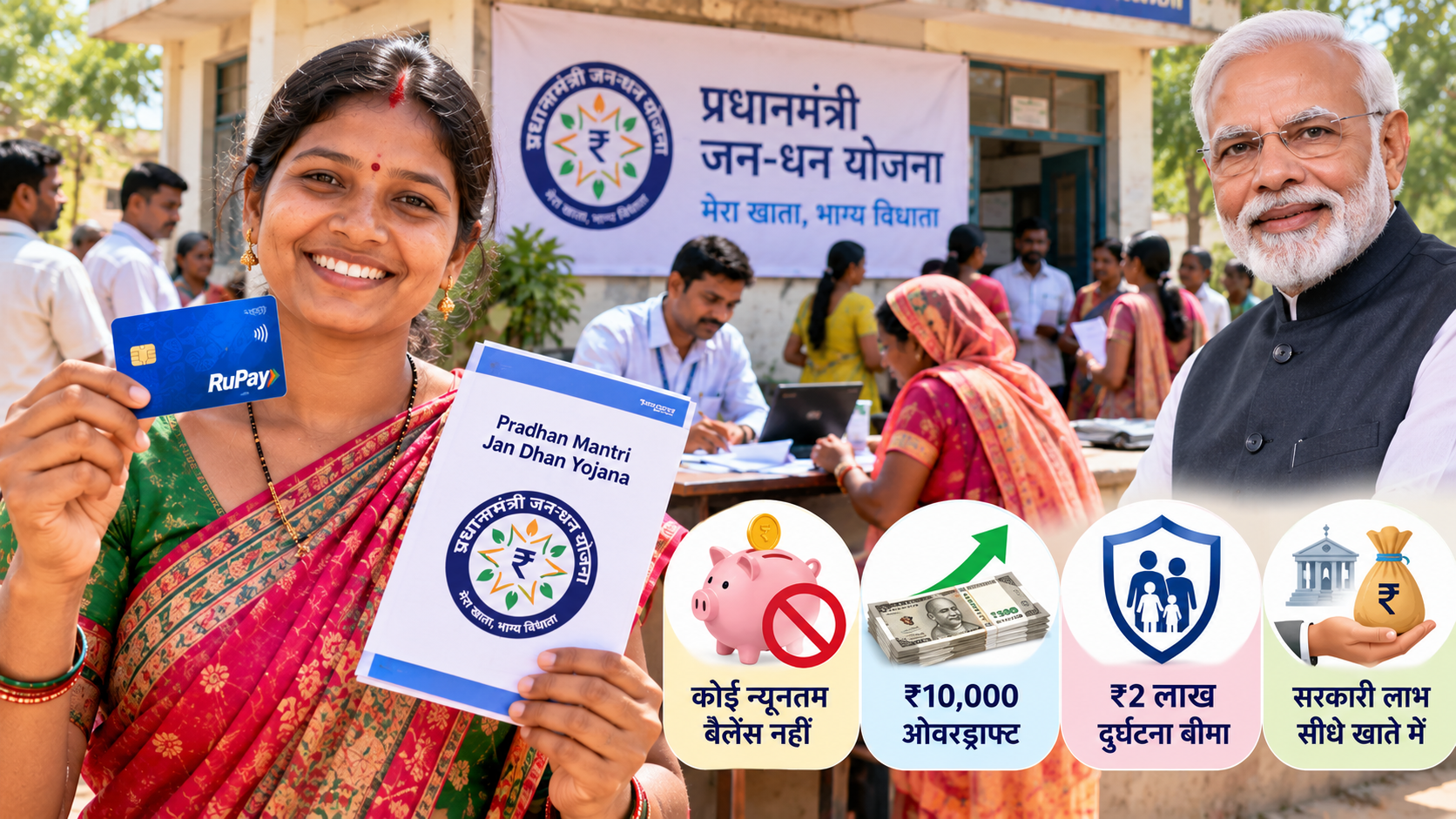
For an ordinary account holder, the most relevant questions are practical: Is there a minimum balance? What documents are needed? Is a RuPay card provided? Does the account receive government payments? Can an overdraft of ₹10,000 really be withdrawn? The answers depend on the specific PMJDY facility and its eligibility conditions.
What Is Pradhan Mantri Jan Dhan Yojana?
PMJDY is the Government of India’s national financial-inclusion programme designed to provide access to essential financial services, particularly for people who were previously outside formal banking.
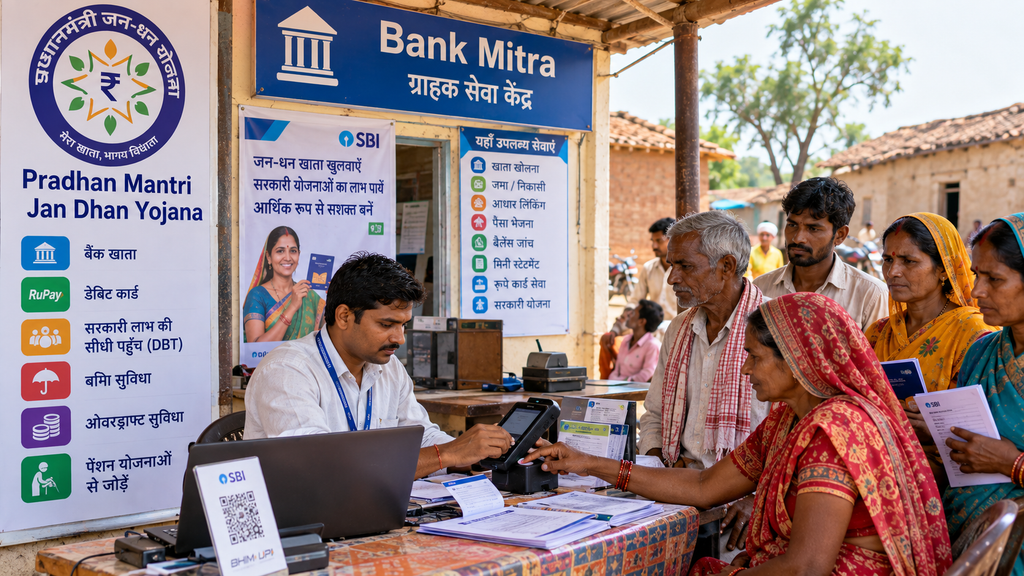
Under the scheme, an eligible unbanked person can open a Basic Savings Bank Deposit (BSBD) account at a participating bank branch or through a Business Correspondent, commonly known as a Bank Mitra. A major advantage of a PMJDY account is that you do not have to maintain a minimum balance. This makes the account useful for people who may have irregular income or cannot keep a fixed amount in their bank account.
A Jan Dhan account can also be used to receive eligible government payments through Direct Benefit Transfer (DBT). Depending on the person’s eligibility, the account can also be linked with financial schemes such as PMJJBY, PMSBY, Atal Pension Yojana and MUDRA. In this way, PMJDY provides a basic banking connection while also making it easier to access other financial services.This is why describing PMJDY simply as a “zero-balance bank account scheme” misses much of its policy purpose.
PMJDY 2026: Key Information
| Detail | Information |
|---|---|
| Scheme Name | Pradhan Mantri Jan Dhan Yojana |
| Short Name | PMJDY |
| Launched | 28 August 2014 |
| Ministry | Ministry of Finance, Government of India |
| Nodal Department | Department of Financial Services |
| Main Objective | Financial inclusion |
| Account Type | Basic Savings Bank Deposit Account |
| Minimum Balance | No minimum balance requirement |
| Debit Card | RuPay debit card |
| Accident Insurance | Eligible RuPay cardholders can get up to ₹2 lakh accident cover. |
| Overdraft | Up to ₹10,000 for eligible account holders |
| DBT | Available |
| Account Opening | Bank branch or Bank Mitra/Business Correspondent |
| Official Portal | pmjdy.gov.in |
Who Can Open a PMJDY Account?
The present PMJDY framework focuses on unbanked adults, rather than restricting the programme to a particular occupation or income category. A person who does not already have a bank account can open a Basic Savings Bank Deposit Account under PMJDY, subject to the applicable banking and KYC requirements.
PMJDY financial-literacy material also states that a minor above 10 years can open a savings bank account, subject to applicable banking rules.
Therefore, PMJDY should not be understood as a scheme exclusively for rural labourers or people below a particular income level. Its broader objective is to bring unbanked people into the formal financial system.
At the same time, the exact account-opening procedure and KYC requirements can depend on the applicant’s circumstances and the bank’s applicable rules.
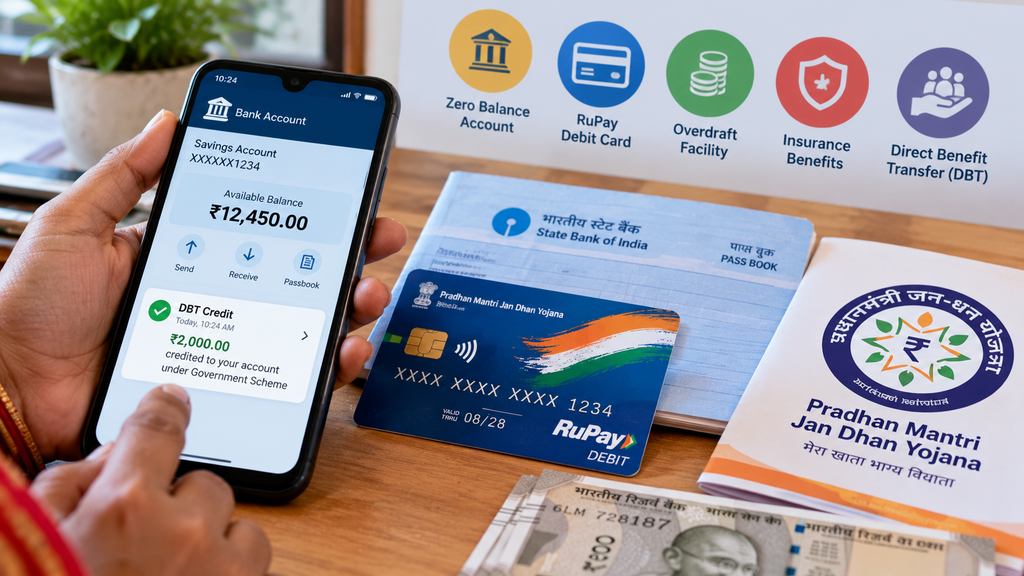
What Are the Benefits of PMJDY?
One of the main advantages of PMJDY is that account holders can use a bank account without having to maintain a minimum balance.
Zero-Balance Banking
With a PMJDY account, there is no need to keep a fixed minimum amount in the account.This is particularly relevant for people whose income may be irregular or who cannot comfortably keep a fixed amount in their account.
The absence of a minimum-balance requirement, however, should not be interpreted as meaning that every banking service is automatically free. Individual banking services can have their own rules and applicable charges.
RuPay Debit Card
PMJDY account holders are eligible to receive a RuPay debit card. For new PMJDY accounts opened after 28 August 2018, the associated accident insurance cover was increased from ₹1 lakh to ₹2 lakh, subject to the applicable terms and conditions.
This insurance benefit should not be confused with a general life-insurance payment or an unconditional cash benefit. The applicable insurance rules and conditions need to be satisfied.
Overdraft Facility
Under PMJDY, eligible account holders may get an overdraft facility of up to ₹10,000, subject to the applicable eligibility conditions. This is one of the most frequently misunderstood features of the scheme.
An overdraft is not a grant. It is a credit facility that allows an eligible account holder to withdraw beyond the available balance up to the sanctioned limit.
The government revised the maximum overdraft limit from ₹5,000 to ₹10,000 when PMJDY was extended beyond August 2018. The revised framework also provided that there would be no conditions attached to overdraft up to ₹2,000 and changed the age limit for availing the facility from 18–60 years to 18–65 years. The overall ₹10,000 facility remains subject to eligibility conditions.

Direct Benefit Transfer
PMJDY accounts can receive Direct Benefit Transfers, making them important for government welfare payments that are transferred electronically to eligible beneficiaries.
This is one of the scheme’s most significant practical roles. Instead of relying exclusively on cash-based delivery mechanisms, government payments can reach a beneficiary’s formal bank account.
Access to Other Financial Schemes
The PMJDY account can also serve as a gateway to other financial-security and credit programmes, including PMJJBY, PMSBY, Atal Pension Yojana and MUDRA, where the account holder separately meets the relevant eligibility conditions.
This convergence is important because financial inclusion is rarely achieved through a bank account alone. Savings, insurance, pension and access to formal credit all form part of a broader financial ecosystem.
PMJDY Documents Required
The official PMJDY website states that if Aadhaar or the Aadhaar number is available, no other document is required for account opening under the stated PMJDY documentation guidance. If the address has changed, self-certification of the current address is sufficient under that guidance.
If Aadhaar is not available, the official site lists government-valid documents such as:
- Voter identity card
- Driving licence
- PAN card
- Passport
- NREGA card
Where the relevant document contains the address, it can serve as identity and address proof.Applicants should check with the bank or authorised Bank Mitra about the current KYC process before visiting, because documentation requirements can depend on the account-opening circumstances.

How to Open a PMJDY Account
Opening a PMJDY account is primarily an offline banking process supported by the formal banking network and Business Correspondents.
Step 1: Visit a Bank or Bank Mitra
A person who does not already have a bank account can approach a participating bank branch or an authorised Bank Mitra/Business Correspondent. The official PMJDY portal specifically identifies both routes for opening a basic savings bank deposit account.
Step 2: Complete the Account-Opening Form
The applicant provides the required personal and KYC information through the bank’s account-opening process.
The PMJDY portal also provides account-opening forms in Hindi and English.
Step 3: Submit KYC Information
Aadhaar or another accepted identity document can be provided according to the applicable documentation requirements.
Step 4: Account Activation and Banking Services
Once the account-opening formalities are completed, the bank provides the account details and applicable banking facilities. An eligible account holder can receive a RuPay debit card and use the account for deposits, withdrawals and eligible digital or government-payment services.
Is PMJDY Account Opening Available Online?
PMJDY is commonly searched as an “online account opening” scheme, but the official scheme description specifically identifies bank branches and Bank Mitra outlets as account-opening points.
This distinction matters. A reader should not assume that every bank offers an identical fully digital PMJDY onboarding process.
The PMJDY portal provides official account-opening forms and scheme information, but the actual KYC and account-opening procedure is handled through the banking channel.
PMJDY Latest Data 2026
The latest official PMJDY progress report available at the time of writing provides data as of 16 September 2026.
According to the PMJDY portal:
- Total beneficiaries/accounts: 59.31 crore
- Rural/semi-urban beneficiaries: 46.10 crore
- Urban/metro beneficiaries: 13.20 crore
- Female beneficiaries: 33.04 crore
- Deposits: approximately ₹3,20,105.85 crore
- RuPay debit cards issued: 41.51 crore
These figures show the scale of the banking network created through PMJDY. They also show why the scheme is increasingly relevant beyond the initial goal of simply opening accounts.
The numbers are reported by the PMJDY portal from data submitted by participating banks, and should therefore be understood as administrative programme data rather than an independent household survey.
PMJDY in Chhattisgarh
Chhattisgarh provides a useful state-level example of the scheme’s reach.As of 16 September 2026, the official statewise PMJDY report recorded 18,887,964 beneficiaries/accounts in Chhattisgarh, including 15,564,783 at rural/semi-urban centre bank branches and 3,323,181 at urban/metro centre branches. Reported deposits were approximately ₹9,076.07 crore, while 11,650,625 RuPay cards had been issued.
For a state with a large rural population and significant dependence on government welfare programmes, access to formal bank accounts can be particularly relevant for DBT-based payments.
The state-level figures also illustrate why financial inclusion cannot be judged only by the number of accounts opened. Continued account usage, access to banking points, digital literacy and the ability to use formal financial products are equally important.
PMJDY and Financial Inclusion: What Has Changed?
When PMJDY began in 2014, the central challenge was to bring households without formal bank accounts into the banking system. The scheme was subsequently extended beyond August 2018, with the focus shifting from every household to every unbanked adult. At the same time, the overdraft limit and accident-insurance cover associated with new RuPay cards were increased.The programme has consequently moved from basic account creation towards a wider financial-inclusion model.
The Department of Financial Services describes its financial-inclusion work as covering banking, insurance, pension and related services, with PMJDY forming one of its flagship programmes.
Frequently Overlooked Facts About PMJDY
One common misunderstanding is that ₹10,000 is automatically deposited into every Jan Dhan account. That is incorrect. The ₹10,000 figure refers to the maximum overdraft facility available to eligible account holders; it is not a government cash grant.
Another misconception is that every PMJDY account automatically receives ₹2 lakh as insurance money. The ₹2 lakh figure relates to the accident-insurance cover attached to RuPay cards issued to new PMJDY accounts opened after 28 August 2018, subject to applicable conditions.
Similarly, opening a Jan Dhan account does not automatically make a person eligible for every other government scheme. PMJDY accounts can be used for schemes such as PMSBY, PMJJBY and APY, but each of those programmes has its own eligibility and enrolment conditions.
Also Read :
- Deen Dayal Swasthya Seva Yojana 2026: Eligibility, Benefits, Coverage, Registration & Hospital List
- Pradhan Mantri Matru Vandana Yojana 2026: Eligibility, Benefits, Registration and Payment
What the Evidence Suggests
The official numbers indicate that PMJDY has become a large-scale financial-inclusion platform rather than a short-term account-opening campaign. From 15.67 crore accounts in March 2015, the programme had reached 53.14 crore accounts by 14 August 2024, according to the Ministry of Finance’s decade review.The latest September 2026 data puts the reported total at 59.31 crore, showing continued expansion in the programme’s account base.
The more important question now is therefore about depth of financial inclusion: whether account holders regularly use their accounts, have convenient access to banking points, understand digital transactions, receive eligible benefits reliably and can access appropriate financial products.
In other words, the next phase of financial inclusion is not simply about adding more account numbers. It is about ensuring that those accounts remain useful and active parts of household financial life.
Conclusion
The significance of Pradhan Mantri Jan Dhan Yojana 2026 lies less in the phrase “zero-balance account” and more in the financial infrastructure built around that account. PMJDY connects previously unbanked people with formal banking, government transfers, RuPay payments and, where eligible, credit, insurance and pension products.
The latest official data shows how far that infrastructure has expanded, with 59.31 crore reported beneficiaries/accounts by September 2026. Yet the next measure of success is not simply how many accounts exist. It is whether people can use those accounts safely, regularly and meaningfully.
FAQ Section
What is Pradhan Mantri Jan Dhan Yojana 2026?
Pradhan Mantri Jan Dhan Yojana is the Government of India’s financial-inclusion programme. It provides access to a basic bank account and connects eligible account holders with banking, DBT and other financial services such as insurance, pension and credit.
Is a minimum balance required in a Jan Dhan account?
No. PMJDY’s Basic Savings Bank Deposit Account does not require the account holder to maintain a minimum balance. The account can be opened through a participating bank branch or authorised Bank Mitra.
Does Jan Dhan Yojana give ₹10,000 for free?
No. ₹10,000 is the maximum overdraft facility available to eligible PMJDY account holders. It is not a free government payment or grant, and the overdraft facility is subject to the applicable eligibility conditions.
How much insurance is available with a PMJDY RuPay card?
New PMJDY accounts opened after 28 August 2018 have a RuPay card with an accident-insurance cover of up to ₹2 lakh, subject to the applicable terms and conditions.
What documents are needed to open a Jan Dhan account?
If Aadhaar or the Aadhaar number is available, the official PMJDY documentation guidance says no other document is required under the stated process.
Where can I open a PMJDY account?
A PMJDY basic savings account can be opened at a participating bank branch or through an authorised Business Correspondent or Bank Mitra outlet.
Can government money be received in a Jan Dhan account?
Yes. PMJDY accounts are eligible for Direct Benefit Transfer, allowing eligible government benefits to be credited electronically to the beneficiary’s bank account.