
The NPS Vatsalya Scheme 2026 is a long-term government-backed savings and pension plan designed especially for children in India. It helps parents and guardians start building a strong financial foundation for their child from an early age. By investing early, families can take advantage of compounding and create a large retirement corpus over time.
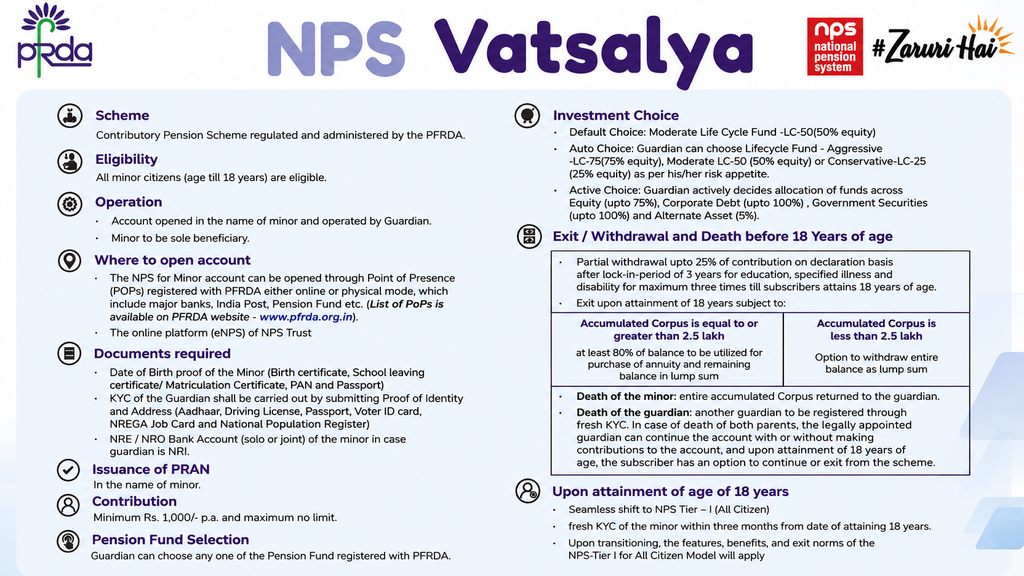
This scheme was introduced by the Government of India on 18 September 2024 under the National Pension System (NPS) and is regulated by the Pension Fund Regulatory and Development Authority (PFRDA). It is meant for minors below 18 years, and the account is opened and managed by a parent or legal guardian. Once the child turns 18, the account is automatically converted into a regular NPS account.
In this guide, you will understand everything about the NPS Vatsalya Scheme 2026, including eligibility rules, required documents, investment structure, expected returns, tax benefits, withdrawal rules, and how to open an account.
NPS Vatsalya Scheme 2026 Overview
| Feature | Details |
|---|---|
| Scheme Name | NPS Vatsalya Scheme |
| Launch Date | 18 September 2024 |
| Regulator | PFRDA |
| Eligible Beneficiary | Child below 18 years |
| Account Holder | Minor child |
| Managed By | Parent or legal guardian |
| Minimum Investment | ₹1,000 per year |
| Maximum Investment | No limit |
| Type of Scheme | Market-linked pension plan |
| Tax Benefits | Available under NPS rules |
| Account Control | Guardian until age 18 |
| Status in 2026 | Active scheme |
- PM Internship Scheme 2026 Registration: Apply Online, Last Date, Eligibility, Stipend & Financial Benefits
- GOBARdhan Scheme India 2026: Full Form, Launch Date, Ministry, Subsidy, Eligibility & Online Application Guide
What is NPS Vatsalya Scheme?
The NPS Vatsalya Scheme is a child-focused version of the National Pension System. It allows parents or guardians to open a pension account in the name of their minor child and contribute regularly for long-term financial growth.
The child remains the actual owner of the account, while the guardian manages it until the child becomes an adult. The invested money is handled by professional fund managers and distributed across equity, government bonds, and corporate debt instruments.
Unlike traditional child savings plans that focus only on education or marriage, this scheme is mainly designed for retirement-oriented long-term wealth creation.
Key Features of NPS Vatsalya Scheme
Account in Child’s Name
The account is legally registered in the child’s name, ensuring ownership of the accumulated funds.
Managed by Guardian
Until the child turns 18, all operations are handled by the parent or legal guardian.
Long-Term Investment Growth
The scheme encourages long-term investing, helping money grow through compounding.
Market-Based Returns
Returns are not fixed and depend on market performance.
Flexible Contributions
Parents can invest any amount above the minimum requirement.
Nationwide Portability
The account can be managed and accessed from any location across India.
Regulated Structure
The scheme is fully regulated by PFRDA, ensuring transparency and safety.
Importance of NPS Vatsalya in 2026
In 2026, financial planning has become more important due to rising education costs and inflation. Many parents focus only on short-term savings, but ignore long-term retirement planning for their children.
NPS Vatsalya solves this problem by starting retirement savings early. Even small contributions made regularly can grow into a large corpus over decades. It also helps children develop financial discipline and ensures a smooth transition into adulthood since the account continues after 18 years.
Eligibility for NPS Vatsalya Scheme
The scheme is open to:
- Indian citizens below 18 years
- NRIs and OCIs (subject to rules)
The account can be opened by:
- Father
- Mother
- Legal guardian
- Court-appointed guardian
- A valid KYC process is mandatory for the guardian.
Documents Required this scheme
For Child
- Birth certificate
- Aadhaar card (if available)
- PAN card (if available)
- Passport (if available)
For Guardian
- Aadhaar card
- PAN card
- Address proof
- Passport or voter ID
- Recent photograph
Additional Documents
- Guardian declaration form
- Relationship proof (if required)
- KYC documents as per service provider
How to Open NPS Vatsalya Account
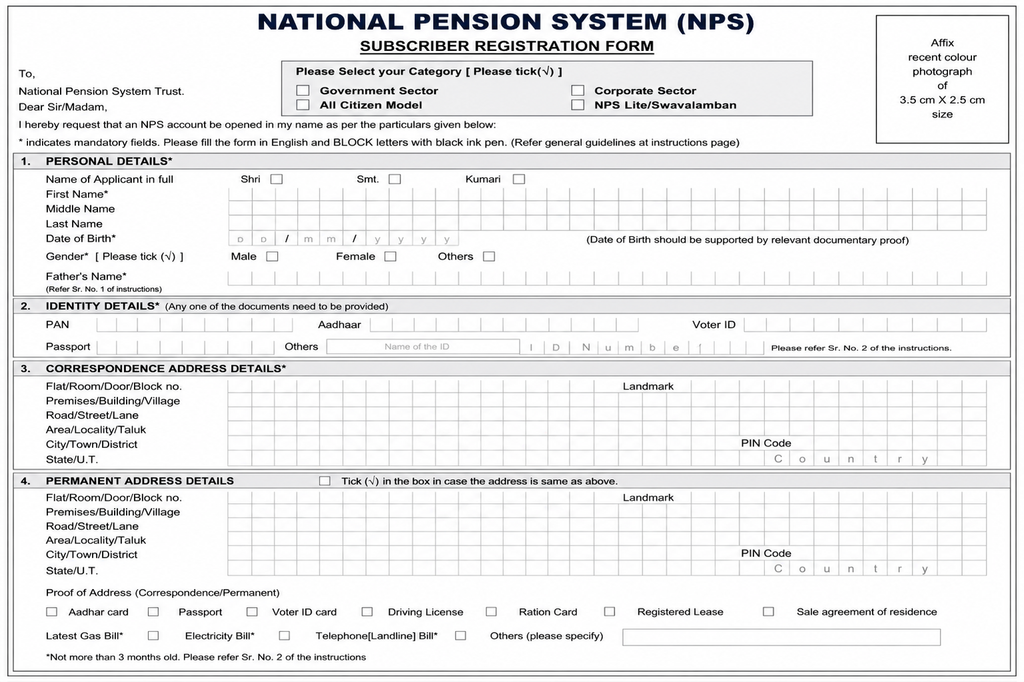
Online Method
- Visit the official eNPS portal
- Select NPS Vatsalya option
- Enter child and guardian details
- Complete KYC verification
- Upload documents
- Choose investment option
- Make first contribution
- Receive PRAN number
Offline Method
- Visit bank or authorized PoP center
- Fill application form
- Submit documents
- Complete KYC process
- Deposit initial amount
- Get PRAN confirmation
Investment Options in NPS Vatsalya
The scheme allows investment in different asset classes:
Equity (E)
High growth potential but with higher risk.
Corporate Bonds (C)
Moderate risk with stable returns.
Government Securities (G)
Low risk and stable investment option.
Alternative Assets (A)
Limited exposure to approved instruments.
Investment Choices
- Auto Choice: System-managed allocation
- Active Choice: User-controlled allocation
Returns in NPS Vatsalya Scheme
- NPS Vatsalya does not offer fixed returns. It is linked to market performance.
- Expected long-term returns generally range between 8% to 12%, depending on market conditions and fund performance.
- Since the investment period is long, compounding plays a major role in increasing the final corpus.
NPS Vatsalya Scheme Tax Benefits
Investments in NPS Vatsalya may qualify for tax deductions under:
- Section 80CCD(1)
- Section 80CCD(1B) (if applicable)
These benefits are subject to income tax rules and may vary based on the taxpayer’s regime.
NPS Vatsalya Scheme Withdrawal Rules
Partial Withdrawal
Allowed for specific needs like:
- Education
- Medical emergencies
- Disability-related expenses
Premature Exit
Subject to NPS exit rules and penalties.
Normal Exit
The scheme is designed for long-term retirement savings.
What Happens After Age 18?
When the child turns 18:
- Account becomes a regular NPS account
- Child gains full control
- Investment choices can be changed
- Contributions can continue independently
Comparison with Other Child Investment Options
| Feature | NPS Vatsalya | SSY | PPF | FD |
| Market Linked | Yes | No | No | No |
| Guaranteed Return | No | Yes | Yes | Yes |
| Long-Term Focus | Yes | No | Partial | No |
| Risk Level | Medium | Low | Low | Low |
| Flexibility | High | Medium | Medium | Medium |
Charges in NPS Vatsalya
The scheme includes low and regulated charges such as:
- Account opening fee
- Annual maintenance charges
- Fund management fees
- Transaction charges
Overall cost remains lower compared to many private investment products.
Important Points Before Investing
- Best for long-term goals (15–20 years+)
- Returns are not fixed
- Market risk is involved
- Regular contributions are important
- Suitable for retirement-focused planning
FAQs
What is the minimum investment?
₹1,000 per year is required.
Is it only for girls?
No, it is for both boys and girls.
Are returns fixed?
No, returns depend on market performamance.
Conclusion
The NPS Vatsalya Scheme 2026 is a powerful long-term investment option for parents who want to secure their child’s financial future. It combines disciplined investing, market growth, tax benefits, and retirement planning in one structured system.
Although returns are not guaranteed, the long investment horizon makes it a strong wealth-building tool. For families planning early financial security for their children, this scheme can be a smart and future-ready choice.