
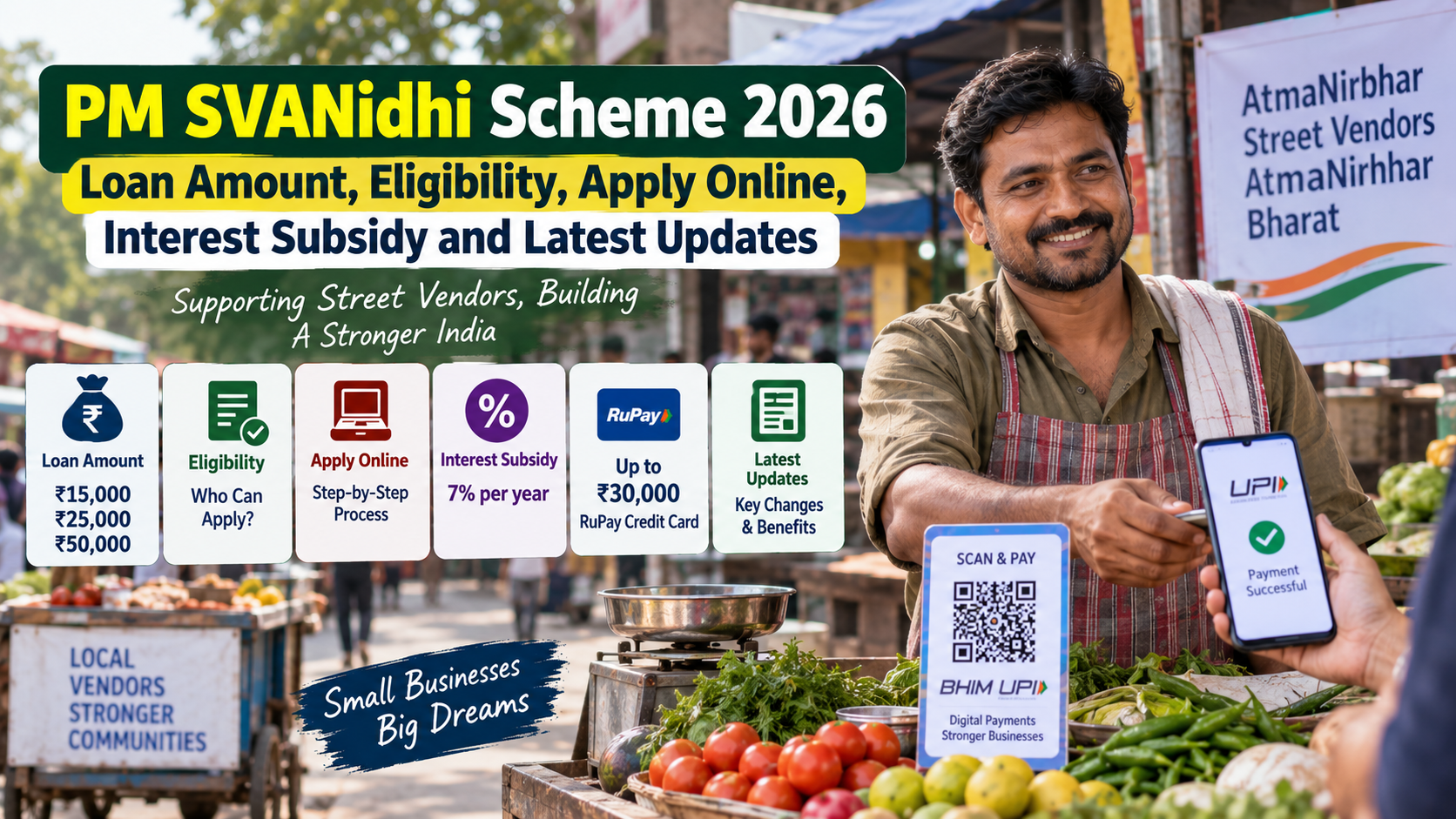
PM SVANidhi Scheme 2026: For many street vendors, access to working capital is not a question of expansion alone. It can determine whether a business has enough stock for the next market day, whether a food cart can continue operating through a slow week, or whether a small seller can move from informal borrowing into the formal financial system.
The Prime Minister Street Vendor’s AtmaNirbhar Nidhi (PM SVANidhi) scheme was launched on 1 June 2020 by the Ministry of Housing and Urban Affairs to provide collateral-free working-capital loans to street vendors. The scheme was originally associated with smaller first-cycle loans, but its structure has since been revised. Under the restructured scheme, the maximum loan amounts are now ₹15,000 for the first tranche, ₹25,000 for the second and ₹50,000 for the third. Lending has also been extended until 31 March 2030.
This change matters because PM SVANidhi is increasingly being positioned not merely as emergency credit, but as a pathway towards formal credit, digital transactions, financial literacy and broader social protection.
What is PM SVANidhi Scheme 2026?
PM SVANidhi is a Central Sector Scheme designed to help eligible street vendors obtain working-capital finance without conventional collateral. The core idea is progressive lending: a vendor begins with the first tranche and can move to higher loan amounts after successful repayment of earlier borrowing.
The 2025 restructuring changed the first two loan ceilings from ₹10,000 to ₹15,000 and from ₹20,000 to ₹25,000, while the third tranche remains at ₹50,000. The government has also introduced digital incentives and a UPI-linked RuPay credit card for eligible vendors who have successfully repaid the second tranche.
This progressive structure is important. A ₹50,000 loan is not simply a larger version of the first loan that every new applicant can immediately demand. The system is designed to connect larger credit access with repayment performance.
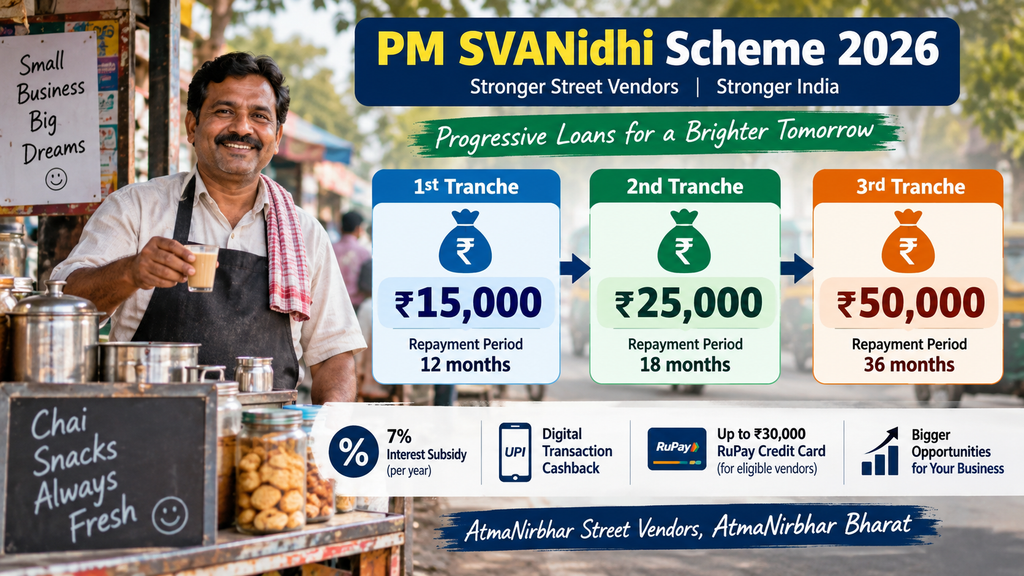
PM SVANidhi Loan Amount in 2026
The current loan structure is:
| Loan Tranche | Maximum Loan | Repayment Period |
|---|---|---|
| First Tranche | ₹15,000 | 12 months |
| Second Tranche | ₹25,000 | 18 months |
| Third Tranche | ₹50,000 | 36 months |
The government’s July 2026 statement confirms that these working-capital term loans are repayable through monthly instalments over 12, 18 and 36 months respectively.The practical lesson is straightforward: vendors should think of PM SVANidhi as a credit progression system, not a one-time cash grant.
Successful repayment of the first tranche makes the vendor eligible for the second tranche, while successful repayment of the second can open access to the third tranche. The staggered structure is intended to encourage responsible repayment and reduce the risk associated with immediately giving a larger loan to a borrower with no previous repayment history.
Is the PM SVANidhi Loan Free?
No. PM SVANidhi is a loan, not a grant.One of the most important benefits is a 7% per annum interest subsidy for timely repayment. The subsidy reduces the effective interest burden, but it should not be interpreted as meaning that every PM SVANidhi loan carries a zero nominal interest rate from the lender.
The interest rate charged is linked to the applicable rules and the lending institution’s policy. Earlier official explanations have clarified that the government subsidy is 7%, while the interest above that subsidy remains the borrower’s responsibility.For borrowers, this distinction matters because websites sometimes describe government-supported credit using simplified “interest-free” language. The safer interpretation is that timely repayment earns an interest subsidy, subject to the scheme’s conditions.
PM SVANidhi Scheme Highlights
| Detail | Information |
|---|---|
| Scheme Name | PM SVANidhi Scheme (Pradhan Mantri Street Vendor’s AtmaNirbhar Nidhi) |
| Launched By | Ministry of Housing and Urban Affairs |
| Launch Year | June 2020 |
| Lending Period Extended Till | 31 March 2030 |
| Total Budget | ₹7,332 crore |
| Loans Given So Far | Over 1.12 crore loans worth ₹17,800 crore |
| Expected Beneficiaries | Around 1.15 crore street vendors |
| Loan Structure | Three tranches of ₹15,000, ₹25,000 and ₹50,000 |
| Credit Card Limit | Up to ₹30,000 RuPay credit card |
| Interest Subsidy | 7% per year |
| Official Website | pmsvanidhi.mohua.gov.in |
Who Is Eligible for PM SVANidhi Scheme 2026?
Eligibility is tied to recognised or identified street-vending activity under the scheme’s framework.The established identification mechanisms include street vendors who possess a Certificate of Vending (CoV) or Identity Card, vendors identified through the Urban Local Body survey, and certain vendors who receive a Letter of Recommendation (LoR) from the relevant Urban Local Body or Town Vending Committee.
The government has also been expanding the scheme’s geographical coverage beyond statutory towns to census towns, peri-urban areas and other locations in a graded manner under the restructured framework.That means a person should not assume that simply running a small roadside business automatically guarantees approval. Eligibility, identification and lender verification still matter.
What Documents Are Generally Relevant?
For an eligible vendor, the documentation can involve proof of vending status and KYC information.Official scheme guidance has referred to documents such as a Certificate of Vending, Identity Card or Letter of Recommendation, along with KYC documents such as Aadhaar and other accepted identity documents. The precise documentation can depend on the applicant’s category and verification route.
Therefore, applicants should rely on the PM SVANidhi portal, their Urban Local Body or the authorised banking channel for the document list applicable to their case rather than assuming that every applicant needs exactly the same paperwork.
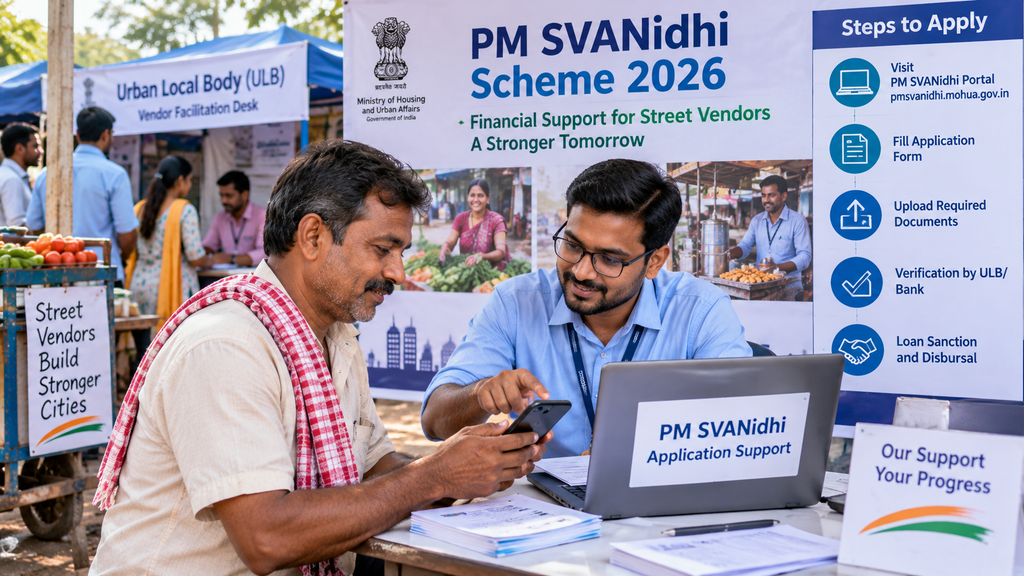
How to Apply for PM SVANidhi Loan Online
The application system is built around an end-to-end digital platform, but digital access does not mean every applicant must navigate the process entirely alone.
A vendor with the relevant CoV or LoR can apply through the PM SVANidhi portal or mobile application and can also seek assistance through the concerned Urban Local Body or authorised banking/financial-service channel. The official FAQ describes the use of the portal, mobile application and ULB support for eligible applicants.
A practical application pathway is therefore:
First, establish whether you are covered or identified under the scheme and whether you have the relevant vending proof.
Second, ensure that your KYC and mobile details are accurate.
Third, submit the application through the official PM SVANidhi system or with assistance from the appropriate local or banking channel.
Fourth, complete verification and lender formalities.
Finally, track the application and repayment through the authorised system.
Does PM SVANidhi Give Cashback?
Yes. Digital transactions are an important part of the restructured scheme.
The current framework provides up to ₹100 per month for 12 months, or a maximum of ₹1,200, for eligible retail digital transactions for each loan tranche. The restructured scheme additionally provides cashback for qualifying wholesale purchases: up to ₹100 per quarter for four quarters, linked to wholesale digital purchases of at least ₹2,000. The total digital cashback opportunity under the restructured design is described by the government as up to ₹1,600.This is more than a small consumer incentive.
For a street vendor, digital payments can create a transaction history. That transaction trail can become economically useful when the vendor later needs to demonstrate business activity to a formal financial institution.The policy therefore links three things that are often treated separately: credit, digital payments and financial history.
What Is the PM SVANidhi RuPay Credit Card?
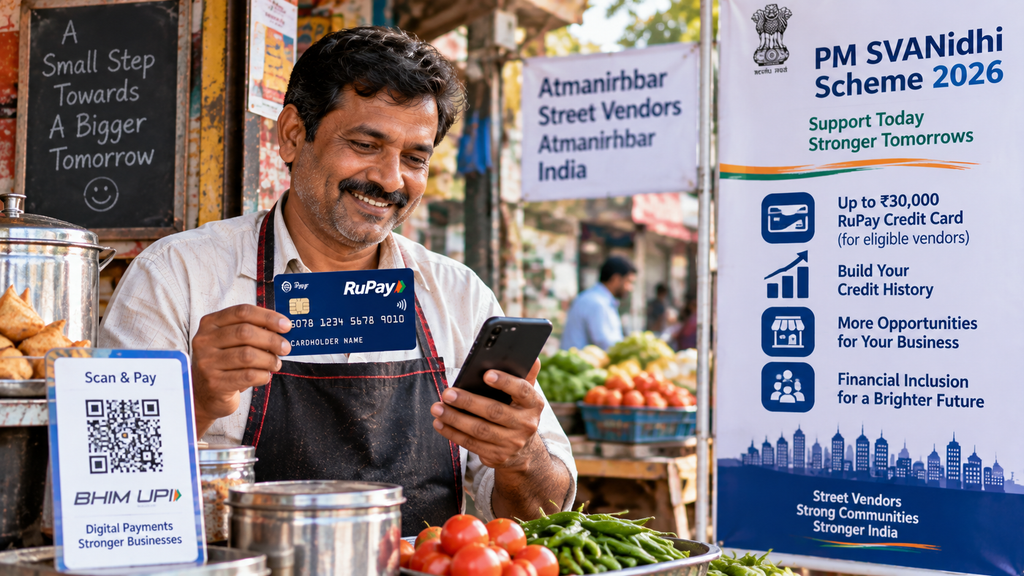
One of the notable additions under the restructured PM SVANidhi scheme is the UPI-linked RuPay Credit Card.
Eligible vendors who have successfully repaid the second tranche can become eligible for a credit card with a limit of up to ₹30,000. The policy objective is to give vendors an additional formal source of credit for immediate business and personal requirements.
This feature is significant because it changes the conversation from short-term working capital to continuing access to formal credit.However, “up to ₹30,000” should again be read as a maximum limit within the scheme framework, not as a guaranteed ₹30,000 balance for every beneficiary.
PM SVANidhi and SVANidhi Se Samriddhi
The scheme has also developed a welfare component known as SVANidhi se Samriddhi.
Launched in January 2021, this component links eligible beneficiaries and their family members with selected Central Government welfare schemes. The government states that the initiative is designed to build a broader social-security network around vendor households rather than treating the business loan in isolation.
The selected schemes include programmes relating to life insurance, accident insurance, bank accounts, pensions, food security and maternal support.This matters because informal workers often face multiple financial risks simultaneously. A working-capital loan can help a business, but a stronger household safety net can reduce the pressure to divert business capital towards emergencies.
Latest PM SVANidhi 2026 Status and Progress
The scale of the scheme has expanded considerably.
According to the Ministry of Housing and Urban Affairs, as of 12 July 2026, 76.95 lakh street vendors had availed more than 1.15 crore loans with a total value of about ₹18,475.06 crore. Of these, more than 29.71 lakh vendors had availed the second tranche and around 8.49 lakh had availed the third tranche.
A later government update marking one year of the restructured phase reported that, by 27 August 2026, the scheme had enabled 78.68 lakh vendors to access more than 1.18 crore loans, amounting to about ₹19,171 crore. More than 57 lakh vendors had undertaken over 908 crore digital transactions, while the government reported ₹418.78 crore released in digital cashback up to that point.
These numbers show that PM SVANidhi is no longer a narrowly targeted pandemic-response instrument. It has become a sizable formal-credit programme for India’s street-vending economy.
What the Evidence Suggests About Its Impact
The most interesting question is not how many loans have been sanctioned, but whether access to formal finance changes the economic position of vendors.
Government-published findings from the Indian School of Business (ISB) provide some evidence on this front. A 2023 study covering more than 5,000 beneficiaries across 100 Urban Local Bodies found that PM SVANidhi was the first bank loan for 95% of beneficiaries studied, with the borrowing used to expand their businesses. A 2025 follow-up study across 99 ULBs reported average annualised business-income growth of around 20% between 2023 and 2025 among the borrowers covered.
These findings should be read as evidence from programme impact studies rather than a guarantee that every borrower will experience the same result.Still, they point toward an important policy effect: formal credit can become valuable even before the loan amount itself becomes large, because it helps create a borrowing and repayment history.
Also Read :
- Lado Lakshmi Yojana Payment 2026: 11th Installment, ₹2,100 Payment, Eligibility and Latest Update
- NPS Vatsalya Scheme 2026: Full Guide on Eligibility, Benefits, Tax Savings, Returns & Account Opening
What Has Changed Under PM SVANidhi 2026?
The 2026 version of the scheme is best understood through five changes.
The first is the larger first and second loan amounts.
The second is the extended lending period to 31 March 2030.
The third is the UPI-linked RuPay credit card for eligible vendors after successful second-tranche repayment.
The fourth is the expanded cashback framework covering both retail and qualifying wholesale digital transactions.
The fifth is the broader emphasis on entrepreneurship, financial literacy, digital skills, marketing, hygiene and food safety, together with stronger welfare convergence.
The policy has therefore shifted from a narrow “loan for street vendors” model toward a broader micro-entrepreneurship framework.
What This Means for an Ordinary Street Vendor
For a vendor deciding whether PM SVANidhi is useful, the most important calculation is not simply the largest available loan amount.A sensible approach is to begin with the amount genuinely required for working capital, understand the monthly repayment obligation, maintain timely repayments and use digital transactions where relevant.
The progressive structure can then become an advantage. A borrower who builds a successful repayment record may gain access to a larger subsequent tranche and, after qualifying repayment milestones, potentially to additional formal credit such as the UPI-linked RuPay card.At the same time, the loan should not be mistaken for free capital. Even with the 7% subsidy, the borrower has repayment obligations, and the lender remains responsible for credit assessment and sanctioning.
Is PM SVANidhi Worth Considering in 2026?
For eligible street vendors seeking formal working capital, PM SVANidhi has become considerably more useful than its original ₹10,000 first-loan structure suggests.
Its greatest strength is not any single benefit. It is the combination of progressive credit, repayment incentives, digital transaction history, credit-card access and welfare linkages.
Its limitation is equally important: the scheme cannot remove the basic realities of borrowing. A vendor still needs adequate cash flow to repay EMIs, and a maximum loan ceiling does not mean that the maximum amount will automatically be sanctioned.
FAQ Section
What is PM SVANidhi Scheme 2026?
PM SVANidhi is a Central Sector Scheme that provides collateral-free working-capital support to eligible street vendors. Under the restructured framework, loan ceilings are up to ₹15,000, ₹25,000 and ₹50,000 in successive tranches, with incentives for timely repayment and digital transactions. Lending has been extended until 31 March 2030.
How much loan can I get under PM SVANidhi in 2026?
The current maximum loan structure is ₹15,000 for the first tranche, ₹25,000 for the second and ₹50,000 for the third. The higher tranches are linked to successful repayment of earlier loans, so a new applicant should not treat ₹50,000 as an automatic first-loan entitlement.
What is the PM SVANidhi interest subsidy?
The scheme provides an interest subsidy of 7% per annum for timely repayment. The subsidy is designed to lower the effective interest burden, but PM SVANidhi remains a loan and the lender’s applicable interest rate and credit conditions continue to matter.
How long do I get to repay PM SVANidhi loans?
The repayment periods under the current structure are 12 months for the first tranche, 18 months for the second and 36 months for the third, with repayment through monthly instalments.
Can I apply for PM SVANidhi online?
Eligible vendors can use the PM SVANidhi portal or mobile application and may also receive assistance through the relevant Urban Local Body and authorised banking channels. Applicants still have to complete verification and lender formalities before sanction.
What is the PM SVANidhi cashback amount?
The restructured scheme allows cashback of up to ₹100 per month for 12 months on qualifying retail digital transactions, giving a maximum of ₹1,200. It also provides up to ₹100 per quarter for four quarters on qualifying wholesale digital purchases, taking the combined maximum opportunity to ₹1,600.
Who can get the PM SVANidhi RuPay Credit Card?
Eligible street vendors who have successfully repaid the second tranche can become eligible for a UPI-linked RuPay Credit Card with a limit of up to ₹30,000 under the restructured scheme. The stated limit is a ceiling within the programme, not a guaranteed amount for every beneficiary.
Is PM SVANidhi available until 2030?
Yes. The Union Cabinet approved restructuring and extension of the scheme in August 2025, extending the lending period until 31 March 2030. The restructured programme has a total outlay of ₹7,332 crore and targets 1.15 crore beneficiaries, including 50 lakh new beneficiaries.
Conclusion
PM SVANidhi Scheme 2026 has evolved from a small working-capital support programme into a broader financial inclusion initiative for street vendors. With loans of up to ₹50,000, a 7% interest subsidy, digital-payment incentives and access to a RuPay credit card for eligible borrowers, the scheme can help vendors strengthen their businesses and build formal credit records. The key is to apply through official channels, borrow according to genuine business needs and maintain timely repayments.

One Comment