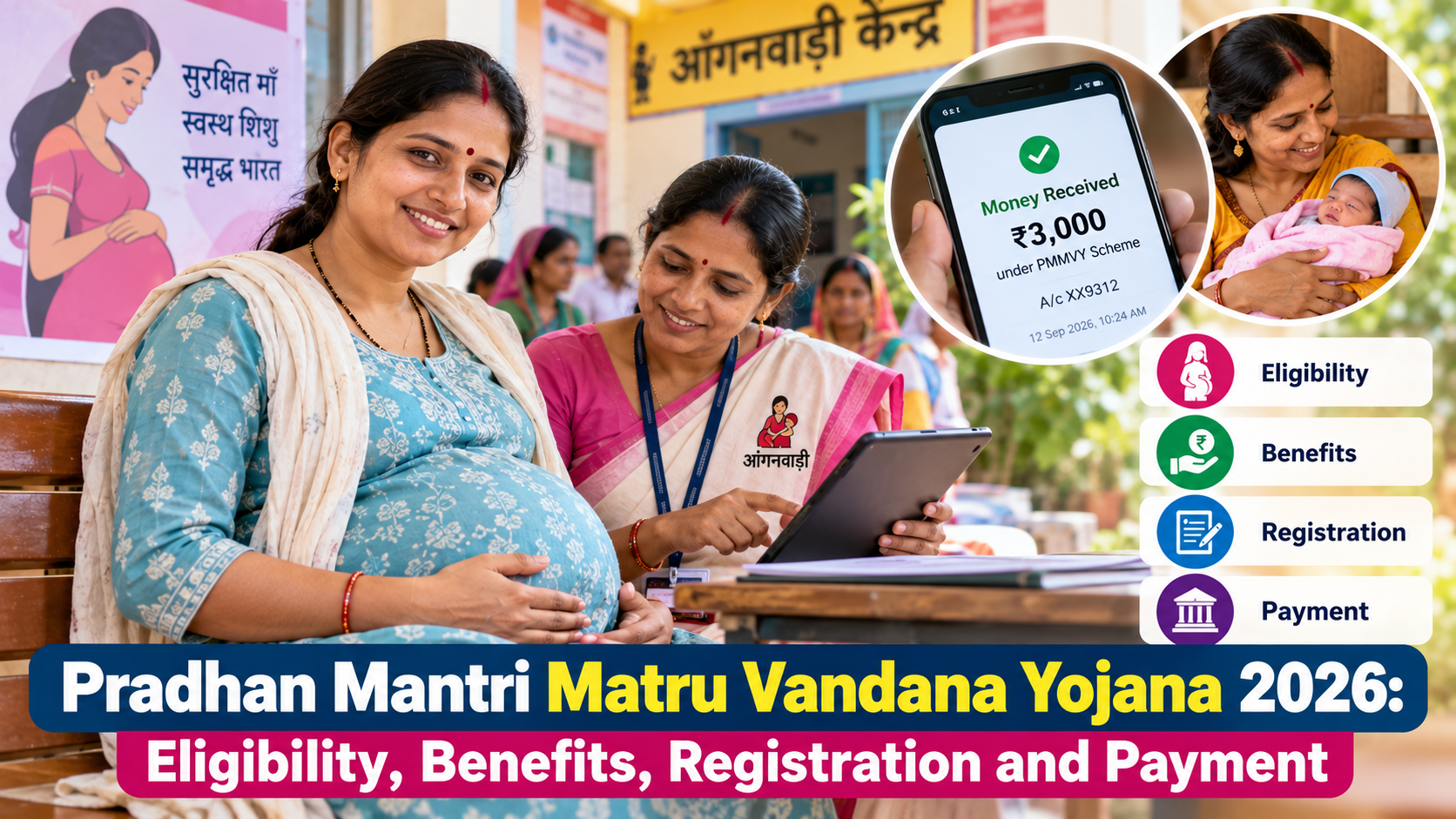
Pradhan Mantri Matru Vandana Yojana 2026:Pregnancy and childbirth can place a considerable financial burden on families, particularly when a woman has limited income or belongs to a socially and economically disadvantaged household. The Pradhan Mantri Matru Vandana Yojana (PMMVY) is designed to provide maternity assistance while encouraging women to seek appropriate healthcare during pregnancy and after childbirth.
The scheme was launched across India on 1 January 2017 and is implemented under the Ministry of Women and Child Development. Under the present PMMVY framework, eligible women can receive ₹5,000 for the first living child in two instalments. A benefit of ₹6,000 is available for the second living child when the second child is a girl, subject to the prescribed conditions. Payments are made through Direct Benefit Transfer (DBT).
The scheme is therefore not simply a cash-assistance programme. Its payment structure is linked to pregnancy registration, antenatal care, childbirth registration and the child’s immunisation.
PMMVY 2026: Key Information
| Detail | Information |
|---|---|
| Scheme Name | Pradhan Mantri Matru Vandana Yojana |
| Short Name | PMMVY |
| Launched | 1 January 2017 |
| Ministry | Ministry of Women and Child Development |
| Target Beneficiaries | Eligible pregnant women and lactating mothers |
| First Living Child Benefit | ₹5,000 in two instalments |
| Second Child Benefit | ₹6,000 if the second child is a girl |
| Payment Mode | Direct Benefit Transfer (DBT) |
| Application Mode | Online through PMMVY portal or with assistance from Anganwadi/ASHA worker |
| Official Portal | PMMVY Portal |
The Ministry states that PMMVY is a centrally sponsored maternity-benefit scheme implemented under Section 4 of the National Food Security Act, 2013.
What Is Pradhan Mantri Matru Vandana Yojana?
PMMVY is a maternity benefit scheme intended to provide partial compensation for wage loss and encourage health-seeking behaviour among pregnant women and lactating mothers.
The idea is straightforward: pregnancy and childbirth can temporarily affect a woman’s ability to work and earn. Financial assistance can help reduce some of this pressure while encouraging timely antenatal care, childbirth registration and immunisation.The scheme originally focused on the first child. Under PMMVY 2.0, the benefit was expanded to cover the second living child if the child is a girl, with effect from 1 April 2022.
How Much Money Is Given Under PMMVY 2026?
The amount depends on whether the benefit relates to the first living child or the second child.
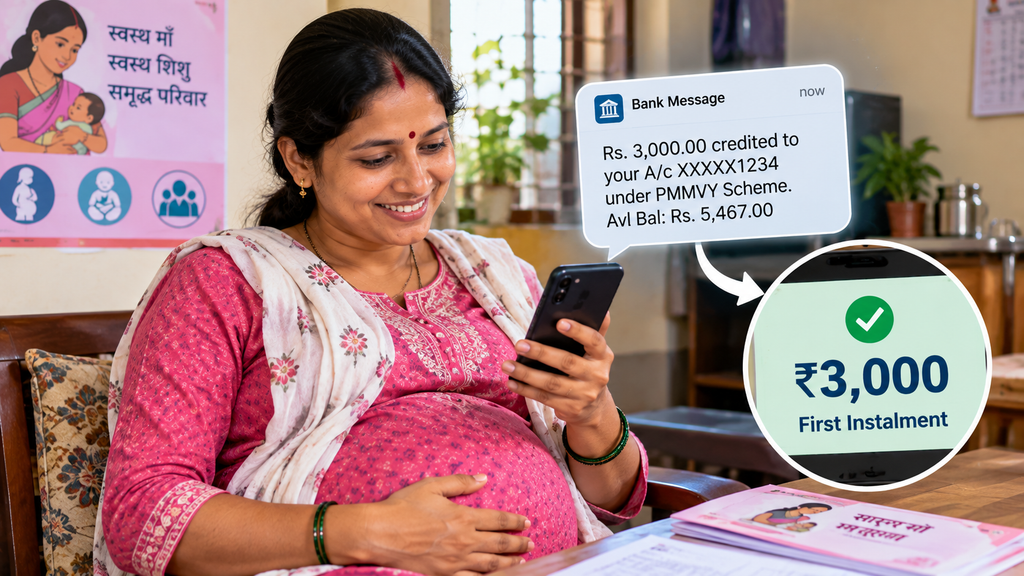
For the first living child, the total PMMVY benefit is ₹5,000, divided into two instalments. The first instalment is ₹3,000 and the second is ₹2,000, subject to the relevant conditions.
For the second living child, the benefit is ₹6,000 in a single instalment when the second child is a girl, again subject to the prescribed conditions.
| Benefit | Amount | Payment Structure |
|---|---|---|
| First living child | ₹5,000 | ₹3,000 + ₹2,000 |
| Second living child, if girl | ₹6,000 | Single instalment |
The Ministry also notes that eligible beneficiaries may receive benefits under Janani Suraksha Yojana (JSY) after institutional delivery, subject to the rules of that scheme.
PMMVY 2026 Eligibility
PMMVY is aimed at women from specified socially and economically disadvantaged sections. Eligibility is not based simply on pregnancy alone.
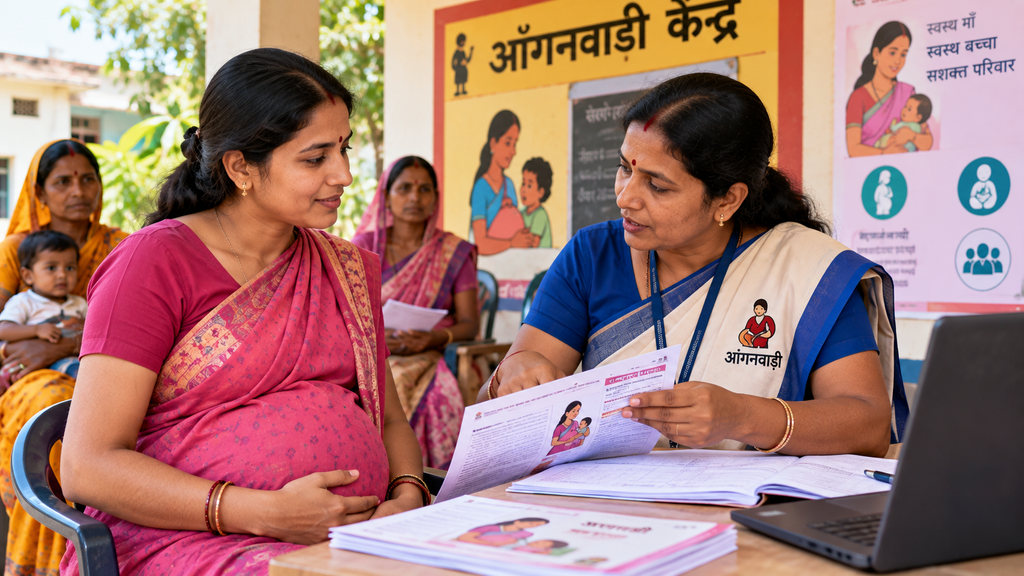
The official PMMVY FAQ lists several categories through which a woman can establish eligibility. These include women belonging to Scheduled Castes or Scheduled Tribes, women with specified disabilities, BPL ration-card holders, women covered under Ayushman Bharat PM-JAY, e-Shram card holders, women farmers receiving benefits under PM-KISAN, MGNREGA job-card holders, women whose net family income is below ₹8 lakh per year, pregnant and lactating Anganwadi Workers, Anganwadi Helpers and ASHA workers, and women holding a ration card under the NFSA 2013.A woman generally needs to provide proof corresponding to the eligibility category selected during registration.
Age Requirement
The PMMVY registration checks specify that the beneficiary should be at least 18 years and 7 months old and below 55 years at the time of childbirth.
This is an important detail because the age condition should not be confused with a simple pregnancy-age requirement.
Government Employee Restriction
The registration checks state that the beneficiary should not be a Central Government, State Government or PSU employee.
PMMVY Benefits and Objectives
The scheme has two broad purposes.
First, it provides financial assistance as partial compensation for wage loss associated with pregnancy and childbirth.
Second, it encourages pregnant women to access antenatal care and ensures that the newborn receives the required immunisation.
The Ministry describes these objectives as supporting adequate rest before and after delivery and promoting health-seeking behaviour among pregnant women and lactating mothers.This conditional structure is significant. PMMVY is not designed as an unconditional payment. Certain healthcare and registration milestones have to be completed before the relevant instalment is released.
PMMVY First Child Payment Conditions
For the first instalment of ₹3,000, pregnancy registration and the required antenatal check-ups must be completed within the prescribed period.
The official FAQ states that registration of pregnancy and at least two antenatal check-ups, preferably within six months from the Last Menstrual Period (LMP), are required for the first instalment under the PMMVY 2.0 FAQ.
For the second instalment of ₹2,000, childbirth must be registered and the child must complete the first cycle of immunisation up to 14 weeks under the applicable Universal Immunization Programme requirements.
This means that simply registering for PMMVY does not automatically trigger the entire ₹5,000 payment.
PMMVY Benefit for Second Girl Child
One of the major changes under PMMVY 2.0 is the inclusion of the second living child when the child is a girl.For an eligible beneficiary, the amount is ₹6,000 in one instalment. The conditions include pregnancy registration, the required antenatal check-ups, registration of the child’s birth and completion of the first cycle of immunisation up to 14 weeks.
The expansion to the second girl child represents a significant change from the original structure of PMMVY, which primarily covered the first child.
How to Apply for PMMVY 2026?
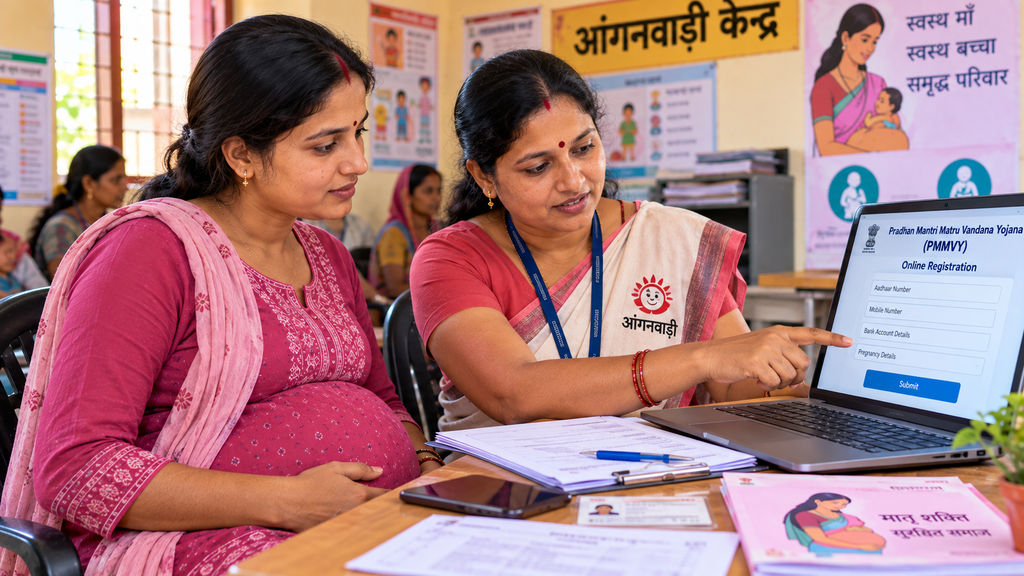
Eligible women can apply through the official PMMVY portal. The government has also provided a mechanism through which Anganwadi Workers and ASHA workers can complete online registration on behalf of eligible beneficiaries.
Online Registration Process
The basic process involves entering the beneficiary’s details, selecting the applicable eligibility category and submitting the required information and supporting document.
Aadhaar authentication is required as part of the registration process, and the beneficiary’s bank account must be Aadhaar-seeded and enabled for DBT according to the official registration checks. A mobile number is also required for communication regarding the application and payment.Women who need assistance can approach their nearest Anganwadi Worker or ASHA Worker, who can help complete the online application.
Documents Required for PMMVY
The exact document required depends on the eligibility category selected by the beneficiary.
Commonly relevant information includes:
- Aadhaar details
- Mobile number
- Bank or Post Office account details
- Proof of the selected eligibility category
- Pregnancy and health-related records as required
- Childbirth and immunisation information for the relevant instalment
The PMMVY registration system requires the identity number and supporting document corresponding to the selected eligibility criterion.The beneficiary’s bank or post-office account should be Aadhaar-seeded and DBT-enabled for the payment process.
How Is PMMVY Money Paid?
PMMVY payments are transferred directly into the beneficiary’s eligible bank or post-office account through Direct Benefit Transfer.
The Ministry’s citizen charter states that the ₹5,000 first-child benefit is transferred through DBT into the beneficiary’s Aadhaar-seeded bank/post-office account. The ₹6,000 second-girl-child benefit is also transferred through DBT after the relevant conditions are fulfilled.The government also provides SMS-based communication regarding registration, rejection and payment status through the PMMVY system.
Also Read:
- Pradhan Mantri Suraksha Bima Yojana (PMSBY) 2026: Benefits, Eligibility, Amount, Renewal, Form, Status Check & Certificate Download
- Pradhan Mantri Shram Yogi Maandhan Yojana 2026: Eligibility, Benefits, Contribution and Registration
PMMVY Application Deadline and Registration Window
The official PMMVY registration checks state that a beneficiary can be registered in the PMMVY system within 270 days after childbirth or within 570 days from the LMP date, subject to the applicable scheme rules and verification requirements.Because the scheme has specific timelines and conditionalities, eligible women should not delay registration until after delivery.Early registration also helps ensure that the required antenatal-care conditions can be completed within the applicable period.
What Happens in Case of Miscarriage or Stillbirth?
PMMVY 2.0 contains a provision for miscarriage or stillbirth. The official FAQ states that in such a situation, the beneficiary is treated as a fresh beneficiary in the event of a future pregnancy, subject to the scheme’s eligibility and conditions.
This is an important provision because a pregnancy that ends in miscarriage or stillbirth does not necessarily permanently prevent the woman from receiving PMMVY benefits for a later eligible pregnancy.
Important Point About PMMVY in 2026
PMMVY 2026 should not be presented as a newly launched scheme. The programme was launched nationwide in 2017 and its present framework includes changes introduced under PMMVY 2.0 and Mission Shakti.
The most important structural change was the addition of the benefit for the second child when the second child is a girl, along with the revised instalment structure for the first living child.
Therefore, readers searching for “PMMVY 2026” are generally looking for the current eligibility, payment amount and application process rather than a separate scheme launched in 2026.
What the Evidence Suggests
PMMVY is best understood as a conditional maternity-support programme, not simply a direct cash-transfer scheme. The payment is connected to health and administrative milestones, including pregnancy registration, antenatal check-ups, childbirth registration and immunisation.
For eligible women, the practical priority is to establish eligibility, keep the relevant documents ready, register through the official portal or an authorised field worker, and ensure that the bank or post-office account is properly enabled for DBT.
The scheme’s effectiveness therefore depends not only on the amount provided but also on whether eligible women can access registration and complete the required healthcare conditions in time.
PMMVY 2026: Key Takeaway
| Point | Details |
|---|---|
| First living child | ₹5,000 |
| First instalment | ₹3,000 |
| Second instalment | ₹2,000 |
| Second living child | ₹6,000 if girl |
| Payment | DBT |
| Registration | PMMVY portal / Anganwadi / ASHA |
| Key health conditions | ANC, childbirth registration and immunisation |
| Eligibility | Specified socially/economically disadvantaged categories |
| Official portal | pmmvy.wcd.gov.in |
The Ministry currently states that Odisha and Telangana are not implementing PMMVY, so readers in those states should check the latest state-level arrangements before assuming that the central PMMVY benefit is available locally.
Conclusion
Pradhan Mantri Matru Vandana Yojana 2026 provides maternity assistance to eligible women while linking financial support with important maternal and child-health milestones. The current structure provides ₹5,000 for the first living child and ₹6,000 for the second living child when the second child is a girl, subject to the prescribed eligibility and conditions.
For beneficiaries, the most important step is not simply applying for the scheme but completing the registration, antenatal-care, childbirth-registration and immunisation requirements correctly. Using the official PMMVY portal or taking assistance from an Anganwadi or ASHA worker can help eligible women navigate the process and receive the benefit through DBT.
FAQs — Frequently Asked Questions
1. What is Pradhan Mantri Matru Vandana Yojana 2026?
PMMVY is a maternity benefit scheme that provides financial assistance to eligible pregnant women and lactating mothers. It also encourages antenatal care, childbirth registration and timely immunisation.
2. How much money is given under PMMVY?
Eligible women can receive ₹5,000 for the first living child in two instalments. For the second living child, the benefit is ₹6,000 when the second child is a girl, subject to scheme conditions.
3. Who is eligible for PMMVY?
Eligibility includes specified categories such as SC/ST women, e-Shram card holders, MGNREGA job-card holders, BPL ration-card holders, certain women with disabilities and women with net family income below ₹8 lakh annually, among others.
4. How can I apply for PMMVY?
An eligible woman can apply through the official PMMVY portal or seek assistance from an Anganwadi Worker or ASHA Worker for online registration.
5. How is PMMVY money received?
The approved benefit is transferred directly to the beneficiary’s eligible Aadhaar-seeded bank or post-office account through Direct Benefit Transfer (DBT).

One Comment