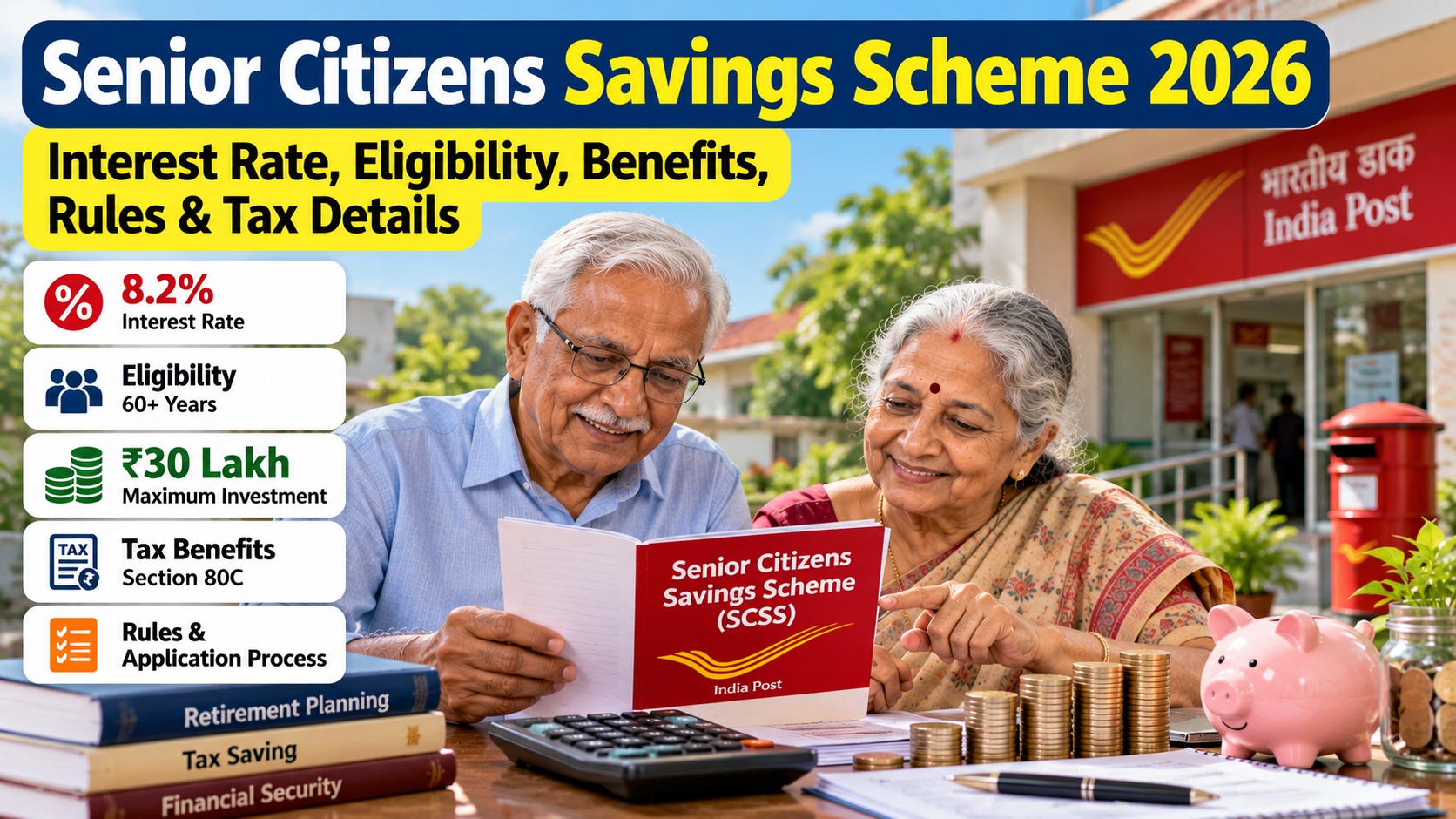
Senior Citizens Savings Scheme 2026: Retirement planning is not only about building a corpus; it is also about deciding how that money will generate dependable income after regular employment ends. The Senior Citizens Savings Scheme (SCSS) is one of India’s government-backed small-savings options designed specifically around this requirement.For the October–December 2026 quarter, the SCSS interest rate is 8.2% per annum. The rate was kept unchanged for the quarter, and the National Savings Institute’s scheme-wise table also lists SCSS at 8.2% across the quarters shown for FY 2026–27.
The scheme generally has a five-year maturity period, allows eligible investors to deposit up to ₹30 lakh, and pays interest quarterly. The maximum deposit was increased from ₹15 lakh to ₹30 lakh through the 2023 amendment to the SCSS rules.For retirees, the important question is therefore not simply whether the interest rate is attractive. The more useful questions are: who can open an SCSS account, how much can be deposited, when is interest paid, what happens at maturity, and how is the interest taxed?
What Is the Senior Citizens Savings Scheme?
The Senior Citizens Savings Scheme, commonly known as SCSS, is a government small-savings scheme intended primarily for senior citizens who want a structured investment with periodic interest income.The scheme was introduced in 2004 and is governed by the applicable Senior Citizens Savings Scheme rules. Accounts can be opened through authorised deposit offices, including eligible post offices and banks.
Unlike schemes where returns accumulate until maturity, SCSS is structured around periodic interest payments. This makes the cash-flow feature particularly relevant for retirees who may need regular income from their savings.However, SCSS should not be confused with a pension scheme. It does not create a government pension entitlement. Instead, an eligible individual deposits money into the account and receives interest according to the notified scheme rate.
| Detail | Information |
|---|---|
| Scheme Name | Senior Citizens Saving Scheme |
| Launched By | Government of India (Ministry of Finance) |
| Beneficiaries | Indian citizens aged 60 and above, retired civilians aged 55 to 60 and retired defence personnel aged 50 to 60 |
| Interest Rate | 8.2% per annum (October to December 2026 quarter) |
| Tenure | 5 years, extendable in blocks of 3 years |
| Minimum Investment | ₹1,000 |
| Maximum Investment | ₹30 lakh |
| Interest Payment | Quarterly (1st April, 1st July, 1st October, 1st January) |
| Application Mode | Offline at post offices and authorised banks |
| Official Website | indiapost.gov.in |
SCSS Interest Rate 2026
As of October–December 2026, the interest rate under the Senior Citizens Savings Scheme is 8.2% per annum. The Department of Economic Affairs lists a specific notification for the revision of small-savings rates for Q3 FY 2026–27 dated 30 September 2026. The rate remained unchanged for the quarter.
| SCSS Detail | 2026 Information |
|---|---|
| Interest rate | 8.2% per annum |
| Interest payment | Quarterly |
| Tenure | 5 years |
| Maximum deposit | ₹30 lakh |
| Minimum deposit | ₹1,000 |
| Interest calculation | On the deposited amount according to scheme rules |
| Extension | Further 3-year periods subject to applicable rules |
The National Savings Institute’s official interest-rate table lists the five-year SCSS rate at 8.2% for April–June, July–September and October–December 2026.

How Much Interest Can ₹30 Lakh Generate?
At a simple annual rate of 8.2%, a ₹30 lakh deposit corresponds to ₹2.46 lakh of annual interest, before considering the applicable tax treatment.
Because SCSS interest is paid quarterly, the equivalent quarterly amount is approximately ₹61,500, assuming the full ₹30 lakh remains invested and the notified rate is applied. This is a calculation based on the stated 8.2% rate, not an additional government benefit.The actual tax impact will depend on the account holder’s overall income, applicable tax regime and other circumstances.
Who Is Eligible for SCSS?
The standard eligibility threshold is 60 years or above at the time of opening the account.Certain individuals who have retired can also qualify at a younger age under specified conditions. India Post’s SCSS documentation provides for eligible retired individuals aged 55 years or more but below 60 years, subject to the applicable retirement-related conditions and prescribed timing for opening the account. Retired defence personnel are covered by separate age provisions under the scheme rules.
This distinction matters because reaching the age of 55 alone does not automatically make every person eligible for SCSS. The special provision is linked to retirement and other conditions prescribed under the rules.

SCSS Maximum Deposit and Minimum Investment
The minimum investment required to open an SCSS account is ₹1,000, while the maximum aggregate deposit permitted under the scheme is ₹30 lakh. The 2023 amendment formally replaced the earlier ₹15 lakh ceiling with ₹30 lakh. The deposit is generally made in multiples of ₹1,000.
An individual may hold more than one SCSS account, but the combined deposits across the accounts must remain within the applicable maximum limit. This is important for people who are considering separate accounts or accounts at different authorised institutions.

How Is SCSS Interest Paid?
One of the defining features of SCSS is its quarterly interest payout.Interest is paid at prescribed quarterly intervals rather than being accumulated only until the end of the five-year period. The scheme rules specify the relevant payment dates and also provide rules governing interest after maturity, extension and premature closure.
This structure can make SCSS useful for retirees who want to convert a portion of their savings into a predictable periodic cash flow.At the same time, investors should remember that receiving interest periodically also means that the money is available for spending rather than automatically being reinvested inside the SCSS account.
SCSS Maturity Period
The normal maturity period of an SCSS account is five years.After the initial five-year period, the account can be extended for a further three years under the applicable rules. The extension mechanism has specific conditions, including the timing of the request and withdrawal provisions.
The distinction between the original five-year term and an extension is important when planning retirement cash flows. An investor should not assume that an account will automatically continue indefinitely on the same terms.
Can SCSS Be Extended?
Yes. The SCSS rules allow an account holder to extend the account for an additional three-year period after maturity, subject to the prescribed procedure.The rules also provide a withdrawal facility after extension. In particular, an account holder using the extension facility can close the account after the specified period following extension without the premature-closure deduction applicable in earlier stages.
Because small-savings interest rates are periodically notified by the government, investors should also distinguish between the scheme’s rules and the rate applicable to a particular deposit or extension.
SCSS Tax Benefits
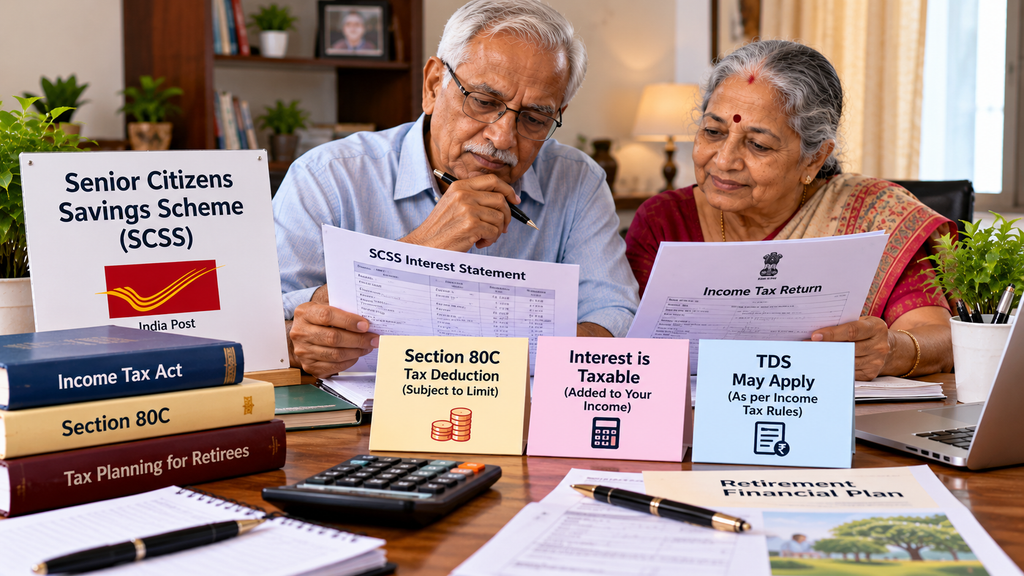
SCSS has a tax-related benefit under Section 80C of the Income-tax Act. Deposits made under the Senior Citizens Savings Scheme are among the investments covered by Section 80C, subject to the overall applicable deduction limit. The Income Tax Department currently lists the maximum Section 80C deduction at ₹1.50 lakh.This does not mean that the entire ₹30 lakh SCSS investment automatically qualifies for a tax deduction.
For example, if an eligible taxpayer deposits ₹5 lakh into SCSS, the Section 80C deduction cannot simply be treated as ₹5 lakh because the overall Section 80C ceiling and the taxpayer’s other eligible investments must be considered.There is another important point: SCSS interest itself is taxable income according to the applicable income-tax provisions. Therefore, investors should distinguish between the tax treatment of the qualifying deposit and the taxation of interest received from the account.
Tax rules can also differ depending on whether a taxpayer uses the old or new tax regime, so retirement planning should consider the individual’s complete tax position rather than looking at SCSS in isolation.
What About TDS on SCSS Interest?
SCSS interest can be subject to tax deduction at source when the applicable statutory conditions and thresholds are met.The Income Tax Department’s current material provides specific rules for TDS on interest and separately recognises senior-citizen provisions. Taxpayers should therefore check the applicable financial-year threshold and their overall tax position rather than assuming that all SCSS interest is automatically tax-free.
Importantly, TDS and final income-tax liability are not the same thing. TDS is a mechanism for collecting tax during the year; the final tax liability depends on the taxpayer’s total taxable income and applicable provisions.
Premature Withdrawal From SCSS
SCSS is designed as a five-year savings product, but the rules allow premature closure subject to prescribed conditions and deductions.The applicable rules provide for interest up to the date preceding premature closure, after the relevant penalty or deduction is applied. Multiple withdrawals from an account are not permitted under the scheme rules.
Therefore, a person considering SCSS should avoid putting money into the account if that money may be required immediately for an emergency or near-term expense.The tax implications of an early closure can also matter. The Income Tax Department states that where an SCSS account is closed before the prescribed five-year period, the amount previously claimed as a Section 80C deduction can have tax consequences under the applicable provisions.
Can a Spouse Be a Joint Holder?
SCSS permits an account to be opened jointly with a spouse under the applicable rules. India Post’s documentation states that the spouse does not necessarily have to independently satisfy the same age criterion for being the joint holder.
This provision can be relevant for retired couples managing their savings together.There are also specific rules concerning what happens when the primary account holder dies. Depending on the account structure and the spouse’s status, the surviving spouse may be able to continue the account under the conditions specified in the scheme rules.
SCSS vs Fixed Deposit: What Should Investors Understand?
SCSS and bank fixed deposits can both provide periodic interest, but their structures are different.SCSS is part of the government’s small-savings framework and is specifically designed around senior citizens. A bank fixed deposit, by contrast, is a deposit product offered by an individual bank, with its own interest rate, tenure and terms.
The key comparison should therefore consider more than the headline interest rate. Investors should look at government small-savings rules, bank-specific deposit terms, taxation, liquidity, deposit limits, interest-payment frequency and their own cash-flow requirements.The objective should be to match the product with the retiree’s financial needs rather than selecting an instrument solely because of its quoted rate.
What Makes SCSS Different From a Pension?
SCSS is sometimes described informally as a retirement-income product, but it is not the same as a pension.A pension generally represents a recurring income entitlement arising from an employment-linked, contributory or pension scheme. SCSS instead works through a lump-sum deposit followed by periodic interest payments.
This distinction is important. A person with ₹30 lakh in SCSS is not receiving a pension of ₹30 lakh or recovering the principal through the quarterly payment. The quarterly amount represents interest under the scheme, while the principal remains subject to the maturity and withdrawal rules.
Important Points Before Opening an SCSS Account
The most important practical issue is liquidity. SCSS has a five-year structure, and premature closure is governed by specific rules.
Second, investors should calculate the after-tax income, not merely the advertised interest rate.
Third, the ₹30 lakh ceiling applies to the overall SCSS investment structure under the applicable rules, so people with multiple accounts should keep track of their aggregate deposits.
Finally, interest rates on small-savings schemes are reviewed and notified periodically. The rate applicable to a new deposit or extension should therefore be checked against the latest government notification before making a fresh investment. The Department of Economic Affairs publishes these quarterly small-savings rate notifications.
Also Read:
- Public Provident Fund Account (PPF): Interest Rate, Eligibility, Tax Benefits, Rules and Maturity Explained
- Pradhan Mantri Jan Dhan Yojana 2026: Eligibility, Benefits, ₹10,000 Overdraft & Account Opening
What This Means for Retirees
SCSS is fundamentally a retirement-income planning instrument, not a substitute for a complete financial plan.For someone who has a retirement corpus and needs periodic interest income, the quarterly payout structure may be relevant. But retirees also need to keep adequate liquidity for healthcare, household expenses and unexpected costs.The practical value of SCSS therefore depends on how it fits alongside bank deposits, pension income, emergency savings, health insurance and other investments.
FAQ Section
What is the SCSS interest rate in 2026?
For the October–December 2026 quarter, the Senior Citizens Savings Scheme carries an interest rate of 8.2% per annum. The government kept the small-savings rates unchanged for this quarter. SCSS interest is paid quarterly according to the scheme’s payment schedule.
What is the maximum SCSS deposit limit in 2026?
The maximum aggregate investment permitted under SCSS is ₹30 lakh. The limit was increased from ₹15 lakh to ₹30 lakh through the Senior Citizens Savings (Amendment) Scheme, 2023.
What is the maturity period of SCSS?
The normal SCSS maturity period is five years. After maturity, the account can be extended for an additional three years under the applicable rules and procedure.
Is SCSS interest paid monthly?
No. SCSS interest is structured as a quarterly payment, rather than a monthly payment. This makes it different from products specifically designed to provide monthly income.
Is SCSS investment eligible for Section 80C deduction?
Yes, deposits under the Senior Citizens Savings Scheme are included among eligible Section 80C investments, subject to the overall applicable ₹1.50 lakh Section 80C limit and the taxpayer’s other qualifying investments.
Is SCSS interest tax-free?
No. The fact that SCSS offers a government-backed small-savings rate does not make its interest automatically tax-free. The interest forms part of the taxpayer’s income and must be considered under the applicable income-tax provisions.
Can SCSS be closed before five years?
Premature closure is permitted under specified conditions, but deductions or penalties can apply. The rules also specify how interest is calculated when an account is closed before maturity.
Can SCSS be opened jointly with a spouse?
Yes. SCSS permits joint accounts with a spouse under the scheme rules. India Post’s documentation states that the spouse does not necessarily have to meet the same age requirement as the primary account holder.