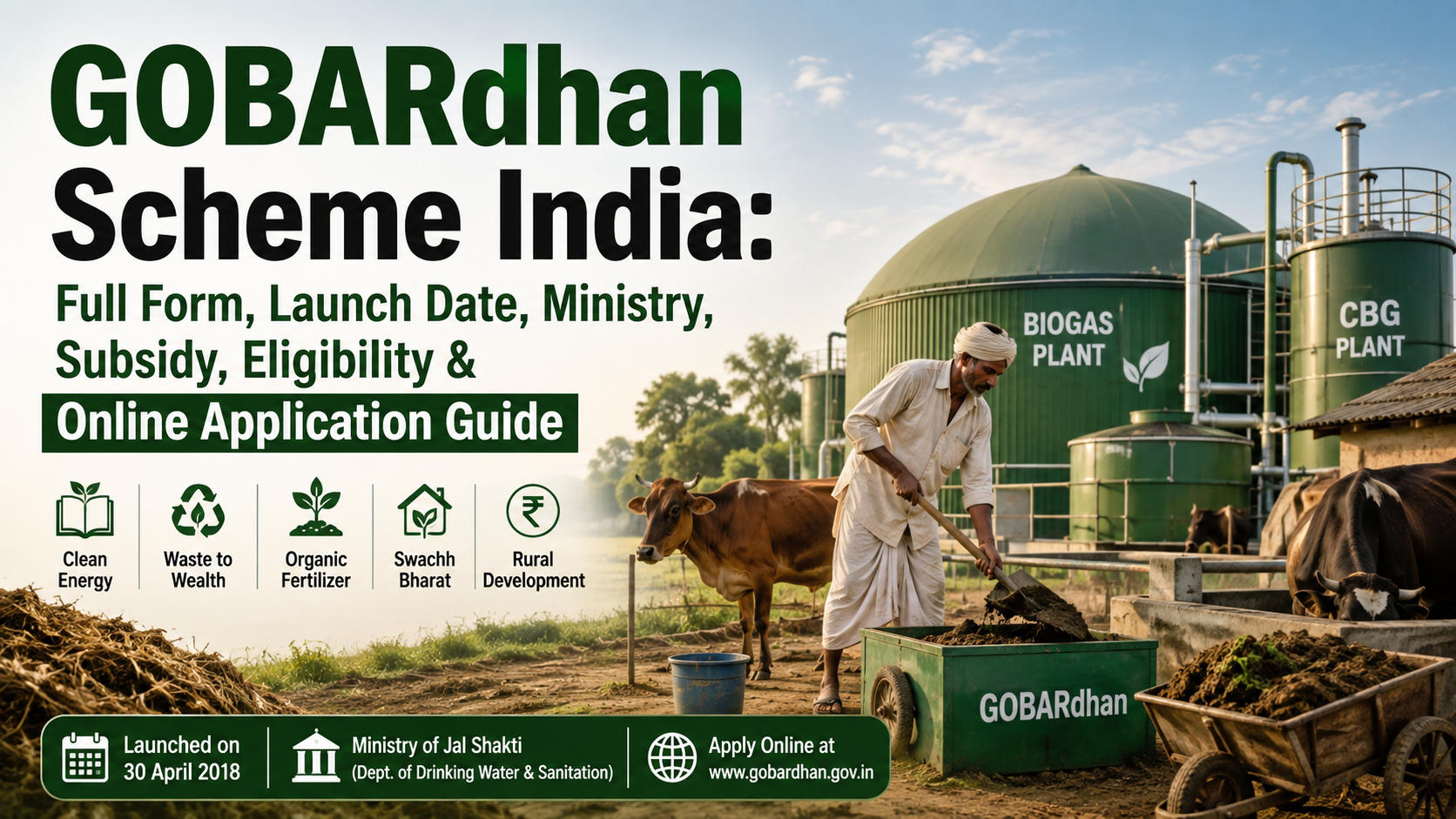
GOBARdhan Scheme India 2026: The GOBARdhan Scheme is one of India’s important waste management and clean energy initiatives. It focuses on converting organic waste such as cattle dung, agricultural waste, and biodegradable household waste into useful products like biogas, compressed biogas (CBG), and organic fertilizer. The scheme supports rural development, clean villages, renewable energy, and better waste management across the country.
Many students preparing for UPSC and other government exams search for topics such as GOBARdhan Scheme India, GOBARdhan Scheme full form, GOBARdhan Scheme under which ministry, GOBARdhan Scheme launch date, GOBARdhan Scheme subsidy, and GOBARdhan Scheme details. This article explains everything in simple English and is useful for both competitive exams and general awareness.
GOBARdhan Scheme Overview
| Particular | Details |
|---|---|
| Scheme Name | GOBARdhan Scheme |
| Full Form | Galvanizing Organic Bio-Agro Resources Dhan |
| Launched | 30 April 2018 |
| Launched Under | Swachh Bharat Mission (Gramin) |
| Ministry | Department of Drinking Water and Sanitation under the Ministry of Jal Shakti |
| Objective | Convert organic waste into biogas, compressed biogas (CBG), and organic fertilizer |
| Beneficiaries | Farmers, rural households, village communities, entrepreneurs, and local bodies |
| Waste Type | Cattle dung, agricultural residue, biodegradable waste, food waste, and other organic waste |
| Application Mode | Online through the official GOBARdhan portal |
What is GOBARdhan Scheme?
The GOBARdhan Scheme is a government initiative that encourages villages, farmers, and entrepreneurs to set up biogas and compressed biogas plants using organic waste. The main idea is to convert waste into wealth. Instead of allowing cattle dung and biodegradable waste to pollute the environment, the scheme promotes their use for producing clean energy and organic manure.
The program is part of the Swachh Bharat Mission (Gramin) and supports India’s goals of sanitation, renewable energy, sustainable agriculture, and a circular economy.
GOBARdhan Scheme Full Form
The GOBARdhan Scheme full form is: Galvanizing Organic Bio-Agro Resources Dhan. The name reflects the purpose of the scheme: creating wealth and useful resources from organic and agricultural waste.
GOBARdhan Scheme Launch Date
The scheme was officially launched on 30 April 2018, during the implementation of Swachh Bharat Mission (Gramin). Since its launch, many biogas and compressed biogas projects have been developed across different states in India.
GOBARdhan Scheme Under Which Ministry?
The scheme is implemented by the Department of Drinking Water and Sanitation (DDWS) under the Ministry of Jal Shakti, Government of India. For UPSC and government exam preparation, remember this point:
- Scheme: GOBARdhan
- Ministry: Ministry of Jal Shakti
- Department: Department of Drinking Water and Sanitation
GOBARdhan Scheme Launched by Which Ministry?
The GOBARdhan Scheme was launched by the Ministry of Jal Shakti through the Department of Drinking Water and Sanitation. Initially, it was introduced under the framework of Swachh Bharat Mission (Gramin) to improve sanitation and waste management in rural India.
GOBARdhan Scheme India: Main Objectives
The GOBARdhan Scheme has several important objectives:
- Convert cattle dung and organic waste into useful resources.
- Produce biogas and compressed biogas (CBG).
- Generate organic fertilizer for agriculture.
- Reduce environmental pollution.
- Improve village cleanliness and sanitation.
- Increase farmers’ income through waste utilization.
- Promote renewable and sustainable energy.
- Encourage entrepreneurship in the waste management sector.
GOBARdhan Scheme Waste Type
The GOBARdhan Scheme waste type includes biodegradable and organic waste materials. These are used as raw materials for biogas and compressed biogas plants. The main waste types are:
- Cattle dung
- Cow dung
- Buffalo dung
- Agricultural residue
- Crop waste
- Food waste
- Kitchen waste
- Vegetable waste
- Fruit waste
- Organic municipal waste
- Biodegradable household waste
These materials are processed through anaerobic digestion to produce biogas, compressed biogas (CBG), and organic manure.
How Does the GOBARdhan Scheme Work?
The working process is simple.
- Organic waste is collected from households, farms, dairies, or markets.
- The waste is transported to a biogas or compressed biogas plant.
- The waste undergoes anaerobic digestion.
- Biogas is produced and can be used for cooking, electricity generation, or compressed into CBG for transport and industrial use.
- The leftover slurry is converted into organic fertilizer, which can be used in farming.
This process reduces waste, produces clean energy, and creates valuable fertilizer.
GOBARdhan Scheme Subsidy
Financial assistance under the scheme may be available through different government programs, ministries, and implementing agencies. Subsidy support can vary depending on:
- The type of biogas or CBG plant.
- Plant capacity.
- State government policies.
- Central government support schemes.
- Implementing agencies and financial institutions.
Large compressed biogas projects may receive support through programs linked with renewable energy, waste-to-wealth initiatives, or sustainable agriculture schemes. Applicants should check the latest subsidy guidelines on the official GOBARdhan portal or the concerned government department.
GOBARdhan Scheme Apply Online
If you want to know GOBARdhan Scheme apply online, follow these general steps:
- Visit the official GOBARdhan portal.
- Register as a farmer, entrepreneur, organization, or implementing agency.
- Fill in the required application details.
- Upload the necessary documents.
- Submit the application online.
- Track the application status through the portal.
The government periodically updates the online application process and project registration guidelines.
Documents Required
The exact documents may vary depending on the type of project. Generally, applicants may need:
- Aadhaar Card
- PAN Card
- Address proof
- Land ownership or lease documents
- Project report
- Bank account details
- Identity proof
- Mobile number and email ID
Eligibility for GOBARdhan Scheme
The scheme is open to various categories of applicants, including:
- Individual farmers
- Dairy farmers
- Farmer Producer Organizations (FPOs)
- Panchayats
- Village communities
- Self-help groups
- Cooperatives
- Entrepreneurs
- Private companies
- Waste management organizations
Eligibility conditions may differ based on the project size and implementation model.
- Ladli Behna Yojana 2026: New Form Date, Online Registration, Eligibility, Documents, KYC, Third Phase & Payment Updates
- Haryana Family ID 2026: How to Get Family ID, Check Status, Update Details and Download PPP
Benefits of GOBARdhan Scheme
The scheme provides several economic and environmental benefits.
Better Waste Management
Organic waste is processed scientifically instead of being dumped in open areas.
Clean Energy Production
Biogas and compressed biogas can replace conventional fossil fuels.
Additional Income for Farmers
Farmers can earn from cattle dung, agricultural residue, and organic waste.
Organic Fertilizer
The digested slurry becomes nutrient-rich organic manure, reducing dependence on chemical fertilizers.
Reduced Pollution
The scheme helps control methane emissions, foul odors, and groundwater contamination.
Rural Employment
Biogas and CBG projects create jobs in collection, transportation, processing, and plant operations.
GOBARdhan Scheme UPSC Notes
For UPSC preparation, remember these key facts:
- Full Form: Galvanizing Organic Bio-Agro Resources Dhan
- Launch Date: 30 April 2018
- Launched Under: Swachh Bharat Mission (Gramin)
- Ministry: Ministry of Jal Shakti
- Department: Department of Drinking Water and Sanitation
- Focus: Organic waste to biogas, compressed biogas, and organic fertilizer
- Waste Type: Cattle dung, agricultural residue, biodegradable waste
- Objective: Waste management, clean energy, sanitation, and rural development
GOBARdhan Scheme Details
The scheme is linked with the broader goal of creating a circular economy in rural India. Instead of treating organic waste as a problem, it is treated as a resource that can generate energy, fertilizer, and income.
GOBARdhan also supports:
- Swachh Bharat Mission
- Sustainable agriculture
- Renewable energy
- Biofuel production
- Climate-friendly rural development
- Waste-to-wealth initiatives
GOBARdhan Scheme Launched in Which State?
The GOBARdhan Scheme is a central government scheme and was launched at the national level, not in a single state. It is implemented across various states and Union Territories of India.
Role of Compressed Biogas (CBG)
One of the major components of GOBARdhan is Compressed Biogas (CBG).
CBG can be used for:
- Vehicle fuel
- Industrial fuel
- Commercial energy use
- Power generation
- Replacing natural gas and fossil fuels
This supports India’s clean energy transition and biofuel goals.
Challenges in Implementation
Although the scheme has significant potential, some challenges remain:
- High initial investment for large plants.
- Collection and transportation of waste.
- Technical maintenance of biogas plants.
- Financial viability in some rural areas.
- Need for awareness among farmers and local communities.
Government support, technology improvements, and private participation can help overcome these challenges.
Frequently Asked Questions (FAQs)
What is GOBARdhan Scheme?
GOBARdhan Scheme is a Government of India initiative that converts organic waste such as cattle dung and agricultural waste into biogas, compressed biogas, and organic fertilizer.
What is the full form of GOBARdhan?
GOBARdhan stands for Galvanizing Organic Bio-Agro Resources Dhan.
GOBARdhan Scheme is under which ministry?
It is implemented by the Department of Drinking Water and Sanitation under the Ministry of Jal Shakti.
Conclusion
The GOBARdhan Scheme India is an important initiative that connects waste management, renewable energy, agriculture, and rural development. By converting cattle dung and organic waste into biogas, compressed biogas, and organic fertilizer, the scheme helps improve village cleanliness, reduce pollution, create employment, and increase farmers’ income.
For students preparing for UPSC, competitive exams, or anyone interested in government schemes, remembering the GOBARdhan Scheme full form, launch date, ministry, waste type, subsidy, and online application process is especially useful. As India continues to promote sustainable development and a circular economy, the GOBARdhan Scheme is expected to play a major role in transforming organic waste into valuable resources across the country.