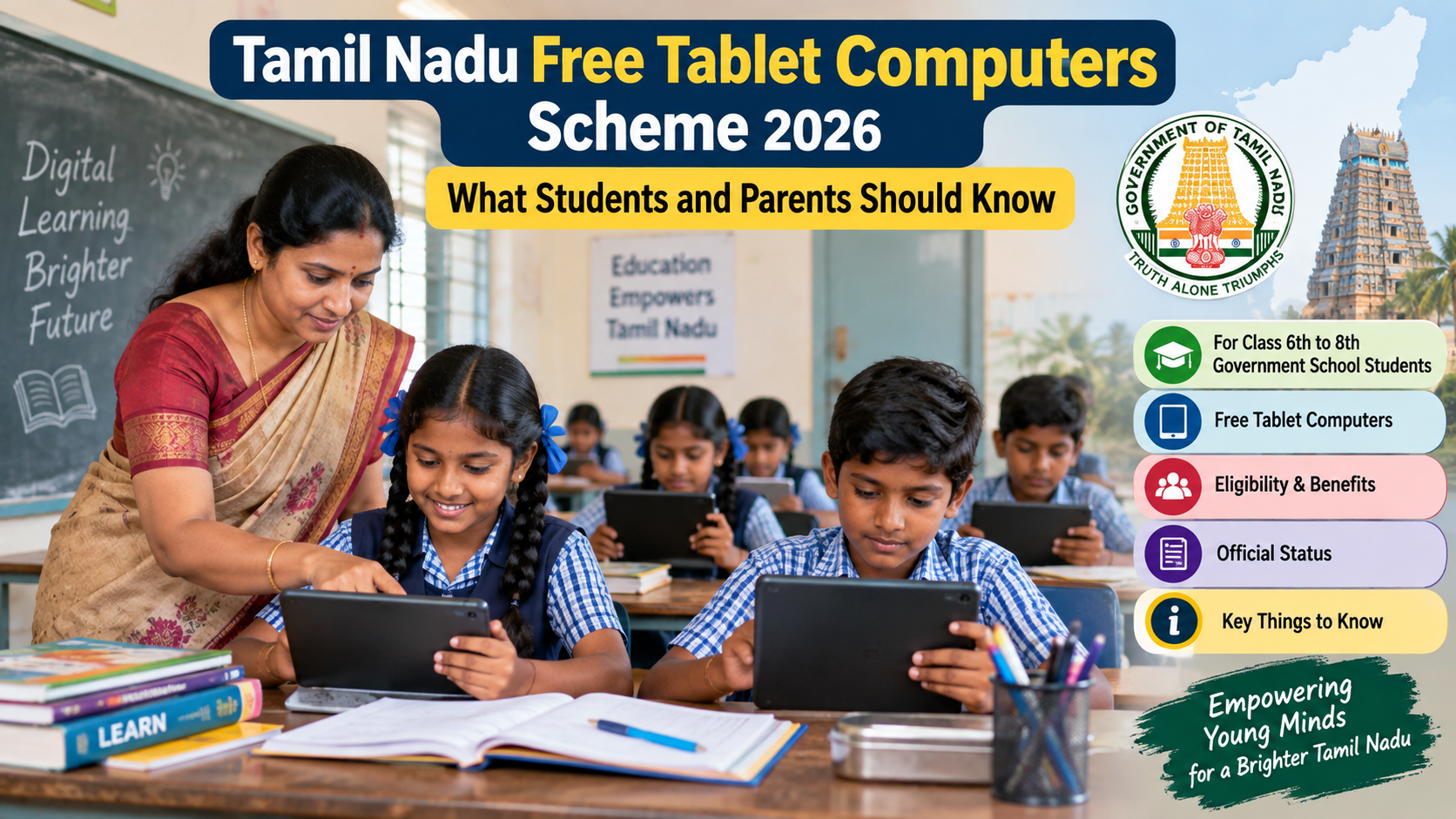
Tamil Nadu Free Tablet Computers Scheme 2026: The phrase Tamil Nadu Free Tablet Computers Scheme 2026 is likely to attract students and parents looking for help with digital learning. But the most important question is not whether the phrase appears online. It is whether a government order, an implementation plan and an actual distribution process can be verified.
Tamil Nadu has previously discussed providing tablet computers to school students. In January 2022, DT Next reported that a proposal announced in 2018–19 had still not been implemented. The report referred to a first phase for students in Classes 6–8 in government and government-aided schools.That history matters because an old proposal can easily be mistaken for a new scheme. A search result, social-media post or article title does not by itself establish that applications are open or that a student is entitled to a device.
What was the earlier Class 6–8 tablet proposal?
The earlier proposal was associated with the previous AIADMK government. According to the January 2022 report, the then School Education Minister K. A. Sengottaiyan had announced a first phase involving 11.70 lakh free tablets for students in Classes 6–8 in government and government-aided schools.
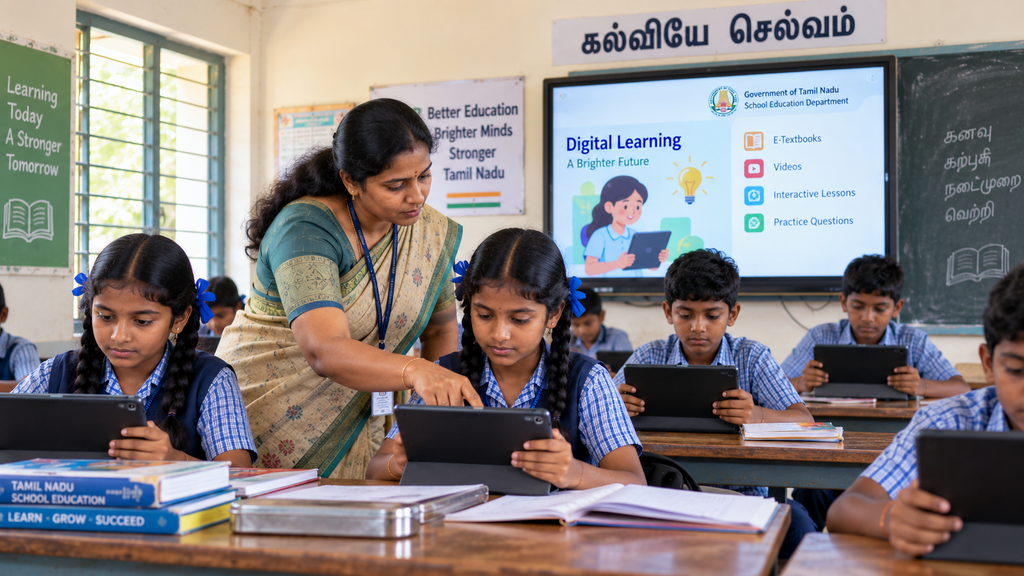
The report also said that the Electronics Corporation of Tamil Nadu, or ELCOT, had been entrusted with procurement through an international tender. The proposed devices were intended to support educational use, including e-textbooks, learning applications, anti-virus software and video tutorials.
These details help explain why the proposal was significant. A tablet distribution programme is not simply a matter of handing out hardware. It requires procurement, specifications, software, distribution arrangements and a plan for how students will use the devices.However, the same report said that the distribution had not taken off and that there was no official word at that time on implementation. It also referred to delays in related free-device initiatives.
Was the older proposal actually launched?
The available historical report does not establish that the Class 6–8 tablet distribution was completed. It specifically described the project as still unimplemented in January 2022.
That is an important distinction:
| What can be established | What cannot be assumed |
|---|---|
| A Class 6–8 tablet proposal was reported. | That every eligible student received a tablet. |
| The proposal involved government and government-aided schools. | That applications are open in 2026. |
| Procurement was reportedly assigned to ELCOT. | That a new 2026 tender has been completed. |
| Educational content was part of the proposed plan. | That a device is currently due to every student. |
The difference between an announcement and implementation is especially important in welfare reporting. A scheme may be proposed, approved, tendered, delayed, modified or discontinued. Each stage requires separate evidence.
Is there a new Tamil Nadu free tablet scheme in 2026?
The available evidence does not establish a new statewide free-tablet scheme for Class 6–8 students in 2026.
The strongest recent official evidence available here is the Tamil Nadu 2025–26 Budget Speech, which describes a separate programme for college students. It says the government planned to provide high-tech devices to students in various colleges, including arts, science, engineering, agriculture and medicine. The first phase was described as covering 20 lakh college students over two years, with a choice between a tablet and a laptop.
This is a different target group and a different policy description from the older school-level proposal. It should not be used as proof that Classes 6–8 students are receiving tablets under a new 2026 scheme.
Why the distinction matters
A student searching for “Tamil Nadu free tablet scheme 2026” may encounter several kinds of information:
- A historical report about the Class 6–8 proposal.
- A newer report about college students receiving high-tech devices.
- A general article about digital learning in schools.
- A social-media post that combines these details.
- A page that presents an old announcement as if it were a current application opportunity.
Who was supposed to receive tablets under the older proposal?
The historical proposal covered students in Classes 6–8 studying in government and government-aided schools. The reported first phase involved 11.70 lakh students.
But this should be described as the proposed eligibility group, not as a confirmed 2026 eligibility list. The available evidence does not establish whether a later government order changed the classes covered, the number of beneficiaries, the type of device or the distribution process.
A useful eligibility statement should therefore read:
The earlier reported proposal was intended for Class 6–8 students in government and government-aided schools. Its historical eligibility should not be treated as proof of a current 2026 entitlement.
This wording is more accurate than publishing a long list of documents, income limits or application steps that have not been verified for the specific scheme.
What was the purpose of the proposed tablets?
The earlier plan was intended to support digital learning. The 2022 report described proposed features such as class-specific e-textbooks, educational applications, anti-virus software and video tutorials.
The wider purpose was to make digital educational material more accessible to students. But the effectiveness of such a programme would depend on more than the device itself.
A tablet can be useful when students have appropriate learning content, teachers can guide its use, and the device is maintained properly. It is less useful if distribution is delayed, software is unavailable, or students cannot access the material they need.
How does the college-device programme differ?
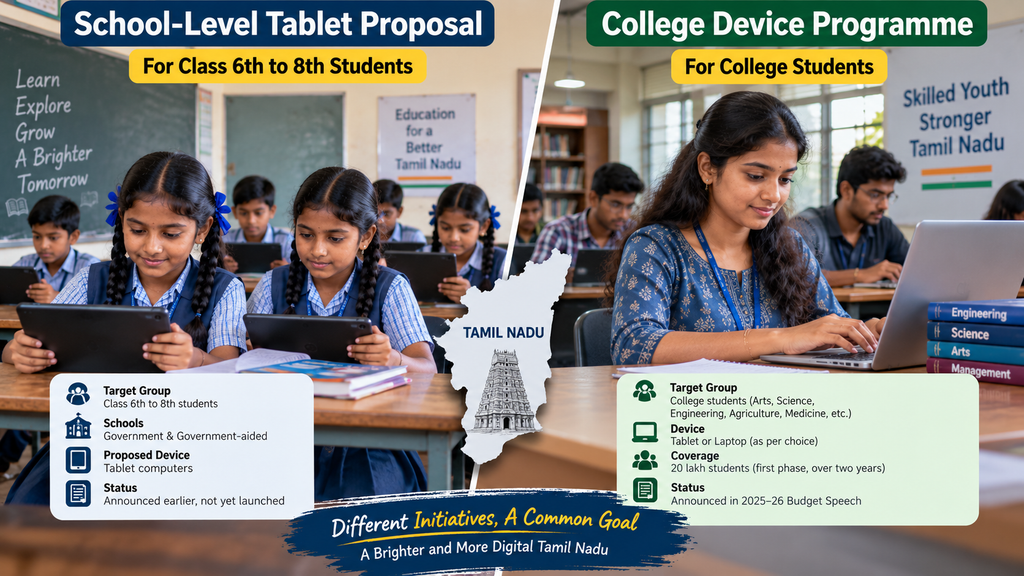
The 2025–26 Budget Speech describes a programme for college students, not a Class 6–8 school distribution scheme. It covers students in various higher-education disciplines and provides for a choice between a tablet and a laptop.
The distinction can be summarised as follows:
| Feature | Earlier school-level proposal | Later college-device programme |
|---|---|---|
| Target group | Classes 6–8 | College students |
| Reported status | Unimplemented in the January 2022 report | Described in the 2025–26 Budget Speech |
| Device | Tablet computers | Tablet or laptop, based on preference |
| Main purpose | Educational access and digital learning | Equipping college students with high-tech devices |
| Evidence available here | Historical news report | Official budget speech |
This comparison is useful because it prevents a common error: treating a college-device announcement as a confirmation of a school-level scheme.
What should students do if they see an application link?
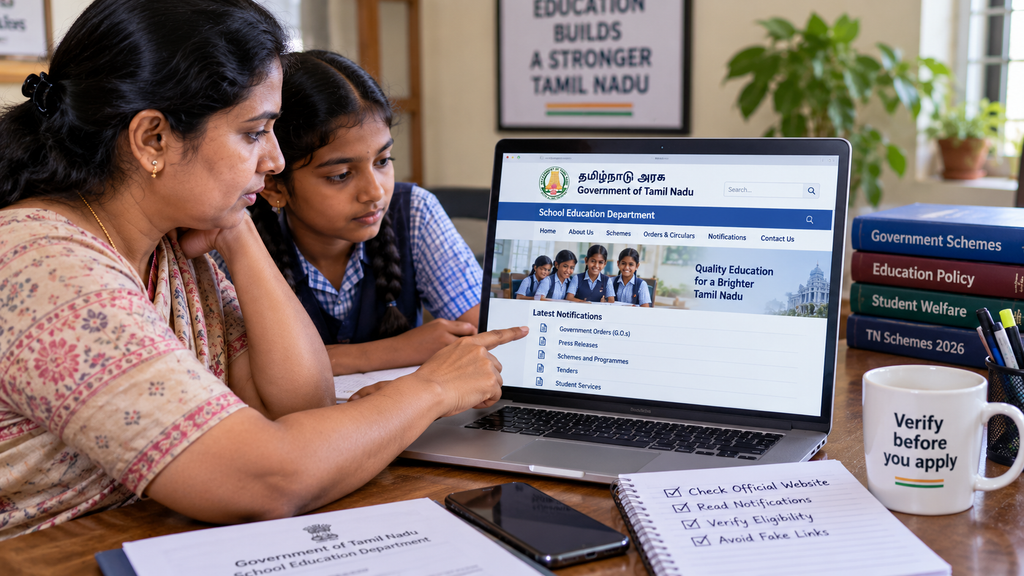
Students and parents should verify the scheme before submitting personal information.
The first step is to check whether the announcement comes from a Tamil Nadu government department, an official school communication or a government order. A genuine scheme should have a clear target group, an implementation authority and a defined process.
The second step is to check whether the announcement refers specifically to Class 6–8 students. If it instead refers to college students, it is not evidence of the school-level proposal.
The third step is to look for an official notice explaining whether applications are required, whether schools will identify beneficiaries, and whether distribution has actually begun. A claim that “registration is open” is not enough without a verifiable government source.
Students should also avoid assuming that a social-media post is an official announcement. The absence of a verified notice is a reason to wait for confirmation, not a reason to submit documents to an unknown website.
What the evidence suggests
The evidence suggests that the older school-level tablet proposal should be understood as a historical announcement whose implementation was reported as delayed, rather than as a confirmed 2026 benefit. The later official budget speech points to a separate college-device programme.
This does not mean that digital learning is unimportant. It means that policy reporting should distinguish between a proposal and a delivered benefit. For students, that distinction affects expectations. For parents, it affects whether they should spend time applying or waiting for an official process.
The most useful approach is therefore to follow the specific scheme’s official status, not merely its name.
Why the scheme’s status matters beyond one device
The tablet proposal raises a broader question about how public education systems adopt technology. A government may announce a device programme to improve access to learning, but the programme must also address procurement, distribution, software and classroom use.
The historical report itself illustrates this point. It described a plan involving ELCOT procurement and educational content, while also reporting that distribution had not begun.
That gap between policy intention and delivery is not unique to digital devices. It is a recurring issue in public programmes. A credible account should therefore explain what has been promised, what has been implemented and what remains uncertain.
- Pashu Aadhaar Card 2026: Complete Guide to Animal Identification, Registration and Benefits
- MP Laptop Yojana 2026: ₹25,000 Payment Status, Eligibility and Official Portal
FAQ Section
1. Is the Tamil Nadu Free Tablet Computers Scheme 2026 officially launched?
The available evidence does not establish a new statewide free-tablet scheme for Class 6–8 students in 2026. The historical proposal was reported as unimplemented in January 2022. A separate college-device programme was described in the 2025–26 Budget Speech.
2. Who was eligible under the older tablet proposal?
The reported proposal was intended for students in Classes 6–8 studying in government and government-aided schools. It should be treated as a historical proposal, not as a confirmed 2026 eligibility list.
3. How many students were covered by the earlier proposal?
The January 2022 report referred to a first phase involving 11.70 lakh students. This was the reported proposed coverage, not evidence that the tablets were distributed.
4. Is the college tablet-and-laptop programme the same as the school tablet scheme?
No. The 2025–26 Budget Speech describes a separate programme for college students, with a choice between a tablet and a laptop. It does not establish a Class 6–8 school distribution scheme.
5. Should students apply through a website claiming to offer free tablets?
Students should first verify that the website is an official government or school-authorised source. They should not assume that an online registration page proves a scheme has been launched.
6. What should parents check before believing a tablet-scheme announcement?
Parents should check the announcement date, target classes, implementing department, official order and distribution status. If these details are missing, the claim should be treated as unverified.
7. Does the older proposal prove that every Class 6–8 student will receive a tablet?
No. A proposal establishes an intention, not a completed distribution. The historical report specifically described the project as not having taken off in January 2022.
8. Where can readers look for a genuine update?
Readers should look for a current announcement from the relevant Tamil Nadu government department or an official school communication. The available evidence here does not establish a new Class 6–8 tablet distribution notice for 2026.
Conclusion
The Tamil Nadu Free Tablet Computers Scheme 2026 should not be presented as a confirmed Class 6–8 distribution programme on the basis of the available evidence. The older proposal was reported as unimplemented in January 2022, while the 2025–26 Budget Speech describes a separate programme for college students.
The unresolved issue is whether any new school-level announcement has since been made. Until that is established through an official notice, students and parents should treat claims about free tablets for Classes 6–8 as information to verify—not as a benefit they can assume is already available.



One Comment