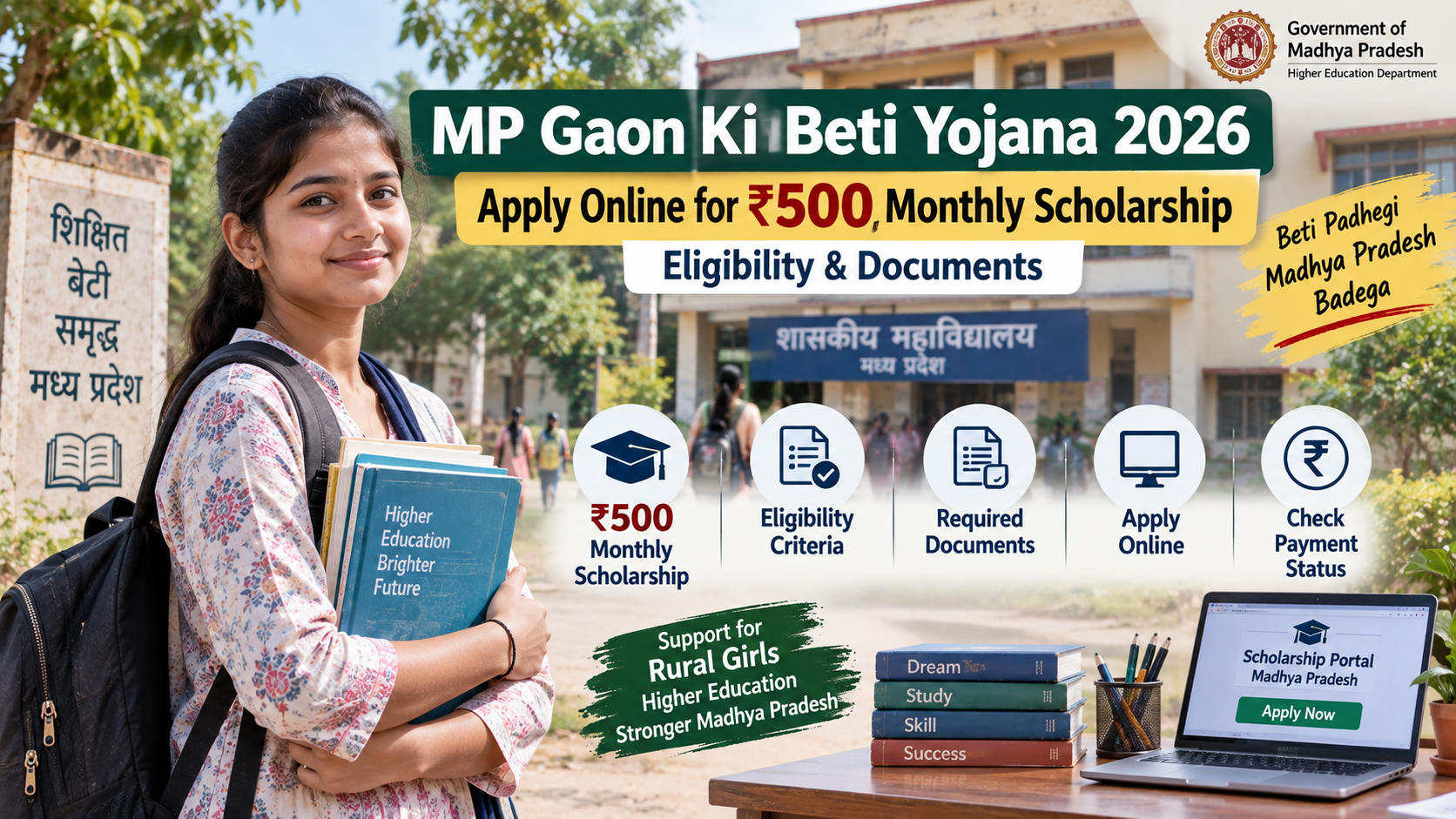
MP Gaon Ki Beti Yojana 2026 : for a student from a rural family, the transition from Class 12 to college can involve expenses that are modest individually but significant when added together: travel, books, examination costs, stationery and other educational needs. Madhya Pradesh’s Gaon Ki Beti Yojana is designed around this transition, offering financial assistance to eligible rural girl students pursuing higher education.
The scheme is administered under the Higher Education Department, Government of Madhya Pradesh. According to the state’s official scheme information, the programme began on July 1, 2005. The stated eligibility includes rural residence, at least 60% marks in Class 12 and the required Gaon Ki Beti certification.
For the standard category described by the state, the assistance is ₹500 per month for up to 10 months, or ₹5,000 in a year. The same official record separately mentions ₹750 per month for 10 months, or ₹7,500 annually, for eligible engineering and medical students.The important point is that this is a conditional scholarship, not an unconditional ₹500 monthly payment to every girl in Madhya Pradesh. Eligibility, rural status, academic performance, enrolment and institutional verification all matter.
What is Gaon Ki Beti Yojana?
Gaon Ki Beti Yojana is a Madhya Pradesh government scholarship intended to encourage academically performing girls from rural areas to continue into higher education. The official scheme record places it under the Higher Education Department and describes the benefit as an incentive for eligible girl students.The policy logic is straightforward. A student may qualify academically for college but still face financial barriers associated with continuing education. A relatively small recurring scholarship can help meet some of these costs.
The scheme also has a broader social purpose. Supporting rural girls after Class 12 is not only about providing cash assistance. It is about reducing the financial friction between school completion and undergraduate education.The Madhya Pradesh Economic Survey has previously described the objective as encouraging talented girls in rural areas to pursue higher education. It reported that 23,269 girl students benefited from the scheme in 2022–23, while noting the ₹500-per-month assistance for a maximum of 10 months for undergraduate study.
Gaon Ki Beti Yojana 2026: What is the scholarship amount?
The standard benefit is ₹500 per month for 10 months, resulting in ₹5,000 for the year.
| Particular | Details |
|---|---|
| Scheme | Gaon Ki Beti Yojana |
| State | Madhya Pradesh |
| Department | Higher Education Department |
| Minimum Class 12 marks | 60% |
| Main target group | Eligible rural girl students |
| Standard assistance | ₹500 per month |
| Duration | Up to 10 months |
| Standard annual amount | ₹5,000 |
| Engineering/medical rate recorded by state | ₹750 per month |
| Engineering/medical annual amount | ₹7,500 |
| Application fee | No fee |
| Level | Undergraduate education |
These figures come from the Madhya Pradesh government’s scheme information. The state’s record specifically states ₹5,000 or ₹7,500 as the annual assistance depending on the applicable category.
Is the ₹500 payment given for all 12 months?
No. The official scheme description specifies ₹500 per month for 10 months, rather than ₹500 for all 12 months. Therefore, the standard annual assistance works out to ₹5,000.
This distinction matters because online searches can sometimes turn a monthly amount into an implied 12-month payment. Applicants should rely on the applicable government rules rather than calculate a benefit that the scheme does not specify.
Who is eligible for Gaon Ki Beti Yojana?
The core eligibility conditions listed by the Madhya Pradesh government are:
- The applicant must be a girl student.
- She must have passed Class 12 with 60% or more marks.
- She must be a resident of a rural area.
- The required Gaon Ki Beti certificate must be available.
- She must be pursuing eligible higher education, with the scheme described for students at the undergraduate level.
- The application must go through the prescribed online and institutional verification process.
Is the scheme only for SC or ST girls?
No. The state scheme record lists General, OBC, SC and ST among the beneficiary categories. Therefore, it should not be treated as a scholarship restricted to one caste category.The decisive question is whether the applicant satisfies the scheme’s other conditions, particularly the academic and rural-residence requirements.
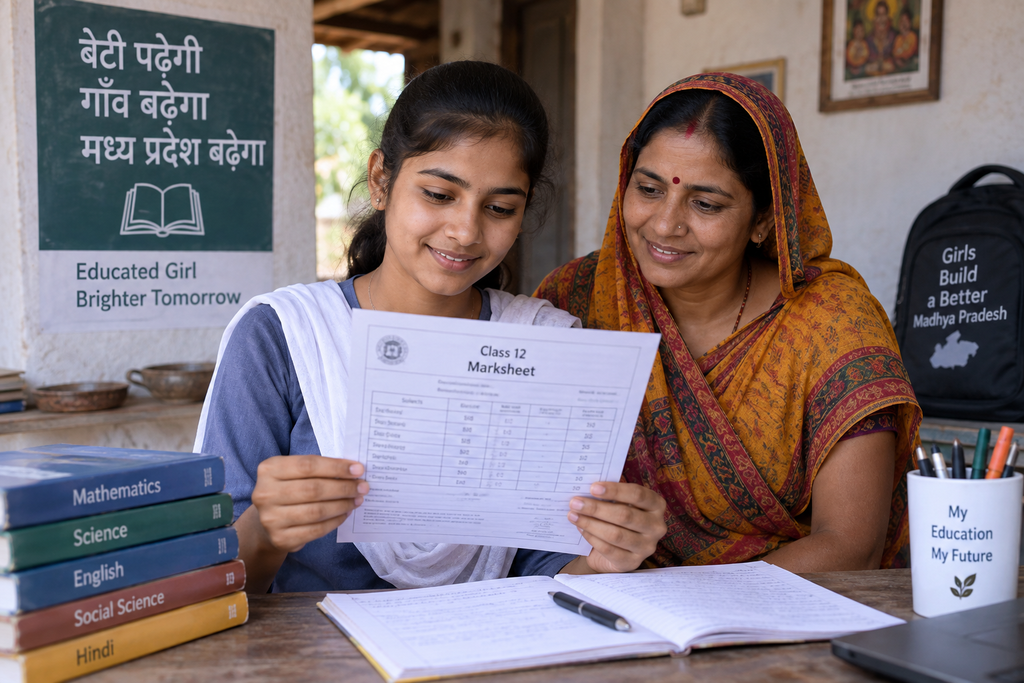
Is the Gaon Ki Beti certificate important?
Yes. The certificate is particularly important because rural residence is central to the scheme.The Madhya Pradesh government’s description specifically refers to the applicant residing in a rural area and having a Gaon Ki Beti certificate.
This is one reason applicants should not assume that simply scoring 60% or more in Class 12 automatically guarantees the scholarship.A student who has the required marks but does not satisfy the rural-residence and certification requirements may not qualify.
How to apply online for Gaon Ki Beti Yojana 2026?
The official scheme record describes an online process through the Madhya Pradesh scholarship portal. According to that record, students from the General, OBC, SC and ST categories first register on the portal and then use their registration ID to log in and apply for the scheme.
The broad process is:
Step 1: Complete registration
Register on the designated Madhya Pradesh scholarship portal using the required student information.
Step 2: Log in with the registration credentials
After registration, use the generated registration ID or applicable credentials to access the scholarship application.
Step 3: Select Gaon Ki Beti Yojana
Choose the appropriate scheme from the available scholarship options and enter the required academic, residential and college details.
Step 4: Upload or provide the required information
The official record refers to the current college code, branch code, photograph and other relevant documents as part of the application requirements.
Step 5: Submit the application
Review the information carefully before final submission. Errors in marks, college details, course information or identification details can create verification problems.
Step 6: College-level verification
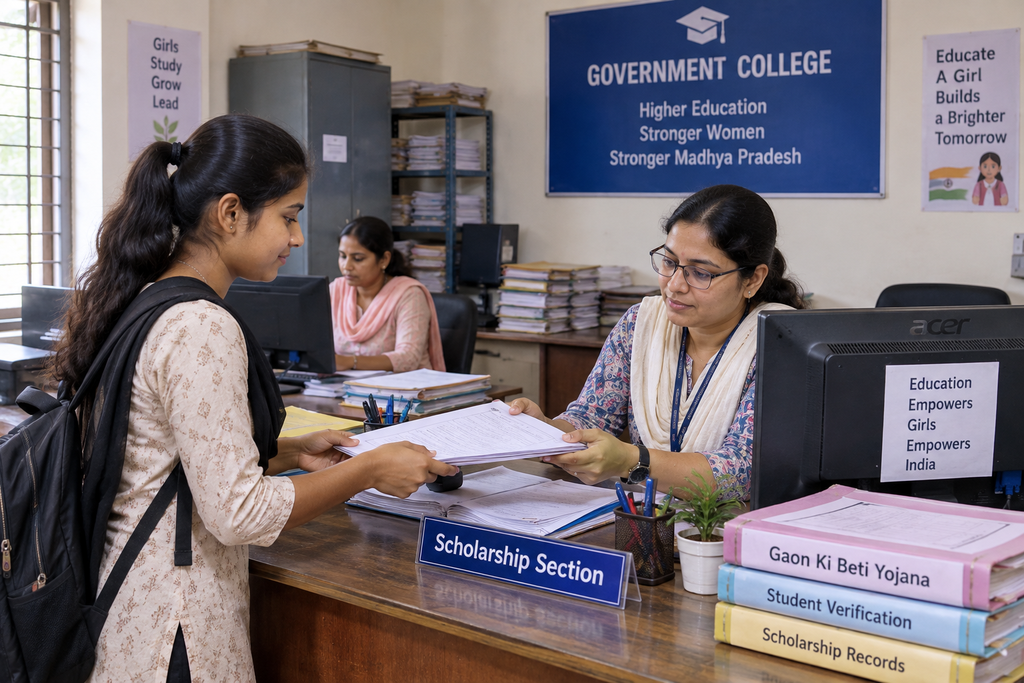
The application is not simply paid immediately after online submission. The official scheme description says the concerned college examines the documents and sends eligible applications forward to the lead college for sanction.
What documents may be required?
Applicants should keep their educational and identification records ready before starting the application.
- Class 12 marksheet
- Photograph
- Gaon Ki Beti certificate
- College admission/enrolment information
- Current college code
- Branch/course code
- Applicable caste/category documents, where required
- Bank account details
- Other documents requested by the scholarship portal or college
The official scheme record specifically mentions the current college code, branch code, photograph and other relevant documents.
How is the scholarship paid?
The payment process involves institutional verification rather than simply relying on the student’s self-declaration.
The official Madhya Pradesh record says that after the student applies through the portal, the concerned college verifies the documents and proposes the application to the lead college for sanction, after which the scholarship is processed through the relevant government college/nodal mechanism.
This means that “application submitted” and “scholarship paid” are two different stages.
Students should therefore retain their application details and check with their college scholarship/nodal office if the application remains pending.
What is the difference between Gaon Ki Beti and Pratibha Kiran?
The two schemes are easy to confuse because both are aimed at supporting girls pursuing higher education.The distinction is primarily geographical and eligibility-based.
Gaon Ki Beti is designed for eligible girls from rural areas, while Pratibha Kiran is intended for eligible girls from urban families living below the poverty line who meet the academic requirement.
The state’s scheme information describes Pratibha Kiran as a ₹500-per-month benefit for 10 months, or ₹5,000 annually, for eligible urban girls.
This distinction is practically important: a student should not choose a scheme simply because its scholarship amount looks similar. The applicant’s residence and other eligibility conditions determine which programme is relevant.
Competitive Advantage: What the ₹500 scholarship really means
The ₹5,000 annual amount should be understood in context.It is unlikely to cover the entire cost of undergraduate education. College fees, transport, books, accommodation and living expenses can be substantially higher. The scheme is therefore better understood as targeted educational assistance rather than full financial support.
That limitation does not make the scheme insignificant.For a rural student, a ₹5,000 annual contribution can help with recurring academic expenses. More importantly, the policy targets a specific transition point: the move from secondary education into higher education.The broader question is whether the amount remains sufficient as educational and household costs change. A scholarship that was meaningful when introduced may have a different real-world value years later. This makes periodic review of benefit levels an important policy consideration.
The available government evidence nevertheless indicates that the programme has been used at meaningful scale. The Madhya Pradesh Economic Survey recorded 23,269 beneficiaries in 2022–23.
Also Read:
- PM Har Ghar Jal Yojana 2026: Jal Jeevan Mission Online Apply, List, Status and Latest Updates
- FASTag KYV 2026: New Rules, KYV Update, Online Process and How to Get the FASTag Annual Pass
What students should verify before applying
A careful applicant should check five things before assuming eligibility:
First, marks: Is the Class 12 score at least 60%?
Second, residence: Does the student meet the rural-residence requirement and have the necessary certificate?
Third, course: Is the student enrolled in an eligible undergraduate programme?
Fourth, college information: Are the college and branch/course details entered correctly?
Fifth, verification: Has the college actually verified and forwarded the application?
These checks are more useful than relying on social-media posts promising an automatic ₹500 payment.
What the evidence suggests
The available official evidence supports three conclusions.
First, Gaon Ki Beti is an established Madhya Pradesh state scheme, rather than a newly announced scholarship created for 2026. The government records its commencement as July 1, 2005.
Second, the ₹500 figure is genuine within the standard benefit structure, but it is ₹500 per month for up to 10 months, not ₹500 every month indefinitely.
Third, eligibility depends on more than marks. Rural residence, certification, higher-education enrolment and institutional verification are all important parts of the process.
FAQ Section
Is Gaon Ki Beti Yojana available in 2026?
The scheme remains listed in Madhya Pradesh government scheme information under the Higher Education Department. The official record identifies it as a state-sponsored scheme that began in 2005. Current applicants should nevertheless verify the active application window and instructions on the official scholarship system and through their college.
How much money is given under Gaon Ki Beti Yojana?
The standard benefit recorded by the Madhya Pradesh government is ₹500 per month for 10 months, making the annual assistance ₹5,000. The same official record separately mentions ₹750 per month for 10 months for eligible engineering and medical students.
Who can apply for Gaon Ki Beti Scholarship?
The scheme is intended for eligible rural girl students. The official eligibility information specifies at least 60% marks in Class 12 and rural residence with the required Gaon Ki Beti certificate. General, OBC, SC and ST students are listed among the beneficiary categories.
Is Gaon Ki Beti only for BPL families?
The current official scheme description available through the Madhya Pradesh CM Helpline emphasises rural residence, 60% or more in Class 12 and the required certificate. It does not present the standard eligibility statement in the same way as an urban BPL-specific scheme. Applicants should therefore follow the current official eligibility fields rather than assume a separate income condition without verification.
Can an engineering or medical student receive more than ₹500 per month?
The Madhya Pradesh government’s scheme record specifically states that eligible engineering and medical students receive ₹750 per month for 10 months, or ₹7,500 annually. The applicable eligibility and course conditions should be verified before relying on the higher amount.
Is there any application fee?
The official scheme information states that the application is free of charge. Students should be cautious if anyone demands a separate payment merely to submit the scholarship application.
Does applying online guarantee payment?
No. Online submission is only one stage. The official process describes document verification by the concerned college and subsequent processing through the designated lead/nodal college mechanism. Therefore, an application should not be considered equivalent to an approved or paid scholarship until the verification and sanction stages are completed.
What should I do if my application is pending?
First, check the application information and status available through the relevant scholarship system. If the application is awaiting institutional verification, contact the scholarship/nodal officer at your college. Keep the application or registration details and copies of submitted documents available so that discrepancies can be resolved efficiently.
Conclusion
Gaon Ki Beti Yojana is best understood not as a blanket ₹500 monthly payment, but as a targeted higher-education incentive for eligible rural girls in Madhya Pradesh. Its value lies in helping students cross the difficult financial transition from Class 12 to undergraduate education. For applicants in 2026, the safest approach is to verify eligibility, certification, college details and institutional approval rather than relying on headline claims about the scholarship amount.