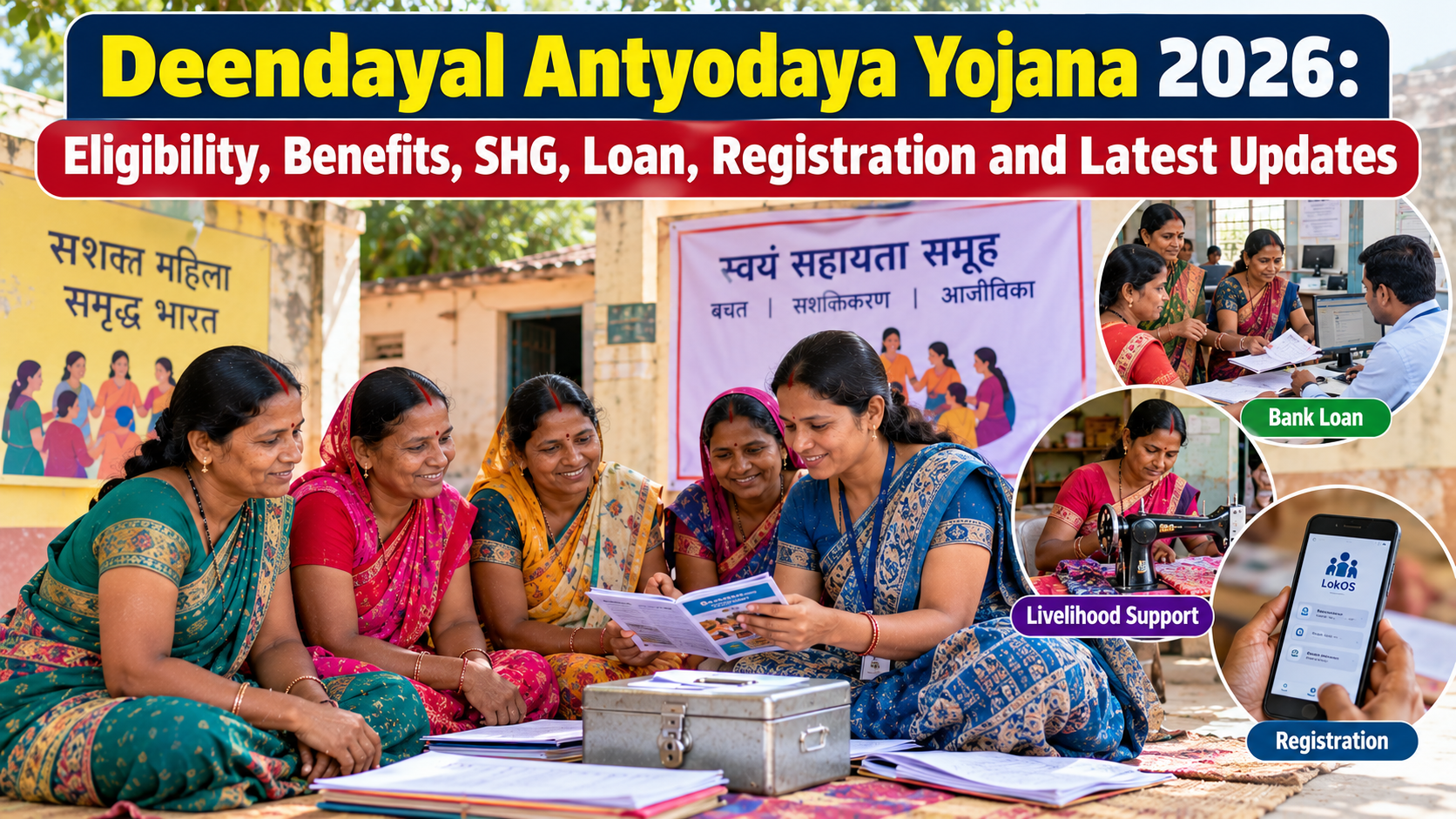
Deendayal Antyodaya Yojana 2026: Deendayal Antyodaya Yojana is a major government programme aimed at reducing poverty by helping rural poor households build sustainable livelihoods. Its rural component, Deendayal Antyodaya Yojana–National Rural Livelihoods Mission (DAY-NRLM), is implemented by the Ministry of Rural Development in partnership with State Rural Livelihood Missions.
Rather than functioning as a single cash-transfer scheme, DAY-NRLM works through Self-Help Groups (SHGs), community institutions, financial inclusion, skills, livelihood activities and access to formal credit. The programme gives particular importance to rural women and seeks to strengthen their ability to save, borrow, start enterprises and increase household income.
As of August 12, 2026, government data shows that 10.19 crore households had been mobilised into 94.46 lakh SHGs under DAY-NRLM. The same official factsheet reported 3.46 crore Lakhpati Didis as of July 29, 2026.
What is Deendayal Antyodaya Yojana?
Deendayal Antyodaya Yojana is the broader name associated with government livelihood initiatives for poor households, with DAY-NRLM being the current rural livelihood mission.DAY-NRLM was launched in June 2011 and has developed a large community-based network of SHGs and their federations. Its approach is based on organising rural poor households into institutions that can collectively access savings, credit, training, livelihood opportunities and government services.
The programme has four broad areas of work: social mobilisation and institution building, financial inclusion, sustainable livelihoods, and social development and convergence.This distinction is important because someone searching for “Deendayal Antyodaya Yojana online apply” may expect a single form and a fixed individual payment. DAY-NRLM generally does not operate in that manner. Implementation takes place through State Rural Livelihood Missions and community institutions.
Deendayal Antyodaya Yojana 2026: Key Information
| Detail | Information |
|---|---|
| Scheme/Programme | Deendayal Antyodaya Yojana – National Rural Livelihoods Mission |
| Short Name | DAY-NRLM |
| Ministry | Ministry of Rural Development |
| Level | Central Government |
| Main Target Group | Rural poor households |
| Primary Institutional Platform | Self-Help Groups (SHGs) |
| Major Focus | Livelihoods, financial inclusion and poverty reduction |
| Major Beneficiaries | Rural women and poor households |
| Key Support | SHG formation, capacity building, funds, bank linkage and livelihood support |
| Revolving Fund | ₹20,000–₹30,000 per eligible SHG |
| Community Investment Fund | Up to ₹2.50 lakh per SHG under existing provisions |
| Loan Support | Bank credit and interest-subvention support for eligible SHGs |
| Implementation | Ministry of Rural Development with State Rural Livelihood Missions |
| Official Website | aajeevika.gov.in |
Who Can Benefit From DAY-NRLM?
DAY-NRLM is primarily intended for poor rural households identified through the mission’s prescribed processes. The programme does not simply use one universal income ceiling to determine every beneficiary.
The official DAY-NRLM framework describes a Participatory Identification of Poor (PIP) process. Households identified as poor through this process, including eligible households identified through the relevant deprivation and automatic-inclusion criteria, are placed before the Gram Sabha for validation and subsequently approved through the prescribed local process.
The mission aims to bring at least one adult woman from each identified rural poor household into an SHG within the programme’s social mobilisation framework. Special attention is also given to particularly vulnerable groups.
What Are the Benefits of Deendayal Antyodaya Yojana?
The benefits under DAY-NRLM are mainly institutional and livelihood-oriented rather than a fixed monthly payment.
Self-Help Group Formation
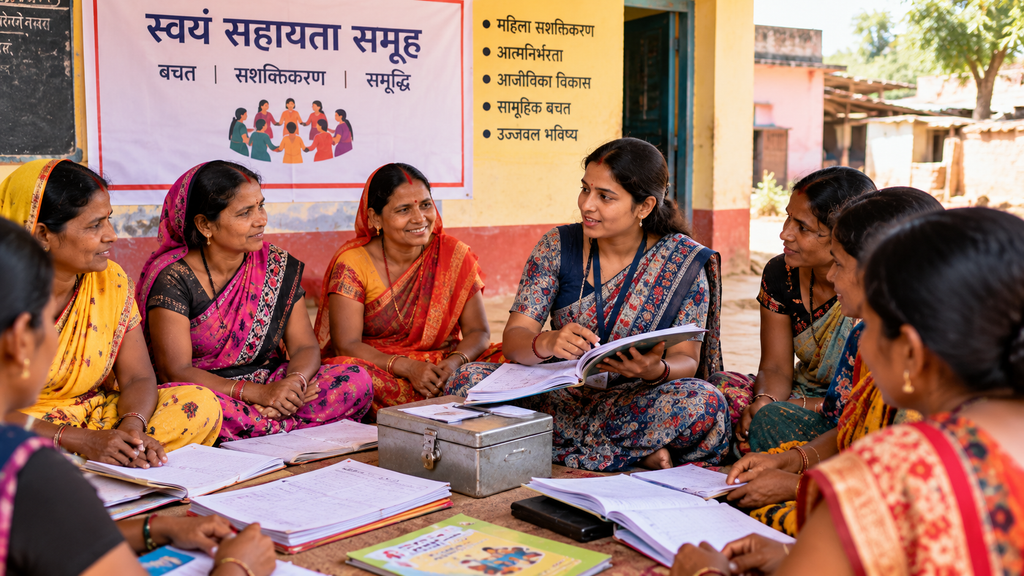
The Self-Help Group is the basic community institution through which much of DAY-NRLM operates. Women from rural households come together, save regularly, maintain records and gradually build a financial history.
The SHG structure creates a platform through which members can access bank credit, training, livelihood services and other government programmes.The scale of this network is significant. By August 2026, more than 94 lakh SHGs had been reported under DAY-NRLM.
Revolving Fund Support
Eligible SHGs can receive a Revolving Fund to strengthen their internal financial base.Current government information places the Revolving Fund support at ₹20,000 to ₹30,000 per eligible SHG. The money is intended to strengthen the group’s corpus and facilitate internal lending and other approved financial activities.
It is important to understand that this amount is not a ₹20,000–₹30,000 personal cash grant to each woman. It is support provided to an eligible SHG.
Community Investment Fund
The Community Investment Fund, or CIF, is another important part of DAY-NRLM’s financial architecture.Under the existing provisions cited by the government, eligible SHGs can receive CIF support of up to ₹2.50 lakh per SHG for livelihood and income-generating activities, including entrepreneurial ventures.
The fund is intended to strengthen community institutions and support members’ livelihood plans rather than function as an unrestricted personal payment.
Access to Bank Credit
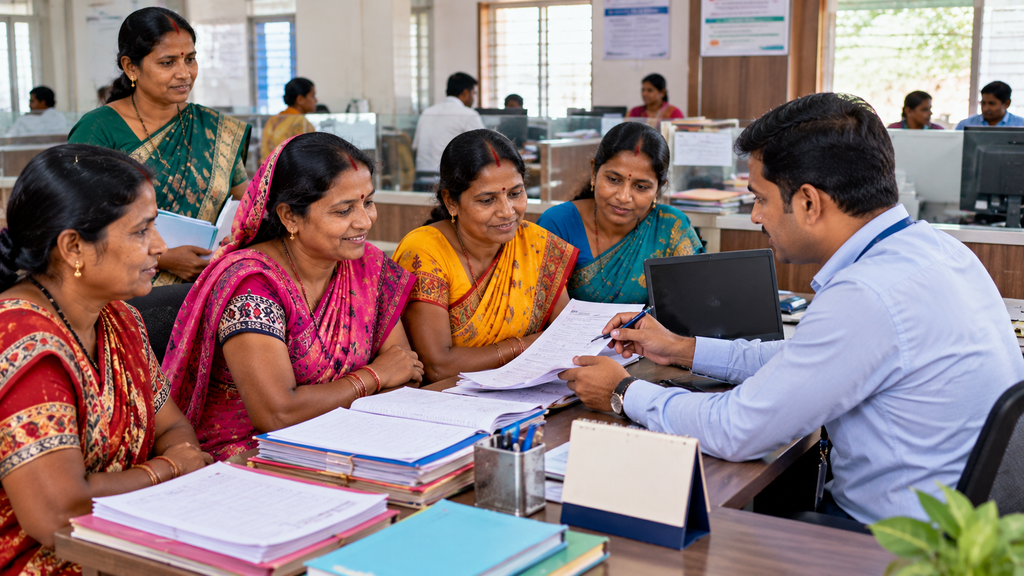
DAY-NRLM also works closely with banks to improve access to formal credit.As of 2026, the government reported cumulative SHG loan disbursement of more than ₹13 lakh crore, showing the scale at which SHG-bank linkage has developed. A July 2026 government response reported cumulative disbursement of ₹13.41 lakh crore.
For eligible SHGs, loans up to ₹3 lakh are available under the stated interest-subvention framework at a concessional 7% annual interest rate. For loans above ₹3 lakh and up to ₹5 lakh, the applicable rate is linked to the bank’s one-year MCLR or another prescribed external benchmark, subject to the stated ceiling.
Deendayal Antyodaya Yojana and Lakhpati Didi
The Lakhpati Didi initiative is closely linked with DAY-NRLM. Its objective is to enable women in SHGs to achieve sustainable annual household income of at least ₹1 lakh through agriculture, allied activities, enterprises and other livelihood opportunities.
Government data reported 3.46 crore Lakhpati Didis as of July 29, 2026.The significance of this approach is that the focus is not simply on providing a one-time financial benefit. The larger objective is to help women build recurring income sources.
That can include agriculture-based activities, livestock, food processing, handicrafts, retail, services and non-farm enterprises, depending on the local economy and available support.
DAY-NRLM and Rural Entrepreneurship
Entrepreneurship has become an increasingly important part of the mission.The Start-up Village Entrepreneurship Programme (SVEP) operates as a sub-scheme under DAY-NRLM and supports SHG members and their family members in establishing small non-farm enterprises. It combines financial assistance with training, business development services and handholding.
By June 2026, SVEP had supported more than 4.32 lakh rural enterprises, according to government information.
In August 2026, the Ministry of Rural Development also launched the second phase of its National Campaign on Entrepreneurship, running from 21 August to 21 November 2026, with an expanded focus on farm and non-farm enterprises and marketing of SHG products.

Skill Development Under DAY-NRLM
Livelihood support is not limited to credit.DAY-NRLM also works with programmes such as Deen Dayal Upadhyaya Grameen Kaushalya Yojana (DDU-GKY) and Rural Self Employment Training Institutes for skill development and employment-related opportunities for rural youth.
Government data released in 2026 reported that DDU-GKY had trained 18.45 lakh rural youth and facilitated placement of 12.35 lakh candidates since its inception, as of August 11, 2026.This makes the wider DAY-NRLM ecosystem relevant not only to existing SHG members but also to rural families looking for employment and enterprise opportunities.
How to Apply for Deendayal Antyodaya Yojana 2026?
There is an important point to understand before searching for an online application form: DAY-NRLM does not work like a standard individual cash-benefit scheme with one universal central application form.The mission is implemented through State Rural Livelihood Missions and local community institutions. Rural households identified under the programme are mobilised into SHGs, while existing SHGs can receive support according to the relevant guidelines and performance criteria.
A person interested in joining the programme should therefore first approach the relevant State Rural Livelihood Mission, local SHG/community institution or the designated rural livelihood functionaries in their area.The exact process can differ from one state to another because states implement DAY-NRLM through their own rural livelihood structures.
General Process
The broad process generally involves:
- Identification of eligible rural poor households through the prescribed state and community process.
- Mobilisation of at least one eligible adult woman from the household into an SHG.
- Formation or joining of a functioning SHG.
- Regular savings, meetings and proper record keeping.
- Capacity building and livelihood planning.
- Access to Revolving Fund/CIF where the SHG meets the applicable criteria.
- Bank linkage for eligible credit requirements.
- Enterprise, agriculture or other livelihood support based on the approved activity and local implementation structure.
Applicants should not pay an intermediary simply because someone claims to provide a guaranteed DAY-NRLM registration.
Is There a Fixed DAY-NRLM Cash Payment?
No. DAY-NRLM should not be described as a universal fixed cash-transfer scheme.Its financial support is mainly channelled through SHGs and community institutions in the form of capitalization support, credit linkage and livelihood-related assistance. The amount and type of support depend on the nature of the intervention and applicable guidelines.
DAY-NRLM Digital Updates in 2026
Digital systems are increasingly becoming part of the mission’s implementation.The LokOS platform has been developed as a digital backbone for SHGs and community-based organisations. It supports digital records relating to members, savings, lending, repayments, financial transactions and livelihood activities.
In 2026, the government also operationalised SHE-LEAPS, a digital platform for capturing information about enterprises promoted under the DAY-NRLM ecosystem. The platform is being implemented through State Rural Livelihood Missions and is designed to improve enterprise monitoring and planning.This shift matters because better digital records can improve monitoring, financial management and visibility of SHG enterprises.

Deendayal Antyodaya Yojana vs DAY-NULM
The names can create confusion because both rural and urban livelihood programmes have historically used the Deendayal Antyodaya Yojana name.
DAY-NRLM is the rural livelihood mission under the Ministry of Rural Development and continues to operate in 2026.
DAY-NULM, the National Urban Livelihoods Mission under the Ministry of Housing and Urban Affairs, was the urban counterpart. However, the government stated in January 2026 that the implementation period of DAY-NULM ended on 30 September 2024.
Therefore, current 2026 searches should not treat DAY-NULM as an ongoing scheme in the same way as DAY-NRLM.For urban street vendors, the government currently points to other programmes such as PM SVANidhi, which was restructured in 2025.
Read Also:
- Ladli Behna Yojana Payment Status 2026: 40th Kisht Credited, 41st Installment Date & Latest Update
- Namo Shetkari Mahasanman Nidhi Yojana 2026: Eligibility, Benefits, Installment, Registration and Payment Status
What the Evidence Suggests
The scale of DAY-NRLM in 2026 shows that the programme has evolved beyond conventional welfare delivery.The mission has created a large network of women-led community institutions and is increasingly linking those institutions with formal credit, entrepreneurship, digital systems and markets. Government figures from August 2026 place the network at 10.19 crore households and 94.46 lakh SHGs.
An evaluation commissioned through NITI Aayog and reported by the government in August 2026 found positive outcomes relating to women’s empowerment, confidence and financial access. The reported evaluation covered 2,206 rural households across 11 states and two Union Territories.
The wider lesson is that access to credit alone does not automatically create a sustainable livelihood. The strength of the DAY-NRLM model lies in combining group institutions, financial access, skills, livelihood planning and continued community support.
What This Means for Rural Families
For a rural household, the practical value of DAY-NRLM is not necessarily a single payment received after submitting an online form.Its value lies in the institutional pathway.
A woman can become part of an SHG, build savings, develop financial discipline, access training, seek bank credit and participate in a livelihood activity. Over time, the group can also connect with markets, government schemes and enterprise-support programmes.
This model is particularly relevant in areas where individual access to formal finance, markets or business knowledge is limited.At the same time, joining an SHG should not be presented as an automatic guarantee of receiving a particular loan or earning a particular amount. Credit approval, fund support and livelihood outcomes depend on eligibility, group performance, implementation and the viability of the activity.
In Conclusion
Deendayal Antyodaya Yojana 2026 is best understood as a livelihood and institution-building framework, not as a simple scheme that deposits a fixed amount into every beneficiary’s bank account.
Through DAY-NRLM, rural poor households—especially women—are organised into Self-Help Groups and connected with savings, financial services, capacity building, livelihood opportunities, entrepreneurship and institutional credit. Current government data shows the programme operating at a very large scale, with more than 10 crore rural households mobilised into SHGs.
For anyone looking to access its benefits, the most important first step is to identify the relevant State Rural Livelihood Mission or local SHG network rather than searching for an unofficial “direct payment” registration form. The programme’s real strength lies in creating a continuing pathway from community organisation to finance, enterprise and sustainable income.
FAQ Section
What is Deendayal Antyodaya Yojana 2026?
Deendayal Antyodaya Yojana, particularly its rural component DAY-NRLM, is a government livelihood programme focused on reducing rural poverty by organising poor households into Self-Help Groups and connecting them with financial services, skills, livelihood opportunities and institutional support
Who is eligible for Deendayal Antyodaya Yojana?
DAY-NRLM primarily targets poor rural households identified through the programme’s prescribed identification process, including Participatory Identification of Poor and related eligibility criteria.
How much money is given under DAY-NRLM?
There is no single fixed cash payment for every beneficiary. Current provisions include Revolving Fund support of ₹20,000–₹30,000 per eligible SHG and Community Investment Fund support of up to ₹2.50 lakh per SHG, along with bank-credit and interest-subvention mechanisms.
How can I apply for Deendayal Antyodaya Yojana?
DAY-NRLM does not generally use one universal central online form for individual beneficiaries. Implementation is carried out through State Rural Livelihood Missions and community institutions.
Is Lakhpati Didi part of DAY-NRLM?
Yes. The Lakhpati Didi initiative is closely associated with the DAY-NRLM ecosystem and aims to enable SHG women to achieve sustainable annual income of at least ₹1 lakh through diversified livelihood and enterprise activities. Government data reported 3.46 crore Lakhpati Didis as of July 29, 2026.
Is DAY-NULM still active in 2026?
No. The Ministry of Housing and Urban Affairs stated in January 2026 that the implementation period of DAY-NULM, the urban livelihood mission, ended on September 30, 2024. DAY-NRLM, the rural livelihood mission under the Ministry of Rural Development, continues to operate in 2026.

One Comment