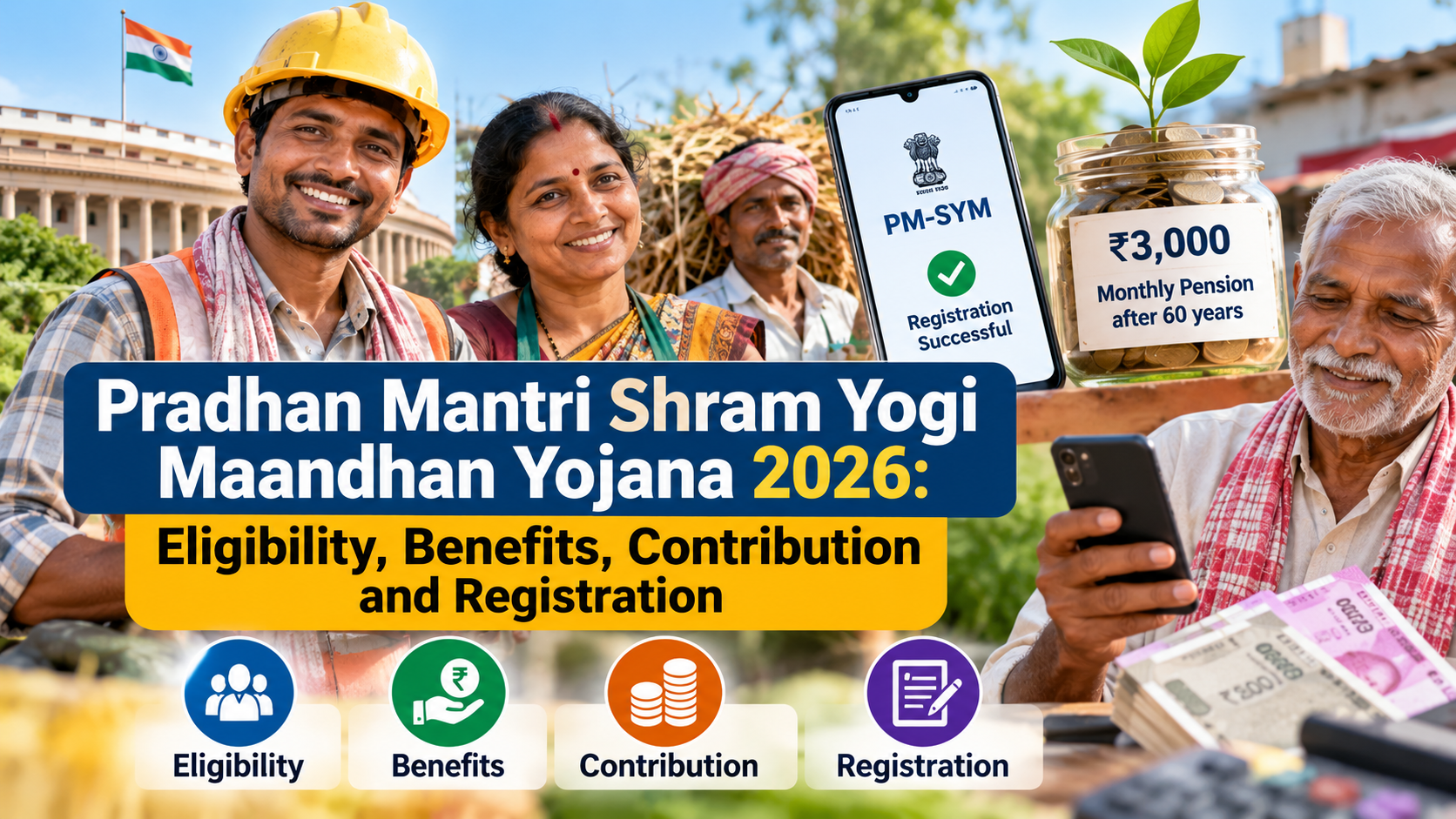
Pradhan Mantri Shram Yogi Maandhan Yojana 2026: India’s large unorganised workforce often has income but no formal employer-sponsored retirement arrangement. For workers whose earnings are irregular and who are outside statutory social-security systems, building a dependable source of income for old age can be difficult. Pradhan Mantri Shram Yogi Maandhan Yojana (PM-SYM) was introduced to address this gap through a voluntary, contributory pension arrangement for eligible unorganised workers.
Under PM-SYM, an eligible subscriber contributes a prescribed amount based on their age when they enter the scheme. The Central Government makes an equal matching contribution. After the subscriber reaches 60 years of age and meets the contribution requirements, the scheme provides a minimum assured pension of ₹3,000 per month. If the subscriber dies after pension has started, the spouse is entitled to 50% of the pension as family pension.
The scheme is therefore different from a conventional welfare payment where the beneficiary receives money without making contributions. PM-SYM combines worker contributions with government matching support and is specifically designed around old-age income protection for eligible workers in the unorganised sector.
What Is Pradhan Mantri Shram Yogi Maandhan Yojana?
Pradhan Mantri Shram Yogi Maandhan Yojana is a Government of India pension scheme for eligible unorganised workers. It is administered under the Ministry of Labour and Employment and operates as a voluntary and contributory social-security scheme.
The scheme covers workers such as street vendors, domestic workers, agricultural workers, construction workers, rickshaw pullers, landless labourers and other workers whose employment is generally outside formal social-security arrangements. The official PM-SYM FAQ specifies an entry age of 18 to 40 years and monthly income of ₹15,000 or less for eligibility.
A central feature is the matching contribution. The worker contributes according to the age at which they join, while the Central Government contributes an equal amount. The worker continues contributing until the age of 60.
PM-SYM Pension Amount in 2026
The most important benefit of PM-SYM is the minimum assured pension of ₹3,000 per month after the subscriber attains 60 years of age.This amount should not be confused with a pension that starts immediately after registration. A person joining the scheme at 18, for example, has a much longer contribution period than someone joining at 40. In both cases, the pension becomes payable after the subscriber reaches 60, subject to the applicable scheme conditions.
The Ministry’s FAQ also states that there is currently no provision under the scheme for automatically increasing the ₹3,000 pension because of inflation; any future enhancement would depend on future circumstances and policy decisions.
Who Can Apply for PM-SYM 2026?
An applicant generally needs to satisfy all the major eligibility conditions below:
- The applicant must be an unorganised worker.
- The entry age must be 18 to 40 years.
- Monthly income must be ₹15,000 or less.
- The applicant should not be an income-tax payer.
- The worker should not be covered by specified statutory social-security schemes such as EPFO or ESIC.
- The worker should not be a member of the applicable excluded pension arrangements specified under PM-SYM.
The official FAQ gives examples of eligible occupational groups including home-based workers, street vendors, domestic workers, agricultural workers, construction workers, rickshaw pullers, brick-kiln workers, cobblers, rag pickers, handloom workers and similar unorganised workers.
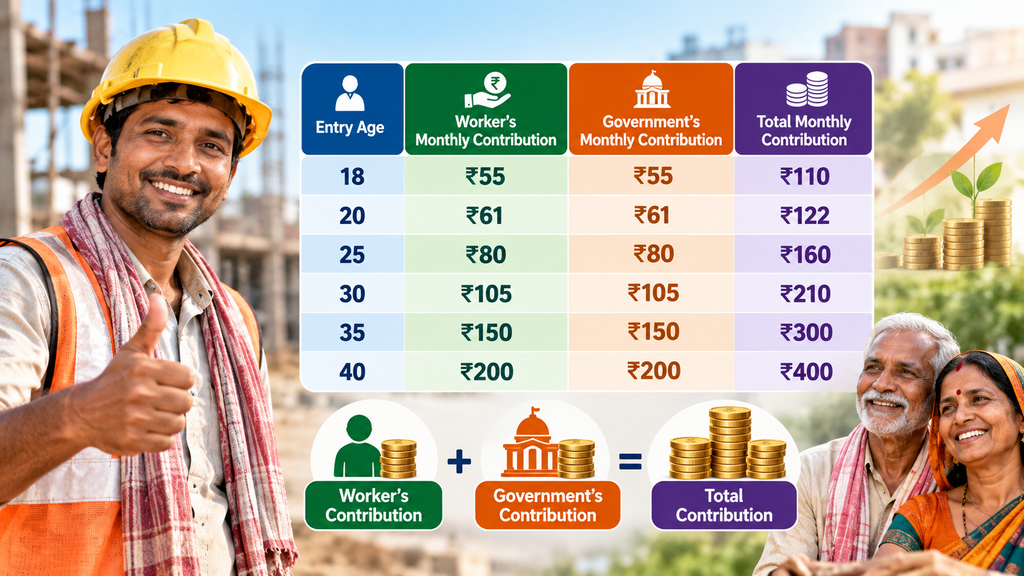
PM-SYM Contribution Chart
The amount a worker pays every month depends on the age at which the worker joins. The Central Government contributes the same amount.
| Entry Age | Worker Contribution | Government Contribution | Total Monthly Contribution |
|---|---|---|---|
| 18 | ₹55 | ₹55 | ₹110 |
| 20 | ₹61 | ₹61 | ₹122 |
| 25 | ₹80 | ₹80 | ₹160 |
| 30 | ₹105 | ₹105 | ₹210 |
| 35 | ₹150 | ₹150 | ₹300 |
| 40 | ₹200 | ₹200 | ₹400 |
The complete official contribution schedule runs from ₹55 per month at age 18 to ₹200 per month at age 40. The government’s contribution is equal to the subscriber’s contribution.
For example, a person joining at age 18 contributes ₹55 per month, while the Central Government contributes another ₹55. At age 30, the subscriber’s monthly contribution is ₹105 and the government contributes ₹105. The fixed contribution is therefore linked to the subscriber’s entry age rather than being chosen freely by the member.
How Does the Government Contribution Work?
PM-SYM follows a 1:1 matching contribution model. This means that for every eligible subscriber contribution, the Central Government contributes an equal amount under the scheme.
This is an important distinction when understanding the actual structure of the pension scheme. The worker does not finance the entire contribution alone, but the government contribution also does not mean that the worker can join without making their own prescribed payments.The subscriber’s contribution is normally collected through an auto-debit arrangement linked to the savings bank or Jan-Dhan account.
PM-SYM Benefits
₹3,000 Minimum Assured Pension
The subscriber becomes eligible for a minimum assured monthly pension of ₹3,000 after reaching 60 years, subject to the scheme’s contribution conditions.
Equal Government Contribution
The Central Government makes a matching contribution equal to the worker’s prescribed monthly contribution.
Family Pension for Spouse
If the subscriber dies while receiving the pension, the spouse is entitled to 50% of the pension as family pension. The official scheme documents specify that this family pension applies to the spouse.
Flexible Exit Provisions
PM-SYM contains provisions for exit and withdrawal in specified situations. This matters because unorganised workers can face irregular employment and income, making a rigid long-term contribution structure difficult to maintain.
No Minimum Educational Qualification
There is no minimum educational qualification prescribed for joining PM-SYM.
How to Apply for PM-SYM 2026
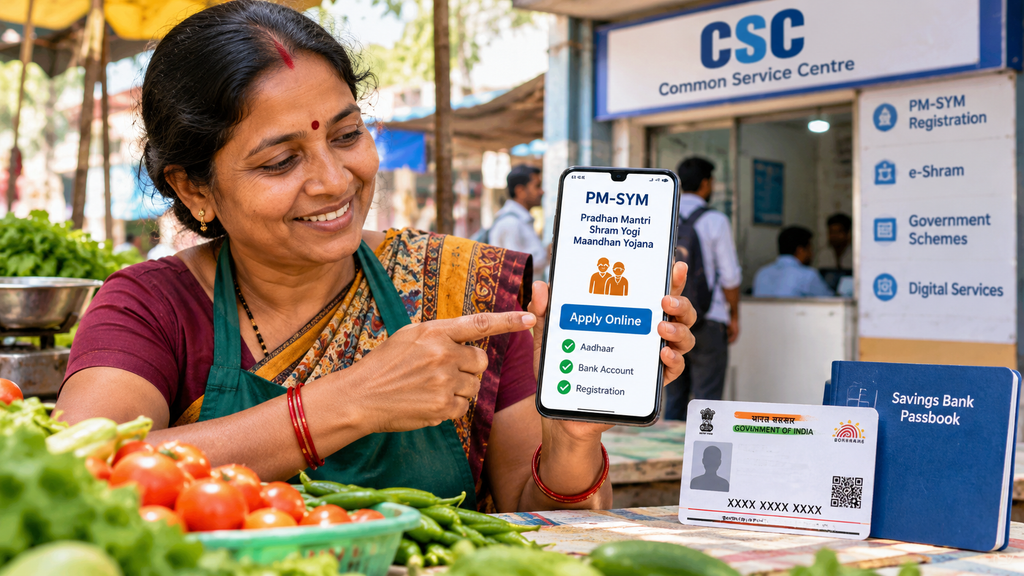
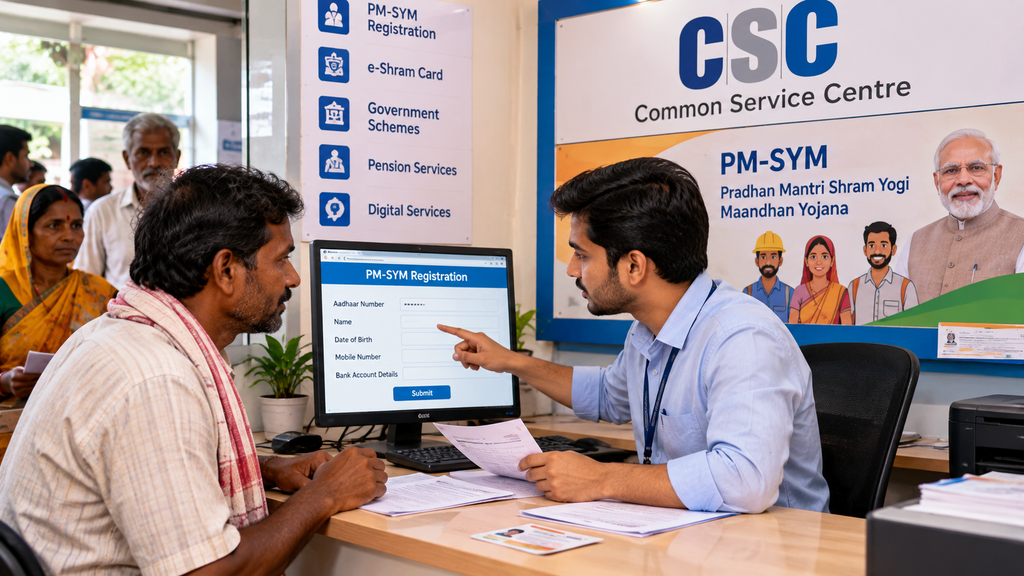
Eligible workers can enrol through a Common Service Centre (CSC). The Ministry has also provided for self-enrolment through the Maandhan portal.
The basic registration process involves providing Aadhaar details and a savings bank or Jan-Dhan account for contribution-related transactions. The official FAQ states that separate documentary proof of age or income is not required at enrolment because self-certification and Aadhaar are used as the basis for registration
Basic Registration Process
First, an eligible worker can approach the nearest CSC or use the official Maandhan portal.The worker’s Aadhaar details and linked bank information are provided for enrolment. The subscriber also gives consent for the contribution to be debited from the linked account.
The first contribution is paid through the enrolment process, while subsequent contributions can be collected through auto-debit. The Ministry states that eligible beneficiaries can enrol through CSCs and can also self-enrol through maandhan.in.
The official FAQ says that a subscriber receives an SMS after the monthly contribution is deducted, helping the member track transactions.
What Documents Are Required?
The official PM-SYM FAQ identifies the following key information/documents for enrolment:
- Aadhaar card
- Savings bank or Jan-Dhan account/passbook details
- Self-certified form
- Consent for auto-debit
The FAQ also states that a photograph is not required for registration and that separate proof of age or income is not required at enrolment under the self-certification process.Workers should nevertheless provide accurate information. False declarations can attract appropriate action under the applicable rules.
What Happens If a Worker Stops Paying?
A missed contribution does not necessarily mean that the subscriber immediately loses all access to the scheme. The official FAQ provides for regularisation of outstanding contributions, with applicable penalty charges where prescribed.This is particularly relevant for unorganised workers because monthly income can fluctuate. A worker should not simply assume that an inactive contribution account has automatically closed; the applicable revival or regularisation procedure should be checked.
The Ministry’s 2024-25 annual report also records that modules relating to voluntary exit, involuntary exit, claim status, account statements and revival have been introduced in PM-SYM.
What Happens If the Subscriber Moves to the Organised Sector?
PM-SYM is designed for eligible unorganised workers, but employment circumstances can change.The official FAQ states that if a subscriber moves into the organised sector and becomes covered by EPFO, the government contribution can stop. Under the applicable provisions, the subscriber may continue by paying the required additional amount representing the government share, or may exit according to the scheme rules.This makes it important for subscribers to understand that changing employment status can affect the contribution structure.
If the Subscriber Dies Before Reaching 60, What Happens?
The scheme contains a specific provision for death before the pension begins.If a subscriber has made regular contributions and dies before 60, the spouse may either continue the scheme by paying the required contributions for the remaining period or exit according to the applicable withdrawal provisions.This provision gives the spouse a defined route instead of treating the subscriber’s death simply as the end of the account.
PM-SYM and e-Shram
PM-SYM has increasingly been connected with the broader digital social-security ecosystem for unorganised workers.The Ministry’s 2024-25 annual report states that e-Shram has been developed as a “One-Stop-Solution” for access to various social-security and welfare schemes. It also records the integration of PM-SYM with e-Shram and says eligible unorganised workers can use their e-Shram Universal Account Number for easier enrolment.
As of 31 December 2024, the Ministry reported that more than 50 lakh beneficiaries had been registered under PM-SYM, including bulk-upload data covering 5.06 lakh beneficiaries.These figures provide useful context: PM-SYM is not a newly introduced 2026 scheme. The 2026 reference in searches generally refers to the scheme’s current information, eligibility and application guidance rather than a separate newly launched pension programme.
Also Read:
- Madhu Babu Pension Yojana 2026: Eligibility, Pension Amount, Application Process and Latest Details
- Kanya Sumangala Yojana 2026: Eligibility, ₹25,000 Benefit, Online Apply and Status
What the Evidence Suggests
PM-SYM addresses a specific social-security problem: many unorganised workers do not have access to the pension arrangements associated with formal employment.Its structure combines three elements — the worker’s contribution, an equal Central Government contribution and a minimum assured pension after 60. The trade-off is that the worker must satisfy the entry conditions and continue the prescribed contribution over a long period.
For someone considering enrolment, the most important questions are therefore not simply whether the pension is ₹3,000. The worker should first establish whether they meet the age, income and social-security exclusions, understand the monthly contribution associated with their entry age, and be prepared for the long contribution period until 60.The pension amount should also be understood in its proper context. A fixed ₹3,000 monthly pension has a different real value in the future than it has today, and the Ministry’s FAQ currently does not provide for an automatic inflation-linked increase.
PM-SYM 2026: Key Details at a Glance
| Particular | Details |
|---|---|
| Scheme | Pradhan Mantri Shram Yogi Maandhan |
| Short Name | PM-SYM |
| Target Group | Eligible unorganised workers |
| Entry Age | 18–40 years |
| Monthly Income Limit | ₹15,000 or less |
| Minimum Assured Pension | ₹3,000 per month |
| Pension Starts | At age 60 |
| Worker Contribution | ₹55–₹200 per month, based on entry age |
| Government Contribution | Equal matching contribution |
| Family Pension | 50% of subscriber’s pension for spouse |
| Enrolment | CSC / Maandhan portal |
| Fund Manager | LIC |
| Contribution Mode | Primarily auto-debit |
| Education Qualification | No minimum qualification |
The core details above are based on Ministry of Labour & Employment material and the official PM-SYM FAQ.
Last Thoughts
The Pradhan Mantri Shram Yogi Maandhan Yojana 2026 offers a systematized way for the eligible unorganized workers to plan for financial security in their old age. The scheme offers a minimum assured pension of ₹3,000 a month to the subscriber once he attains the age of 60 years. The subscriber has to contribute monthly starting from ₹55 and the Central Government will also contribute an equal amount.
But workers should check the eligibility conditions, contribution requirements and other rules of the scheme before enrolling. For those who meet the criteria, PM-SYM can serve as an important part of long-term retirement planning and social security.
FAQs —
What is PM-SYM 2026?
PM-SYM is a pension scheme for eligible unorganised workers. After completing the required conditions and reaching 60 years, the subscriber receives a minimum assured pension of ₹3,000 per month.
Who can join PM-SYM?
Unorganised workers aged 18 to 40 years with a monthly income of up to ₹15,000 can generally join, subject to the scheme’s other eligibility conditions.
How much does PM-SYM cost each month?
The subscriber contribution ranges from ₹55 to ₹200 per month, depending on the age at which the person joins the scheme.
How can I apply for PM-SYM?
Eligible workers can register through a Common Service Centre (CSC) or use the Maandhan portal for self-enrolment.
After the subscriber’s death What happens to the pension?
If the subscriber dies after pension starts, the spouse can receive 50% of the subscriber’s pension as family pension.