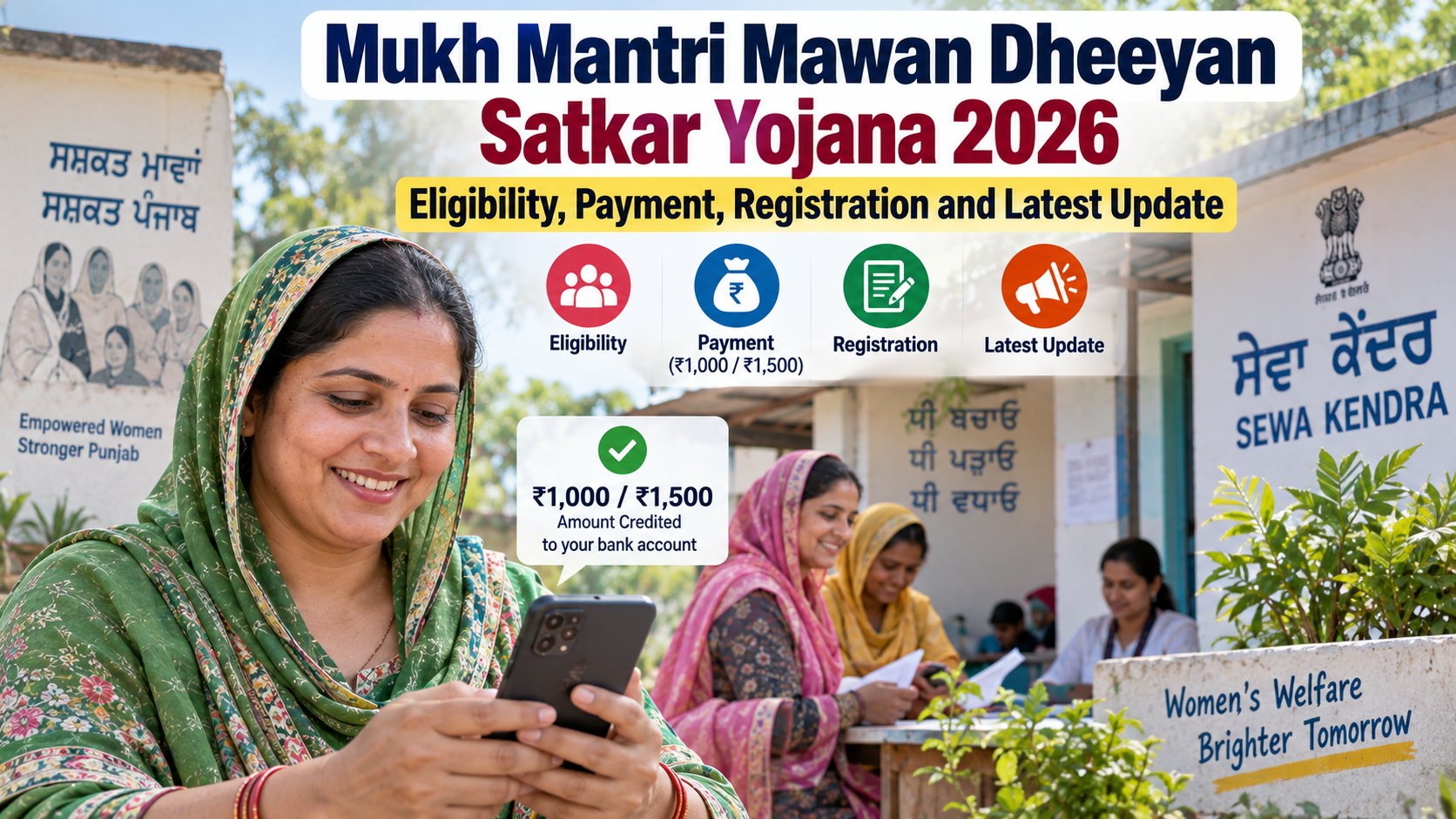
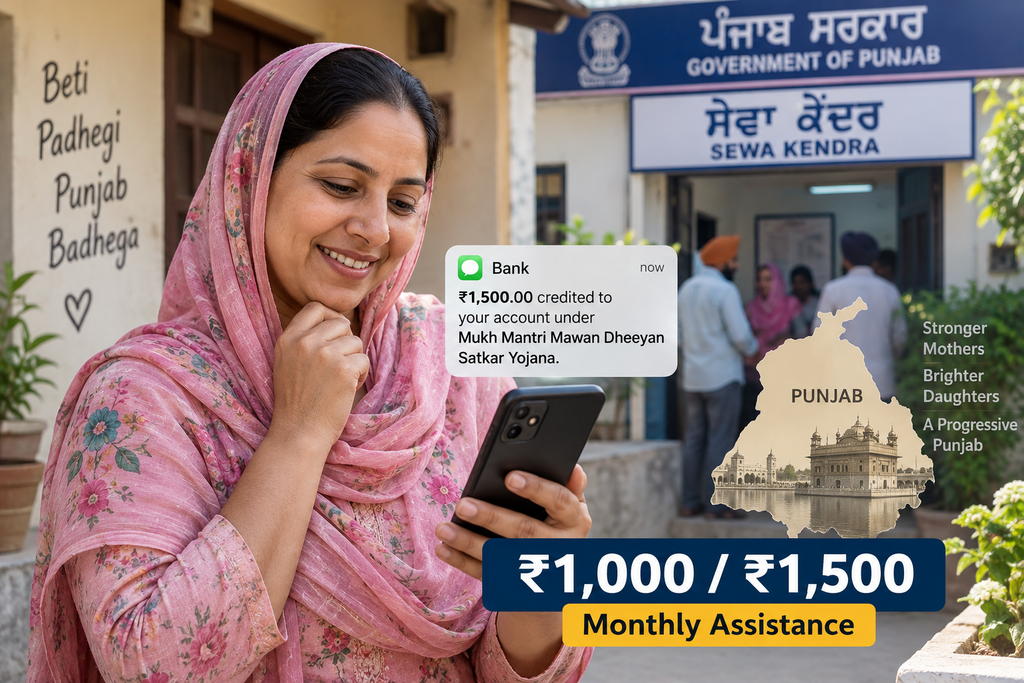
Mukh Mantri Mawan Dheeyan Satkar Yojana 2026 : The Mukh Mantri Mawan Dheeyan Satkar Yojana 2026 is Punjab’s state-level monthly financial assistance programme for eligible women. The scheme provides ₹1,000 per month to eligible women in the general category and ₹1,500 per month to eligible women belonging to the Scheduled Caste (SC) category. The programme was formally notified by the Punjab Government’s Department of Social Security, Women and Child Development in April 2026.
What is Mukh Mantri Mawan Dheeyan Satkar Yojana?
The Mukh Mantri Mawan Dheeyan Satkar Yojana is a Punjab Government welfare scheme designed to provide predictable financial assistance to eligible adult women.
Under the notified framework, the monthly assistance is:Beneficiary categoryMonthly assistanceEligible women other than SC category₹1,000Eligible SC women₹1,500
The Gazette says the scheme is intended to strengthen women’s financial security and independence, improve household welfare and consumption stability, increase women’s participation in household financial decisions, and promote gender equity and inclusive development across Punjab.This makes the scheme different from a one-time grant. Its policy logic is based on recurring assistance, although the exact frequency and schedule of disbursement are determined by the implementation framework.
| Detail | Information |
|---|---|
| Scheme Name | Mukh Mantri Mawan Dheeyan Satikar Yojana |
| Launched By | Punjab Government |
| Announced On | 8 March 2026, International Women’s Day |
| Scheme Notified | 2 April 2026 |
| First Payment Date | 1 July 2026 |
| Monthly Amount – General Category | ₹1,000 |
| Monthly Amount – SC Women | ₹1,500 |
| Women Registered | 76.11 lakh |
| Money Transferred | ₹2,381 crore to 68.06 lakh beneficiaries |
| Budget Allocation | ₹9,300 crore for 2026–27 |
| Payment Mode | Direct Benefit Transfer (DBT) |
| Registration Mode | Anganwadi Centres, Sewa Kendras and designated centres |
| Field Support | Mahila/Satkar Sakhis |
| Target Beneficiaries | Eligible women aged 18 years and above in Punjab |
| Family Restriction | No limit on the number of eligible women per family |
| Social-Security Pensioners | Eligible pensioners can also receive the benefit, subject to scheme conditions |
Mawan Dheeyan Satkar Yojana 2026 latest update
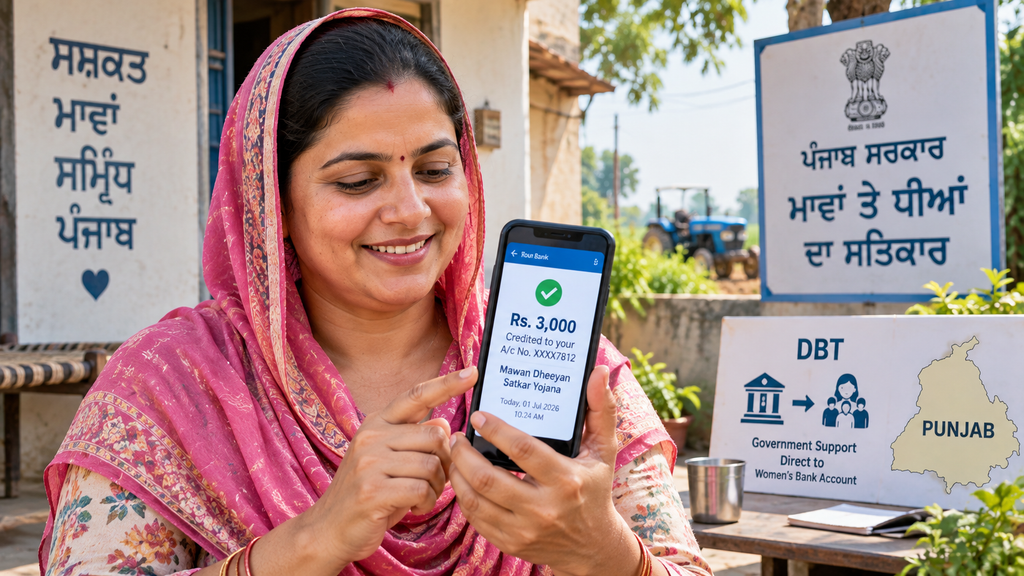
The scheme moved from notification and registration into actual payment during 2026. In July, reports said the Punjab Government had transferred around ₹1,147 crore to nearly 33 lakh women through DBT. The first payment covered three months, meaning eligible non-SC beneficiaries received ₹3,000 while eligible SC beneficiaries received ₹4,500 for that initial period.
By August 27, Punjab Chief Minister Bhagwant Mann said 76.11 lakh women had been registered, while ₹2,381 crore had already been transferred to the accounts of 68.06 lakh beneficiaries. The government also announced another instalment around Raksha Bandhan.These figures are useful for understanding the scale of implementation, but they should not be interpreted as meaning that every registered woman has automatically received every instalment. Registration, eligibility verification and successful bank transfer remain important stages.
Who is eligible for the scheme?
The core eligibility rule is relatively straightforward: an applicant must be a woman aged 18 years or above and a registered resident voter of Punjab. The notified framework also requires valid Aadhaar and Punjab voter identification.
However, meeting these basic conditions does not automatically guarantee payment. The notification contains several exclusions that applicants should check carefully.
Main eligibility conditions
An applicant should generally:
- Be a woman aged 18 years or above.
- Be a registered resident voter in Punjab.
- Possess valid Aadhaar identification.
- Possess a Punjab voter ID.
- Provide the bank details required for DBT.
- Satisfy the scheme’s exclusion rules.
- Complete the required registration and verification
Who is not eligible?
This is one of the most important parts of the scheme because the ₹1,000 headline can create the impression that every adult woman in Punjab qualifies.
The notified rules exclude several categories. These include regular or retired employees of the Punjab Government, Central Government or another State/UT Government. Certain regular or retired employees drawing pensions from public-sector undertakings, statutory boards, corporations, commissions, committees, directorates, cooperative institutions or tribunals are also excluded.
Women who paid income tax of ₹1 or more during the previous financial year are also excluded under the notified rules. Serving or former Ministers, MPs and MLAs, as well as spouses of serving Ministers, MPs and MLAs, are excluded.The practical lesson is simple: age and Punjab residency are necessary conditions, not the complete eligibility test.
Can more than one woman in the same family receive the benefit?
Yes. The notified scheme specifically states that there is no restriction on the number of eligible women in a family who may receive benefits. This is an important distinction because some welfare programmes impose a household-level limit.
For example, if a household has two or three adult women and each independently satisfies the eligibility conditions, the presence of one beneficiary does not by itself prevent the others from receiving the assistance.The rule should not, however, be misunderstood as automatic eligibility for every woman in the household. Each applicant still has to meet the applicable conditions.
Can women already receiving a social-security pension get this benefit?
Yes. The Gazette provides that existing social-security pensioners can receive the scheme’s financial assistance in addition to the social-security pension already being paid to them.
This provision is significant because it means that receiving an existing social-security pension is not, by itself, a reason to assume that a woman is excluded from Mawan Dheeyan Satkar assistance.The more important question is whether she falls into one of the specific exclusion categories in the scheme notification.
How is the Mawan Dheeyan Satkar payment made?
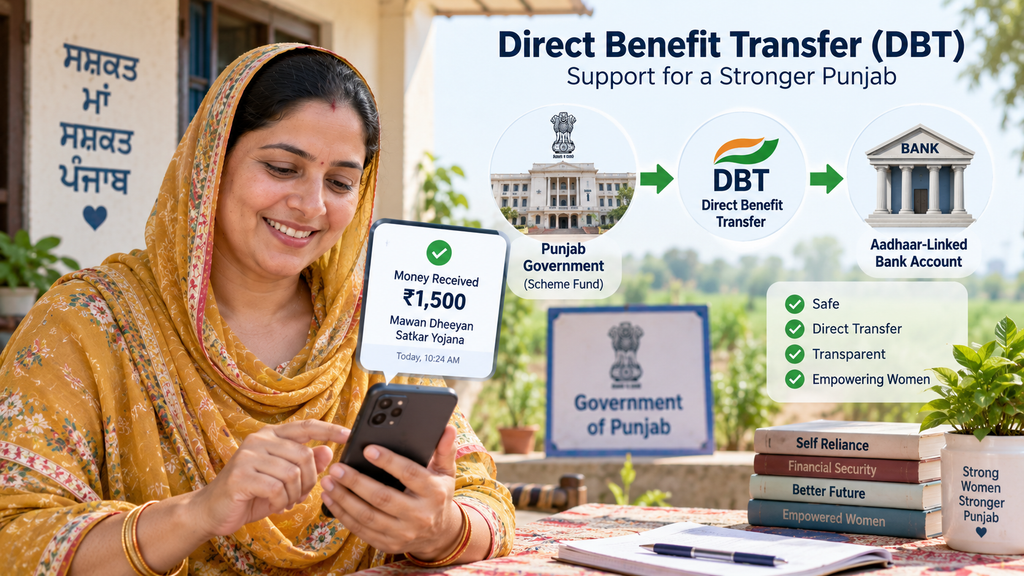
The scheme is designed around Direct Benefit Transfer (DBT). The notified rules state that financial assistance is transferred directly into the beneficiary’s Aadhaar-linked bank account.This has an important practical implication: registration alone should not be confused with successful payment.
A beneficiary’s information has to move through the registration, verification and payment process. If identity information, bank information or other records contain discrepancies, payment may require correction or verification.The government had also reported implementation challenges involving document mismatches, dormant bank accounts and caste-certificate issues during the early registration phase.
What should a beneficiary check if payment has not arrived?
A sensible verification sequence is:
- Confirm that the registration was successfully completed.
- Check whether the application has been verified.
- Confirm that Aadhaar and beneficiary details are correctly recorded.
- Check whether the bank account is active.
- Verify that the account is appropriately linked for DBT.
- SC beneficiaries should ensure their caste documentation is correctly submitted where required.
- Seek clarification through the designated government registration or district-level channel if the problem remains unresolved.
What documents are required?
The registration framework identifies several important documents, including:
- Aadhaar card
- Punjab voter ID
- Bank account passbook/details
- Caste certificate, where applicable
Government registration was organised through designated centres such as Anganwadi Centres and Sewa Kendras, with women mobilisers also involved in outreach and beneficiary support.Applicants should ensure that names, dates of birth and other key details are consistent across documents wherever possible. Document mismatch was identified as one of the practical difficulties during implementation.
Is registration free?
Yes. The scheme notification provides for zero-cost registration at designated centres. A beneficiary should therefore be cautious if anyone demands an unofficial registration fee.
The safest approach is to use designated government registration channels and avoid sharing sensitive banking credentials, PINs or OTPs with intermediaries.
What about SC women who do not initially have a caste certificate?
The implementation process has included clarification that an SC woman without a caste certificate at the time of registration could still remain eligible, with the additional SC-linked amount becoming payable after the required caste documentation is submitted. A clarification reported by the Ludhiana administration stated that eligible previous months could also be considered for the additional ₹500 component after submission of the certificate.
Because documentation procedures can be updated during implementation, beneficiaries should rely on the latest district or department-level instructions rather than assuming that every local process is identical.
What makes this scheme different from a simple ₹1,000 cash announcement?
The more important feature is its scale and recurring nature.A monthly ₹1,000 payment amounts to ₹12,000 a year if twelve monthly payments are made. For an eligible SC woman receiving ₹1,500 per month, the annual amount would be ₹18,000.
But these are annualised figures, not a guarantee that a particular beneficiary will receive that exact amount immediately. Actual credits depend on eligibility, registration, verification and the government’s payment schedule.The scheme also permits multiple eligible women in a household to receive assistance. Consequently, its household-level effect can be larger than the individual monthly figure suggests.
For instance, two eligible non-SC women in the same family would collectively qualify for ₹2,000 per month, while two eligible SC women would collectively qualify for ₹3,000 per month, assuming both remain eligible.
Also Read:
PM Har Ghar Jal Yojana 2026: Jal Jeevan Mission Online Apply, List, Status and Latest UpdatesSSO ID Rajasthan 2026: Registration, Login, Find SSO ID and Government Employee Guide
Competitive Advantage: What readers should check before assuming a payment is due
The most useful way to evaluate Mawan Dheeyan Satkar Yojana is to separate registration from entitlement and entitlement from payment.
A woman may satisfy the basic age and residency requirements but still need to pass the exclusion checks. A registered applicant may then have to complete verification. Finally, a verified beneficiary still needs a functioning payment pathway for DBT.
This three-stage model helps explain why online statements such as “everyone will get ₹1,000” can be misleading.
Stage 1 — Eligibility: Does the applicant satisfy the scheme’s conditions?
Stage 2 — Registration and verification: Has the government accepted and verified the beneficiary information?
Stage 3 — Payment: Has the approved beneficiary entered the relevant disbursement cycle, and is the DBT route functioning correctly?
For anyone checking a missing instalment, this framework is more useful than simply searching for another payment-date headline.
What the evidence suggests
The available 2026 evidence suggests that the scheme has moved well beyond the announcement stage. Payments have been made through DBT at substantial scale, and the number of registered women has increased sharply during the year. By late August, the Punjab Government was reporting more than 76 lakh registrations and more than 68 lakh women who had received transfers.
At the same time, the early implementation experience shows why administrative capacity matters. Registration has involved document verification, bank-account issues and outreach across Punjab.
The broader policy question is therefore not merely whether a monthly cash transfer exists. It is whether the system can maintain accurate beneficiary records, minimise failed payments and keep eligibility verification transparent as coverage expands.
Mawan Dheeyan Satkar Yojana and women’s financial security
The scheme’s stated objective is to strengthen women’s financial security and participation in household financial decisions. A recurring transfer can provide beneficiaries with a predictable source of personal income, even though the economic effect will naturally differ between households.
The amount itself is modest relative to household expenditure, but regularity can matter. Small predictable transfers may be used for personal needs, household purchases, education-related expenses or other routine spending.
The policy should nevertheless be judged not only by the number of beneficiaries but also by the quality of delivery: whether eligible women can register without unnecessary barriers, whether payments reach the correct accounts, and whether grievance mechanisms respond when records are wrong.
FAQ Section
What is Mukh Mantri Mawan Dheeyan Satkar Yojana 2026?
Mukh Mantri Mawan Dheeyan Satkar Yojana is a Punjab Government financial assistance scheme for eligible women aged 18 years and above who meet the state’s residency and other eligibility requirements. The notified assistance is ₹1,000 per month for eligible women other than SC beneficiaries and ₹1,500 per month for eligible SC women.
How much money is given under Mawan Dheeyan Satkar Yojana?
Eligible women other than those in the SC category receive ₹1,000 per month, while eligible SC women receive ₹1,500 per month. The initial payment cycle in 2026 covered three months, resulting in ₹3,000 for non-SC beneficiaries and ₹4,500 for eligible SC beneficiaries.
Who can apply for Mawan Dheeyan Satkar Yojana?
A woman generally needs to be at least 18 years old, be a registered resident voter of Punjab and possess valid Aadhaar and Punjab voter identification. She must also satisfy the scheme’s exclusion rules. Government employees, specified public-sector pensioners, income taxpayers and certain political office-holders and their spouses are among those excluded.
Can two women from the same family receive the scheme benefit?
Yes. The notified rules do not impose a limit on the number of eligible women in one family. Therefore, multiple women can receive the assistance if each independently satisfies the scheme’s eligibility requirements. The presence of one beneficiary in a household does not automatically disqualify another eligible woman.
Can a woman receiving a social-security pension also get this benefit?
Yes. The scheme notification specifically states that existing social-security pensioners can receive the Mawan Dheeyan Satkar benefit in addition to the social-security pension already being paid to them, provided they otherwise meet the scheme requirements.
How is Mawan Dheeyan Satkar Yojana money paid?
The financial assistance is designed to be transferred directly into the beneficiary’s Aadhaar-linked bank account through Direct Benefit Transfer. Therefore, correct beneficiary information, an appropriate bank account and successful verification are important for receiving the payment.
Is registration for Mawan Dheeyan Satkar Yojana free?
Yes. The scheme notification provides for zero-cost registration at designated centres. Applicants should be cautious about anyone demanding unofficial fees for registration or asking for confidential banking information such as an ATM PIN or OTP.
What should I do if my payment has not arrived?
First check whether registration and verification have been completed. Then verify the beneficiary’s Aadhaar, bank-account and other recorded details, and ensure the account is active and capable of receiving DBT. If the issue continues, the beneficiary should contact the appropriate designated government registration or district-level authority rather than relying on unofficial payment-date claims.
Conclusion
The Mukh Mantri Mawan Dheeyan Satkar Yojana 2026 is now an operational Punjab welfare programme rather than merely an electoral promise or announcement. Its core benefit is ₹1,000 a month for eligible women outside the SC category and ₹1,500 for eligible SC women, delivered through DBT.
For beneficiaries, however, the most important figure is not the headline amount. It is whether their individual eligibility, registration, verification and bank-payment details are correctly aligned. The latest government-reported figures indicate substantial implementation, but the scheme’s long-term credibility will depend on sustaining accurate and transparent delivery as its beneficiary base expands.

2 Comments